The Vishwakarma / Vishwabrahmin Community in India:
Historical Legacy, Social Transformation, Policy Impact, and Future Development Prospects Abstract This research paper examines the role of the Vishwakarma (also known as Vishwabrahmin) community within India’s traditional occupational social

Historical Legacy, Social Transformation, Policy Impact, and Future Development Prospects
Abstract
This research paper examines the role of the Vishwakarma (also known as Vishwabrahmin) community within India’s traditional occupational social structure. It traces their transformation from ancient artisanal traditions to participation in modern technological sectors, while analyzing their socio-economic conditions, educational mobility, and the impact of governmental policies. The findings suggest that the Vishwakarma community remains a vital force in India’s cultural and economic development, possessing significant potential within the emerging skill-based economy.
Keywords: Vishwakarma, Vishwabrahmin, artisan traditions, occupational communities, social development, skill economy
1. Introduction
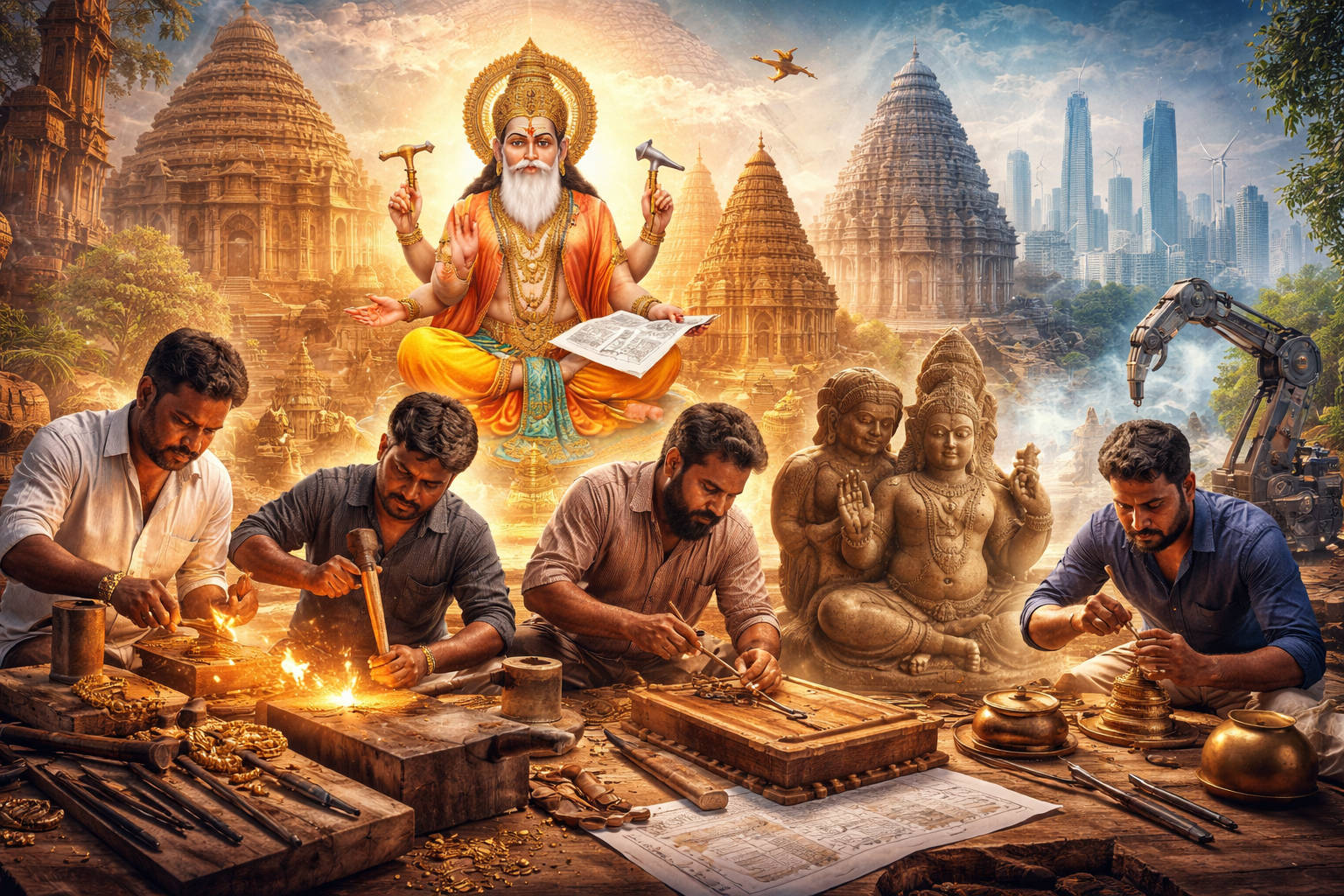
Occupationally structured communities have played a pivotal role in shaping Indian civilization. The Vishwakarma community historically represents a distinctive artisan group integrating architecture, metallurgy, mechanical arts, sculpture, and spiritual traditions. Traditionally divided into five sub-groups—blacksmiths, carpenters, sculptors, bronze workers, and goldsmiths—the community contributed extensively to India’s cultural and economic foundations through specialized craftsmanship.
This study analyzes their historical evolution, social status, educational transitions, and contemporary positioning within India’s economic framework. The technological transformations, industrialization, and globalization of the twentieth century significantly affected their traditional occupations. Understanding their present socio-economic status is therefore essential for inclusive national development.
2. Objectives of the Study
- Historical Analysis: To examine the historical origins and role of the Vishwakarma community in ancient India.
- Social Significance: To analyze the socio-cultural importance of their traditional occupations.
- Identification of Challenges: To explore the economic and educational challenges faced by the community in contemporary times.
- Policy Evaluation: To assess the impact of governmental schemes and development policies.
- Future Pathways: To propose strategies for integrating traditional skills with modern technological advancements.
3. Research Methodology
This study adopts a qualitative research framework and relies primarily on secondary sources. The methods include:
- Historical Textual Analysis: Examination of classical treatises on architecture and craftsmanship, Vedic literature, Puranic references, and medieval historical accounts.
- Socio-economic Survey Reports: Review of reports published by the Government of India and academic institutions.
- Policy Document Review: Analysis of central and state government initiatives, skill development programs, and MSME policies relevant to artisan communities.
- Secondary Literature Review: Study of books, journals, and research articles addressing artisan livelihoods, economic conditions, and social mobility.
4. Historical Background
4.1 The Vishwakarma Community in Ancient India
In ancient India, the Vishwakarma community occupied a respected and indispensable position. Their contributions are evident in:
- Temple Architecture: Monumental structures such as the Sun Temple at Konark, the Khajuraho temples, and the temple complexes of Belur and Halebidu reflect their architectural and sculptural mastery.
- Royal Constructions: Palaces, forts, and courtly architecture were often designed and executed under their supervision.
- Weapons and Tools Manufacturing: They played a crucial role in producing military equipment, chariots, and agricultural implements.
- Custodians of Technical Knowledge: Beyond manual labor, they preserved and transmitted knowledge of Vastu Shastra, Shilpa Shastra, metallurgy, and mechanical arts across generations.
4.2 Medieval Period
During the medieval era, while artisans continued to receive royal patronage, the rigidification of caste-based occupational structures affected their social positioning. In South India, they were often identified as Vishwabrahmins, adopting certain Brahmanical rituals, yet they did not consistently receive equivalent social recognition within hierarchical structures.
5. Impact of Colonial Rule
The British colonial period severely disrupted India’s indigenous artisanal economy.
- Industrial Imports: The influx of inexpensive machine-made goods from Britain undermined traditional crafts.
- Decline of Patronage: The dissolution of royal courts and reduction in temple construction reduced employment opportunities.
- Economic Marginalization: Many artisans were forced to abandon hereditary occupations and shift to agricultural or wage labor, leading to economic instability and erosion of traditional knowledge systems.
6. Post-Independence Scenario
6.1 Economic Conditions
After independence, the community continued to face structural challenges:
- Dependence on small-scale workshops.
- Difficulty competing with mass-produced industrial goods.
- Exploitation by intermediaries controlling raw materials and market access.
6.2 Educational Transition
Education emerged as a transformative pathway:
- Increased enrollment in engineering and polytechnic institutions.
- Adoption of CAD technologies in jewelry and design sectors.
- Expansion into construction entrepreneurship and contracting.
This transition marks a shift from hereditary craftsmanship toward formal technical professionalism.
7. Impact of Government Policies
Various initiatives have targeted artisan upliftment:
Positive Aspects
- Skill Development Programs: Schemes such as the Pradhan Mantri Kaushal Vikas Yojana (PMKVY) provide vocational training.
- Handicraft Promotion: The Export Promotion Council for Handicrafts (EPCH) facilitates global market access.
- MSME Support: Financial assistance, subsidies, and credit schemes encourage small enterprises.
- State-level Vishwakarma-focused training initiatives in select regions.
Limitations
- Limited awareness in rural areas.
- Weak market linkages for direct sales.
- Absence of specialized universities dedicated to traditional crafts and architectural sciences.
8. Discussion
The study suggests that the Vishwakarma community holds significant potential within India’s emerging skill-based economy. The fusion of inherited craftsmanship with digital tools, sustainable design practices, and global marketing platforms can position them competitively in both national and international markets.
Effective implementation of policies, improved market connectivity, and institutional support are critical for sustainable empowerment.
9. Key Findings
- The Vishwakarma community has been foundational to Indian civilizational and architectural heritage.
- Integration of traditional skills with modern technology has begun yielding positive socio-economic mobility.
- Government schemes exist but suffer from implementation and awareness gaps.
- Direct market access and digital empowerment can significantly enhance artisan incomes.
10. Recommendations
- Establish specialized universities dedicated to traditional architecture, craftsmanship, and technical heritage.
- Provide structured digital marketing and e-commerce training.
- Prioritize local artisans in heritage restoration and public infrastructure projects.
- Create district-level handicraft export hubs linked to international markets.
- Digitize and archive traditional technical knowledge systems as open-access resources.
11. Conclusion
The Vishwakarma community represents a living embodiment of India’s civilizational craftsmanship. Their development is not merely a matter of community welfare but a national imperative tied to economic growth, cultural preservation, and technological innovation.
The convergence of traditional knowledge with modern science and digital infrastructure can position them at the forefront of India’s “Skill India” mission. Collaborative efforts between government, academia, and industry are essential to fully harness their potential.