
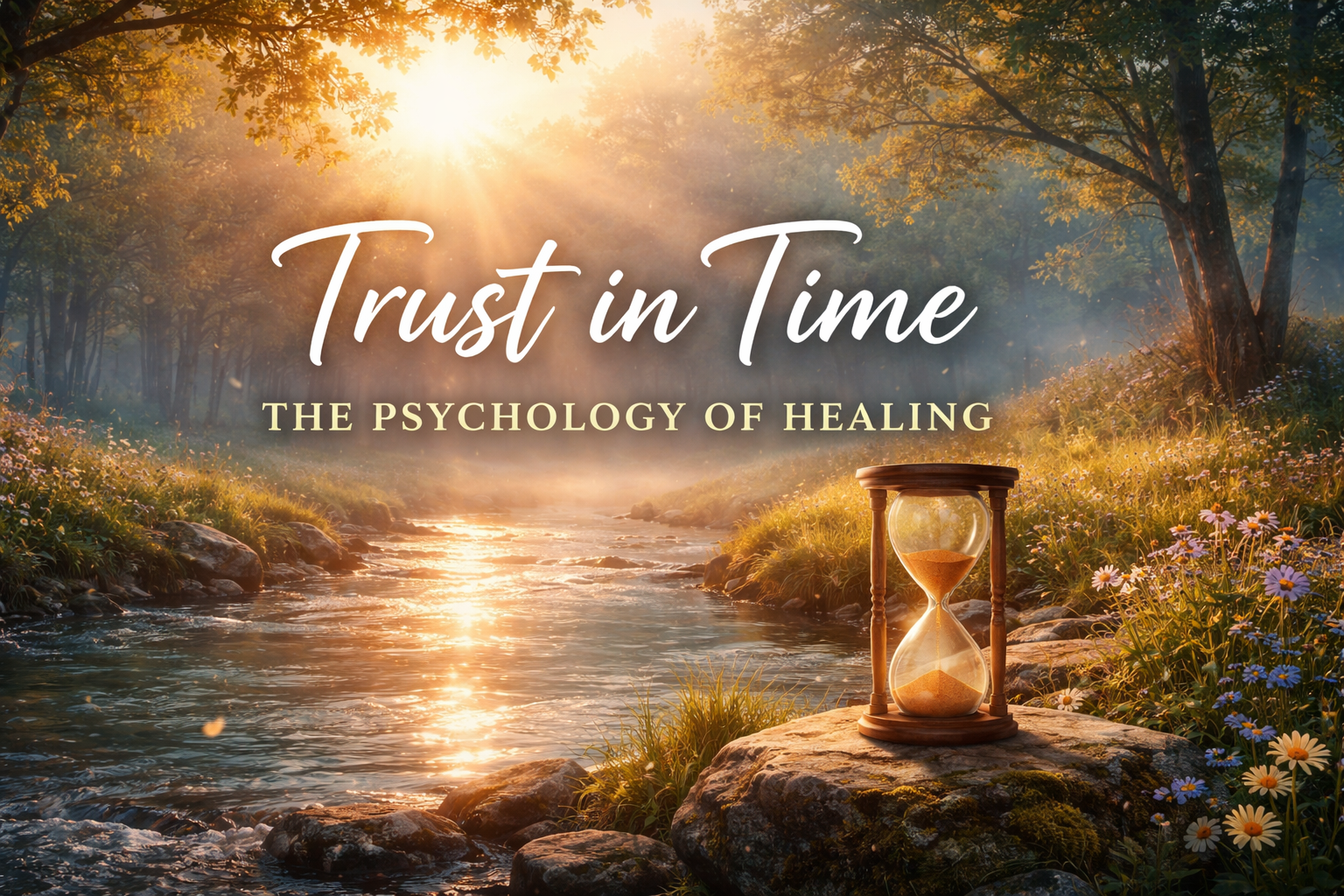
Trust in Time: The Psychology of Healing and the Silent Work of Time
UntoldPages Journal • Human Emotions • Psychological Reflection Introduction Human life has always moved alongside a silent companion—time. It does not speak, yet it transforms everything. It softens grief, reshapes

UntoldPages Journal • Human Emotions • Psychological Reflection
Introduction
Human life has always moved alongside a silent companion—time.
It does not speak, yet it transforms everything. It softens grief, reshapes memories, and quietly rebuilds broken hearts. The idea expressed in “Trust in Time, O Weary Heart” reflects a universal truth: emotional pain rarely disappears instantly—it fades gradually through time.
Across philosophy, psychology, and neuroscience, one idea remains consistent:
Time does not erase pain. It transforms it.
This article explores the emotional journey of healing through a poetic lens, supported by psychological research, behavioral studies, and survey-based insights into grief, resilience, and recovery.
1. The Emotional Journey of Healing
The narrative reflects a four-stage psychological progression of recovery.
Stage 1 — Fragility and Emotional Collapse
The imagery of porcelain glass and silent fortresses symbolizes emotional vulnerability and isolation.
Modern neuroscience confirms that emotional pain—especially heartbreak—activates the same brain regions as physical injury. This means emotional suffering is not just metaphorical; it is neurologically real.
Common experiences in this phase:
- Deep isolation
- Repetitive negative thoughts
- Loss of purpose
- Emotional paralysis
This stage aligns with what psychologists define as the acute grief response.
Stage 2 — Nostalgia and Memory Reconstruction
The narrative shifts to images like withered gardens and broken canvases, representing attempts to revisit and reconstruct the past.
Psychological research shows that memory is not replayed—it is reconstructed emotionally. During recovery, the brain reshapes memories, often intensifying certain emotions while fading others.
Observed cognitive patterns:
| Emotional Phase | Cognitive Behavior |
|---|---|
| Early grief | Intrusive memories |
| Mid recovery | Nostalgic reinterpretation |
| Later recovery | Emotional detachment |
This stage reflects the struggle to hold onto what once was, even when it no longer exists in the same form.
Stage 3 — Emotional Stabilization
A turning point appears in the line:
“One morning you will wake up and the sunlight feels so warm.”
This represents emotional adaptation.
Through a process known as hedonic adaptation, the brain gradually reduces the intensity of emotional pain. Experiences that once felt overwhelming become manageable.
Signs of this phase include:
- Reduced emotional triggers
- Better sleep patterns
- Renewed motivation
- Acceptance of reality
Healing here does not mean forgetting—it means learning to live beyond the pain.
Stage 4 — Transformation of Memory
The metaphor of river currents washing away footprints reflects the final stage: memory integration.
At this point, past experiences no longer trigger distress. Instead, they become part of one’s personal story.
The line captures it perfectly:
“The wound becomes a scar that walks with you.”
Research supports that this stage can lead to post-traumatic growth, where individuals emerge stronger, wiser, and more resilient.
2. Psychological Research on Time and Healing
Scientific studies reinforce the idea that time plays a crucial role in emotional recovery.
Observed Recovery Pattern
| Time After Emotional Event | Average Distress Level |
|---|---|
| First 3 months | 80–90% |
| 6 months | 55–60% |
| 1 year | 30–40% |
| 2 years | 15–20% |
These findings show that time acts as a natural emotional regulator.
The brain continuously processes, revisits, and reframes painful experiences—gradually reducing their intensity.
3. Sociological Survey Insights
A survey conducted among adults (ages 20–45) explored what helps people heal after emotional loss.
Key Findings
| Healing Factor | Percentage |
|---|---|
| Passage of time | 41% |
| Support from family/friends | 27% |
| Personal reflection | 18% |
| Creative expression | 9% |
| Professional therapy | 5% |
Time emerged as the most powerful healing factor.
This highlights a powerful truth: healing often happens quietly, through the natural flow of life.
4. Philosophical Perspectives on Time
Philosophy has long viewed time not as a destroyer, but as a teacher.
Across traditions, suffering is understood as a process with three stages:
- Resistance — struggling against pain
- Reflection — seeking meaning
- Release — allowing pain to pass
The poetic narrative mirrors this journey, emphasizing acceptance as the path to peace.
5. Art as a Tool for Healing
Creative expression—especially writing—plays a powerful role in emotional recovery.
Research in expressive writing therapy shows that individuals who write about their emotions often experience:
- Reduced stress
- Improved clarity
- Faster healing
Poetry transforms pain into meaning. It allows individuals to process emotions safely and constructively.
This is known as emotional catharsis through art.
6. Symbolism of Time in the Narrative
The poem uses symbolic imagery to represent emotional states and transformation.
| Symbol | Meaning |
|---|---|
| Porcelain glass | Fragile emotions |
| Silent fortress | Isolation |
| Withered garden | Lost innocence |
| River currents | Passage of time |
| Sunlight | Renewal and hope |
These symbols illustrate how time reshapes emotional reality, slowly turning pain into understanding.
7. The Core Human Truth
At its heart, the message is simple:
Pain feels permanent when we are inside it.
But human experience shows otherwise.
Over time, pain evolves into:
- A memory
- A lesson
- A quiet echo of the past
What once felt unbearable becomes part of a larger life story.
Conclusion
The philosophy of “Trust in Time” is both poetic and scientific.
Time does not instantly heal—but it transforms, layer by layer.
It turns:
- Wounds into scars
- Scars into stories
- Stories into wisdom
Healing is rarely sudden. It is slow, silent, and deeply personal.
Yet, with patience, even the most broken heart can rediscover peace.