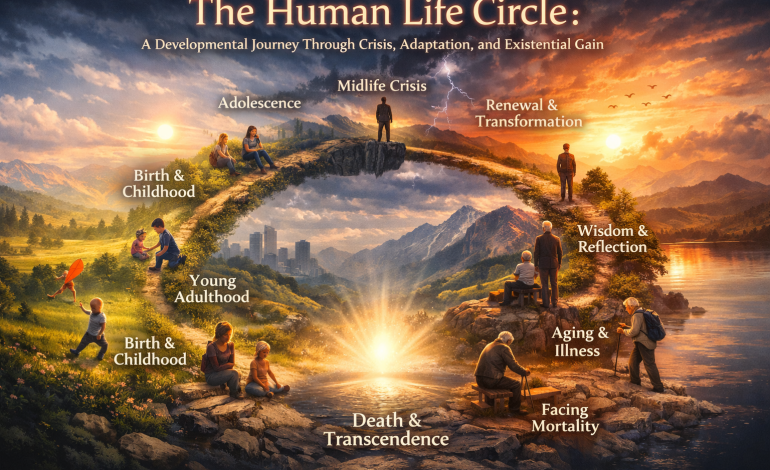
The Human Life Circle: A Developmental Journey Through Crisis, Adaptation, and Existential Gain
The Human Life Circle: A Developmental Journey Through Crisis, Adaptation, and Existential Gai Introduction: Understanding the Life Circle Paradigm The human life circle represents a complex interplay

- The Human Life Circle: A Developmental Journey Through Crisis, Adaptation, and Existential Gai
Introduction: Understanding the Life Circle Paradigm
The human life circle represents a complex interplay of biological, psychological, and social transitions that every individual navigates from birth to death. This framework, grounded in developmental psychology, life course epidemiology, and socio-structural analysis, reveals that crisis is not an aberration but a fundamental feature of human development. Drawing from established research in lifespan development, this analysis explores how humans encounter, adapt to, and derive meaning from successive crises across the life course.
Theoretical Foundations of Lifespan Development
The Stage-Crisis View
Daniel Levinson’s stage-crisis view provides a foundational framework for understanding adult development as a sequence of alternating stable periods and transitional crises . According to this theory, the life cycle—distinct from the chronological life course—comprises common sequential stages through which every person progresses. These stages include:
· Pre-adulthood (0-22 years): The formative years characterized by rapid physical growth and the transition from dependence to independence, marked by the “me vs. not me” crisis of identity formation
· Early Adulthood Transition (17-22 years): The overlap period where individuals distance themselves from family structures to solidify adult identity
· Early Adulthood Era (17-45 years): A period of establishing occupation, love, and family, accompanied by significant stress from multiple responsibilities
· Midlife Transition (40-45 years): A critical period where individuals face the “midlife crisis,” characterized by reevaluation of life choices and the transition from early to middle adulthood
· Middle Adulthood Era (45-60 years): A period focused on generativity and adaptation to aging
· Late Adulthood Transition (60-65 years): Marked by confronting mortality, declining physical capabilities, and the loss of social authority
· Late Adulthood Era (60-85 years): A period of reflection, wisdom cultivation, and balancing social engagement with inner resources
Erik Erikson’s Psychosocial Framework
Complementing Levinson’s structural approach, Erikson’s psychosocial theory identifies developmental crises at each life stage that require resolution for healthy progression. These include trust versus mistrust in infancy, identity versus role confusion in adolescence, intimacy versus isolation in early adulthood, generativity versus stagnation in middle adulthood, and ego integrity versus despair in late adulthood .
The First Crisis: Birth as Existential Transition
The transition from the protected uterine environment to the external world constitutes the first fundamental crisis in human life. As Mary Lewis articulates in her bioarchaeological analysis, “The transition of a child from a stable uterine environment to the external environment, with its variety of pathogens and other stimuli, can be viewed as the first crisis in a human’s life” .
Biological Precariousness
At birth, the infant faces immediate adaptive challenges. In the womb, the fetus receives passive immunity and nutrients directly from the mother. After birth, the physical and biological environment exerts direct effects on the child’s survival capacity. For a brief period, breastfeeding provides continued immunological protection, but the infant must rapidly develop independent physiological regulation. Lewis notes that “if the child fails to adapt to its new environment, it will die,” making infant mortality a fundamental indicator of a population’s adaptive success .
Socioeconomic Foundations
The circumstances of birth establish lifelong trajectories of advantage or disadvantage. Research demonstrates that socioeconomic position at birth conditions lifelong patterns of inequality through unequal provision of physical, social, and economic resources . Prenatal and neonatal care quality, strongly tied to poverty and social exclusion, creates formative inequalities that compound across the life course.
Early Childhood: The Foundation of Life Course Capital
Cumulative Advantage and Disadvantage
The early years represent a critical period for establishing what scholars term “life course capital”—the accumulated resources that enable successful navigation of subsequent developmental challenges . Research utilizing data from the UK Millennium Cohort Study reveals the profound impact of childhood economic conditions on adolescent outcomes.
Analysis of 10,496 children identified four distinct income trajectories: low (47.3%), lower-middle (33.3%), upper-middle (15.4%), and high (3.9%). Compared to children in upper-middle-income families, those in low-income trajectories demonstrated significantly elevated risks:
· Overweight/obesity: 48% increased risk (adjusted risk ratio 1.48, 95% CI 1.23–1.74)
· Cognitive disability: 70% increased risk (aRR 1.70, 95% CI 1.06–2.33)
· Socioemotional behavioral problems: 133% increased risk (aRR 2.33, 95% CI 1.47–3.19)
· GCSE failure: 66% increased risk (aRR 1.66, 95% CI 1.39–1.94)
The Embodiment of Inequality
Non-optimal childhood income trajectories accounted for substantial proportions of adverse outcomes:
· 43.1% of socioemotional behavioral problems
· 27.4% of cognitive disability cases
· 24.8% of educational underachievement
· 18.8% of overweight/obesity cases
These findings demonstrate that early life crisis conditions are not merely temporary setbacks but become “embodied”—biologically incorporated into physiological systems with lasting consequences.
Adolescence: Identity Formation and Digital Age Crises
The Identity Crisis
Adolescence represents a period of intensified identity exploration across multiple domains: ethnoracial identity, gender identity, sexual orientation, religious affiliation, and career orientation. Research indicates that young adults show more transition in their ethnoracial identity status than older adults, with the salience, centrality, and regard for identity shifting in response to developmental transitions .
Contemporary Digital Media Crises
A comprehensive meta-analysis published in JAMA Pediatrics synthesized 153 longitudinal studies (115 cohorts, 1,072 effect sizes) examining digital media use and child health outcomes. The findings reveal consistent associations between digital media exposure and developmental risks :
Social Media Impacts:
· Higher depression rates (pooled correlation r = 0.09–0.21)
· Increased externalizing and internalizing behaviors
· Higher rates of self-injurious thoughts
· Greater substance use
· Lower academic achievement (r = -0.14)
· Poorer self-perception
Video Gaming Effects:
· Higher aggression and externalizing behaviors (r = 0.16–0.17)
· Modestly higher attention and executive functioning (r = 0.10), suggesting complex, domain-specific effects
These associations were particularly pronounced in early adolescence, highlighting this period as a sensitive window for digital media’s developmental impact.
Early Adulthood: The Quarter-Life Crisis and Intimacy Challenges
The Quarter-Life Phenomenon
Contemporary economic conditions have given rise to what developmental researchers term the “quarter-life crisis”—feelings of helplessness or indecision experienced by young adults navigating the transition to independence . This crisis is exacerbated by economic difficulties that delay traditional markers of adulthood: financial independence, stable employment, marriage, and parenthood.
The Intimacy Crisis
According to Erikson, the primary developmental challenge of early adulthood is establishing close, trusting relationships with others. Intimacy requires “both commitment and willingness to sacrifice and compromise” . This crisis manifests in several contemporary contexts:
Cohabitation Trends: More young adults are cohabiting than in previous generations, yet by the end of early adulthood, most remain unmarried—a departure from traditional social clocks.
Relationship Quality: High-quality intimate relationships are characterized by frankness and spontaneity, sensitivity and knowing, exclusivity, giving and helping, trust and loyalty, and secure attachment .
Friendship as Resource: Self-determination theory research indicates that well-being is maximized when needs for autonomy, competence, and relatedness are met. Friends in early adulthood facilitate this process by valuing each other’s individuality while providing support to achieve goals—a stage Selman termed “autonomous interdependence” .
Career Development Crisis
Super’s lifespan theory of career development describes the trajectory from exploration in emerging adulthood to establishment in early to middle adulthood. Those who successfully establish themselves in good jobs take strategic approaches to career development, using entry-level positions to build skills, knowledge, and professional networks .
Middle Adulthood: The Midlife Crisis and Generativity
The Midlife Transition
Levinson’s midlife transition (approximately ages 40-45) represents one of the most controversial and culturally recognized developmental crises. This period involves three key tasks:
1. Ending the stage of early adulthood
2. Initiating middle adulthood
3. Coping with sources of discord in one’s life
During this transition, individuals must develop “compassion, acceptance and love” to avoid becoming burdened by internal and external conflict. The crisis stems from confronting the gap between youthful aspirations and actual achievements, along with awareness of physical decline and limited remaining time .
Generativity Versus Stagnation
Erikson’s psychosocial crisis for middle adulthood—generativity versus stagnation—captures the fundamental tension between contributing to future generations and becoming self-absorbed or stagnant. Successful resolution involves finding ways to nurture, guide, and contribute to society beyond one’s immediate family.
Late Adulthood: Mortality Confrontation and Wisdom
The Late Adulthood Transition
The late adulthood transition (approximately ages 60-65) confronts individuals with “physical or bodily decline” and the “higher frequency of friends, family members, and peers dying or experiencing illness” . This awareness forces recognition of movement from middle age to old age.
The central crisis of this period involves the fear that “inner youthfulness is disappearing, and only an old, fatigued, boring person will remain.” Successful adaptation requires “keeping their youthfulness in a way that is suitable for late adulthood” .
Ego Integrity Versus Despair
Erikson’s final psychosocial crisis involves reflecting on one’s life and achieving a sense of coherence and meaning (ego integrity) or succumbing to regret and despair. Levinson similarly emphasizes that the main task in late adulthood is “to reflect on one’s life, including their times of success and failure, and appreciate the rest of their life experiences” .
Interrupted Learning and Cognitive Adaptation
Research on lifelong learning challenges assumptions that developmental trajectories inevitably decline in late adulthood. A 2025 article in Human Development proposes that adulthood may represent a period of “prolonged interrupted learning” with reduced learning opportunities, despite the demonstrated importance of lifelong learning for adaptation . This perspective shifts focus from maintaining basic functional skills toward understanding how lifespan circumstances facilitate or hinder adaptation to new and changing environments.
Cumulative Evidence: How Crises Shape Biological Health
The Biological Health Score Framework
Research using data from 8,105 participants in the UK Household Longitudinal Study examined associations between lifecourse socioeconomic position and an overall biological health score (BHS) encompassing six physiological subsystems: endocrine, metabolic, cardiovascular, inflammatory/immune, liver, and kidney .
Key Findings on Cumulative Effects
Stage-Specific Effects: Disadvantage at every life stage demonstrated associations with higher BHS (worse health), with the slope index of inequality (SII) for most recent socioeconomic position at 0.04 (95% CI 0.02–0.06) .
Cumulative Disadvantage: The cumulative effect of disadvantage across the lifecourse showed a stepped association with increasing biological health scores (SII 0.05, 95% CI 0.04–0.07), demonstrating that each life stage of disadvantage adds incrementally to physiological wear and tear .
System-Specific Effects: Associations were largely driven by metabolic, cardiovascular, and inflammatory systems—the physiological pathways most responsive to chronic stress exposure.
Mechanisms of Embodiment: The concept of “embodiment” explains how socioeconomic conditions become biologically incorporated through “allostatic load”—the cumulative physiological wear and tear resulting from chronic stress responses . As Goodman and Armelagos noted, “death is the ultimate indicator of failure to adapt… it may be fruitfully viewed as the end result of an accumulated set of biological, behavioral and cultural challenges to the individual” .
What Humans Gain: The Fruits of Crisis Navigation
Wisdom and Perspective
Through successful navigation of developmental crises, individuals cultivate wisdom—the capacity to integrate experience, recognize complexity, and exercise sound judgment. Levinson’s research suggests that “by harnessing one’s own inner resources and interests in an unselfish way, one can gain more wisdom about the external world” .
Resilience and Adaptive Capacity
Each successfully navigated crisis builds adaptive capacity for future challenges. Research on allostatic load demonstrates that physiological systems maintain plasticity throughout the lifespan, allowing for recovery from stress when adequate resources and support are available .
Identity Coherence
The ongoing process of identity development across the lifespan yields increasingly coherent self-understanding. Research synthesizing developmental neuroscience findings suggests that “cognitive and social processes are building blocks for developing a coherent sense of self, resulting in self-concept clarity across various domains in life” .
Generativity and Legacy
Middle adulthood offers the gain of generativity—the capacity to contribute meaningfully to future generations. This may manifest through parenting, mentoring, creative production, community involvement, or professional contributions that outlive the individual.
Social Connection and Affiliation
George Valliant’s research emphasizes that “affiliation allows us to reduce the anxiety of developmental tasks by confiding in others and being willing to ask for and receive help” . The capacity for deep, reciprocal relationships represents one of the primary gains of successful development.
Research Implications and Future Directions
Methodological Considerations
Current lifespan research increasingly emphasizes:
· Longitudinal designs that track individuals across developmental periods
· Multi-system biological measures that capture physiological embodiment of social conditions
· Intersectional approaches recognizing how multiple identity domains interact to shape experience
· Neurodiversity perspectives that challenge assumptions about normative development
Policy Implications
The evidence for cumulative effects of socioeconomic disadvantage across the lifecourse suggests that “every life-stage should be a target for public health policies and intervention” . Early intervention alone, while important, cannot fully compensate for continuing disadvantage across subsequent developmental periods.
Future Research Questions
Emerging research directions include:
· Understanding the neural underpinnings of interrupted learning across the lifespan
· Examining how cultural context moderates developmental crisis experiences
· Investigating protective factors that buffer cumulative disadvantage effects
· Exploring how digital environments reshape identity formation processes
Conclusion: The Circle Completed
The human life circle encompasses successive crises from birth to death, each presenting both risk and opportunity. Research across developmental psychology, life course epidemiology, and social science converges on several fundamental truths:
First, crisis is normative—not a sign of pathology but a necessary feature of human development that drives growth and adaptation.
Second, inequalities compound—disadvantage at any life stage creates vulnerabilities that accumulate, producing widening disparities across the lifespan.
Third, the body remembers—social conditions become embodied through physiological systems, creating biological signatures of life experience.
Fourth, resources matter—access to social support, economic security, and developmental opportunities shapes crisis navigation capacity.
Fifth, gains are possible—successful crisis navigation yields wisdom, resilience, identity coherence, generativity, and deepened capacity for connection.
As Levinson’s framework suggests, the life cycle represents a “common sequence of stages that every person undergoes during their life course” . While specific experiences vary, the fundamental pattern of stability, crisis, transition, and renewal constitutes the universal architecture of human development. Understanding this pattern—with its truths, facts, and evidence—illuminates not only what humans face but what they ultimately gain from the journey.
—
References
1. Riser, D., Spielman, R., & Biek, D. (2024). Ch. 12 Summary – Lifespan Development. OpenStax.
2. Whitley, E., Benzeval, M., Kelly-Irving, M., & Kumari, M. (2024). When in the lifecourse? Socioeconomic position across the lifecourse and biological health score. Elsevier, 96, 73-79.
3. OP57 Family income trajectories and adverse outcomes in late adolescence: evidence from the millennium cohort study. (2025). Journal of Epidemiology and Community Health, 79(Suppl_1), A28.2-A28.
4. Lewis, M. E. (2009). Difficult births, precarious lives. In The Bioarchaeology of Children (pp. 81-96). Cambridge University Press.
5. Stage-crisis view. (2009). In Wikipedia.
6. Stratification and the Life Course: Life Course Capital, Life Course Risks, and Social Inequality. (2007). ScienceDirect.
7. Digital Media Use and Child Health and Development. (2026). JAMA Pediatrics.
8. Wu, R., et al. (2025). Interrupted Learning Across the Lifespan. Human Development, 69(2), 65-78.
9. The Circle of Life – Birth, Dying, and the Liminality of Life. (2022). German Historical Institute Warsaw.