Human Life Lessons from Birth to Death: Wisdom Gained Through the Arc of Existence
Human Life Lessons from Birth to Death: Wisdom Gained Through the Arc of Existence Life is not merely a sequence of biological events but a profound journey of learning—each stage

Human Life Lessons from Birth to Death: Wisdom Gained Through the Arc of Existence

Life is not merely a sequence of biological events but a profound journey of learning—each stage offering distinct lessons that shape who we become. Drawing from developmental psychology, lifespan research, and longitudinal studies, this exploration distills the core lessons humans acquire from infancy to old age. These lessons, grounded in empirical evidence, reveal not only what we face but what we ultimately gain.
—
Infancy (0–2 years): The Lesson of Trust
Core Lesson: The World Can Be Relied Upon
The foundational lesson of infancy is trust versus mistrust, as articulated by Erik Erikson. Through consistent caregiving, an infant learns that their needs will be met—that the world is predictable and safe. This early relational template becomes the blueprint for all future relationships.
Evidence: Longitudinal studies such as the Minnesota Longitudinal Study of Risk and Adaptation have shown that secure attachment in infancy predicts better social competence, emotional regulation, and even physical health decades later. Infants who develop secure attachment learn that vulnerability is survivable and that connection is a source of safety.
Gain: The capacity for hope and the belief that others can be trusted—a resource that underpins resilience across the lifespan.
—
Early Childhood (2–6 years): The Lesson of Autonomy and Initiative
Core Lesson: I Can Act Upon the World
During the preschool years, children learn that they can exercise choice, control their bodies, and initiate activities. Erikson framed this as autonomy versus shame and doubt, followed by initiative versus guilt. Success in this stage teaches that asserting one’s will is acceptable and that exploration leads to competence.
Evidence: Research in developmental neuroscience shows that the prefrontal cortex undergoes rapid growth during this period, enabling self-regulation and goal-directed behavior. The HighScope Perry Preschool Study demonstrated that children who receive supportive environments for autonomy show higher educational attainment, employment, and lower crime rates in adulthood.
Gain: Self-confidence, a sense of purpose, and the courage to pursue goals independently.
—
Middle Childhood (6–12 years): The Lesson of Competence
Core Lesson: I Can Master Skills Through Effort
School-age children learn industry versus inferiority. The central lesson is that sustained effort leads to mastery. They compare themselves to peers and internalize either a sense of competence or inadequacy.
Evidence: Carol Dweck’s research on mindset reveals that children praised for effort rather than innate ability develop a “growth mindset”—believing intelligence can be developed. Longitudinal data show that growth mindset predicts academic resilience and higher achievement. The lesson of “effort leads to results” becomes a lifelong cognitive framework.
Gain: Self-efficacy, perseverance, and the understanding that failure is a step toward mastery, not a verdict on worth.
—
Adolescence (12–18 years): The Lesson of Identity
Core Lesson: I Am the Author of My Own Life
Adolescence is the crucible of identity formation. The central lesson is that one must integrate multiple facets—ethnicity, gender, values, aspirations—into a coherent self. Erikson called this identity versus role confusion.
Evidence: James Marcia’s identity status research shows that adolescents who engage in exploration and commitment (identity achievement) report higher well-being and clearer life direction. Neuroimaging studies indicate that the brain’s socio-affective systems undergo remodeling, making adolescents exquisitely sensitive to social feedback—a mechanism that drives identity exploration.
Gain: A sense of self-continuity, the ability to make commitments, and the foundation for authentic relationships.
—
Emerging Adulthood (18–29 years): The Lesson of Exploration and Possibility
Core Lesson: Life Paths Are Not Fixed
Jeffrey Arnett’s theory of emerging adulthood highlights this as a distinct period of exploration—in love, work, and worldview. The lesson is that uncertainty is normal and that one can reshape one’s trajectory through deliberate choices.
Evidence: The National Longitudinal Study of Adolescent to Adult Health (Add Health) shows that most individuals in their twenties change jobs multiple times and experience shifts in romantic partnerships. Those who navigate this period with intentional exploration (rather than drift) report greater career satisfaction and relationship stability in their thirties.
Gain: Flexibility, openness, and the realization that identity is not discovered but constructed through experience.
—
Early Adulthood (30–45 years): The Lesson of Intimacy and Commitment
Core Lesson: Deep Connection Requires Vulnerability
Erikson’s intimacy versus isolation stage teaches that true closeness comes from sacrificing a degree of independence for mutual care. The lesson is that commitment—in relationships, career, or community—requires vulnerability and yields profound rewards.
Evidence: The Harvard Study of Adult Development, one of the longest longitudinal studies, found that the quality of close relationships at midlife is the strongest predictor of happiness and health in late life. The lesson of intimacy—learning to be known and to know another—emerges as a cornerstone of well-being.
Gain: The capacity for love, loyalty, and the stability that enables generativity.
—
Middle Adulthood (45–65 years): The Lesson of Generativity and Letting Go
Core Lesson: Meaning Comes from Contributing Beyond the Self
Midlife confronts individuals with the tension between generativity—guiding the next generation—and stagnation. The lesson is that lasting significance lies in what we give, not only what we accumulate.
Evidence: Research on “generativity” by Dan McAdams shows that midlife adults who engage in generative acts (mentoring, volunteering, parenting, creative work) report higher life satisfaction and lower depressive symptoms. Longitudinal studies also reveal that midlife is a period of emotional regulation maturation—the ability to hold complexity and let go of unrealistic aspirations.
Gain: Wisdom, a sense of legacy, and the freedom that comes from releasing the need for external validation.
—
Late Adulthood (65+ years): The Lesson of Integrity and Acceptance
Core Lesson: A Life Well-Lived Is One Embraced in Its Wholeness
Erikson’s final stage—ego integrity versus despair—teaches that the ultimate lesson is to accept one’s life as it was, with its triumphs and regrets. This acceptance allows facing death without fear.
Evidence: The Berlin Wisdom Study identified that wisdom—defined as expert knowledge about the fundamental pragmatics of life—tends to increase in late life, particularly among those who have engaged in reflective life review. Palliative care research shows that individuals who achieve a sense of meaning in their life story experience less anxiety about death.
Gain: Peace, gratitude, and the ability to face mortality with dignity.
—
Universal Lessons: What All Stages Teach Collectively
1. Vulnerability Is Not Weakness
From birth’s total dependence to old age’s gradual decline, life repeatedly shows that needing others is intrinsic to the human condition. Research on allostatic load demonstrates that social support buffers physiological wear and tear; those who accept interdependence live longer and healthier.
2. Change Is the Only Constant
Lifespan developmental psychology underscores that humans are in constant transition. The capacity to adapt—what researchers call “plasticity”—remains throughout life, challenging the myth that personality or intelligence is fixed after a certain age.
3. Meaning Is Constructed, Not Found
Viktor Frankl’s work, supported by contemporary positive psychology, shows that meaning arises from how we interpret experiences. The life review process common in late adulthood reveals that the same events can be framed as failures or as sources of growth.
4. Relationships Are the True Currency
The Harvard Study’s central finding is that “good relationships keep us happier and healthier.” This lesson recurs at every stage: the quality of one’s social bonds outweighs wealth, fame, or IQ in predicting well-being.
5. Time Is Finite, and That Gives Value
Awareness of mortality, often avoided in youth, becomes a teacher in later life. Research on “socioemotional selectivity theory” shows that as people perceive time as limited, they prioritize meaningful relationships over superficial pursuits—a shift that enhances contentment.
—
Conclusion: The Integration of Lessons
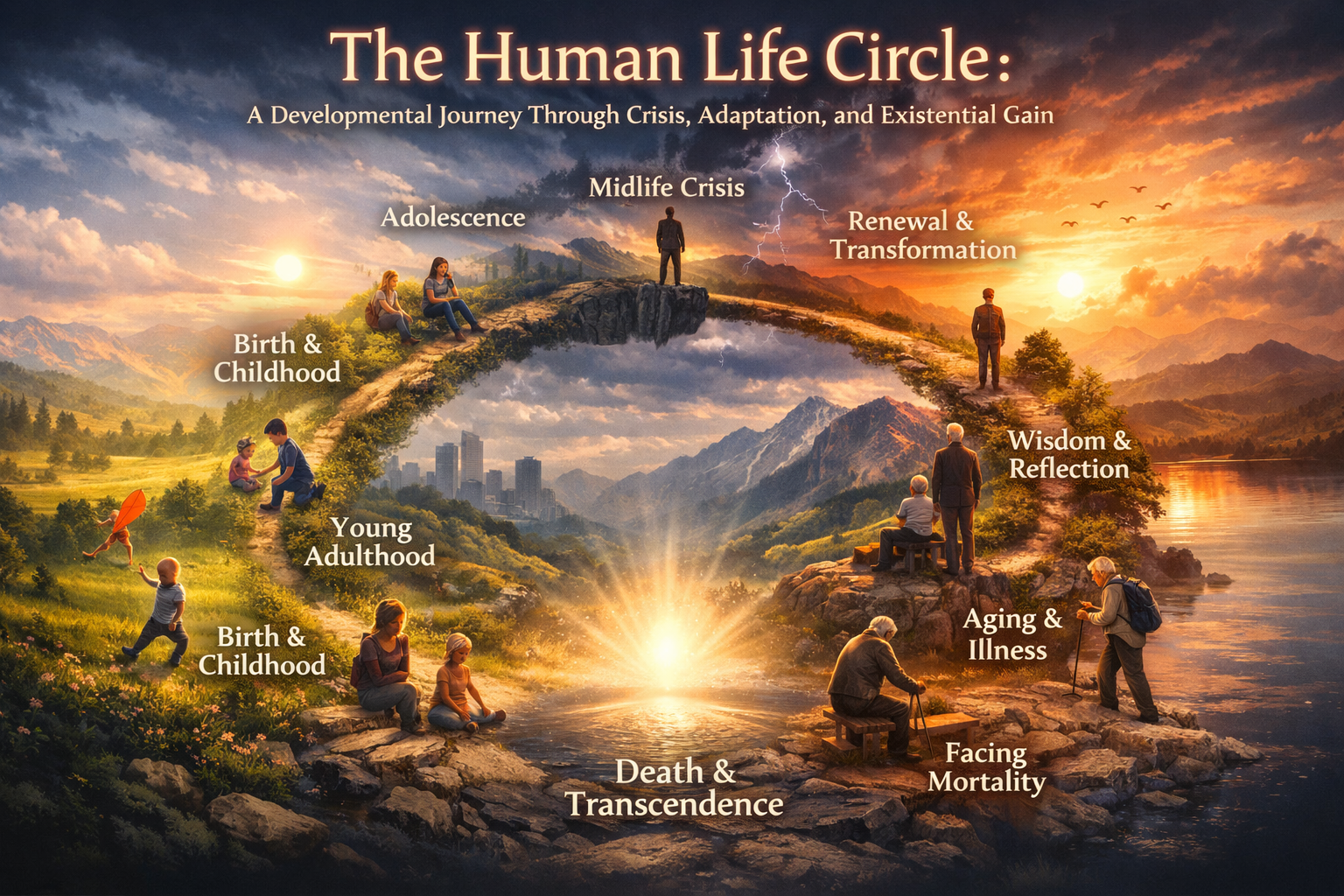
The arc from birth to death is not merely a series of crises but a curriculum. Each stage builds upon the last: trust enables autonomy, which enables competence, which enables identity, which enables intimacy, which enables generativity, which enables integrity. The lessons are cumulative, not sequential; wisdom in old age depends on the foundations laid in childhood.
As the philosopher and developmental psychologist Jerome Bruner noted, “We are storytellers.” The final lesson is that we become the story we tell about our lives. Those who craft a narrative of growth—acknowledging hardship yet emphasizing agency and connection—achieve what Erikson called ego integrity: the quiet satisfaction that this life, with all its imperfections, was enough.
—
Selected References
· Erikson, E. H. (1950). Childhood and Society. Norton.
· Vaillant, G. E. (2002). Aging Well. Little, Brown.
· Dweck, C. S. (2006). Mindset: The New Psychology of Success. Random House.
· Arnett, J. J. (2000). Emerging adulthood: A theory of development from the late teens through the twenties. American Psychologist, 55(5), 469–480.
· McAdams, D. P., & de St. Aubin, E. (1992). A theory of generativity and its assessment through self-report, behavioral acts, and narrative themes in autobiography. Journal of Personality and Social Psychology, 62(6), 1003–1015.
· Waldinger, R. J., & Schulz, M. S. (2016). The long reach of nurturing family environments: Links with midlife emotion-regulatory styles and late-life security in intimate relationships. Psychological Science, 27(11), 1443–1450.
· Carstensen, L. L., Isaacowitz, D. M., & Charles, S. T. (1999). Taking time seriously: A theory of socioemotional selectivity. American Psychologist, 54(3), 165–181.