A Complete Analysis of Living Standards in India – From Villages to Metro Cities (Economic Class Division)
Executive Summary In India, the standard of living is not uniform. It depends on geography, education, job opportunities, family size, healthcare costs, and the rural/urban divide. This analysis divides Indian


Executive Summary
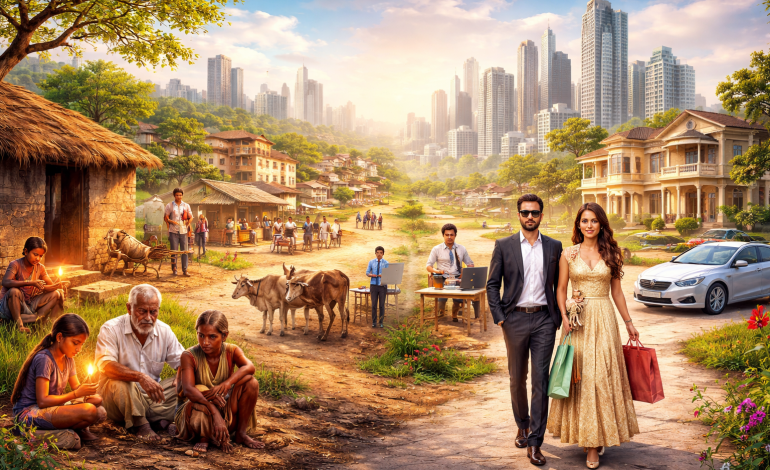
In India, the standard of living is not uniform. It depends on geography, education, job opportunities, family size, healthcare costs, and the rural/urban divide. This analysis divides Indian society into 7 economic classes – from the ultra-rich to those below the poverty line. Each class has a distinct lifestyle, expense pattern, and retirement need. Nearly 70% of Indians fall into the lower-middle and low-income categories, while the high-income class makes up less than 5%. Understanding where you stand is the first step toward financial planning and a secure retirement.
—
Introduction
Standard of living means the level of comfort, goods, and services available to a person or family. In India, this is shaped by several factors:
· Geographic location (metro, Tier-1/2/3 city, village)
· Family size (joint vs nuclear)
· Education access (government school vs private international)
· Healthcare costs (government hospital vs private super-specialty)
· Inflation (6-8% annual rise in expenses)
This blog post from Untold Pages breaks down each economic class, compares villages with metros, and gives practical retirement targets.
—
Detailed Economic Class Division (Table Format)
Class Monthly Family Income Net Worth Residence Key Features
1. High Class / Rich ₹5 lakh – ₹50 lakh+ ₹10 crore – ₹100 crore+ Metro luxury apartment / villa International travel, private healthcare, multiple income sources
2. Upper Middle Class ₹1.5 lakh – ₹5 lakh ₹2 crore – ₹10 crore Metro / Tier-1 city Private school, car with EMI, occasional foreign trip
3. Lower Upper Middle Class ₹80,000 – ₹1.5 lakh ₹1 crore – ₹3 crore Tier-1 / Tier-2 city One car, good education, budget control
4. Middle Class ₹40,000 – ₹80,000 ₹20 lakh – ₹1 crore Tier-2 / Tier-3 city Priority to kids’ education, EMI burden, limited health insurance
5. Lower Middle Class ₹20,000 – ₹40,000 ₹5 lakh – ₹20 lakh Small town / village Focus on basic needs, healthcare costs are heavy
6. Low Income / Working Poor ₹10,000 – ₹20,000 ₹1 lakh – ₹5 lakh Village / slum area Daily wage dependent, limited access to health & education
7. Poverty Level (BPL) Below ₹10,000 Negligible or zero Remote village / no amenities Dependent on government schemes, struggle for basic needs
—
Lifestyle, Expenses & Retirement Needs for Each Class
1. High Class / Ultra Rich
· Monthly expenses: ₹3 – ₹15 lakh (luxury shopping, clubs, international travel)
· Retirement corpus needed: ₹15 – ₹50 crore+
· Advice: Build passive income through rent, dividends, and global investments.
2. Upper Middle Class
· Monthly expenses: ₹1 – ₹2.5 lakh (school fees, two cars, one foreign trip per year)
· Retirement corpus needed: ₹6 – ₹15 crore
· Challenge: Children’s overseas education can cost ₹2-4 crore alone.
3. Lower Upper Middle Class
· Monthly expenses: ₹60,000 – ₹1.2 lakh
· Retirement corpus needed: ₹3 – ₹6 crore
· Advice: Increase health insurance cover to ₹1 crore. Avoid lifestyle inflation.
4. Middle Class (The squeezed segment)
· Monthly expenses breakdown (example for ₹60,000 income):
· Rent: ₹15,000
· Education: ₹10,000
· Groceries/food: ₹12,000
· Transport: ₹5,000
· Medical: ₹3,000
· Savings: ₹10,000 (if lucky)
· Retirement corpus needed: ₹1.5 – ₹3 crore
· Reality check: One medical emergency can wipe out years of savings.
5. Lower Middle Class
· Monthly expenses: ₹15,000 – ₹30,000 (mostly food, basic utilities, government school fees)
· Retirement corpus needed: ₹50 lakh – ₹1.5 crore
· Advice: Join government schemes (PMJJBY, PMSBY). Build an emergency fund first.
6. Low Income / Working Poor
· Lifestyle: Daily wage labor, no savings, no health insurance, children often drop out of school.
· Retirement: Not planned. Depend on children or old age pension.
· Advice: Use NREGA job card, ration card, and free healthcare under Ayushman Bharat.
7. Poverty (BPL)
· Lifestyle: Food insecurity, no proper housing, no access to clean drinking water in many cases.
· Retirement: Impossible without social support. Government old-age pension is the only lifeline.
—
Village vs Metro City – A Comparative Analysis
Factor Village Metro City
Income Very low (₹5,000 – ₹20,000/month) High (₹30,000 – ₹3,00,000+/month)
Expenses Very low (own house, own vegetables) Extremely high (rent ₹30,000+, travel, maintenance)
Healthcare Primary Health Center (PHC), lack of specialists World-class hospitals but very expensive
Education Government schools, low quality Private, international, coaching for IIT/IIM
Job opportunities Agriculture, daily labor, very few IT, finance, services, startups
Social security High community support Low neighbor support, more loneliness
Stress level Lower High due to cost of living and competition
Savings potential 20-30% of income can be saved (though absolute amount is small) 10-15% of income saved (absolute amount may be higher)
Conclusion: Metro gives higher income but also higher stress and lower savings percentage. A person saving ₹5,000 in a village (25% of ₹20,000) may be more financially secure than someone saving ₹10,000 in a metro (12.5% of ₹80,000) after expenses.
—
Key Insights from the Analysis
1. The middle class is shrinking – Rising inflation and lifestyle costs are pushing many from middle class to lower-middle class.
2. Healthcare is the biggest risk – A single cancer treatment or heart surgery can cost ₹10-25 lakh. Without insurance, a middle-class family’s 10-year savings vanish in weeks. Health insurance with ₹1 crore cover is non-negotiable.
3. Assets matter more than income – Many families with decent monthly income have very low net worth because they rent homes, own no land, and have no investments. In a crisis, they collapse faster than a low-income family with owned land.
4. Rural to urban migration – Young people move to cities for jobs, leaving elderly in villages. This worsens the standard of living for the aged in rural areas, who often have no one to care for them.
5. Only 5% are truly “rich” – The high and upper-middle classes together make up less than 15% of the population. The rest struggle with some level of financial insecurity.
—
Conclusion & Recommendations
India operates like a dual economy – one of the richest people in the world live here, and at the same time, millions lack basic toilets and clean water.
For your own financial planning, here is practical advice:
· If you live in a metro city and belong to middle class: Target a retirement corpus of ₹5 – ₹10 crore to maintain a decent lifestyle after age 60.
· Health insurance is mandatory – Buy a super top-up plan of ₹1 crore even if you are young.
· In villages: Fully utilize government schemes (PMJAY for health, NREGA for work, Ration card for food). Create small non-farm income sources.
· For young professionals: Every time your salary increases, don’t immediately upgrade your lifestyle. First build assets (land, mutual funds, PPF). Delay car and foreign trips until you have at least ₹1 crore net worth.
—
Final Note from Untold Pages
Your standard of living in India is not determined by your salary alone. It is determined by your location, family size, health, assets, and financial discipline. The good news? Even with a modest income, you can live a secure life if you plan early, avoid debt, and insure yourself properly.
Untold Pages brings you real, data-driven insights that mainstream media often ignores. Bookmark this guide and share it with someone who needs to understand where they stand.