The Sound: The Hidden Force Between Consciousness and Science
Abstract Sound, known as Shabdham in Sanskrit, is far more than a sensory experience—it is a force that shapes both the universe and human life. Ancient Vedic philosophy identifies sound
Bridging Vedic Wisdom and Scientific Understanding of Sound
Abstract
Sound, known as Shabdham in Sanskrit, is far more than a sensory experience—it is a force that shapes both the universe and human life. Ancient Vedic philosophy identifies sound as the primordial essence of existence (Shabda Brahman), while modern science defines it as a measurable mechanical wave influencing biological systems.
This article explores both perspectives in depth, revealing how sound can heal or harm, create harmony or disruption. Drawing from Vedic scriptures, philosophical doctrines, global health research, and modern acoustic studies, it presents a unified understanding of sound as a powerful, multidimensional phenomenon. It concludes with practical strategies—spiritual and scientific—to harness beneficial sound and protect against harmful exposure.
Introduction: The Dual Nature of Sound
Sound surrounds us constantly—yet we rarely pause to consider its true nature. A melody can calm the mind, while noise can trigger stress and illness. Words can inspire, but they can also wound.
Two great knowledge systems have explored this duality:
The Vedic tradition, which sees sound as the foundation of creation itself
Modern science, which studies sound as a physical force affecting the body and brain
Rather than contradicting each other, these perspectives complement one another. Together, they reveal that sound operates on both consciousness and physiology, bridging the inner and outer worlds.
The Vedic Perspective – Sound as Consciousness
Part One: The Vedic Perspective – Sound as Consciousness
Shabda Brahman: The Primordial Reality
In Vedic philosophy, sound is not created—it is eternal. The concept of Shabda Brahman describes ultimate reality as vibration itself.
This is not audible sound, but a subtle cosmic resonance from which all existence unfolds. Ancient scholars like Bhartrihari described reality as an expression of sound, where every object, thought, and form emerges from this underlying vibration.
Cosmic Creation Through Sound
The Vedic model of creation begins with Akasha (Ether), whose primary quality is sound.
From this unfolds a sequence:
Ether → Air
Air → Fire
Fire → Water
Water → Earth
Each stage accumulates properties, but sound remains the first and most subtle element, present in everything.
This implies a profound idea: All matter is rooted in vibration.
Om: The Universal Sound
The sacred syllable Om (Omkara) is considered the origin of all sound and existence.
It consists of:
A – Creation
U – Preservation
M – Dissolution
The silence after Om represents transcendence—the state beyond existence.
Chanting Om is believed to align human consciousness with universal vibration, producing measurable calming effects even in modern studies.
Nada: Inner and Outer Sound
Vedic texts distinguish between two types of sound:
Anahata Nada (Unstruck Sound) – Inner, subtle sound experienced in deep meditation
Advanced practitioners report hearing internal sounds without external sources, suggesting that sound also exists as an inner perception of consciousness.
Mantra and the Science of Sound Precision
Mantras are not merely words—they are structured sound frequencies.
Their effectiveness depends on:
Correct pronunciation
Pitch and rhythm
Breath control
Ancient phonetic science (Shiksha) ensured accuracy because even slight errors (Apashabda) could distort outcomes.
The concept of Sphota explains how meaning emerges—not from individual sounds, but from a sudden “burst” of understanding in the mind.
Negative Sound in Vedic Thought
The Vedic system acknowledges that sound can be misused.
Apashabda (Distorted Sound)
Improper or chaotic sound disrupts harmony and leads to imbalance.
Tamasic Applications (Dark Use of Sound)
Certain traditions describe intentional misuse of sound:
Marana – Destructive intent
Vashikarana – Psychological influence
Stambhana – Immobilization
Uccatana – Driving away
Though controversial and ethically discouraged, their existence reflects an ancient awareness: Sound can influence mind, body, and environment—positively or negatively.
The Scientific Perspective – Sound as a Biological Force
The Scientific Perspective – Sound as a Biological Force
Part Two: The Scientific Perspective – Sound as a Biological Force
Noise Pollution: A Silent Global Crisis
Modern research identifies noise as a major health hazard.
According to the World Health Organization, environmental noise is one of the leading environmental risks after air pollution.
Safe exposure limits:
Daytime: ~53 dB
Nighttime: ~40–44 dB
Beyond these levels, sound becomes harmful—not just annoying.
Impact on Heart and Metabolism
Chronic noise activates stress systems in the body:
Increases cortisol and adrenaline
Raises blood pressure
Damages blood vessels
Studies show:
Higher risk of heart disease
Increased chances of stroke
Links to diabetes
Sound, therefore, acts as a chronic biological stressor.
Sleep and Mental Health Effects
Noise disrupts sleep even when we don’t fully wake up.
Consequences include:
Poor sleep quality
Increased anxiety and depression
Cognitive fatigue
Long-term exposure is associated with higher risk of mental health disorders.
Cognitive Impact on Humans
Children exposed to constant noise show:
Reduced reading ability
Poor memory retention
Slower learning development
Adults experience:
Reduced focus
Impaired decision-making
Mental exhaustion
Noise essentially reduces the brain’s efficiency.
Infrasound: The Invisible Influence
Infrasound (below 20 Hz) cannot be heard—but can be felt.
Effects include:
Anxiety and discomfort
Hormonal changes
Neurological impact
Sources include turbines, heavy machinery, and natural events.
Ultrasound: Healing and Risk
Ultrasound (above 20 kHz) has dual roles:
Medical use – imaging and therapy
Industrial exposure – can cause headaches, fatigue, and discomfort
Again, sound proves to be both beneficial and harmful depending on usage.
Acoustic Weapons and Modern Applications
Devices like LRAD (Long Range Acoustic Device) use intense sound to:
Disperse crowds
Cause disorientation and pain
Reported incidents such as Havana Syndrome suggest possible use of directed acoustic or energy-based technologies causing:
Cognitive issues
Headaches
Neurological symptoms
This reflects a modern parallel to ancient ideas of targeted sound influence.
——————————————-
Part Three: Bridging Vedic Wisdom and Science
Both systems, though separated by centuries, converge on a powerful truth:
Bridging Vedic Wisdom and Scientific Understanding of Sound
When we closely examine both Vedic philosophy and modern scientific research, a striking alignment emerges. Though expressed in different languages and frameworks, both traditions recognize that sound is not merely a sensory phenomenon—it is a powerful force capable of influencing human health, behavior, and consciousness.
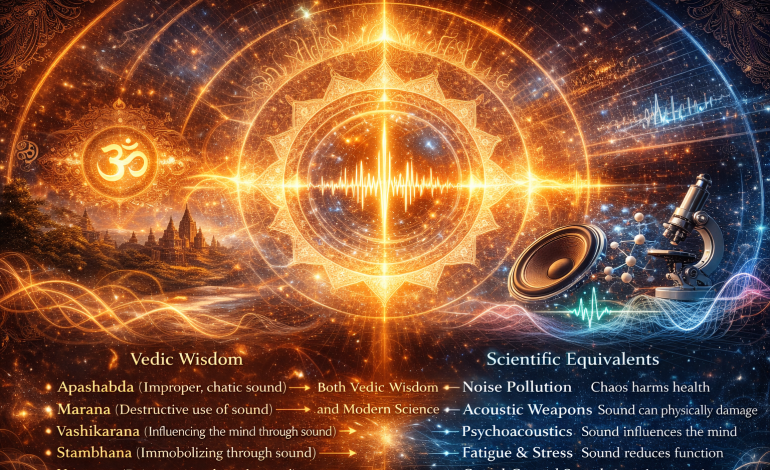
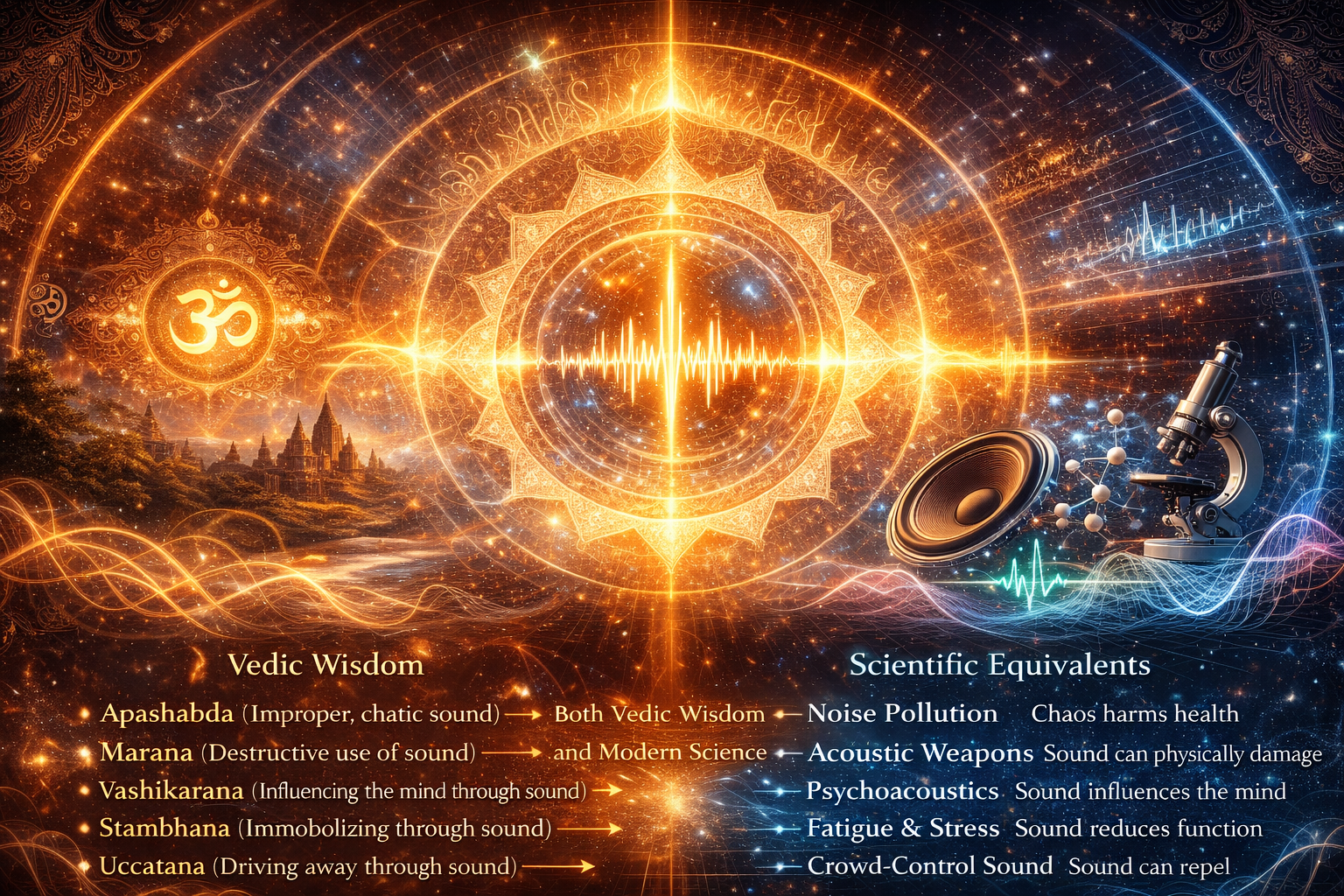
In the Vedic tradition, the concept of Apashabda refers to improper, distorted, or chaotic sound. This aligns closely with what modern science identifies as noise pollution. Continuous exposure to unstructured, irregular sound disrupts mental balance, increases stress levels, and interferes with biological rhythms. What ancient sages described as inauspicious or disharmonious sound is now scientifically proven to harm both psychological and physiological well-being.
The Vedic idea of Marana, often described as the destructive use of sound through mantras or vibrations, finds a modern parallel in acoustic weapons. Technologies such as high-intensity sound devices demonstrate that sound can indeed cause physical damage—affecting hearing, internal organs, and even neurological stability. What was once considered esoteric knowledge now appears as measurable, engineered force.
Similarly, Vashikarana, which refers to influencing or controlling the mind through sound, resonates with the scientific field of psychoacoustics. Research shows that certain frequencies and sound patterns can alter mood, behavior, and decision-making. Sound can induce calmness, fear, focus, or confusion—demonstrating its subtle yet powerful control over the human mind.
The concept of Stambhana, meaning immobilization or suppression of activity, can be compared to the effects of chronic fatigue and stress caused by prolonged noise exposure. Modern studies confirm that constant sound disturbance reduces cognitive performance, slows reaction time, and leads to mental exhaustion. In this way, sound doesn’t physically paralyze the body, but it significantly reduces functional capacity.
Lastly, Uccatana, traditionally described as driving away or dispersing individuals using sound-based methods, is mirrored in modern crowd-control technologies. Devices like directed sound systems are used to create discomfort and force movement, effectively dispersing groups without physical contact. This demonstrates how sound can be used as a tool of behavioral control.
Part Four: Protection and Practical Solutions
Vedic Approaches
Chanting mantras to create positive vibrations
Meditation (Nada Yoga) to internalize awareness
Use of protective hymns (Kavachams)
Cultivating calm, harmonious sound environments
Scientific Strategies
Reducing exposure to loud environments
Using ear protection in high-noise areas
Improving building insulation
Monitoring sound levels with technology
Urban planning to control noise pollution
Even simple actions—like choosing quiet spaces—can significantly improve health.
Conclusion: The Unified Truth About Sound
Sound is not just a wave—it is a force of influence.
The Vedic tradition understood it as the essence of creation. Modern science confirms its power over the human body and mind.
Together, they reveal a unified insight:
Sound can create harmony or chaos, health or disease, clarity or confusion.
By becoming conscious of the sounds we consume and produce, we gain the ability to:
Protect our health
Enhance our mental clarity
Align with deeper states of awareness
In a world filled with noise, the true wisdom lies in choosing which sounds we allow to shape us.