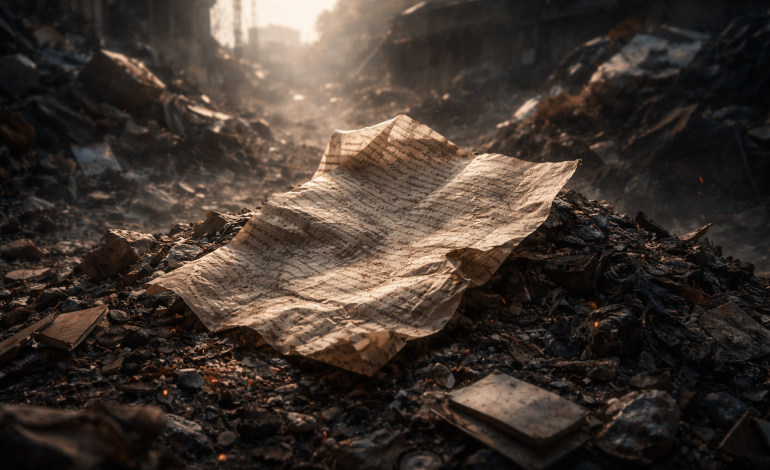
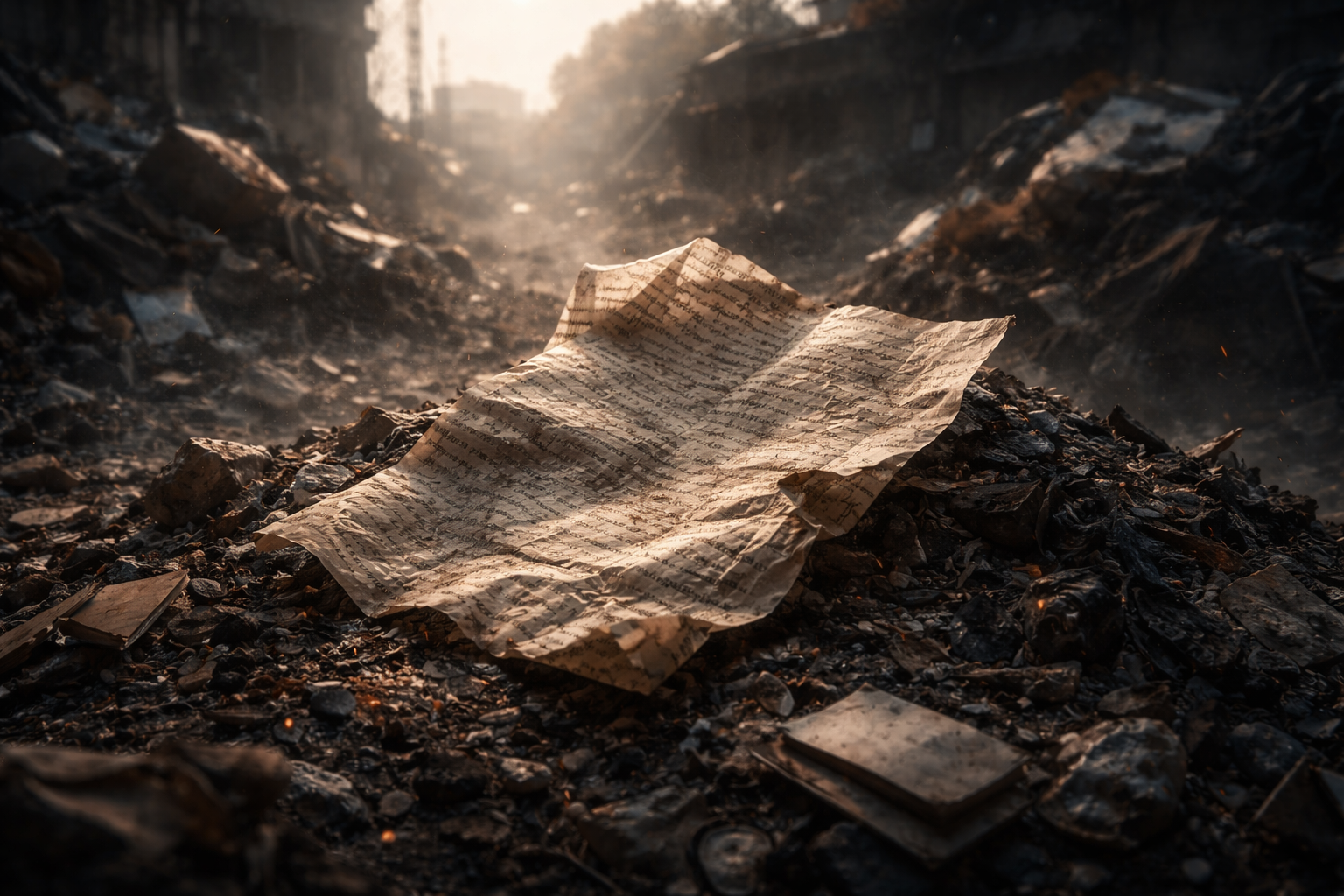
My life is a crumpled paper thrown into a heap of trash
Though it holds words of great worth,Is it not useless? — Is it not meaningless?Just traces of dried emotions, of no use to anyone. A crumpled paper in a heap

Though it holds words of great worth,
Is it not useless? — Is it not meaningless?
Just traces of dried emotions, of no use to anyone.A crumpled paper in a heap of waste — that is my life,
Though it carries countless meaningful lines,
Even if I dig wells of depth within it,
Is it not useless? — a pile of humiliated letters.Within the folds of that paper — my mother’s handwriting, a scripture of affection,
My father’s drops of sweat — lessons of righteousness,
Dreams written as poems of compassion — a river of tears soaked in kindness,
Yet, lost in that heap — they remain unseen in this light.Even if written by a great sage, even if spoken by a yogi,
If that paper lies in the trash — who will read it?
Who will understand? — even if meanings exist,
A life buried in waste cannot be read, can it?A crumpled paper in a heap of trash — my life,
Though it holds countless meaningful words,
Is it not useless? — a cluster of dishonored letters.Some writings are love — a stream of life-giving touch,
Some are pain — the lament of shattered dreams,
Some are sacrifice — words that walked on fire,
Some are despair — echoes hitting a dark wall.All together, a book of life — like a tree shedding leaves,
But a heap of trash is never a cherished memory,
It is a pit of rejection — a pile meant for fire.My letters are a sorrow I cannot burn away — my debt,
My sentences are experiences I cannot overcome — my curse,
No matter how meaningful they are, once fallen into trash,
They cannot become a lamp that gives light,
Nor a branch that gives fire —
Just the final sigh before turning into ash.A crumpled paper in a heap of trash — my life,
Though it holds countless meaningful words,
Is it not useless? — a cluster of dishonored letters.Words shining with philosophy are mine — the melody of my soul,
Thoughts as vast as the sky are my share — my universe,
But who needs a crumpled paper in trash?
Who needs something valuable yet unusable?
Every word I wrote — a permanent resident of that heap,
A shadow dance on an unseen screen till my last breath.My life is a crumpled paper thrown into a heap of trash,
Though it holds words of worth,
Is it not useless? — Is it not meaningless?
Traces of dried emotions, of no use to anyone.Like fragments blown by the wind — scattered curses,
Like cracks tearing the heart — each piece a wound’s story,
Soaked and dissolving in rain — my words like my shadow,
Even if they fade, the imprint of pain never disappears.A torn life starving for a touch, for a glance,
Yet standing in a heap of waste — a directionless flame.In the end, just a spark of fire — a lonely touch,
Even if it burns into ash — that is not true liberation,
What remains in that ash? — remnants of my songs,
Though useless, rising into the sky — that paper is my life,
A mind in waste — in the end, it becomes poetry.My life is a crumpled paper thrown into a heap of trash,
Though it holds words of worth,
Is it not useless? — Is it not meaningless?
Traces of dried emotions, of no use to anyone.O crumpled paper — the words written on you are useful — to someone, somewhere,
But if the whole world is a heap of trash,
To whom will you prove your worth?
If that heap is your grave, if your words are your curse,
Is it not useless? — Is it not meaningless?
My life — a crumpled paper thrown into trash,
Crumpled paper — my life — my death — my poetry,
Is it not useless? — is it not useless?
1. Central Metaphor: Life as a Crumpled Paper
The poem revolves around a deeply symbolic idea—life compared to a crumpled paper thrown into a heap of trash.
This metaphor represents:
- A life that once had value but is now ignored
- A person whose experiences, emotions, and talents are unseen
- The painful transformation from “meaningful” to “meaningless” in society’s eyes
Even though the paper contains valuable writing, its placement in trash defines its worth, not its content. This reflects a harsh truth:
Society often judges value based on visibility, not substance.
2. The Tragedy of Hidden Worth
Throughout the poem, the speaker insists that:
- The paper contains meaningful words
- It holds memories of love, sacrifice, pain, and wisdom
Yet, all of it becomes irrelevant because:
- No one reads it
- No one notices it
This highlights a profound emotional reality:
- Many people carry depth, intelligence, and emotional richness
- But remain unrecognized due to circumstances, status, or rejection
3. Family and Emotional Roots
The poem brings in deeply personal imagery:
- Mother’s handwriting → unconditional love
- Father’s sweat → discipline and values
These symbolize:
- The foundation of identity
- The emotional and moral investments that shape a person
However, even these sacred elements are lost in the “trash heap,” suggesting:
Even the most meaningful roots can be forgotten in a world driven by indifference.
4. Categories of Human Experience
The poem classifies life’s writings into emotional dimensions:
- Love
- Pain
- Sacrifice
- Despair
This structure shows that:
- A human life is not one-dimensional
- It is a collection of layered emotional experiences
Yet, when the whole life is dismissed, every experience loses its recognition.
5. Existential Questioning
The poem repeatedly asks:
- Who will read it?
- Who will understand it?
These are not literal questions—they are existential cries:
- Does life have meaning if no one acknowledges it?
- Is value dependent on recognition?
This connects to a deeper philosophical conflict:
Is meaning intrinsic, or is it assigned by others?
6. The Pain of Self-Awareness
The speaker is not ignorant—they are painfully aware:
- Of their own worth
- Of their own suffering
- Of the injustice of being ignored
This creates a heavier burden:
Knowing your value but being treated as worthless is more painful than ignorance.
7. Fire, Ash, and False Liberation
Fire appears as a symbol of:
- Destruction
- Possible release
But the poem rejects even that:
- Burning into ash is not true freedom
- Pain does not disappear—it transforms
The line suggests:
Escape is not liberation if the essence of suffering remains.
8. The World as the Real “Trash Heap”
One of the most powerful underlying ideas:
- What if the problem is not the paper…
- But the world that treats everything as disposable?
This reverses the perspective:
The individual is not worthless—the environment is incapable of recognizing worth.
9. Final Transformation: Pain into Poetry
Despite all despair, the poem ends with a subtle transformation:
- The “crumpled paper” becomes poetry itself
This is deeply significant:
- Even rejected life becomes art
- Even ignored pain becomes expression
It suggests:
Meaning may not come from society—but from expression itself.
10. Core Message
The poem ultimately conveys:
- Value is not always recognized
- Pain does not erase meaning
- Being unseen does not make you worthless
- Even discarded lives hold profound stories
And most importantly:
What the world calls “trash” may still be poetry in its purest form.