
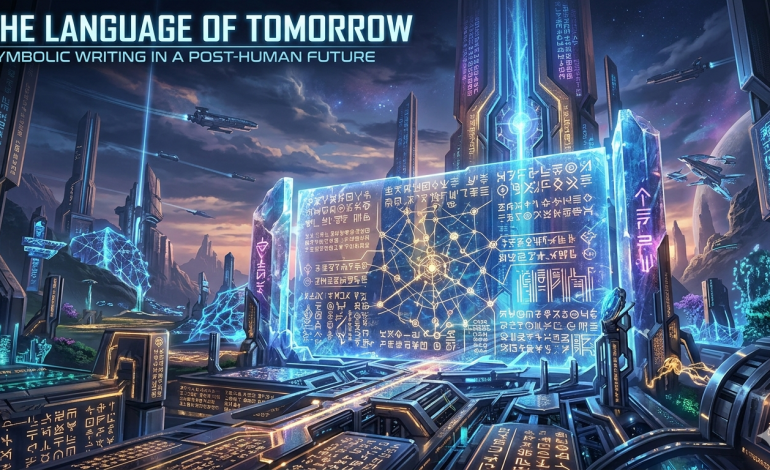
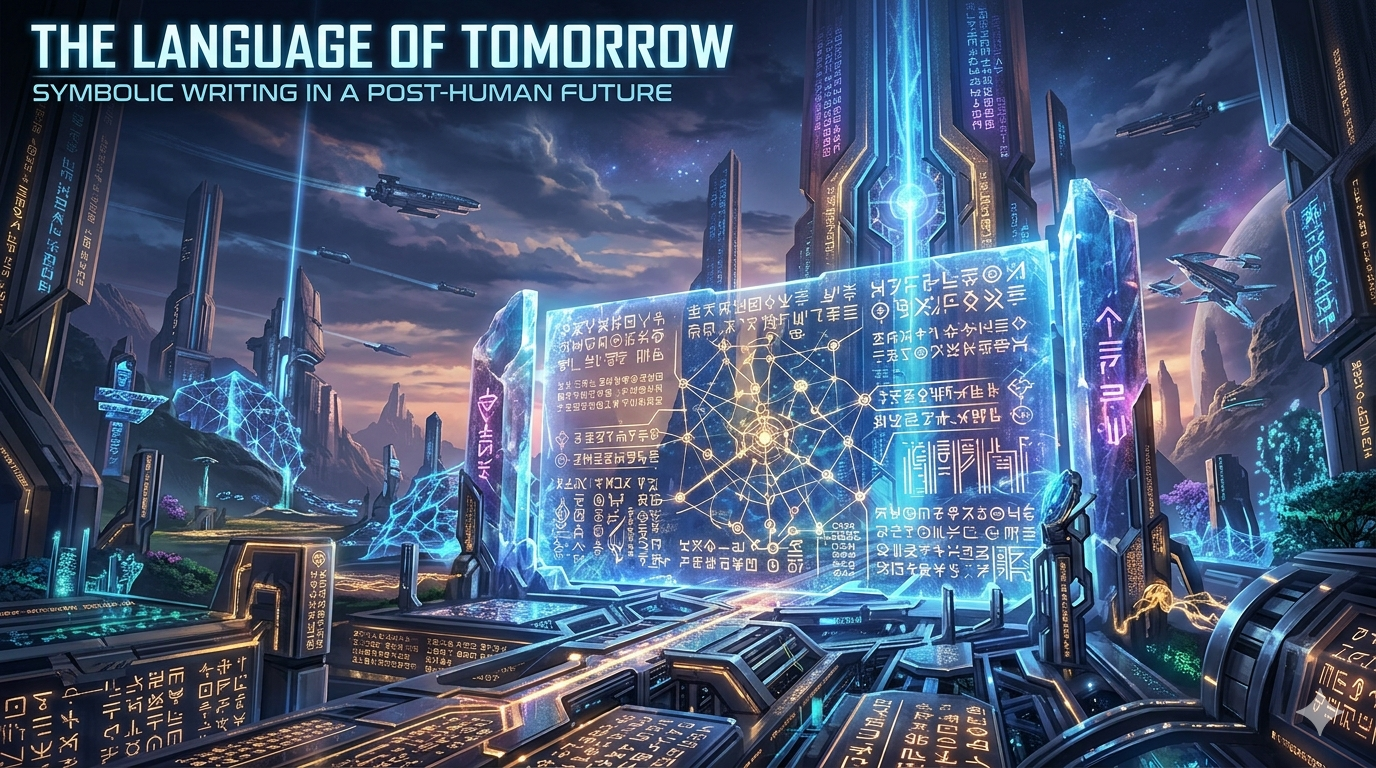
The Language of Tomorrow: Symbolic Writing in a Post-Human Future
Human communication has always evolved—from cave paintings to alphabets, from printed text to digital emojis. As we move deeper into the technological age, the limitations of traditional language are

Human communication has always evolved—from cave paintings to alphabets, from printed text to digital emojis. As we move deeper into the technological age, the limitations of traditional language are becoming more evident. Words often fail to capture complex emotions, multidimensional thoughts, and abstract realities. The future may not belong to spoken or written language as we know it, but to a new form—symbolic writing.
Symbolic writing is not new; it has existed in ancient scripts, spiritual diagrams, and cultural iconography. However, in the future, it may transform into a highly advanced, intuitive system capable of conveying vast meaning instantly.
THE EVOLUTION OF SYMBOLS: FROM PRIMITIVE TO INTELLIGENT
Early humans used symbols as their primary mode of communication. Cave drawings, hieroglyphs, and sacred geometries were not just artistic expressions—they were carriers of knowledge, belief, and identity.
In the modern world, symbols have re-emerged in digital forms—icons, emojis, logos, and visual cues. But these are still simplistic. The future points toward intelligent symbols—dynamic, adaptive representations that can change meaning based on context, emotion, and user perception.
These symbols may not be static images but living constructs, powered by artificial intelligence and neural interfaces.
SYMBOLIC WRITING AND THE HUMAN MIND
The human brain processes images faster than text. Symbols bypass linguistic barriers and connect directly with cognition and emotion. In a future where attention spans shrink and information overload increases, symbolic writing could become the most efficient mode of communication.
Imagine conveying an entire story, memory, or feeling through a single evolving symbol. This is not science fiction—it is a natural progression of how humans process and transmit meaning.
Symbolic writing could also enhance memory retention, learning speed, and emotional intelligence by aligning communication with how the brain naturally functions.
THE ROLE OF ARTIFICIAL INTELLIGENCE IN SYMBOLIC LANGUAGE
Artificial intelligence will play a crucial role in shaping future symbolic systems. AI can analyze patterns in human thought, emotion, and behavior to generate symbols that are universally understandable.
These AI-generated symbols could adapt in real-time. For example, a symbol representing “love” might appear differently based on cultural context, personal experience, or emotional intensity.
AI could also act as a translator between traditional language and symbolic expression, enabling a seamless transition into this new form of communication.
A UNIVERSAL LANGUAGE WITHOUT BARRIERS
One of the greatest challenges in human history has been linguistic diversity. While languages enrich culture, they also create barriers. Symbolic writing has the potential to become a universal language—one that transcends geography, culture, and spoken dialects.
In a globalized and interconnected future, such a system could unify communication. People from different parts of the world could understand each other instantly, not through translation, but through shared symbolic meaning.
This could revolutionize education, diplomacy, business, and human relationships.
SYMBOLIC WRITING IN VIRTUAL AND AUGMENTED REALITIES
As virtual reality (VR) and augmented reality (AR) become mainstream, symbolic writing may find its natural habitat in immersive environments. Instead of reading text, users might interact with floating symbols that represent ideas, commands, or narratives.
In these digital worlds, symbols could be three-dimensional, interactive, and responsive. A learning module, for instance, might use symbolic structures to teach complex concepts instantly.
This integration could redefine storytelling, gaming, education, and even spiritual experiences.
SPIRITUAL AND PHILOSOPHICAL DIMENSIONS
Symbolic writing has always had a deep connection with spirituality. Ancient mandalas, yantras, and sacred symbols were believed to hold cosmic truths.
In the future, symbolic writing might reconnect humanity with these deeper dimensions. It could serve as a bridge between science and spirituality, logic and intuition, the material and the metaphysical.
Such a system may not just communicate information, but also elevate consciousness.
CHALLENGES AND ETHICAL CONSIDERATIONS
Despite its potential, symbolic writing also presents challenges. Who controls the creation and standardization of symbols? Can symbols be manipulated to influence thought or behavior?
There is also the risk of over-simplification—reducing complex human experiences into abstract representations. Ensuring authenticity, diversity, and ethical use will be critical.
Privacy concerns may arise if symbols are generated based on personal cognitive or emotional data.
THE FUTURE HUMAN: THINKING IN SYMBOLS
As symbolic writing evolves, it may not just change how we communicate—it may change how we think. Future humans might process reality in symbols rather than words.
This shift could lead to new forms of creativity, innovation, and understanding. Thought itself may become more visual, interconnected, and holistic.
The boundaries between language, art, and cognition may dissolve completely.
CONCLUSION: A NEW ERA OF EXPRESSION
The future of symbolic writing is not just about replacing words—it is about redefining human expression. It represents a shift toward deeper, faster, and more universal communication.
In this emerging era, symbols will not just represent reality—they will shape it. As humanity steps into a post-human future, symbolic writing may become the language of consciousness itself.
The question is not whether this transformation will happen, but how prepared we are to understand and guide it.