Future Technology 2050: Global Transformation, Youth Opportunities, and the Next 30 Years Roadmap
THE NEXT 30 YEARS WILL REDEFINE HUMAN CIVILIZATION The next 30 years (2025–2055) will not be a continuation of the past — they will be a transformation of human existence

THE NEXT 30 YEARS WILL REDEFINE HUMAN CIVILIZATION
The next 30 years (2025–2055) will not be a continuation of the past — they will be a transformation of human existence itself. Technology is no longer a tool; it is becoming an ecosystem shaping economies, education, identity, and even human biology.
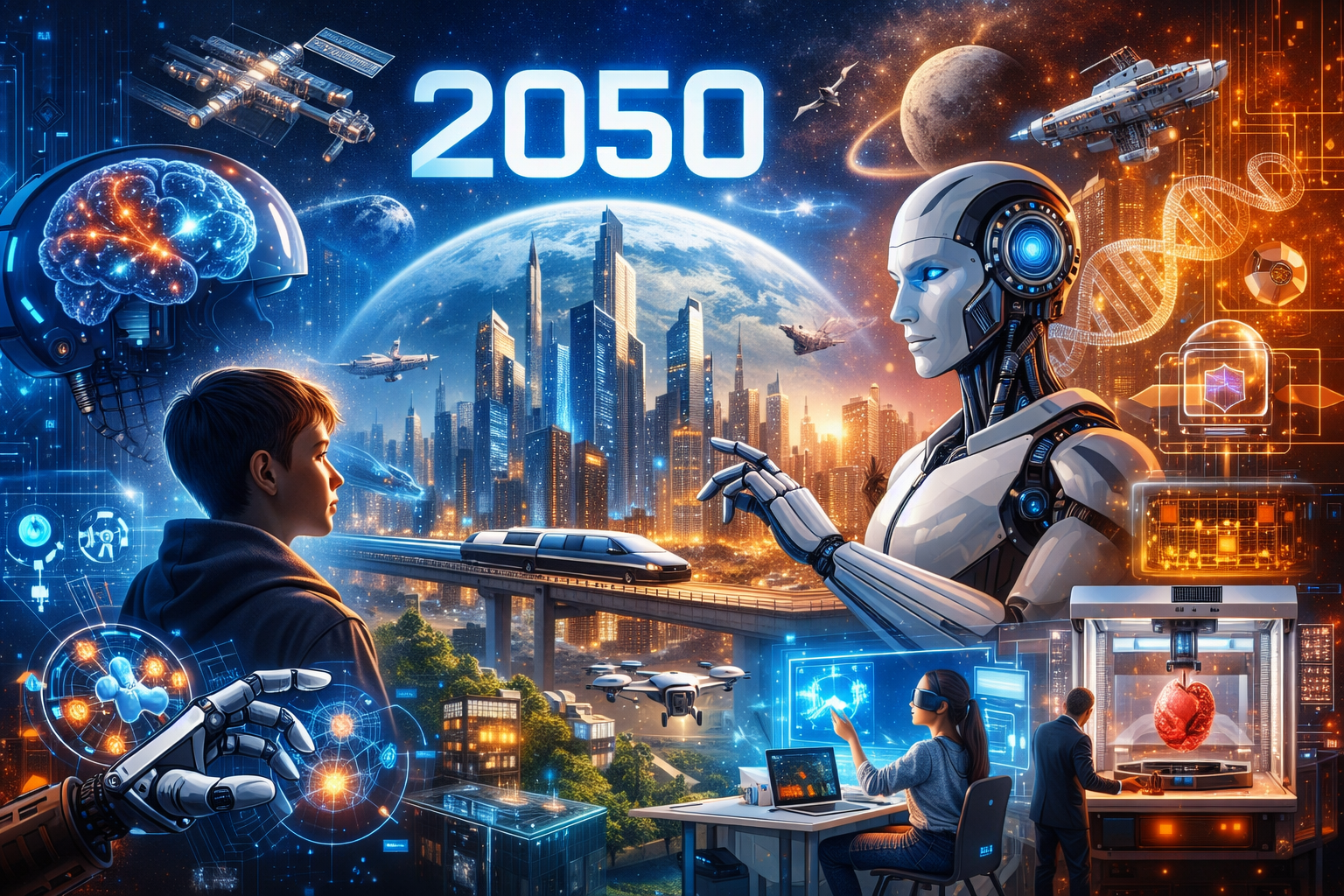
Research projections indicate that by 2050, artificial intelligence, robotics, biotechnology, and quantum computing will converge into a unified system of “Next Technologies (NT)” that dominate global systems.
This article explores facts, truths, global strategies, and youth opportunities in a rapidly evolving world.
1. THE CORE TECHNOLOGIES SHAPING 2050
1.1 Artificial Intelligence & AGI (Artificial General Intelligence)
AI is expected to become the most powerful force in human history. By 2050:
- AI may perform most scientific research autonomously
- Machines could generate Nobel-level discoveries
- Human intelligence may be augmented or merged with AI systems
Truth: AI will not just replace jobs — it will redefine intelligence itself.
1.2 Robotics & Autonomous Systems
- Fully autonomous industries (factories, hospitals, agriculture)
- Smart cities with robotic maintenance systems
- Self-driving transport as the global standard
Robots will no longer follow commands — they will learn, adapt, and decide independently.
1.3 Biotechnology & Human Enhancement
Future breakthroughs include:
- Lab-grown organs (bioprinting)
- Genetic disease elimination
- Personalized medicine based on DNA
Biotechnology may even extend human lifespan significantly and redefine aging itself.
1.4 Quantum Computing & Advanced Materials
- Ultra-fast computation solving global problems instantly
- Climate modeling, drug discovery, and space research acceleration
- Self-healing materials and 4D printing systems
1.5 Brain-Computer Interfaces & Human-Machine Integration
- Direct brain communication with devices
- Thought-based computing
- Memory enhancement and digital consciousness
This may blur the line between human and machine.
2. FUTURE EDUCATION: EDUCATION 5.0 REVOLUTION
Traditional education will collapse and transform into personalized, AI-driven learning systems.
Key Features:
- AI tutors for every student
- Virtual Reality classrooms
- Skill-based micro-learning instead of degrees
- Global open-access education
Research highlights that AI can democratize education but may also increase inequality if not managed properly.
Education 5.0 focuses on:
- Creativity
- Emotional intelligence
- Problem-solving
- Human-machine collaboration
3. GLOBAL ECONOMIC TRANSFORMATION
3.1 Automation & Job Disruption
- 30–50% of current jobs may disappear
- New jobs will emerge in AI, biotech, and digital ecosystems
- Gig economy and independent digital careers will rise
World Economic Forum scenarios suggest that outcomes depend on how societies adapt to AI-driven change.
3.2 Rise of Tech-Driven Economies
Countries investing in:
- AI
- Quantum computing
- Robotics
will dominate global power structures.
Example: National strategies already focus on AI integration across industries, including education and healthcare.
3.3 Wealth Gap Reality
Truth:
Technology will increase wealth — but not equally.
- High-skill individuals benefit the most
- Low-skill jobs decline rapidly
- Digital divide becomes a major global issue
4. FUTURE SOCIETY: FACTS AND TRUTHS
4.1 Smart Cities & Digital Life
- AI-controlled infrastructure
- Sensor-based governance
- Fully connected digital ecosystems
4.2 Human Identity Crisis
- Digital avatars replacing physical identity
- Social media evolution into immersive realities
- Reduced human-to-human interaction
4.3 Ethical Challenges
- AI control vs human freedom
- Data privacy vs surveillance
- Bioengineering vs natural evolution
5. YOUTH & NEXT GENERATION: REALITY CHECK
5.1 Skills Required for Future Survival
Youth must focus on:
- AI & Machine Learning
- Data Science
- Biotechnology
- Robotics Engineering
- Creative Thinking & Innovation
5.2 The Biggest Truth for Youth
Degrees will not guarantee success.
Skills + adaptability = survival.
5.3 Opportunities for Youngsters
- Digital entrepreneurship
- Global freelancing economy
- Content creation & knowledge economy
- AI-powered startups
Technology gives youth global reach without borders.
6. FUTURE ROADMAP (2025–2055)
2025–2030
- AI expansion in daily life
- Automation begins replacing repetitive jobs
- Rise of digital education
2030–2040
- Human-AI collaboration becomes standard
- Smart cities expand globally
- Biotech revolution begins
2040–2050
- AGI emergence possible
- Brain-computer interfaces mainstream
- Autonomous world systems
2050+
- Human-machine integration
- New definition of life, intelligence, and society
7. RISKS AND WARNINGS
- Mass unemployment if unprepared
- Ethical misuse of AI and biotech
- Increased inequality
- Loss of human values
Truth: Technology is powerful — but direction depends on humanity.
CONCLUSION: THE FUTURE IS NOT COMING — IT IS BEING BUILT NOW
The next 30 years will decide:
- Who leads the world
- Who survives economically
- Who adapts and evolves
For youth, the message is clear:
Do not prepare for jobs — prepare for change.
The future belongs not to the strongest or smartest,
but to those who adapt, learn, and evolve continuously.