Social Myths in India: Between Belief, Power, and Reality in a Changing World
India stands at the intersection of tradition and transformation. This article uncovers the deep-rooted social myths influencing everyday life, governance, and global perception—revealing how belief systems can both guide and

India stands at the intersection of tradition and transformation. This article uncovers the deep-rooted social myths influencing everyday life, governance, and global perception—revealing how belief systems can both guide and misguide a nation in transition.
Social Myths in India: Truth & Facts
Introduction
India is changing quickly. Technology is growing. Cities are expanding. However, many social myths still influence daily life.
These myths affect decisions, relationships, and even policies. In many cases, people accept them without question. As a result, truth and belief often get mixed.
So, understanding these myths is important.
If you’re exploring deeper ideas like perception and truth, you can also read our internal article on Reality vs Illusion.
What Are Social Myths?
Social myths are common beliefs that people accept as true. However, they are not always based on facts.
Sometimes, myths help society feel stable. For example, they give simple answers to complex problems. On the other hand, they can also spread confusion.
Because of this, myths can both help and harm society.
To understand how beliefs shape hidden systems, check our article on Hidden Truths.
Common Social Myths in India
1. Superstition Over Science
Many people still believe in superstitions. For instance, astrology often guides life choices. Similarly, rituals are used to control outcomes.
However, science does not support many of these beliefs.
According to research by the World Health Organization, misunderstanding health and illness can delay proper treatment. Therefore, relying only on belief can be risky.
2. Myths About Society and Identity
Some myths create divisions. For example, people may believe that certain communities behave in fixed ways.
In reality, social behavior depends more on education and environment.
Moreover, these myths can increase tension. As a result, they affect unity in society.
3. Gender-Based Myths
Gender myths are still common. For instance, many believe certain roles are fixed for men and women.
However, modern India is changing. Women are leading in business, science, and politics.
Still, these old beliefs slow progress.
Modern Myths in the Digital Age
Misinformation and Social Media
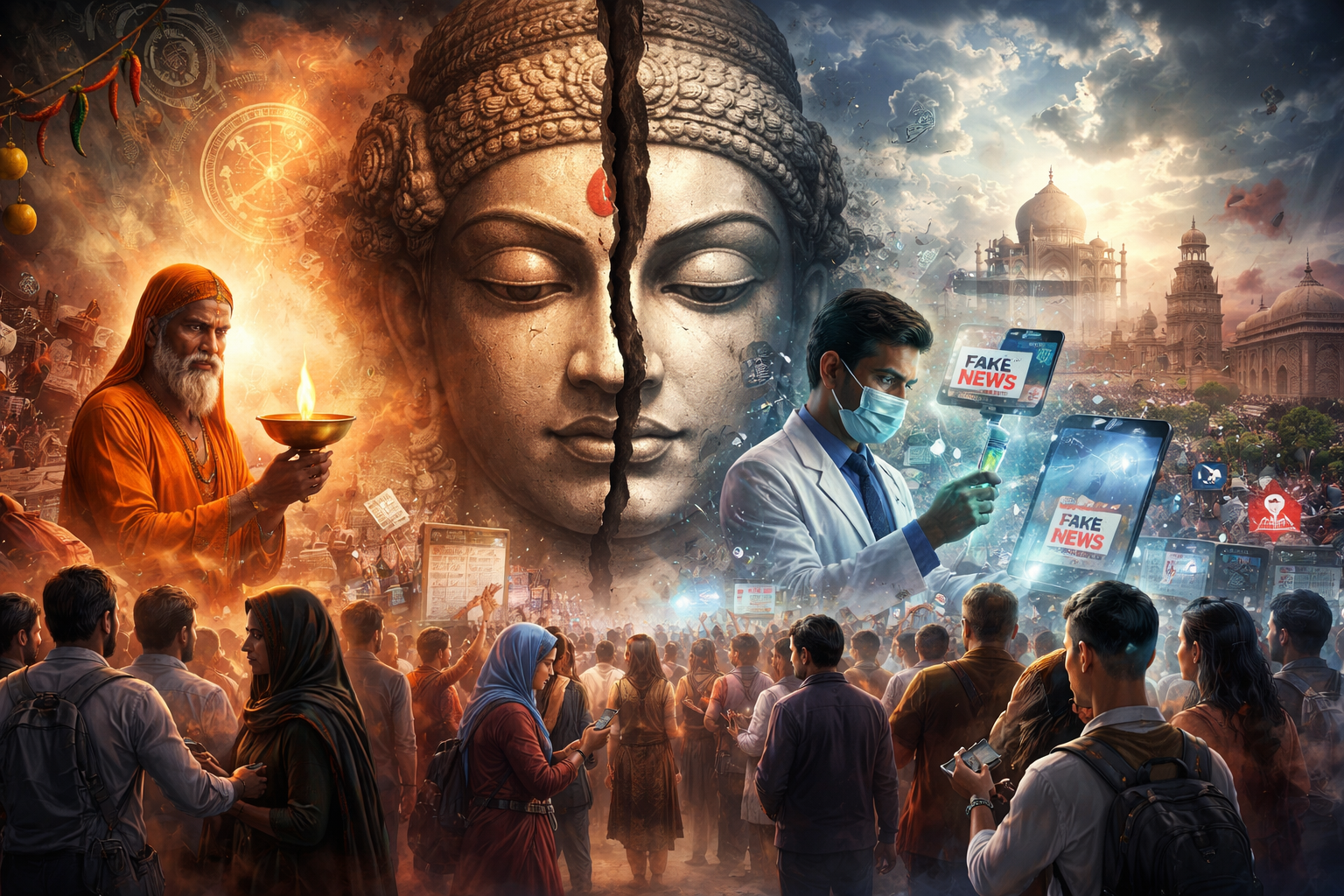
Today, myths spread faster than ever. Social media plays a big role in this.
False information can go viral in minutes. Consequently, people may believe things without checking facts.
According to UNESCO, media literacy is key to fighting misinformation. Therefore, people must learn to verify information.
Why Do Myths Continue?
There are several reasons:
- First, myths are easy to understand
- Second, they are passed through generations
- Also, they feel emotionally comforting
- Finally, they are often supported by authority
Because of these factors, myths are hard to remove.
Impact of Social Myths
Social Impact
Myths can create bias. They may lead to discrimination or misunderstanding.
Economic Impact
Wrong beliefs can affect decisions. For example, people may avoid new ideas or technologies.
Mental Impact
Fear-based thinking can increase stress. It also prevents logical decision-making.
Breaking the Cycle
India promotes scientific thinking. In fact, the Constitution of India encourages citizens to develop a scientific mindset.
So, what can be done?
- Encourage education
- Promote fact-checking
- Support open discussions
- Question blind beliefs
In addition, reading and awareness play a big role.
Conclusion
India is moving forward. However, social myths still exist.
Some beliefs are harmless. Yet, others can slow progress.
Therefore, balance is important. Respect culture, but question false ideas.
In the end, truth should guide growth.