
The Indian IT Industry Crisis 2025: Why Traditional IT Jobs Are Disappearing and What Comes Next
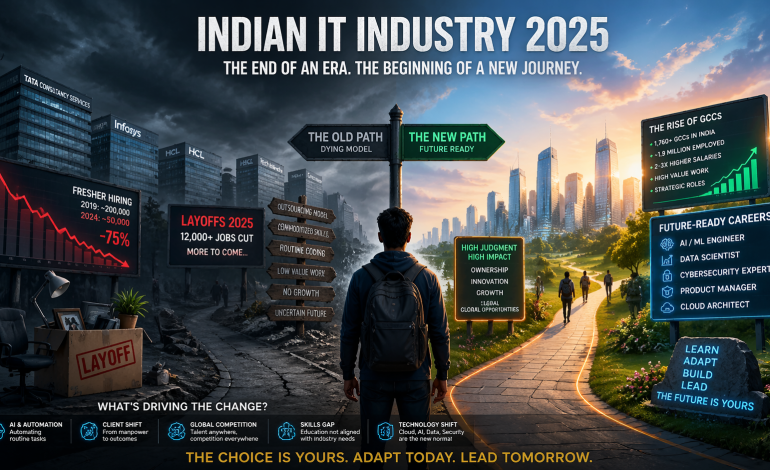
The Indian IT Industry Crisis The Indian IT dream is not dead, but it is undergoing a brutal structural reset. Fresher hiring at top IT firms has collapsed by over


The Indian IT Industry Crisis
The Indian IT dream is not dead, but it is undergoing a brutal structural reset. Fresher hiring at top IT firms has collapsed by over 90% since 2022, and 84% of engineering graduates remain unemployed or without internships, according to the Unstop Talent Report 2025. The India Skills Report 2025 places national employability at just 54.81%, while a joint IIT-Kanpur and La Trobe University study found that 78% of employers believe fresh graduates are not work-ready. Research published in The Indian Journal of Labour Economics (2025) confirms that generative AI is automating routine IT roles while creating new opportunities in AI governance and model validation. Yet, over 1,850 Global Capability Centers (GCCs) now employ nearly two million professionals in high-value roles, with projections of 3.1 million jobs by 2030. This article provides an exhaustive, research-backed analysis of the crisis and offers a strategic roadmap for students, professionals, and job seekers to thrive in the new IT landscape.
1. The Structural Crisis: Layoffs, Hiring Freezes, and the End of Growth
The most definitive indicator of a systemic shift is the dramatic downturn in hiring, particularly for entry-level engineers.
India’s top five IT services companies TCS, Infosys, Wipro, HCLTech, and Tech Mahindra hired fewer than 5,000 people in the June 2025 quarter. This represents a decline of over 90% from the 50,000-plus levels seen just two years ago, driven directly by the rise of AI, automation, and cloud platforms that are replacing routine tech jobs. In FY25, these five firms collectively added just 12,718 employees, a dismal number for an industry that has historically been the nation’s largest formal employer. This marks a sharp reversal from FY24, when the same group had trimmed their headcount by nearly 70,000 amidst global demand uncertainty.
The crisis is not limited to India. Globally, tech layoffs in 2025 have already crossed 130,000, nearly reaching half of the previous year’s total of 238,461, according to the tech job marketplace TrueUp. Hiring in the IT-software and software services sector de-grew 6% year-on-year in August 2025 and dropped a sharp 15.6% month-on-month, marking the sixth monthly decline in eight months. As a result of these pressures, India’s three largest tech giants TCS, Infosys, and Wipro saw their total employee count shrink by over 60,000 in the last year.
A critical structural change has emerged: growth no longer requires hiring. Between FY23 and FY25, TCS increased its revenue from Rs 2.25 lakh crore to roughly Rs 2.55 lakh crore, yet its headcount remained broadly unchanged. Infosys grew its revenue from Rs 1.46 lakh crore to about Rs 1.63 lakh crore, even as its workforce shrank by roughly 20,000. HCLTech’s headcount remained virtually flat for two consecutive years. For an industry that has historically scaled by adding people, this is a fundamental break in the business model.
2. The Crumbling Foundation: The Collapse of Fresher Hiring and the Skills Gap
The social and economic implications of this shift are severe, as the traditional pathway from campus to career is rapidly closing.
India produces approximately 1.5 million engineering graduates every year. However, the Unstop Talent Report 2025 found that a staggering 84% of engineering graduates remained unemployed or without an internship. Furthermore, a separate analysis notes that nearly 83% of engineering graduates fail to secure relevant jobs or internships upon graduation. Fresher hiring in the IT sector has collapsed to an estimated 70,000–80,000 in FY24, down 87.5% from 600,000 in 2022. The impact is also being felt at the premier Indian Institutes of Technology (IITs), where placement rates have dropped from 90.4% to 80.2% in just two years.
This paradox of high graduate numbers and low hiring is explained by a deep employability gap. The India Skills Report 2025, based on over 650,000 candidates and insights from 1,000 corporations, places the national employability rate at just 54.81%. A study by IIT-Kanpur and La Trobe University found that 78% of employers believe fresh engineering graduates are not well-trained for the workplace. The problem is a severe mismatch between outdated college curricula, which give minimal attention to fields like AI, data analytics, and IoT, and the rapidly evolving needs of industry. This gap forces companies to invest in long, costly retraining programs. Both TCS and Infosys operate some of the world’s largest training centers just to make fresh engineers minimally productive, a stark reflection of how far education remains from industry reality.
3. The Disruptor: AI and the End of Labor Arbitrage
The fundamental business model of the Indian IT industry, built on labor arbitrage, is collapsing. Research confirms that the recent mass layoffs signal not merely AI-driven job displacement, but the fundamental collapse of a three-decade-old business model built on geographic wage differentials. The traditional “people rental” model is becoming obsolete as AI tools enable single engineers to match the productivity of entire offshore teams.
The mechanism of disruption is detailed in academic research. A 2025 study published in The Indian Journal of Labour Economics found that generative AI adoption is automating routine business process management roles while simultaneously creating augmentation-driven opportunities in model validation, governance, and AI explainability. This dual effect is the source of the current crisis: jobs are being destroyed in one area while new, more specialized ones are created in another. The study further projects that information-based services revenues will reach $17 billion by FY2027, contributing over 40% of IT-BPM income by 2030. Occupations such as AI engineers, data scientists, and MLOps specialists are growing at 20–25% annually. However, the report also warns of a projected talent deficit of 140,000 professionals by 2027, highlighting the critical gaps in workforce readiness.
Further research in the International Journal of Productivity and Quality Management confirms a positive and significant link between AI adoption drivers and productive business outcomes in Indian IT companies, reinforcing that this shift is not a temporary trend but a fundamental transformation.
4. The New Engine of Growth: Global Capability Centers
While the traditional IT services model stagnates, a new powerhouse is rapidly expanding: Global Capability Centers.
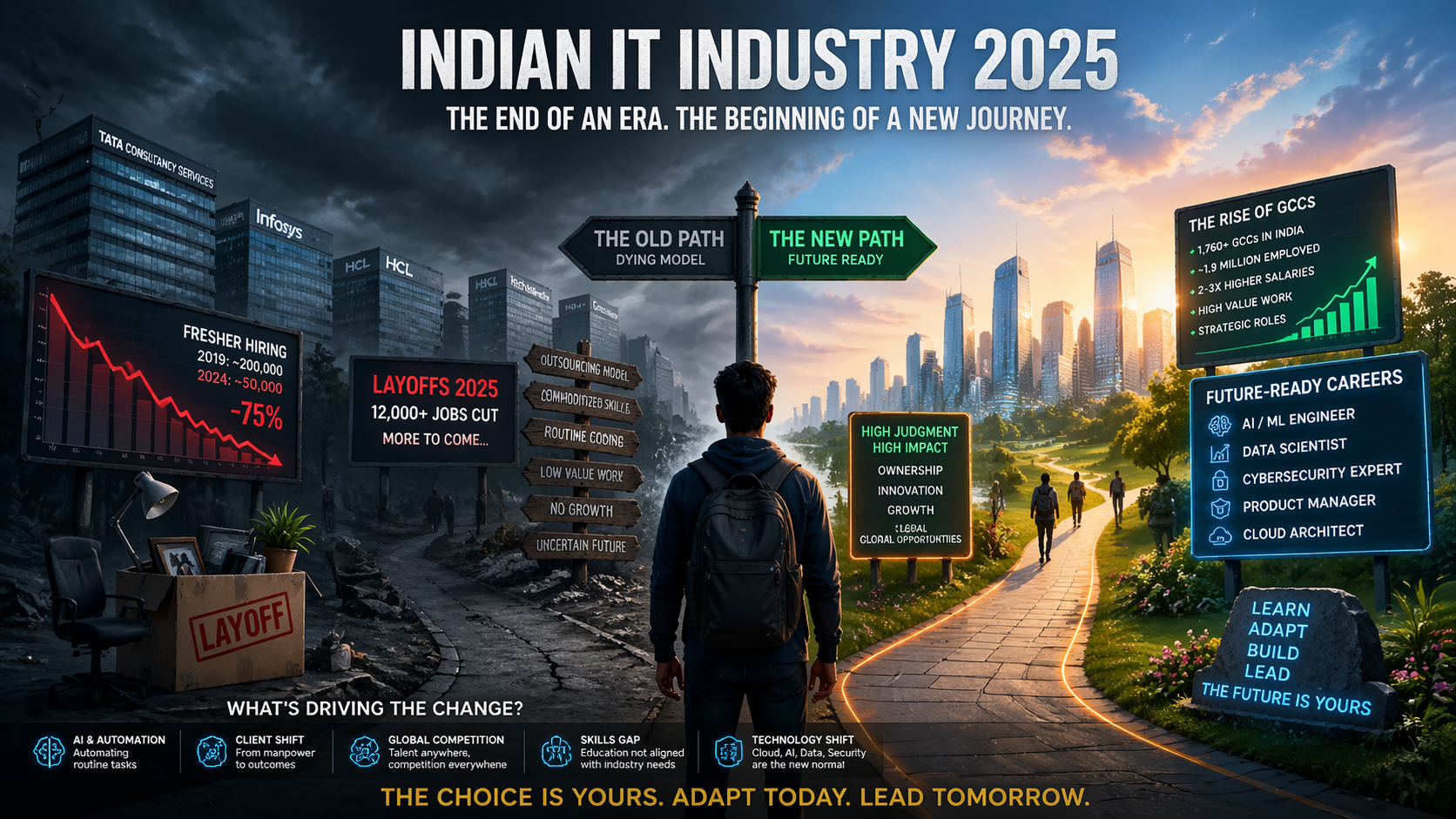
India currently hosts over 1,850 GCCs, employing close to two million professionals. Projections indicate this will grow to over 2,400 GCCs employing over 3 million workers by 2030, contributing to a $125 billion market size. The GCC ecosystem in India is on track to employ over 3.1 million people by 2030, up from an estimated 2.1 million by the end of 2025. A report estimates that the GCC ecosystem supports a staggering 10.4 million jobs in total, including 2 million direct roles, 1.8 million allied, and 6.5 million induced, with average salaries 25 to 30% higher than the national average.
GCCs are not just growing in number; they are evolving in nature. They are transitioning from cost-arbitrage centers to strategic AI command centers, accounting for 22.5% of India’s AI talent demand and building full-stack generative AI teams. This shift is also geographic, spreading beyond metros to tier-2 and tier-3 cities like Indore, Jaipur, Nagpur, Coimbatore, and Trivandrum, which recorded 8-9% quarterly growth. In a clear sign of their strategic importance, leadership hiring by GCCs grew by 7.7% in 2025, compared to just 2.4% for traditional IT services companies, cementing their role as the primary engine sustaining India’s tech job market.
5. The Road Ahead: Policy, Research, and Actionable Strategies
The future of the Indian IT professional will depend on navigating from a low-judgment, low-AI capability role to a high-judgment, AI-orchestrated one. The transformation is already underway, and the window to adapt is closing.
Policy initiatives are beginning to respond. The All India Council for Technical Education (AICTE) launched the PRACTICE project in 2025, aimed at enhancing critical thinking, industry-academia linkage, and employability, specifically for students in tier-2 and tier-3 engineering colleges. At the national level, the FutureSkills Prime and IndiaAI Mission programs are essential for building talent pipelines for the new information-based services economy.
For individual professionals, the path forward is clear but demanding. Academic research highlights that the psychological impact of AI-induced job displacement is profound, affecting the emotional, cognitive, and behavioral well-being of Indian IT professionals. The solution lies in proactive upskilling. The India Skills Report 2025 notes that MBA graduates are the most employable at 78%, followed by B.Tech graduates at 71.5%, reflecting the rising demand for a blend of business, technology, and IT expertise. The most in-demand technical skills as per the Instahyre Product-Tech PayCheck 2025 report include Python, Java, Node.js, cloud platforms like AWS, and security integrations.
Actionable advice derived from these findings includes:
-
For Students: Do not rely on campus placements. Build a portfolio of real-world projects in AI, data science, cloud computing, or cybersecurity. Target internships and entry-level roles at GCCs, which offer higher pay and more strategic work.
-
For Mid-Level Professionals: Audit your current role. If a majority of your day is spent on routine tasks, you are at high risk. Invest in cloud certifications (AWS, Azure, GCP) with a focus on their AI services. Develop skills in orchestrating AI agents and moving into problem-framing and architectural roles.
-
For All Job Seekers: Rewrite your resume to focus on outcomes and value created, not just tasks performed. Create a “skill-proof” portfolio on GitHub. Network directly with professionals at GCCs and product startups, as these are the primary zones of growth. The Indian IT dream is not dead, but it has transformed. The era of the guaranteed campus placement is over. For those who adapt and acquire the skills of the future, immense opportunities await. For those who do not, the path forward will be increasingly difficult.