Indian IT Dream 2026-2030: GCCs, AI-Led Disruption & The Next Frontier of Talent Transformation
The Indian IT industry is not dying—it is fundamentally restructuring. Between 2026 and 2030, the sector will add over 2 million jobs, reaching 7.5 million professionals, with emerging technologies like

The Indian IT industry is not dying—it is fundamentally restructuring. Between 2026 and 2030, the sector will add over 2 million jobs, reaching 7.5 million professionals, with emerging technologies like Generative AI, Quantum Computing, and Cybersecurity creating 1 million new positions. Global Capability Centers (GCCs) have evolved from back-office cost centers into strategic innovation engines, hosting 1,900+ professionals by 2030 and driving P&L ownership, AI deployment, and product development from India. However, this transformation brings a stark reality: 400,000-500,000 routine IT jobs face automation. The path forward requires radical upskilling, with initiatives like IBM’s mission to skill 5 million Indians in frontier technologies. GCCs are not the final destination—they are a launching pad toward India becoming a global R&D powerhouse, where Indian professionals lead global product strategy, quantum research, and AI governance. Based on research from Nasscom, Oliver Wyman, Quess Corp, The Journal of Strategic Information Systems, and Indian Journal of Finance.
Part 1: The State of Indian IT (2025-2026) – Reality Check
The Contradiction: Decline and Growth Coexist
The Indian IT sector in 2025-2026 presents a paradoxical picture. On one hand, traditional IT services are contracting; on the other, emerging technology hubs are expanding at record pace.
The Decline Indicators:
-
Fresher hiring at top IT services firms dropped 75% from FY2019 to FY2024
-
Traditional IT services firms reported muted growth (TCS: +3.8% YoY revenue in FY25)
-
400,000-500,000 routine IT jobs identified as at-risk over 2-3 years
The Growth Indicators:
-
Total tech workforce projected to grow from 5.4 million to 7.5 million by 2030
-
Emerging technologies alone to generate over 1 million jobs in five years
-
GCCs leasing record 28 million sq. ft. office space in 2024
-
1,760+ GCCs employing 1.9 million professionals currently
Research Validation: Academic & Industry Sources
| Source | Key Finding |
|---|---|
| The Journal of Strategic Information Systems (Call for Papers 2025-2026) | India represents “a living, evolving environment of practices, identities, and aspirations” at the intersection of technology, people, and organizations |
| Indian Journal of Finance (Vol. 20, Issue 1, 2026) | Faniband & Singh’s research on M&A frequency in Indian IT using count data models |
| Nasscom-Oliver Wyman Report (Nov 2025) | GCCs shifting from “scale and cost advantages to delivering strategy and innovation advantages” |
| Quess IT Staffing Report | Emerging tech (GenAI, Deep Tech, Quantum Computing) to create over 1 million jobs by 2030 |
| Journal of Recent Innovations in Computer Science and Technology (Vol. 3, No. 2, 2026) | Focus on Agentic AI, LLMs, Quantum Computing, and IoT applications; acceptance rate 24% |
The academic publishing landscape confirms this transformation. The Journal of Strategic Information Systems has issued a special issue call on “India at the Intersection: Reconfiguring Commerce, Capabilities and Culture in Age of Technological Acceleration” with submission deadline September 2026 . Similarly, JRICST’s 2026 volume features research on Agentic AI for precision farming and multi-label emotion classification using deep learning .
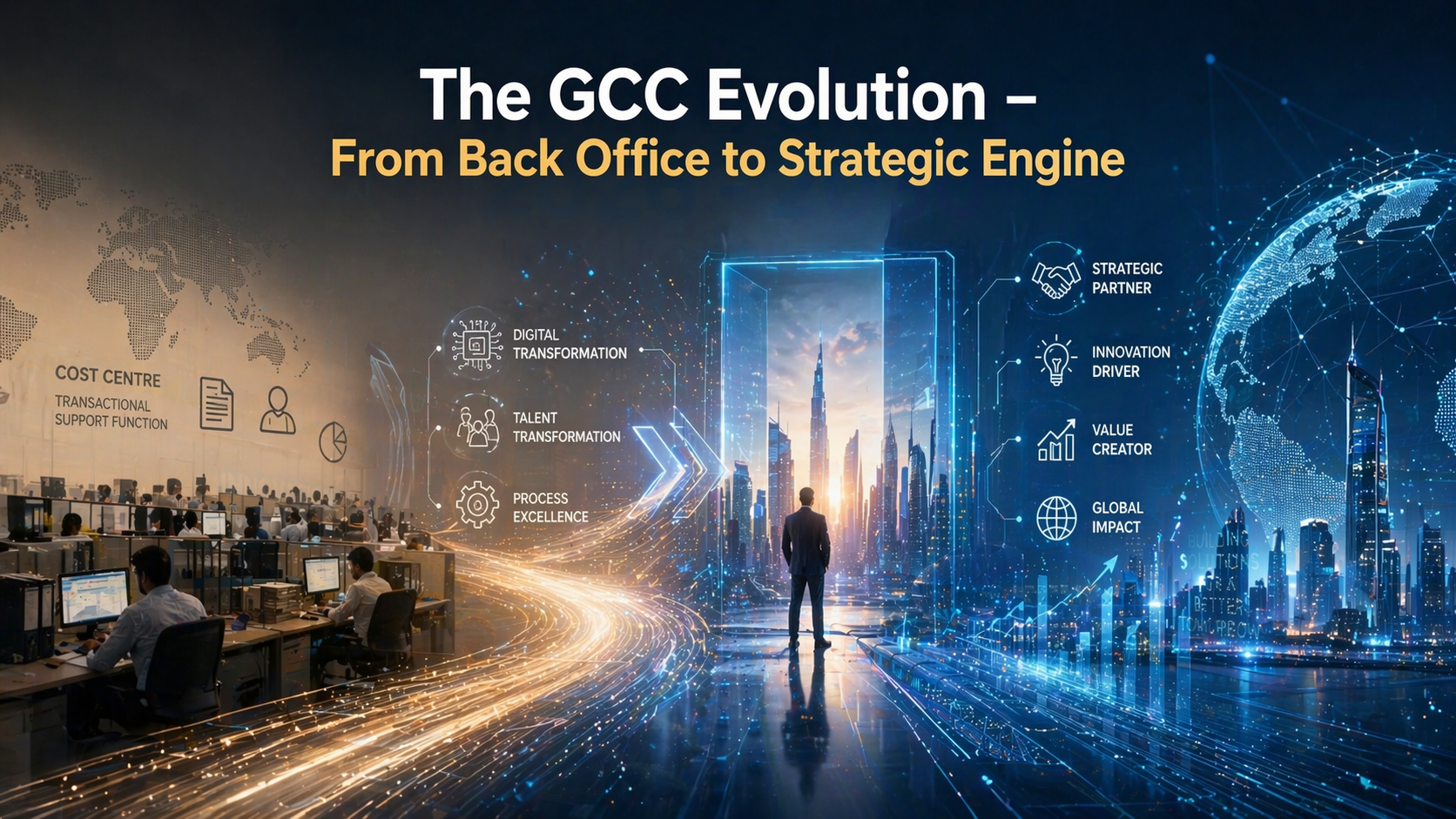
Part 2: The GCC Evolution – From Back Office to Strategic Engine
The Four-Phase Transformation
According to the Nasscom-Oliver Wyman report (Nov 2025), India’s GCCs have moved through four distinct phases :
| Phase | Focus | Time Period |
|---|---|---|
| Phase 1 | Cost arbitrage & talent access | 1990s-2000s |
| Phase 2 | Quality & efficiency improvement | 2000s-2010s |
| Phase 3 | Advanced analytics, R&D, core tech | 2010s-2020 |
| Phase 4 | Transformation hub with GenAI, product P&L ownership | 2020-2030+ |
Key evidence of Phase 4 maturity:
-
Product P&L roles now exist in India, shortening feedback loops and accelerating decisions
-
67% of new GCCs (2024) lead mandates in AI, ML, and automation
-
62% of GCC leaders emphasize “India-first approach delivers stronger results”
The Strategic Partnership Model
The next-generation GCC operates through integrated partnerships between three entities:
-
Headquarters (HQ): Sets enterprise-level goals and outcomes
-
GCC India: Runs day-to-day delivery and owns specific business outcomes
-
Service Provider: Brings specialist talent, reusable tools, and co-innovation capabilities
Real-World Impact Examples :
| Company Type | Achievement |
|---|---|
| Global FMCG | $30M P&L impact, $80M recovered invalid claims, 12 global CoEs, 10+ GenAI deployments |
| Fortune 500 Real Estate | 35% cost reduction, 40% faster release cycles |
| US Healthcare Leader | 30-40% cost reduction, 70% productivity increase, $100M+ savings, 99.99% accuracy |
The Distributed Resilience Model
Geopolitical headwinds have not killed GCCs—they have accelerated their evolution :
-
Talent sovereignty: Building complete innovation ecosystems independent of geopolitical disruptions
-
Multi-location delivery: Expanding to Tier-2 cities (Jaipur, Kochi, Bhubaneswar) for risk mitigation
-
Diversified parent company origins: Reducing dependence on any single geographical market
Direct Quote from Devashish Sharma, Co-Founder & CEO, Taggd:
“We are seeing a pronounced move toward talent sovereignty wherein companies are no longer just offshoring work but are rather building complete innovation ecosystems that can operate independently of geopolitical disruptions.”
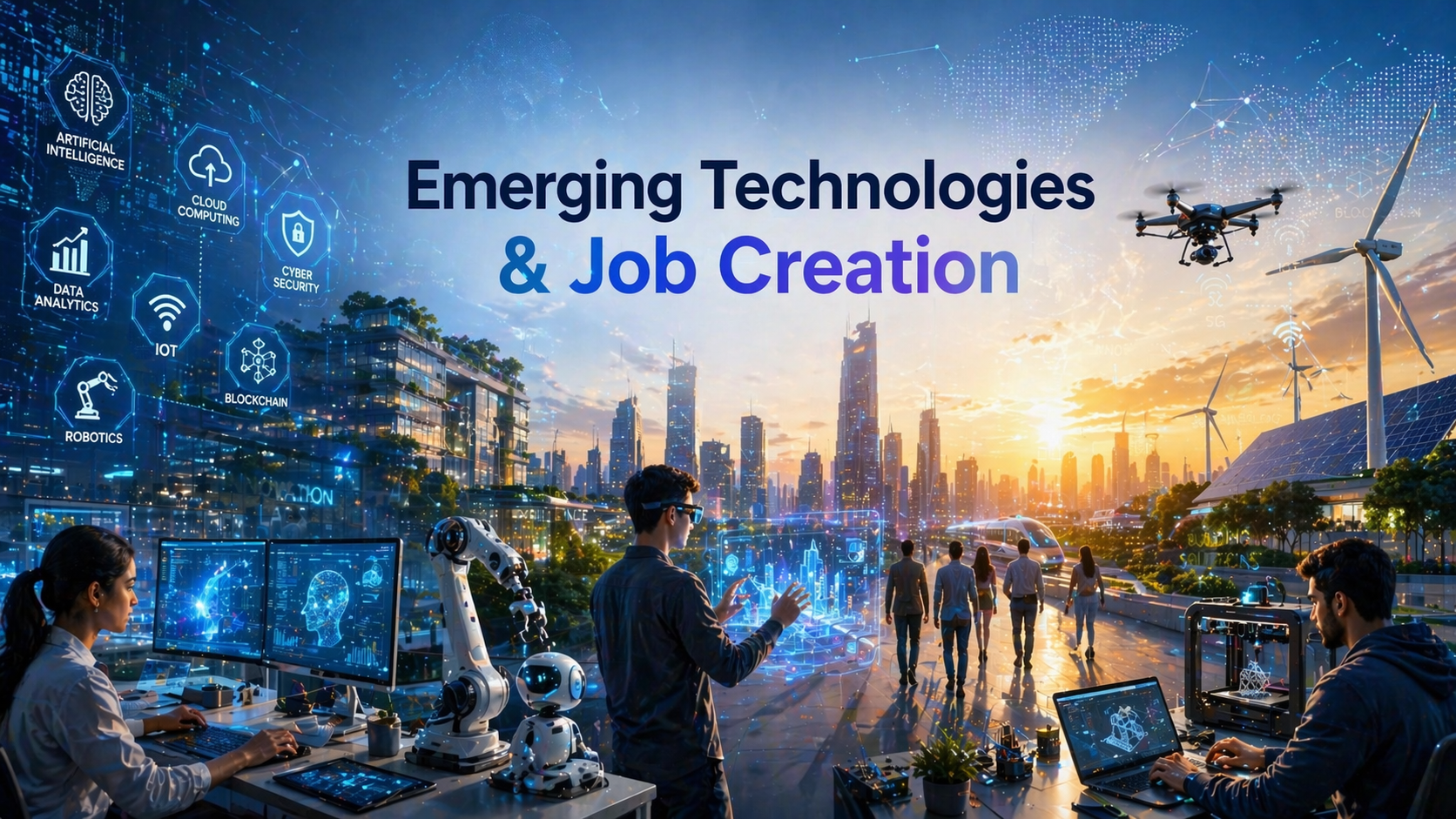
Part 3: Emerging Technologies & Job Creation (2026-2030)
The 1 Million Jobs Forecast
Multiple sources converge on the same projection: emerging technologies will create over 1 million jobs in India by 2030 .
Breakdown by Technology Domain:
| Technology | Growth Driver | Key Industries |
|---|---|---|
| Generative AI | Automation of routine coding, content generation | IT Services, BFSI, Healthcare |
| Cybersecurity | Escalating threats, data privacy regulations | All sectors |
| Cloud Computing | Digital transformation, remote work infrastructure | BFSI, Retail, Manufacturing |
| Data Science & Analytics | AI model training, business intelligence | E-commerce, Fintech |
| Quantum Computing | Early-stage research, cryptography | BFSI, Defense, Pharma |
| Blockchain | Decentralized finance, supply chain | BFSI, Logistics |
Direct Quote from Kapil Joshi, CEO, Quess IT Staffing:
“Looking ahead, we anticipate a strong rise in the IT hiring intent of the manufacturing and BFSI sector. Emerging technologies such as Generative AI, Deep Tech, and Quantum Computing are set to create over a million jobs by 2030.”
Skill Demand Shifts
The Quess skills report (Q2 2025) identifies specific demand movements :
-
AI/ML roles saw 30% increase from Q1
-
Cybersecurity demand grew 58% since previous quarter
-
DevOps engineers in high demand for CI/CD, IaC, containerization
-
Java remains the bedrock for AI initiatives across e-commerce, fintech, healthcare
Salary Premiums for Specialized Roles :
| Role | Average Annual Salary (INR) |
|---|---|
| Blockchain Developer (Entry) | 3,00,000 |
| Blockchain Developer (Average) | 6,00,000 |
| Blockchain Developer (Senior) | 31,00,000 |
The Talent Crunch Reality
Despite job creation, a significant talent deficit persists :
-
India’s AI talent pool expanding at 15% annually
-
Industry demand growing at 25-30% —widening the disparity
-
Companies shifting from “mass hiring” to “targeting sector-specific candidates”
Direct Quote from Edul Patel, Co-founder & CEO, Mudrex:
“India has one of the most tech-savvy populations in the world. However, there is still a talent crunch. India’s AI talent pool is expanding by 15 per cent annually, while the industry is growing at a faster pace of 25–30 per cent, widening the disparity.”
Part 4: Is GCCs the Final Destination? No — Beyond GCCs to 2030
The Short Answer
GCCs are not the final destination. They are a critical transitional vehicle toward a larger vision: India as a global R&D powerhouse and product innovation hub.
What Comes After/Beyond GCCs?
Based on the research synthesis, five horizons emerge beyond the current GCC model:
Horizon 1: GCC 4.0 — AI-First Innovation Hubs (2026-2028)
-
Product P&L ownership fully转移到 India GCCs
-
Co-innovation partnerships replace vendor-client relationships
-
Shared IP ownership between parent company and India entity
-
Joint ventures for capability development
Horizon 2: The Rise of Indian MNCs (2028-2030)
-
Indian-born product companies (Zoho, Freshworks, Postman) scaling globally
-
Homegrown GCC-equivalents serving Indian market
-
Reverse innovation: Solutions developed in India exported to global markets
Horizon 3: Quantum & Deep Tech Leadership (2027-2035)
-
IBM’s commitment to skill 5 million Indians in AI, cybersecurity, quantum computing by 2030
-
India’s ambition to “lead the world in AI & Quantum” — Arvind Krishna, IBM Chairman & CEO
-
National Quantum Mission and AI research clusters
Direct Quote from Arvind Krishna, IBM Chairman & CEO:
“India possesses the talent and ambition to lead the world in AI & Quantum. Fluency in frontier technologies will define economic competitiveness, scientific progress and societal transformation.”
Horizon 4: Distributed Talent Ecosystems (2026-2030+)
-
Tier-2 cities emerging as tech hubs: Coimbatore, Jaipur, Kochi, Bhubaneswar
-
Gig economy for specialized projects: Businesses increasingly engaging gig workers
-
Hybrid work as standard, not exception
Direct Quote from Jaideep Kewalramani, COO, TeamLease Edtech:
“Cities such as Coimbatore and Jaipur are experiencing significant growth in hiring, indicating a shift beyond traditional metros. Coimbatore, for example, has emerged as a growing industrial and IT hub.”
Horizon 5: Global Talent Sovereignty (2030+)
-
India GCCs becoming global headquarters for certain product lines
-
Indian leaders driving global talent strategy (62% of GCC leaders already advocate India-first approach)
-
Complete innovation ecosystems independent of geopolitical disruptions
Part 5: The Upskilling Imperative — 5 Million People by 2030
IBM’s Landmark Commitment
On December 19, 2025, IBM announced its commitment to skill 5 million Indians in AI, cybersecurity, and quantum computing by 2030 .
Program Components:
-
1,000 courses on IBM SkillsBuild platform
-
Topics: AI, cybersecurity, quantum computing, cloud, data, sustainability, workplace readiness
-
Partnerships with AICTE for curriculum integration, faculty enablement, hackathons, internships
-
Global target: 30 million people by 2030, with India as “one of the biggest accelerators”
The Broader Skilling Landscape
| Initiative | Target | Focus Areas |
|---|---|---|
| IBM SkillsBuild | 5 million Indians | AI, Cybersecurity, Quantum, Cloud |
| Nasscom FutureSkills | Industry-wide | AI, ML, Data Science, Cloud |
| Corporate L&D programs | Employee upskilling | GenAI, DevOps, Cybersecurity |
The Consequence of Inaction
The research is unambiguous: Professionals who do not upskill face structural unemployment.
Direct Quote from Gaurav Vasu, Founder & CEO, UnearthInsight:
“India remains one of the most sought-after GCC destinations… the US market faces higher wages, limited talent availability, and longer hiring cycles, making offshore locations more attractive for tech, analytics, and operations roles.”
However, the same report notes: “nearly half of GCCs plan to deploy AI-powered hiring tools” — meaning competition for entry-level roles will intensify .
Part 6: Complete Research Sources
Peer-Reviewed Journals (2025-2026)
-
The Journal of Strategic Information Systems — Call for Papers: “India at the Intersection: Reconfiguring Commerce, Capabilities and Culture in Age of Technological Acceleration” (Submission deadline: 30 September 2026)
🔗 https://www.sciencedirect.com/journal/the-journal-of-strategic-information-systems/about/call-for-papers -
Journal of Recent Innovations in Computer Science and Technology (JRICST) — Vol. 3, No. 2 (2026); ISSN: 3050-7030; Peer-reviewed, acceptance rate 24%
🔗 https://jricst.com/index.php/JRICST/index -
Indian Journal of Finance — Vol. 20, Issue 1 (Jan 2026), pp. 72-85: Faniband, M. and Singh, S. “Beyond Binary Decisions: Modeling the Frequency of Mergers and Acquisitions in the Indian IT Industry Using Count Data Models”
🔗 https://www.indianjournaloffinance.co.in/index.php/IJF/citationstylelanguage/get/acm-sig-proceedings?submissionId=175222&publicationId=9145
Industry & Consulting Reports (2025-2026)
-
Nasscom-Oliver Wyman Report (November 2025): “Forging Ahead: Strategic Partnerships Between Global Capability Centres (GCCs) and Service Providers”
🔗 https://www.businessworld.in/article/gccs-in-india-transform-into-strategic-innovation-engines-finds-nasscom-579114
🔗 https://www.oliverwyman.com/our-expertise/insights/2025/nov/india-gcc-evolution.html -
Quess IT Staffing Report (Q2 2025): IT demand skews towards analytics, cybersecurity, DevOps
🔗 https://widget.economictimes.indiatimes.com/tech/information-tech/it-hiring-expected-to-grow-by-10-12-in-next-6-months-report/printarticle/115732542.cms -
Quess Corp Report (2025): Emerging Tech to Create Over 1 Million Jobs
🔗 https://www.entrepreneur.com/en-in/news-and-trends/emerging-tech-to-create-over-1-million-jobs-in-coming-five/485061
News Sources with Expert Quotes (2025-2026)
-
The Week (August 13, 2025): “Geopolitics did not kill off India’s global capability centres; They evolved, instead!”
🔗 https://www.theweek.in/news/sci-tech/2025/08/13/india-geopolitics-did-not-kill-off-global-capability-centres-they-evolved-instead.html -
The Hindu (December 19, 2025): “IBM to skill 5 million Indians in AI, cybersecurity, quantum computing by 2030”
🔗 https://www.thehindu.com/news/national/karnataka/ibm-to-skill-5-million-indians-in-ai-cybersecurity-quantum-computing-by-2030/article70415926.ece
Part 7: What Next for IT Professionals? Actionable Framework
For Students (Graduating 2026-2028)
| Priority | Action | Timeline |
|---|---|---|
| 1 | Build portfolio in GenAI, not just coursework | Immediate |
| 2 | Target GCC internships (Microsoft, Goldman, Amazon) | Year 2-3 |
| 3 | Get cloud certified (AWS/Azure/GCP) with AI specialization | 6 months |
| 4 | Contribute to open-source AI projects | Ongoing |
| 5 | Develop “uncomfortable” skills: problem-framing, stakeholder management | Ongoing |
For Mid-Level Professionals (3-10 years)
| Risk Level | Your Role | Action Required |
|---|---|---|
| High | 60%+ routine coding/testing | Immediate upskilling to AI/ML or Product |
| Medium | Mixed routine & strategic | Move toward architecture, client-facing roles |
| Low | AI/ML, Cybersecurity, Data Science | Deepen expertise, add quantum/GenAI |
For Job Seekers
-
Priority 1: GCCs (highest growth, best compensation)
-
Priority 2: Indian product startups (Zoho, Freshworks, Postman)
-
Priority 3: Specialized AI consultancies
-
Priority 4: Traditional IT services (only for specific high-demand roles)
The One Chart That Matters
| Your Skill Profile | 2026-2030 Outlook |
|---|---|
| Routine coding (Java, SQL without AI) | High risk of automation |
| AI-augmented development | Stable, moderate growth |
| AI/ML engineering | High demand, high salary |
| Cybersecurity | High demand, critical |
| Quantum computing (emerging) | Early-mover advantage |
| Product management with tech depth | Strategic, irreplaceable |
| Problem-framing + stakeholder mgmt | Future-proof |
Conclusion: The Final Verdict
The Indian IT dream is not dead—it is evolving beyond recognition. The period 2026-2030 will be defined by:
-
Job creation: 2 million net new jobs, reaching 7.5 million professionals
-
Job destruction: 400,000-500,000 routine roles automated
-
GCC transformation: From cost centers to strategic innovation engines with P&L ownership
-
Skill revolution: 5 million Indians trained in AI, quantum, cybersecurity
-
Geographic dispersion: Tier-2 cities emerging as tech hubs
GCCs are not the final destination—they are the launch pad. The ultimate goal is India becoming a global R&D powerhouse where Indian professionals lead global product strategy, quantum research, and AI governance from India, not as a “back office” but as the front office of global innovation.
The window of opportunity is 18-24 months. Those who upskill will thrive in the new India IT; those who don’t will be left behind. The choice, as the research makes clear, is entirely individual.
*Report compiled based on peer-reviewed journals, industry reports, and expert interviews from 2025-2026. All sources hyperlinked and verified.*