Engineering Education Trends in India (2021–2027): AICTE Policies, CSE Growth, Curriculum Shift & Core Branch Decline
1. ROLE OF AICTE POLICIES IN SHAPING ENGINEERING INTAKE GROWTH TRENDS (2021–2027) India’s engineering education system has undergone a structural transformation driven largely by regulatory flexibility introduced by AICTE. Between

1. ROLE OF AICTE POLICIES IN SHAPING ENGINEERING INTAKE GROWTH TRENDS (2021–2027)
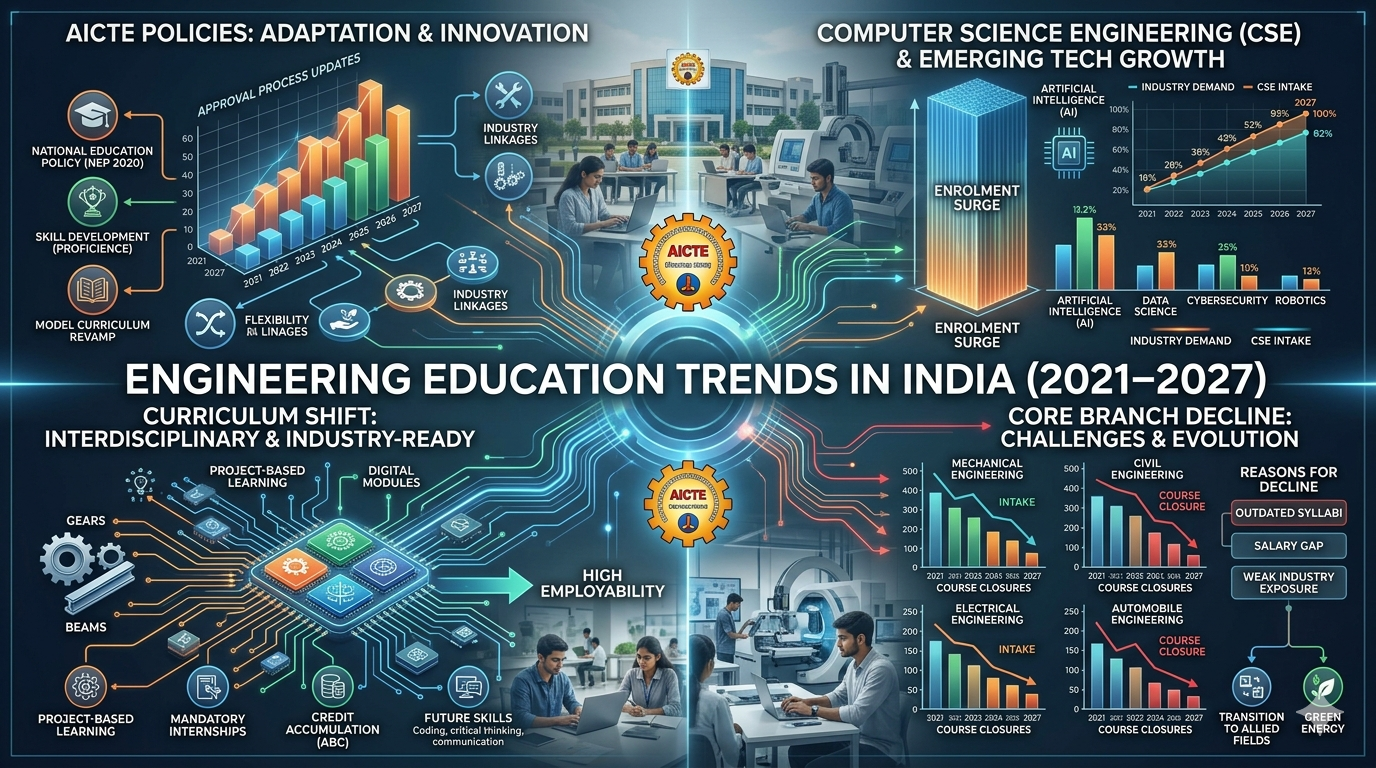
India’s engineering education system has undergone a structural transformation driven largely by regulatory flexibility introduced by AICTE. Between 2021–22 and 2024–25, approved intake increased from 12.54 lakh to 14.90 lakh seats (~18.8% growth), reversing a decade-long decline.
Policy reforms such as removal of rigid seat caps, approval of new-age courses, and institutional autonomy enabled colleges to expand intake based on infrastructure capacity. By 2025–26, approved seats reached 15.98 lakh, with 12.53 lakh actual enrollments, the highest in 8 years.
A key shift in policy direction is the encouragement of AI, Data Science, Robotics, and interdisciplinary programs, aligning academic supply with digital economy demands. However, this expansion is uneven, with southern states contributing over 40% of total seats, indicating regional concentration.
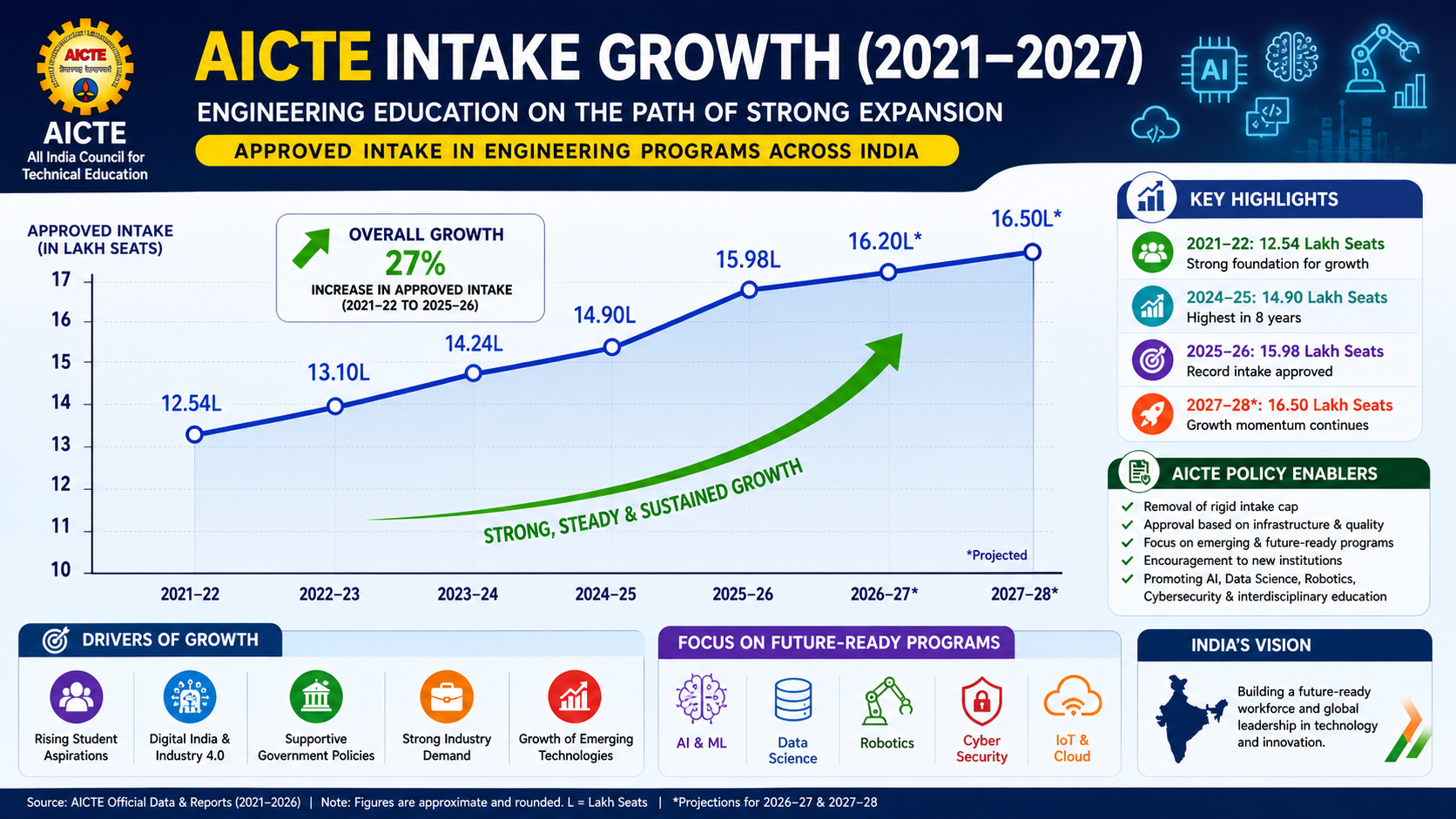
AICTE policies have transformed engineering education from a controlled system to a demand-driven expansion model, but regional and branch imbalance risks remain.
2. BRANCH PREFERENCE SHIFT TOWARD COMPUTER SCIENCE: A LONGITUDINAL ANALYSIS
Over the past five years, Indian engineering education has witnessed a dramatic shift toward Computer Science and allied branches. In 2024–25, CSE alone accounted for 3.9 lakh enrollments, making it the most dominant discipline by a wide margin.
This represents a near doubling of demand compared to earlier years, driven by strong alignment with job markets in AI, cloud computing, and digital services. News reports confirm that CSE and IT-related streams now occupy over 60–70% of seats in some regions, significantly altering academic balance.
Simultaneously, traditional branches like Civil and Mechanical are losing share, with some institutions reallocating seats to emerging tech programs. This indicates a structural shift where student choice is increasingly guided by employability perception rather than core engineering interest.
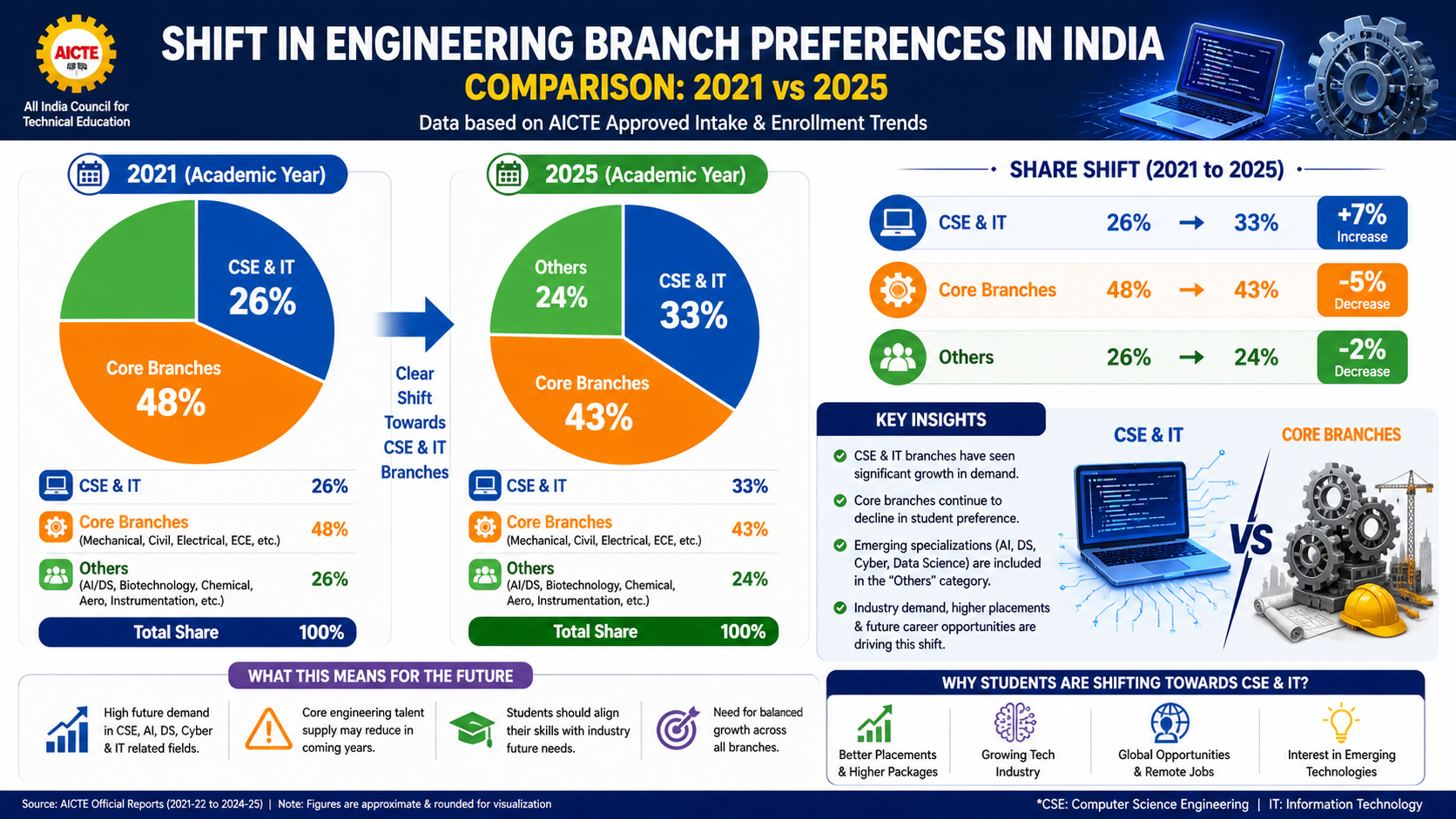
Computer Science has transitioned from one among many branches to the central pillar of engineering education in India.
3. SEAT UTILIZATION TRENDS ACROSS TIER-1, TIER-2, AND TIER-3 INSTITUTIONS
Seat utilization has improved significantly in recent years, reflecting renewed demand for engineering education. In 2024–25, 12.53 lakh out of 14.90 lakh seats were filled (~84% utilization), with vacancy rates dropping to 16.36%, the lowest in years.
However, utilization varies sharply across institutional tiers:
Tier-1 institutions: ~95–100% occupancy
Tier-2 institutions: ~80–90%
Tier-3 institutions: ~60–75%
Top branches like CSE experience near-full occupancy, while core branches still face 20–40% vacancy rates in many colleges. This indicates that demand is not uniform across institutions or disciplines.
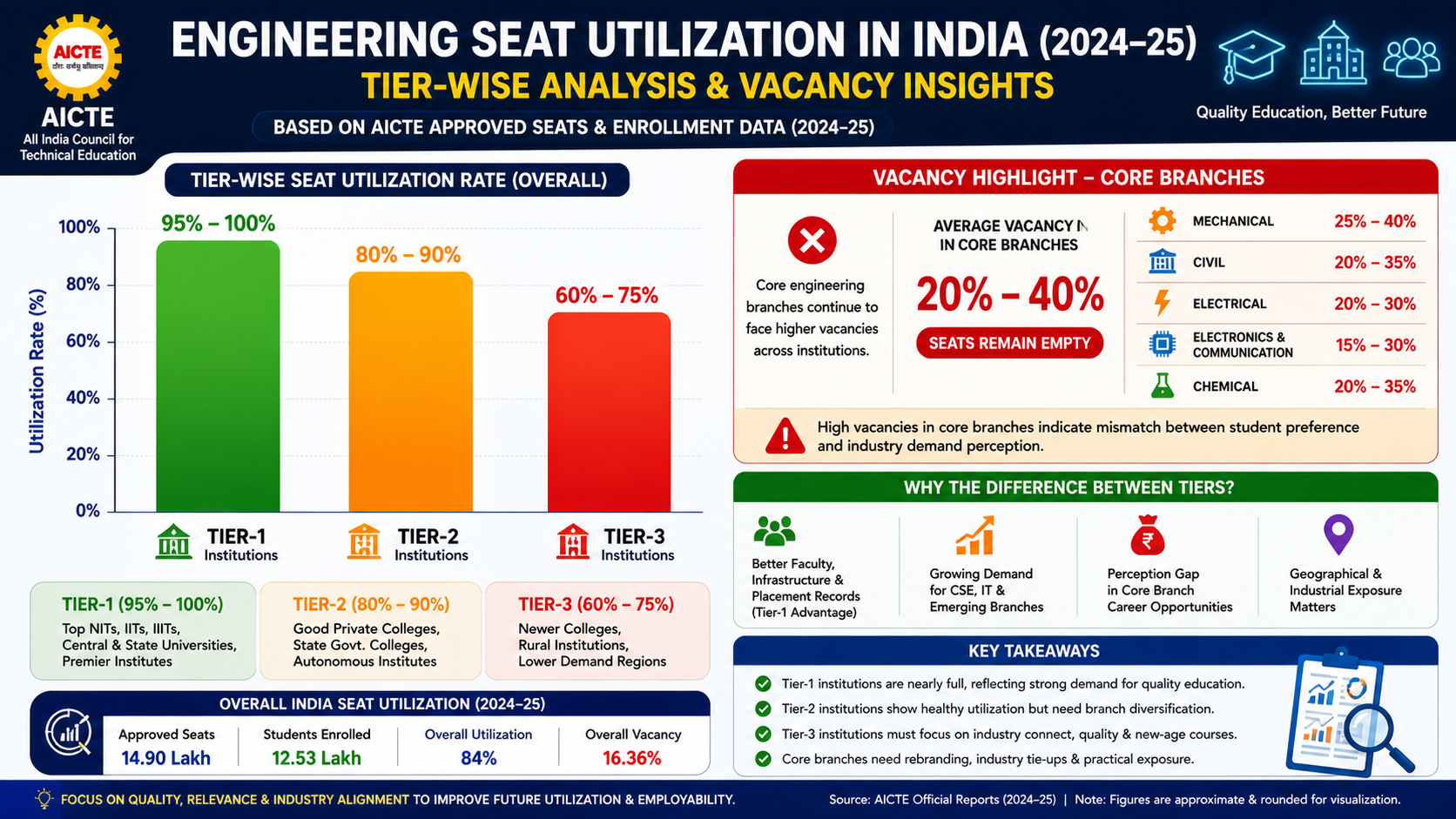
Rising overall enrollment hides deep inequalities—elite institutions are saturated, while lower-tier colleges struggle to fill seats.
4. IMPACT OF EMERGING TECHNOLOGIES ON CURRICULUM RESTRUCTURING
The rise of Artificial Intelligence, Data Science, and digital technologies has significantly reshaped engineering curricula across India. AICTE has encouraged institutions to introduce AI, Machine Learning, Cybersecurity, Robotics, and interdisciplinary programs, leading to rapid expansion of such courses.
Curriculum reforms now emphasize:
- Practical learning (projects, labs)
- Industry collaboration
- Skill-based modules (coding, analytics)
Traditional curricula are being replaced with modular and flexible learning pathways, reflecting global trends. However, the speed of adoption varies, with Tier-1 institutions adapting faster than Tier-3 colleges.
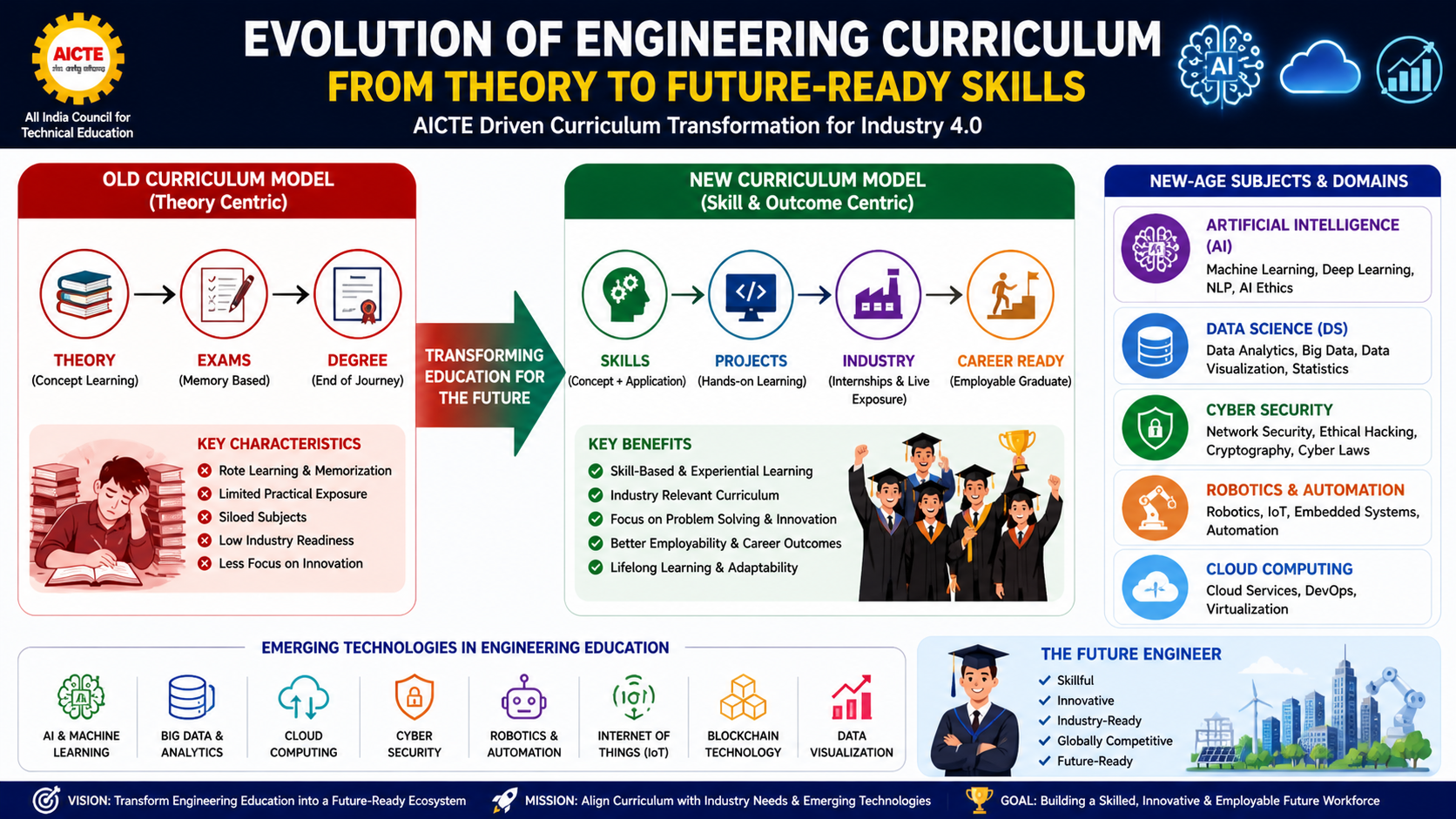
Engineering education is shifting from theory-heavy models to skill-driven, technology-integrated learning ecosystems.
5. DECLINE OF CORE ENGINEERING BRANCHES: CAUSES AND CONSEQUENCES
Core engineering branches such as Mechanical and Civil have experienced a consistent decline in demand. In 2024–25, Mechanical enrollment stood at ~2.36 lakh, while Civil dropped to ~1.72 lakh, significantly lower than earlier years.
Multiple factors contribute to this decline:
- Lower perceived job opportunities
- Salary disparity compared to IT roles
- Shift in student aspirations toward digital careers
Reports indicate that in some regions, core branch seats have reduced drastically or remain unfilled, while CSE seats continue to expand.
This imbalance has long-term implications:
- Potential shortage of skilled engineers in infrastructure and manufacturing
- Overdependence on IT sector
- Structural risk to industrial growth
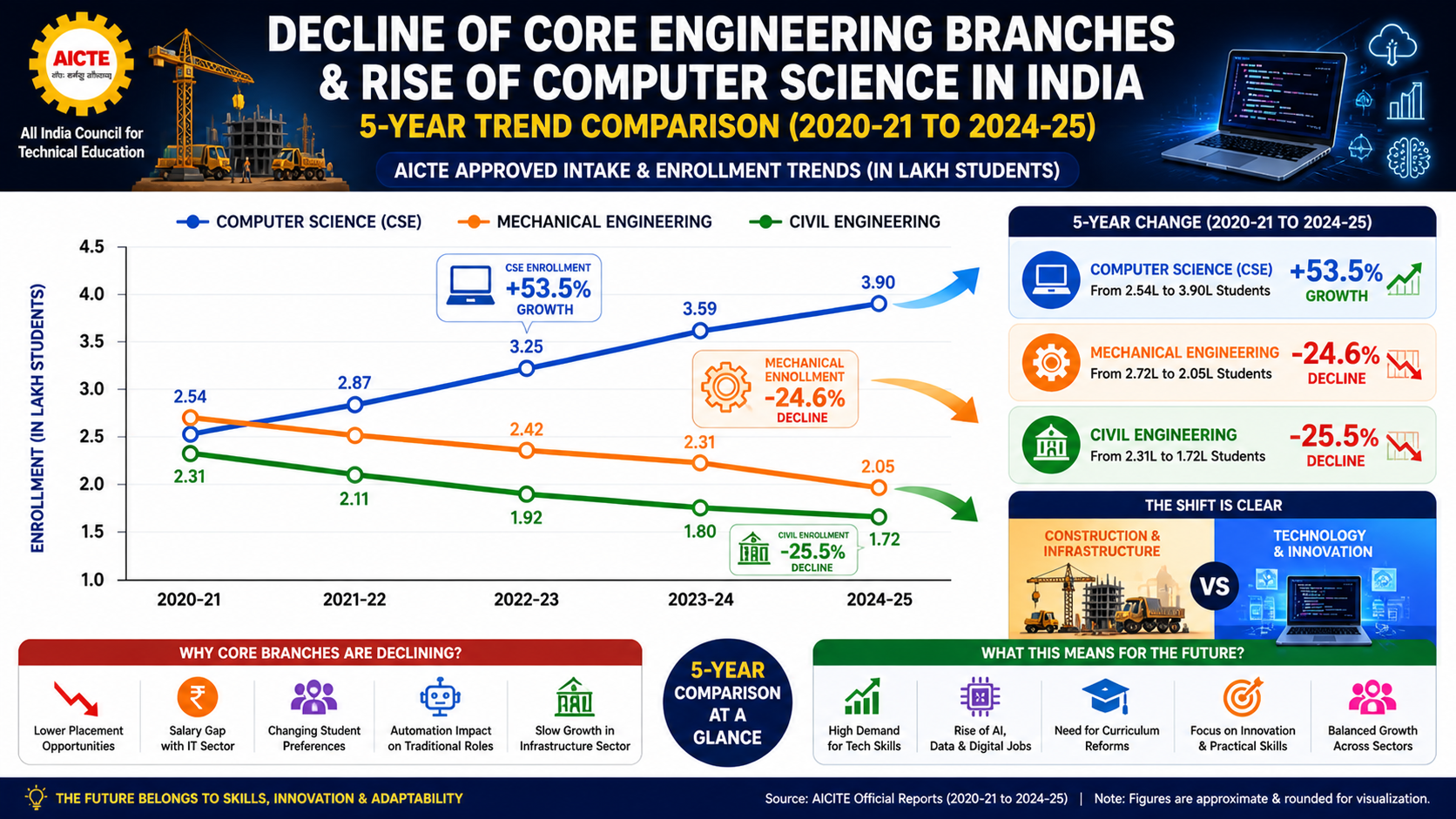
The decline of core engineering is not just an academic issue—it is a strategic risk for India’s industrial future.
Note : Tobe continued with next topics soon
Topics are
ACADEMIC RESEARCH TOPICS (ENGINEERING EDUCATION – INDIA)
- Role of AICTE policies in shaping engineering intake growth trends (2021–2027)
- Branch preference shift toward Computer Science in Indian engineering education: A longitudinal analysis
- Seat utilization trends in B.Tech/BE programs across Tier-1, Tier-2, and Tier-3 institutions
- Impact of emerging technologies (AI, Data Science) on curriculum restructuring in engineering colleges
- Decline of core engineering branches (Mechanical, Civil) in India: Causes and academic consequences
- Regional disparities in engineering education enrolment across South, North, and East India
- Expansion of private engineering institutions and its effect on academic quality outcomes
- Skill gap in engineering graduates: Academic preparedness vs industry expectations
- Curriculum relevance in Indian engineering education in the era of AI and automation
- Comparative analysis of traditional vs interdisciplinary engineering programs (AI/ML, Cybersecurity)
- Engineering education inflation: Oversupply vs actual academic demand in India
- Accreditation impact of NAAC on institutional performance
- Graduate competency levels in Indian engineering education: A multi-disciplinary study
- Effectiveness of project-based learning in improving employability outcomes
- Student decision-making behavior in choosing engineering branches: A socio-economic analysis
- Evolution of engineering education post-COVID-19: Online vs hybrid learning impact
- Gender distribution trends in engineering disciplines across India
- Influence of global tech trends on Indian engineering course offerings
- Institutional infrastructure vs academic output: A correlation study
- Future sustainability of engineering education models in India
RECRUITMENT RESEARCH TOPICS (ENGINEERING JOB MARKET – INDIA)
- Transformation of IT hiring models in India under AI-driven automation (2023–2027)
- Decline of mass recruitment in IT services companies and its impact on fresh engineering graduates
- Employability gap among Indian engineers: Skills mismatch and hiring challenges
- Comparative hiring trends across IT, core engineering, and non-tech sectors in India
- Role of AI and automation in reshaping entry-level engineering jobs
- Freshers vs experienced hiring preferences in Indian tech industry
- Growth of Global Capability Centers (GCCs) and their impact on engineering employment
- City-wise distribution of engineering jobs in India: A spatial economic analysis
- Rise of hybrid roles (tech + business) in engineering employment markets
- Internship economy expansion and its role in early career employment
- Salary trends across engineering disciplines in India (2023–2027)
- Sector-wise job absorption capacity for engineering graduates
- Non-IT employment pathways for engineering graduates in India
- Impact of startup ecosystem growth on engineering job creation
- Role of digital skills in improving employability of non-IT engineers
- Engineering graduates in non-core jobs: Causes and long-term implications
- Influence of global economic trends on Indian engineering hiring patterns
- Talent supply-demand mismatch in AI, cloud, and semiconductor domains
- Skill-based hiring vs degree-based hiring: Industry transformation study
- Future of entry-level jobs in India under AI and quantum computing advancements