
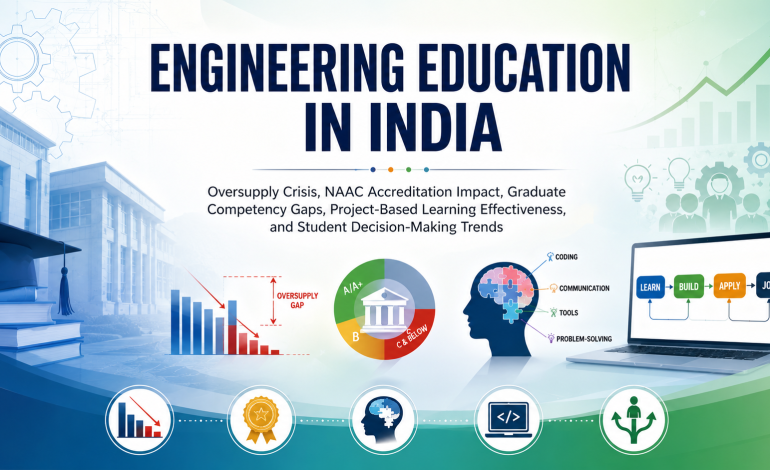
Engineering Education in India: Oversupply Crisis, NAAC Accreditation Impact, Graduate Competency Gaps, Project-Based Learning Effectiveness, and Student Decision-Making Trends
Continued 11. ENGINEERING EDUCATION INFLATION: OVERSUPPLY VS ACTUAL ACADEMIC DEMAND IN INDIA India’s engineering education system is increasingly characterized by “education inflation,” where institutional capacity has expanded beyond sustainable academic

Continued
11. ENGINEERING EDUCATION INFLATION: OVERSUPPLY VS ACTUAL ACADEMIC DEMAND IN INDIA
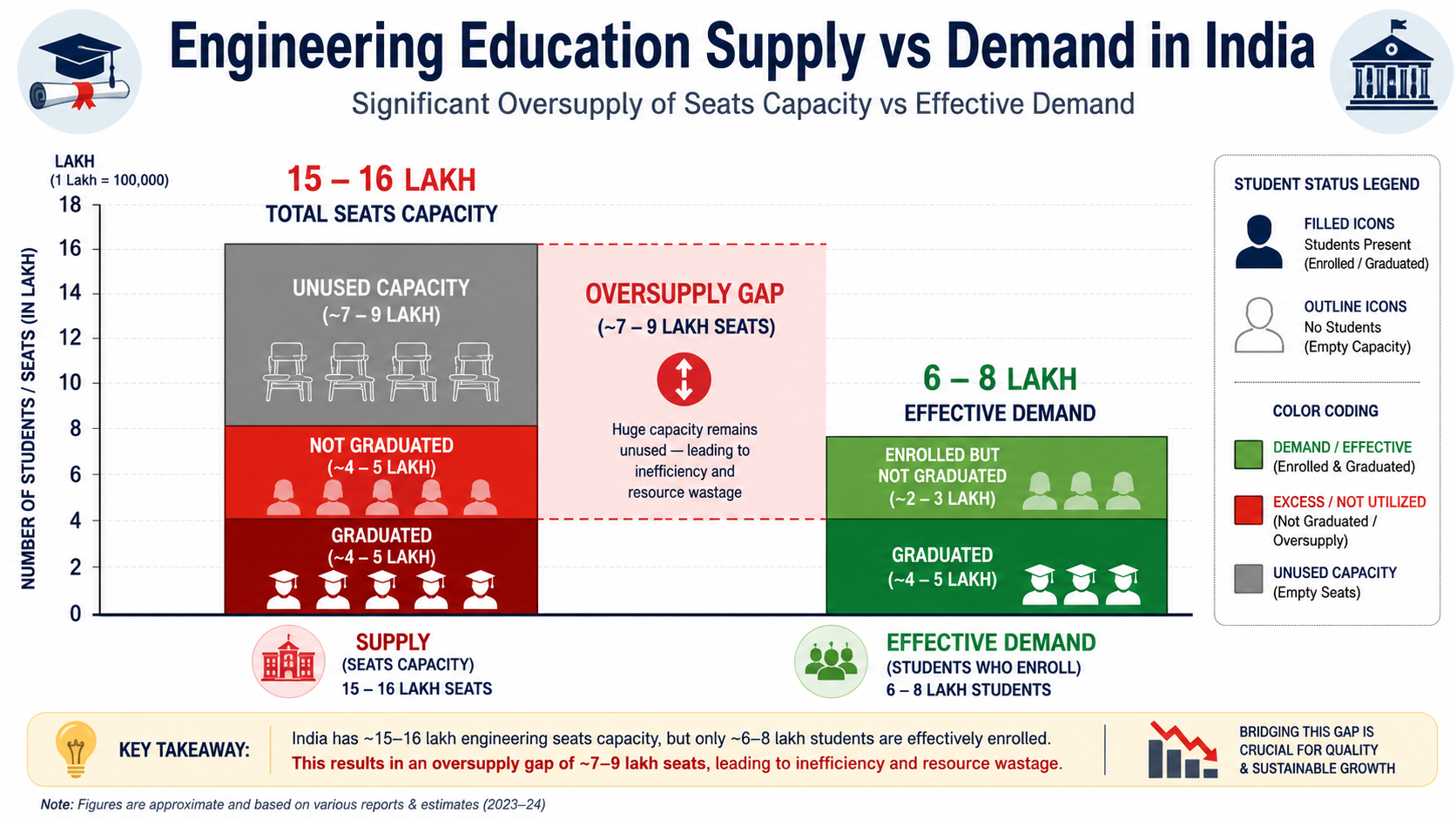
India’s engineering education system is increasingly characterized by “education inflation,” where institutional capacity has expanded beyond sustainable academic and industry demand. As per data aligned with All India Council for Technical Education, the country has approximately 15–16 lakh approved engineering seats annually, with actual enrolment hovering around 13–14 lakh.
Despite this large intake, only 10–12 lakh students graduate each year, and the effective demand—defined as industry-aligned, quality employable graduates—is estimated at just 6–8 lakh. This creates a significant oversupply, particularly concentrated in lower-tier institutions.
Key consequences of this imbalance include:
- High seat vacancy rates (especially in Tier-3 colleges, often exceeding 40–50%)
- Dilution of academic quality due to underutilized infrastructure
- Increased competition among graduates without proportional job creation
- Institutional financial stress leading to closures or consolidation
This phenomenon reflects a structural mismatch between educational expansion policies and labor market absorption capacity, raising concerns about long-term sustainability.
Engineering education in India has scaled beyond realistic demand, producing more graduates than the system can effectively absorb.
12. ACCREDITATION IMPACT OF NAAC ON INSTITUTIONAL PERFORMANCE
Accreditation frameworks play a critical role in quality assurance within higher education. In India, the National Assessment and Accreditation Council evaluates institutions across multiple dimensions, including teaching-learning processes, infrastructure, research output, governance, and student outcomes.
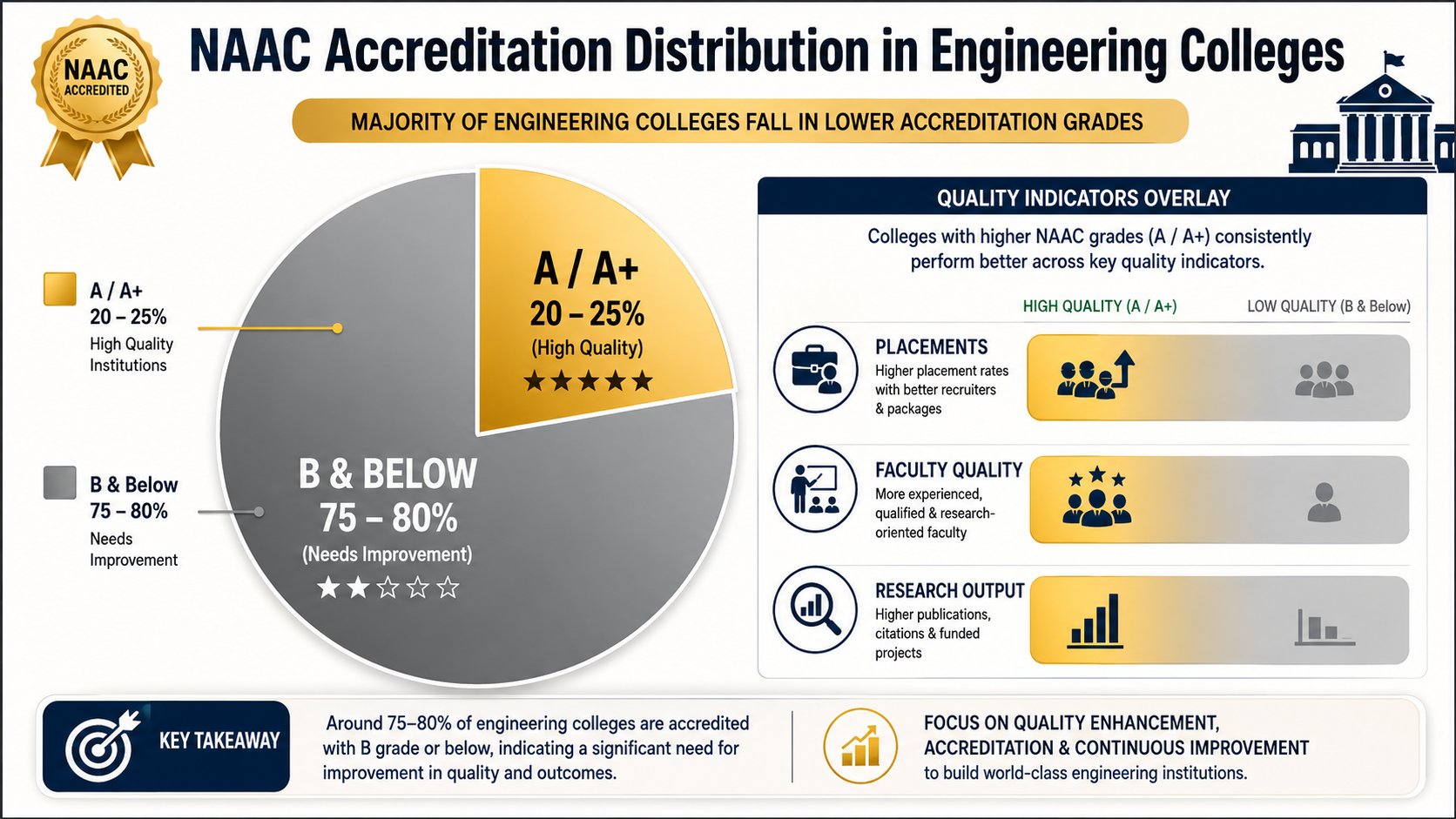
Institutions with A and A+ accreditation grades typically demonstrate:
- Strong faculty credentials and lower student–teacher ratios
- Higher placement rates and recruiter engagement
- Better-funded research ecosystems
- Modern infrastructure and digital learning environments
However, a significant proportion of engineering institutions fall into B grade or below (approximately 75–80%), reflecting uneven quality distribution across the system.
Accreditation outcomes influence:
- Student admission preferences
- Eligibility for government funding and grants
- Institutional rankings and public perception
- Industry collaboration opportunities
Despite its importance, challenges remain, including:
- Periodic rather than continuous evaluation
- Variability in compliance vs actual quality
- Limited awareness among students about accreditation significance
NAAC accreditation serves as a key quality benchmark, but the wide distribution of grades highlights systemic inconsistency.
13. GRADUATE COMPETENCY LEVELS IN INDIAN ENGINEERING EDUCATION: A MULTI-DISCIPLINARY STUDY
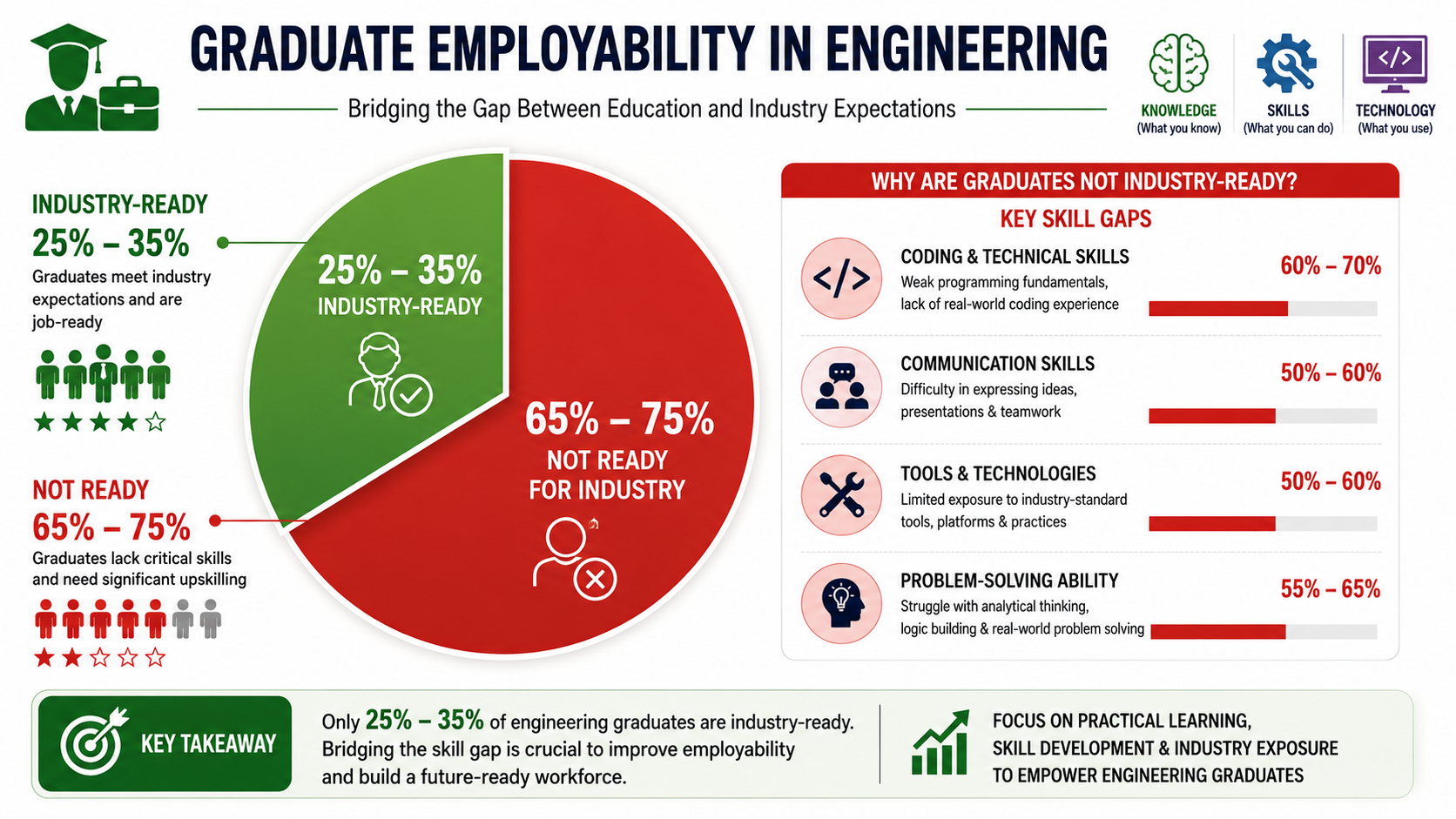
Graduate competency remains one of the most critical challenges in India’s engineering ecosystem. Despite high enrolment and graduation numbers, only 25–35% of graduates are considered industry-ready, indicating a substantial competency deficit.
This gap varies across disciplines:
- Computer Science Engineering (CSE): نسبतగా higher readiness due to exposure to coding and digital tools
- Core Engineering (Mechanical, Civil, Electrical): strong theoretical grounding but weak practical and industry application
- Emerging Fields (AI, Data Science): curriculum evolving rapidly, often ahead of faculty preparedness
Core competency deficiencies include:
- Analytical problem-solving in real-world contexts
- Hands-on technical skills and tool proficiency
- Interdisciplinary thinking
- Communication and professional collaboration
The root causes include:
- Outdated teaching methodologies
- Limited industry-academic integration
- Insufficient lab infrastructure in lower-tier institutions
- Over-reliance on rote learning and examination systems
Engineering graduates in India often hold formal qualifications without the applied competencies required for modern industry roles.
14. EFFECTIVENESS OF PROJECT-BASED LEARNING IN IMPROVING EMPLOYABILITY OUTCOMES
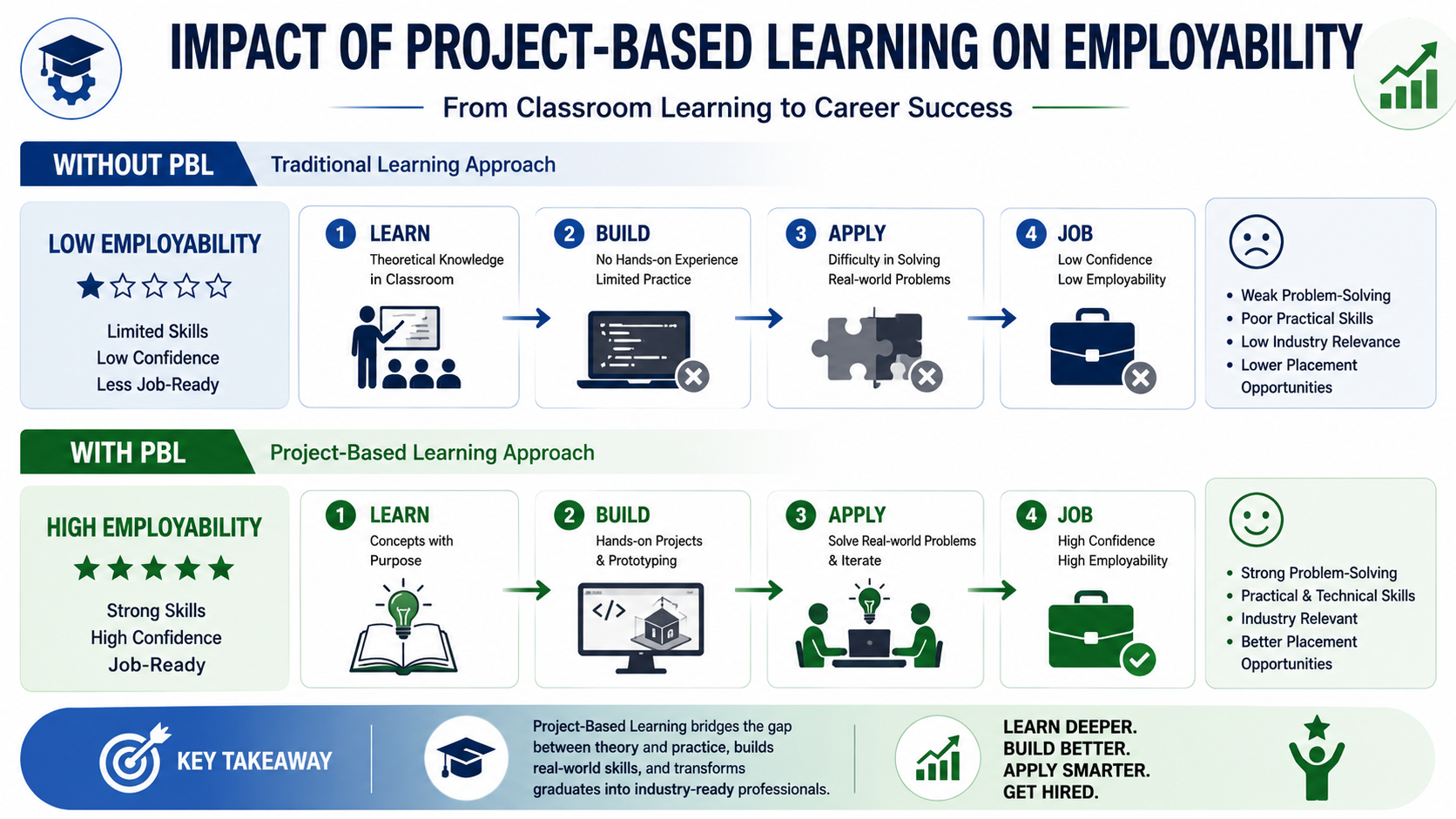
Project-Based Learning (PBL) has emerged as a transformative pedagogical approach aimed at bridging the gap between theoretical knowledge and practical application. Institutions that actively integrate PBL into their curriculum report measurable improvements in student outcomes.
Empirical observations indicate that students who complete 2–3 real-world or industry-linked projects demonstrate:
- Enhanced problem-solving capabilities
- Better understanding of applied engineering concepts
- Increased confidence in technical interviews
- Higher placement rates and job readiness
Adoption patterns show a tiered distribution:
- Tier-1 institutions: extensive integration of capstone projects and industry collaborations
- Tier-2 institutions: partial implementation with academic projects
- Tier-3 institutions: minimal or superficial adoption
Barriers to widespread PBL adoption include:
- Faculty training limitations
- Lack of industry partnerships
- Time constraints within rigid curricula
- Resource and infrastructure gaps
Project-based learning converts academic knowledge into practical competence, but its impact is limited by uneven institutional adoption.
15. STUDENT DECISION-MAKING BEHAVIOR IN CHOOSING ENGINEERING BRANCHES: A SOCIO-ECONOMIC ANALYSIS
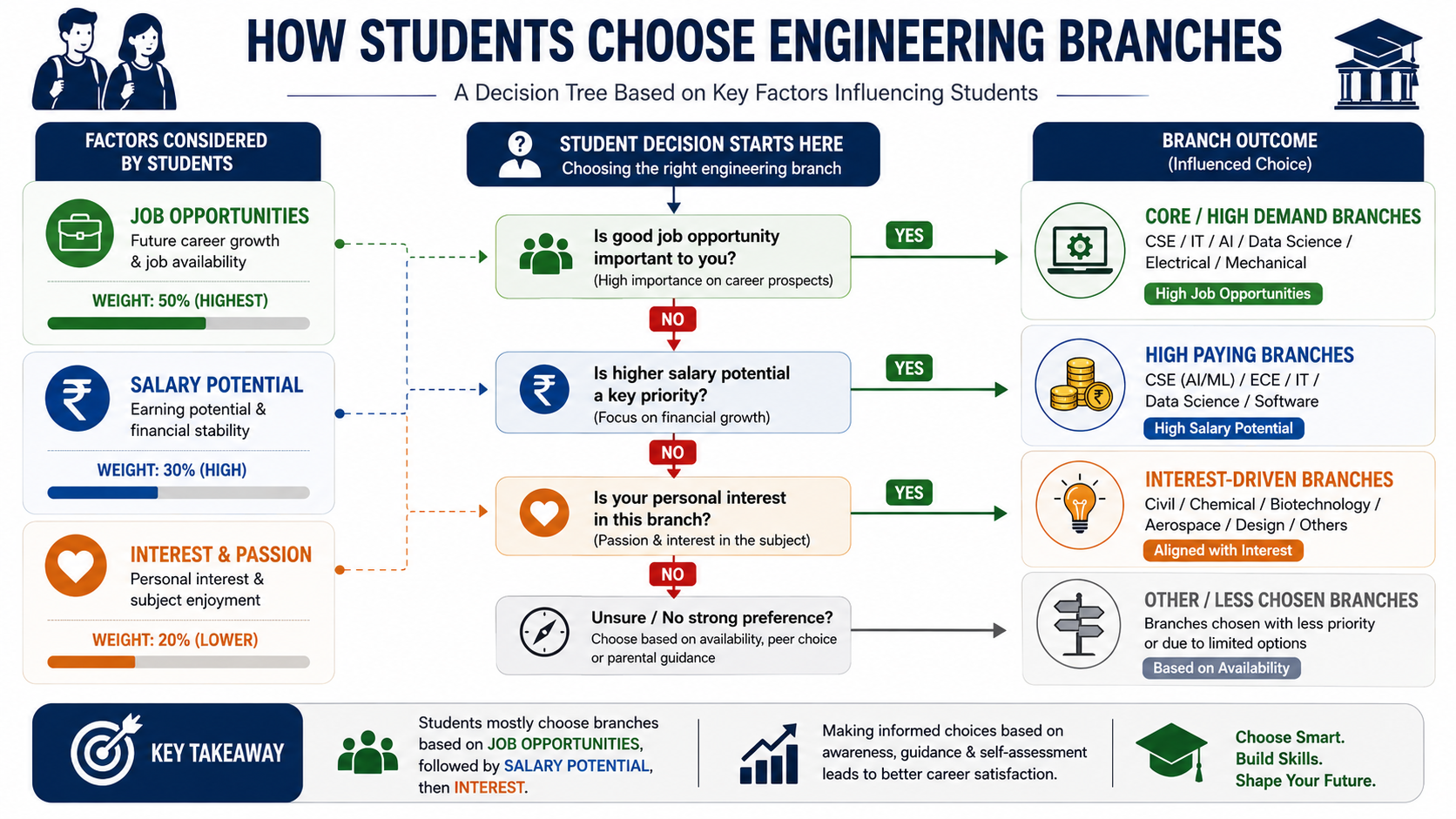
The selection of engineering disciplines among students in India is increasingly influenced by socio-economic considerations rather than intrinsic academic interest. The dominant driver is perceived return on investment (ROI), particularly in terms of placement outcomes and salary potential.
Key influencing factors include:
- Historical placement records of institutions and branches
- Peer group trends and societal perception
- Parental influence and financial considerations
- Market demand, especially the dominance of IT and software sectors
As a result:
- Computer Science Engineering (CSE) accounts for approximately 30–35% of total enrolment, reflecting its strong job alignment
- Traditional core branches are witnessing declining demand despite their industrial importance
Socio-economic segmentation further shapes decision-making:
- Urban students: greater exposure to technology trends, prefer AI/ML, Data Science
- Rural students: decisions driven by affordability, proximity, and seat availability
- Middle-income families: prioritize stability and placement assurance over interest
This behavior leads to systemic imbalances, including oversaturation in certain branches and underutilization of others.
Engineering branch selection in India is driven more by economic outcomes and social influence than by individual academic passion.
FINAL SYNTHESIS FOR ACADEMIC CONTEXT
These five themes collectively deepen the structural understanding of engineering education in India:
- Oversupply vs demand imbalance creating systemic inefficiency
- Accreditation-based quality differentiation across institutions
- Persistent competency gaps affecting employability
- Growing importance of project-based experiential learning
- Behavioral and socio-economic drivers shaping academic choices
Together, they explain why, despite massive scale and expansion, engineering education outcomes remain uneven, fragmented, and misaligned with industry needs.
Note : Tobe continued with next topics soon
Topics are
ACADEMIC RESEARCH TOPICS (ENGINEERING EDUCATION – INDIA)
- Role of AICTE policies in shaping engineering intake growth trends (2021–2027)
- Branch preference shift toward Computer Science in Indian engineering education: A longitudinal analysis
- Seat utilization trends in B.Tech/BE programs across Tier-1, Tier-2, and Tier-3 institutions
- Impact of emerging technologies (AI, Data Science) on curriculum restructuring in engineering colleges
- Decline of core engineering branches (Mechanical, Civil) in India: Causes and academic consequences
- Regional disparities in engineering education enrolment across South, North, and East India
- Expansion of private engineering institutions and its effect on academic quality outcomes
- Skill gap in engineering graduates: Academic preparedness vs industry expectations
- Curriculum relevance in Indian engineering education in the era of AI and automation
- Comparative analysis of traditional vs interdisciplinary engineering programs (AI/ML, Cybersecurity)
- Engineering education inflation: Oversupply vs actual academic demand in India
- Accreditation impact of NAAC on institutional performance
- Graduate competency levels in Indian engineering education: A multi-disciplinary study
- Effectiveness of project-based learning in improving employability outcomes
- Student decision-making behavior in choosing engineering branches: A socio-economic analysis
- Evolution of engineering education post-COVID-19: Online vs hybrid learning impact
- Gender distribution trends in engineering disciplines across India
- Influence of global tech trends on Indian engineering course offerings
- Institutional infrastructure vs academic output: A correlation study
- Future sustainability of engineering education models in India
RECRUITMENT RESEARCH TOPICS (ENGINEERING JOB MARKET – INDIA)
- Transformation of IT hiring models in India under AI-driven automation (2023–2027)
- Decline of mass recruitment in IT services companies and its impact on fresh engineering graduates
- Employability gap among Indian engineers: Skills mismatch and hiring challenges
- Comparative hiring trends across IT, core engineering, and non-tech sectors in India
- Role of AI and automation in reshaping entry-level engineering jobs
- Freshers vs experienced hiring preferences in Indian tech industry
- Growth of Global Capability Centers (GCCs) and their impact on engineering employment
- City-wise distribution of engineering jobs in India: A spatial economic analysis
- Rise of hybrid roles (tech + business) in engineering employment markets
- Internship economy expansion and its role in early career employment
- Salary trends across engineering disciplines in India (2023–2027)
- Sector-wise job absorption capacity for engineering graduates
- Non-IT employment pathways for engineering graduates in India
- Impact of startup ecosystem growth on engineering job creation
- Role of digital skills in improving employability of non-IT engineers
- Engineering graduates in non-core jobs: Causes and long-term implications
- Influence of global economic trends on Indian engineering hiring patterns
- Talent supply-demand mismatch in AI, cloud, and semiconductor domains
- Skill-based hiring vs degree-based hiring: Industry transformation study
- Future of entry-level jobs in India under AI and quantum computing advancements