Engineering Education in India: Oversupply Crisis, NAAC Accreditation Impact, Graduate Competency Gaps, Project-Based Learning Effectiveness, and Student Decision-Making Trends
Continued 16. EVOLUTION OF ENGINEERING EDUCATION POST-COVID-19: ONLINE VS HYBRID LEARNING IMPACT The COVID-19 pandemic triggered an unprecedented digital transformation in engineering education across India. Between 2020 and 2022, nearly

Continued
16. EVOLUTION OF ENGINEERING EDUCATION POST-COVID-19: ONLINE VS HYBRID LEARNING IMPACT
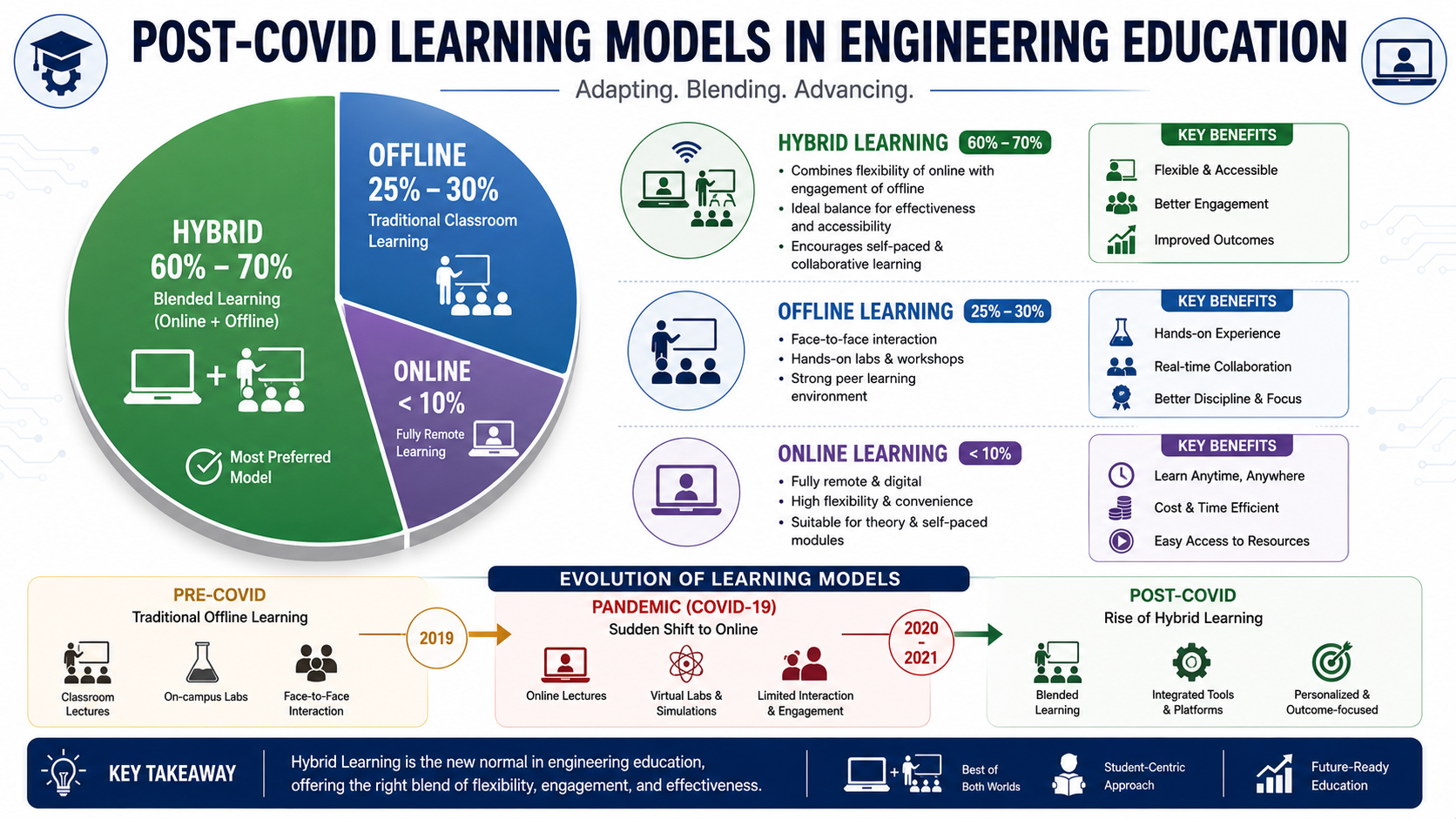
The COVID-19 pandemic triggered an unprecedented digital transformation in engineering education across India. Between 2020 and 2022, nearly 90% of engineering institutions transitioned to fully online learning, leveraging Learning Management Systems (LMS), virtual classrooms, and video-based instruction.
In the post-pandemic phase (2025–26), the system has stabilized into a hybrid learning model, now adopted by approximately 60–70% of institutions. Fully offline education accounts for 25–30%, while purely online models remain limited to less than 10%, primarily in distance or certification programs.
The hybrid model integrates:
- Asynchronous recorded lectures for flexibility
- Synchronous live sessions for interaction
- On-campus laboratory work for practical exposure
- Digital assessments and blended evaluation methods
Key advantages include:
- Improved accessibility across geographic regions
- Flexible learning pace for students
- Increased use of digital tools and resources
However, persistent challenges remain:
- Difficulty in replicating hands-on lab environments online
- Reduced student engagement in virtual settings
- Concerns over academic integrity in remote assessments
- Digital divide affecting rural and low-income students
This transformation reflects a long-term structural shift toward technology-enabled education ecosystems, rather than a temporary adaptation.
The pandemic permanently redefined engineering education delivery, establishing hybrid learning as the dominant and enduring model.
17. GENDER DISTRIBUTION TRENDS IN ENGINEERING DISCIPLINES ACROSS INDIA
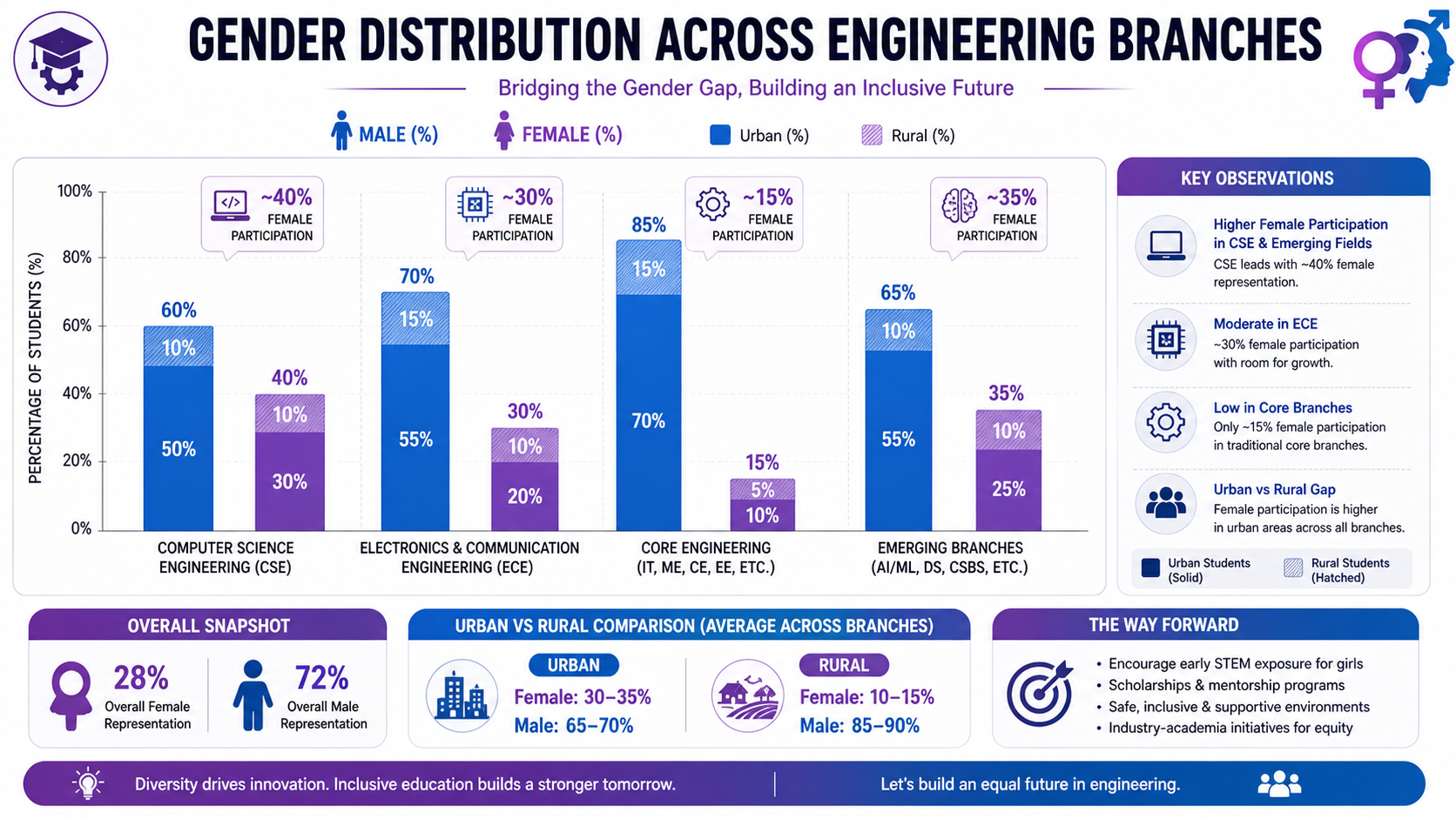
Gender diversity in engineering education in India has shown gradual improvement over the past decade, though disparities persist across disciplines and regions. Overall female participation in engineering programs is estimated at 30–35%, reflecting increased access but continued structural imbalance.
Branch-wise participation highlights clear variation:
- Computer Science / IT: ~35–45% female participation
- Electronics and Communication (ECE): ~30–35%
- Mechanical / Civil (Core branches): ~10–20%
Higher participation in CSE and IT is often attributed to:
- Perceived safer and flexible work environments
- Stronger placement opportunities in the IT sector
- Societal preferences for non-field-based roles
In contrast, core engineering branches remain male-dominated due to:
- Perception of physically demanding work environments
- Limited role models and representation
- Cultural and social biases
Urban institutions and Tier-1 colleges show relatively balanced gender ratios, supported by:
- Government initiatives (scholarships, reservations)
- Awareness programs promoting STEM for women
- Institutional diversity policies
However, rural regions continue to face barriers related to access, affordability, and socio-cultural constraints.
While gender diversity in engineering is improving, it remains uneven and concentrated in specific disciplines like Computer Science.
18. INFLUENCE OF GLOBAL TECH TRENDS ON INDIAN ENGINEERING COURSE OFFERINGS
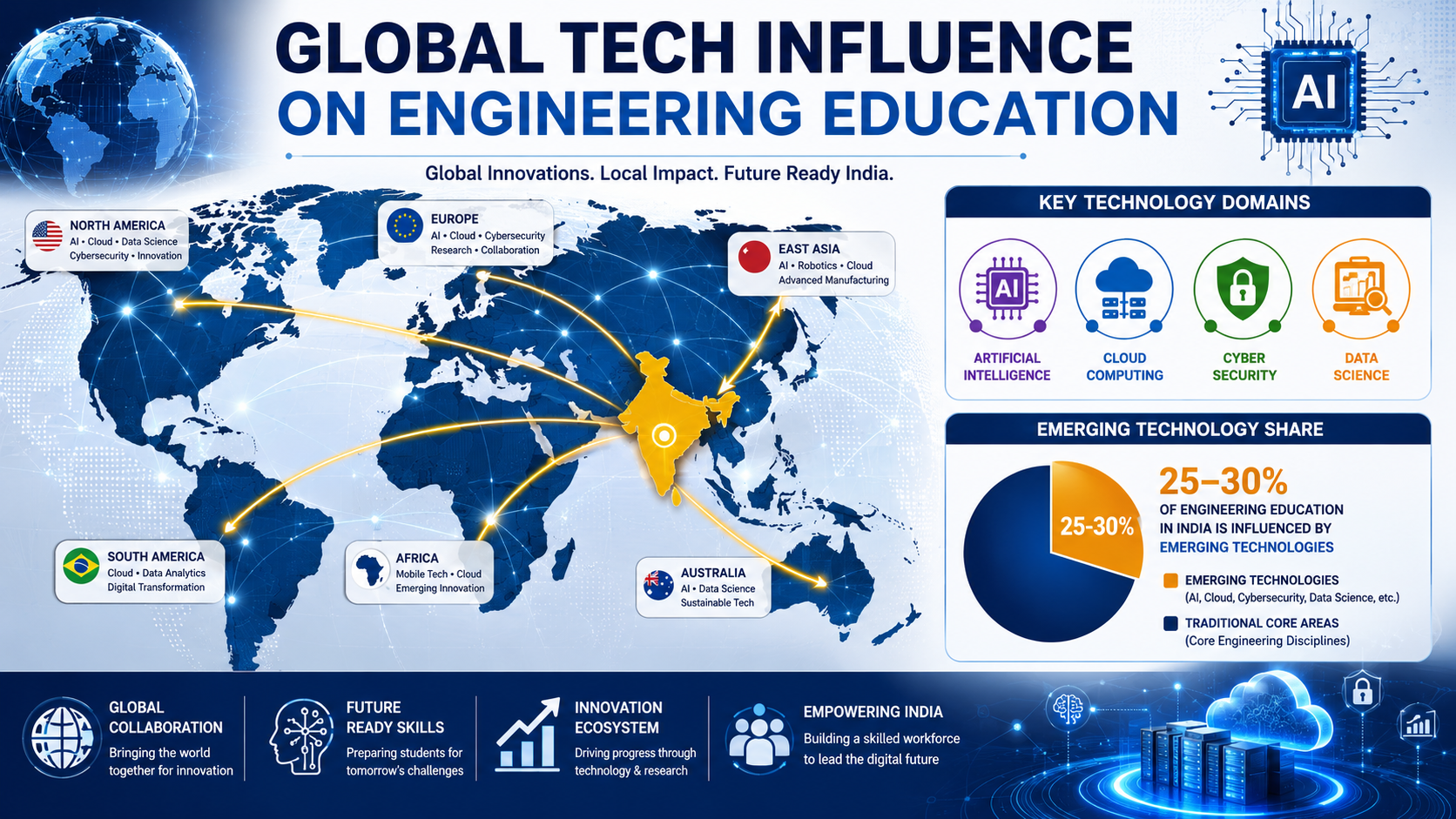
Engineering education in India is increasingly shaped by global technological trends, reflecting the growing integration of the Indian workforce into international markets. The rise of domains such as Artificial Intelligence, Data Science, Cloud Computing, and Cybersecurity has significantly influenced curriculum design and program offerings.
By 2025–26:
- Approximately 25–30% of engineering seats are aligned with emerging technology domains
- A large number of institutions offer specialized tracks within Computer Science, including AI/ML, Data Science, and Cybersecurity
Key drivers of this transformation include:
- Global demand for digital and technology skills
- Industry partnerships with multinational corporations
- Rapid evolution of technology ecosystems
- Competitive pressure among institutions to remain relevant
This shift marks a transition from discipline-based education to skill- and application-oriented learning models, where interdisciplinary integration is central.
However, challenges include:
- Faculty readiness to teach advanced subjects
- Infrastructure requirements for emerging technologies
- Risk of oversaturation in trending domains
Engineering education in India is aligning with global tech trends, reshaping course structures and student career pathways.
19. INSTITUTIONAL INFRASTRUCTURE VS ACADEMIC OUTPUT: A CORRELATION STUDY
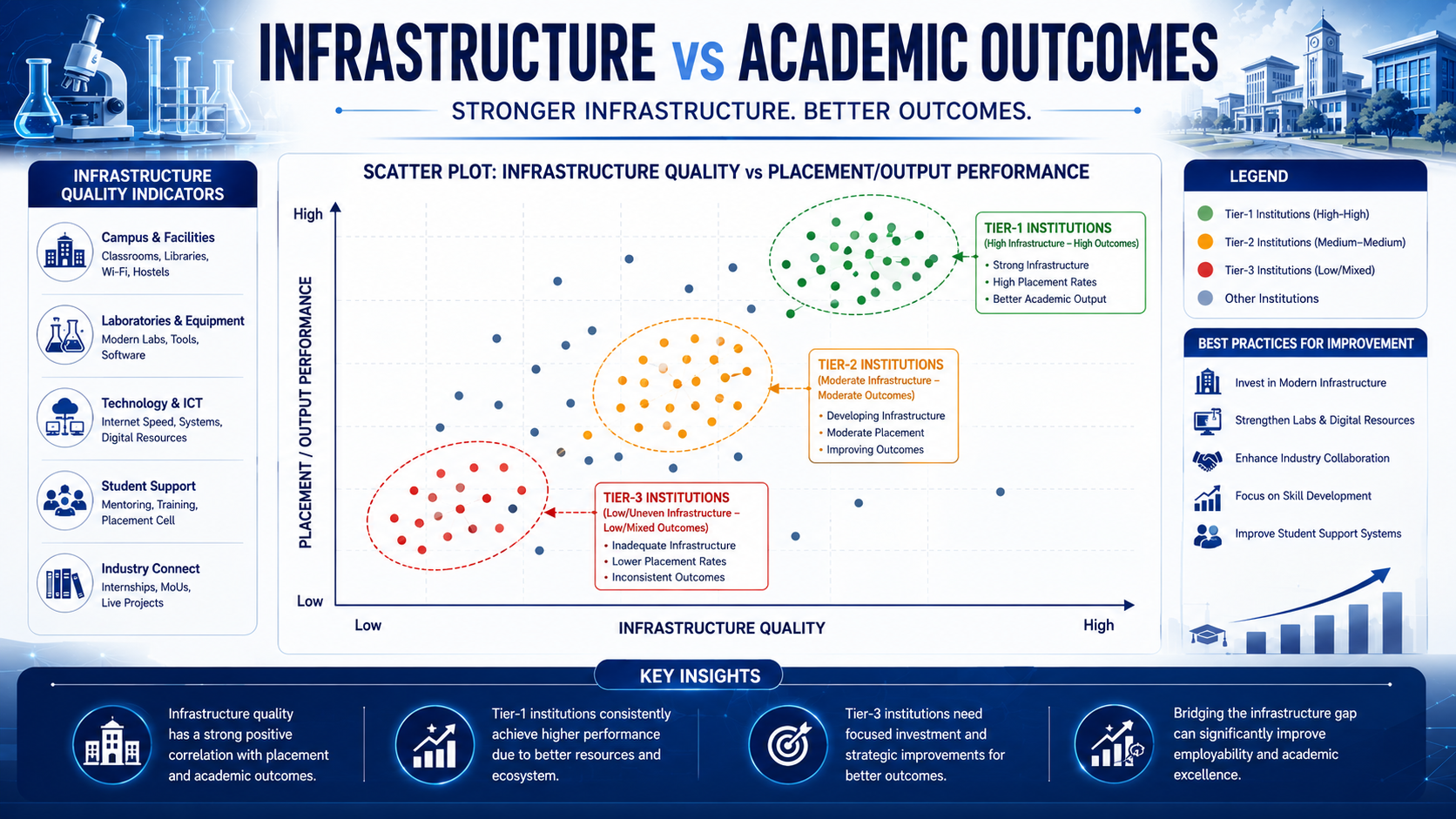
The relationship between institutional infrastructure and academic outcomes in engineering education is complex and non-linear. While high-quality infrastructure is a critical enabler, it does not automatically guarantee strong academic performance.
Tier-1 institutions typically demonstrate:
- Advanced laboratories and research facilities
- Strong industry collaborations
- High placement rates (often 80–95% in top branches)
However, many Tier-3 institutions, despite having adequate physical infrastructure, underperform due to:
- Limited faculty expertise and engagement
- Weak curriculum delivery and pedagogy
- Minimal industry exposure and internship opportunities
This indicates that academic output is influenced more by the quality of execution—including teaching effectiveness, curriculum relevance, and industry integration—than by infrastructure alone.
The findings suggest that:
- Infrastructure is a necessary but not sufficient condition
- Human capital (faculty) plays a decisive role
- Institutional culture and governance significantly impact outcomes
Infrastructure provides the foundation, but academic success depends on how effectively it is utilized.
20. FUTURE SUSTAINABILITY OF ENGINEERING EDUCATION MODELS IN INDIA
The long-term sustainability of engineering education in India depends on the system’s ability to balance scale, quality, and relevance. While the sector has achieved massive expansion, structural challenges continue to threaten its effectiveness.
Key issues include:
- Oversupply of engineering seats relative to demand
- Persistent skill gaps among graduates
- Uneven institutional quality across regions and tiers
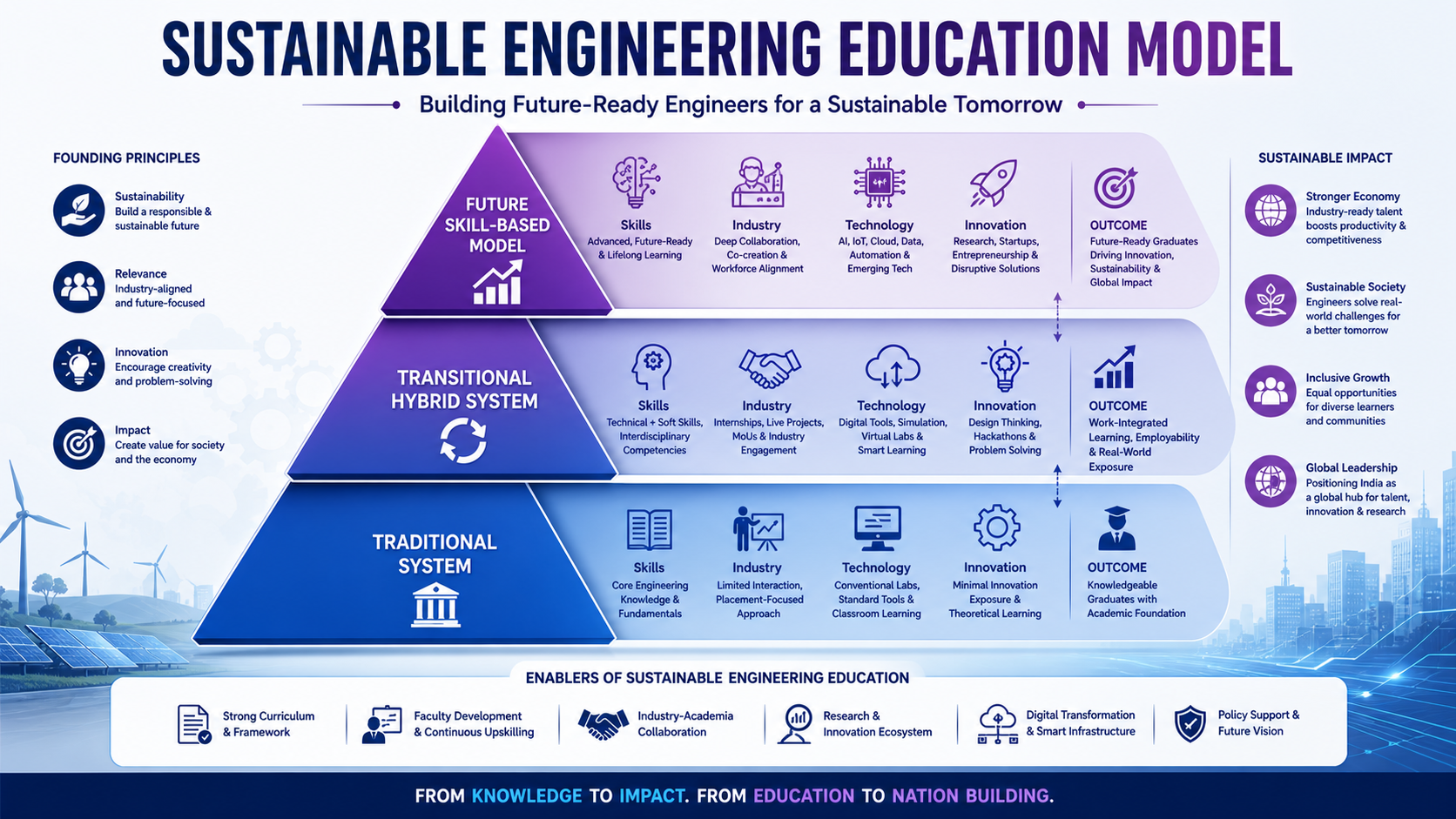
A sustainable future model must focus on:
- Skill-based and outcome-oriented curricula
- Strong industry-academic collaboration
- Flexible and modular learning pathways
- Continuous curriculum updates aligned with technology trends
- Emphasis on employability and lifelong learning
Projected trends for the next decade include:
- Consolidation or closure of low-performing institutions
- Growth of specialized, technology-focused colleges
- Increased adoption of interdisciplinary programs
- Integration of digital and hybrid learning ecosystems
This transformation reflects a shift from quantity-driven expansion to quality-driven optimization.
The future of engineering education lies in building a system that prioritizes skills, adaptability, and industry relevance over sheer scale.
FINAL SYNTHESIS: COMPLETE 360° ACADEMIC FRAMEWORK
These final five dimensions complete a comprehensive analytical framework of engineering education in India:
- Post-pandemic transformation toward hybrid learning models
- Gradual progress in gender inclusion, though uneven
- Strong global technological influence on curriculum evolution
- Critical debate on infrastructure vs academic execution quality
- Urgent need for sustainable, skill-driven education models
Grand Conclusion Across All 20 Topics
When integrated with the previous 15 topics, this framework reveals a system that is:
- Expanding rapidly, but unevenly
- Digitally evolving, yet structurally challenged
- Globally aligned, but locally imbalanced
- Rich in capacity, but inconsistent in outcomes
Engineering education in India is not in crisis—it is in transition. The next decade will determine whether it evolves into a globally competitive, skill-driven ecosystem or remains fragmented by scale without quality.
Note : Tobe continued with next topics soon
RECRUITMENT RESEARCH TOPICS (ENGINEERING JOB MARKET – INDIA)
- Transformation of IT hiring models in India under AI-driven automation (2023–2027)
- Decline of mass recruitment in IT services companies and its impact on fresh engineering graduates
- Employability gap among Indian engineers: Skills mismatch and hiring challenges
- Comparative hiring trends across IT, core engineering, and non-tech sectors in India
- Role of AI and automation in reshaping entry-level engineering jobs
- Freshers vs experienced hiring preferences in Indian tech industry
- Growth of Global Capability Centers (GCCs) and their impact on engineering employment
- City-wise distribution of engineering jobs in India: A spatial economic analysis
- Rise of hybrid roles (tech + business) in engineering employment markets
- Internship economy expansion and its role in early career employment
- Salary trends across engineering disciplines in India (2023–2027)
- Sector-wise job absorption capacity for engineering graduates
- Non-IT employment pathways for engineering graduates in India
- Impact of startup ecosystem growth on engineering job creation
- Role of digital skills in improving employability of non-IT engineers
- Engineering graduates in non-core jobs: Causes and long-term implications
- Influence of global economic trends on Indian engineering hiring patterns
- Talent supply-demand mismatch in AI, cloud, and semiconductor domains
- Skill-based hiring vs degree-based hiring: Industry transformation study
- Future of entry-level jobs in India under AI and quantum computing advancements