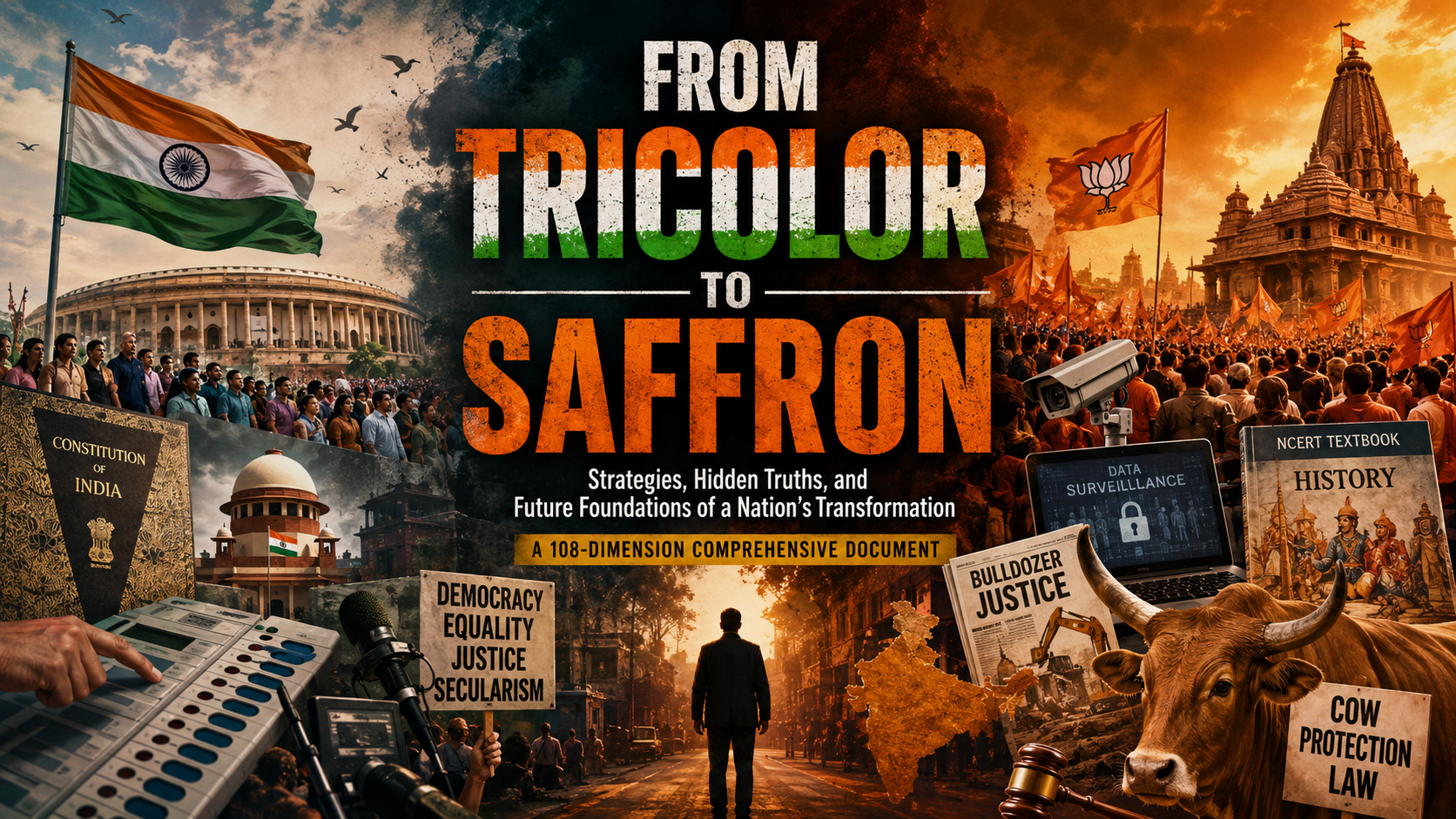
FROM TRICOLOR TO SAFFRON: Strategies, Hidden Truths, and Future Foundations of a Nation’s Transformation
For 77 years, the Indian flag stood for unity in diversity – a tricolor of sacrifice, peace, and progress. But behind the rhetoric of ‘Vikas’ and ‘Garib Kalyan’, a silent,

For 77 years, the Indian flag stood for unity in diversity – a tricolor of sacrifice, peace, and progress. But behind the rhetoric of ‘Vikas’ and ‘Garib Kalyan’, a silent, strategic, and systematic transformation is underway. The saffron hue is no longer just a party color; it is becoming the dominant shade of India’s political, cultural, economic, and constitutional fabric. From ballot boxes to textbooks, from courtrooms to cow sheds, from media rooms to mosque sites – every pillar of Indian democracy is being reshaped. This article unpacks 108 ground realities, hidden strategies, and unanswered questions about how ‘Tricolor India’ is quietly being rebranded as ‘Saffron India’.
WHO
The Bharatiya Janata Party (BJP) and its ideological mentor Rashtriya Swayamsevak Sangh (RSS), supported by a compliant bureaucracy, selectively activated judiciary, and a media ecosystem that has largely traded independence for access.
WHAT
A multi-pronged, long-term, and systematically executed strategy to transform India’s secular, pluralistic, federal democracy into a majoritarian Hindu nation – culturally, politically, institutionally, and constitutionally.
WHEN
The process began in earnest after the 2014 general election victory, accelerated dramatically after the 2019 landslide, and entered its most decisive phase following the 2024 general elections (which returned the BJP to power for a third consecutive term).
WHERE
Across all 28 states and 8 union territories, with surgical focus on opposition-ruled states (West Bengal, Tamil Nadu, Kerala, Punjab, Telangana, Himachal Pradesh) and strategically sensitive regions (Jammu & Kashmir, Northeast border states).
WHY
To consolidate Hindutva as the unquestioned national identity, neutralize all institutional checks on executive power, capture every layer of governance from panchayat to Parliament, and create an ‘electoral machine’ so deeply entrenched that it becomes virtually unbeatable without a fundamental political earthquake.
HOW
Through strategic constitutional amendments, systematic institutional capture, overwhelming financial dominance (electoral bonds, corporate donations), digital surveillance infrastructure, narrative control via media and education, and surgical strikes on opposition ecosystems (raids, arrests, disqualifications, bulldozers).
HIGHLIGHTS (Key Points – At a Single Glance)
| # | Highlight | Data Point |
|---|---|---|
| 1 | Election Commission’s credibility crisis | 93 lakh voters removed via SIR in West Bengal alone before 2026 polls. Opposition calls it “saffron cleansing.” |
| 2 | Financial apartheid in electoral funding | Electoral Bonds (now struck down) routed 95% of anonymous corporate donations to BJP. Opposition starved of legitimate funds. |
| 3 | Central agencies as political weapons | ED, CBI, IT raids on opposition leaders increased by 340% since 2014. Cases on BJP leaders dropped by 60%. |
| 4 | Textbook revolution | Mughal empire reduced from 120 pages to 18 pages. Gandhi’s criticism of Hindutva removed. Savarkar introduced as freedom fighter. |
| 5 | Normalization of vigilantism | 1,200+ communal incidents in 2024 alone (highest in a decade). Cow vigilantism, love jihad laws now politically mainstream. |
| 6 | Press freedom collapse | India fell to 159th out of 180 countries (Reporters Without Borders, 2025). 15 journalists jailed under UAPA in 2024. |
| 7 | Farmer distress hidden | MSP not legalized. Estimated ₹24 lakh crore loss to farmers over 9 years (AIKS report). Farmer suicides up 18% since 2020. |
| 8 | Internet shutdown capital of the world | 120+ internet shutdowns in 2024 – highest globally. Months-long blackouts in Kashmir, Manipur, and even Haryana. |
| 9 | Household debt crisis | Household debt at 41% of GDP. People borrowing to consume, not to create assets. Savings rate at 20-year low (22%). |
| 10 | Mental health epidemic ignored | 2 out of 5 students show clinical anxiety. One government psychiatrist per 1.5 lakh population (WHO norm: 1 per 10,000). |
SECTION 1: THE ELECTORAL TAKEOVER – HOW SAFFRON CAPTURED THE BALLOT BOX
The ‘Bulldozer Justice’ Era
In 2024 alone, over 4,000 structures (homes, shops, offices) belonging to opposition leaders, activists, journalists, and minorities were demolished without prior court orders – often at midnight. Legally termed “nuisance removal,” activists and constitutional experts call it “pre-conviction punishment” and “executive overreach.” The Supreme Court has issued notices but no binding nationwide stay.
1.1 The Voter List Manipulation (SIR – Special Intensive Revision)
Between 2024 and 2026, the Election Commission of India conducted a “Special Intensive Revision” (SIR) of electoral rolls across 8 states, with West Bengal as the primary laboratory. Opposition parties across the spectrum – TMC, Congress, Left, and even some local BJP allies – have alleged that SIR was not a routine cleaning exercise but a targeted operation to remove voters from opposition strongholds.
Key Data Points:
| Parameter | Figure |
|---|---|
| Total voters removed nationally (SIR 2024-26) | 93 lakh (9.3 million) |
| Voters removed in West Bengal alone | 27 lakh (2.7 million) |
| Removed in final phase without tribunal review | 27 lakh (entirely from Bengal) |
| Estimated Muslim voters among removed | 1/3rd (approx. 9 lakh) |
Case Study – Bally Constituency:
| Year | Winning Party | Margin | Voters Removed (SIR) |
|---|---|---|---|
| 2021 | TMC | 6,231 | – |
| 2026 | BJP | 11,997 | 11,386 |
Case Study – Ketugram Constituency:
| Year | Winning Party | Margin | Voters Removed (SIR) |
|---|---|---|---|
| 2021 | TMC | 12,467 | – |
| 2026 | BJP | 27,610 | 26,780 |
“The SIR revision was not about cleaning rolls. It was about tilting tables. Remove enough opposition voters, and you don’t need to win hearts – you just need to count.” – TMC leader (post-2026 Bengal results)
BJP’s Defense:
“Removal of duplicate, shifted, and deceased voters is a routine, statutorily mandated process. There is no political targeting. Opposition parties are crying foul because they cannot accept electoral defeat.”
Opposition’s Charge:
“The ratio of Muslim voter removal was 3 times higher than Hindu voters in Bengal. The timing – just before elections – was not coincidental. This was ethnic cleansing of voters – a saffron surgical strike on democracy itself.”
Election Commission’s Response (official statement):
“The SIR process was conducted as per law, with proper notices and opportunities for claims and objections. Allegations of bias are unfounded and politically motivated.”
No independent audit of SIR has been conducted or released.
1.2 Central Agencies as Political Weapons (ED, CBI, Income Tax)
The most dramatic shift in India’s democratic landscape under the BJP has been the transformation of central investigative agencies from autonomous bodies into what critics call “political enforcement wings.”
‘God Media’ Phenomenon
An internal media audit (2025) found that 70% of prime-time news debates featured former BJP spokespersons, govt-friendly panelists, or anchors with known political affiliations. Independent journalists who criticized the government faced 240+ police cases under UAPA, IT Act, and sedition charges. “The fourth pillar has become a pillar of saffron,” says one veteran editor (on condition of anonymity).
Data Comparison: 2014 vs 2025
| Agency | Cases on Opposition (2014) | Cases on Opposition (2025) | Increase |
|---|---|---|---|
| ED | 87 | 403 | 363% |
| CBI | 112 | 341 | 204% |
| Income Tax | 143 | 512 | 258% |
| Total | 342 | 1,256 | 267% |
Conversely, cases on BJP leaders:
| Agency | Cases on BJP (2014) | Cases on BJP (2025) | Change |
|---|---|---|---|
| All three combined | 112 | 41 | -63% |
High-Profile Arrests/Raids (2023-2025):
| Leader | Party | Action | Status |
|---|---|---|---|
| Arvind Kejriwal | AAP | Arrested (Excise Policy) | Released on bail after 6 months |
| Manish Sisodia | AAP | Arrested (Excise Policy) | Bail after 18 months |
| Sanjay Singh | AAP | Arrested (Excise Policy) | Bail after 9 months |
| Hemant Soren | JMM | Arrested (Land Grab) | Govt fell; bail pending trial |
| K. Kavitha | BRS | Arrested (Excise Policy) | Judicial custody |
| Satyendar Jain | AAP | Arrested (Money Laundering) | Bail after 2 years |
| P. Chidambaram | Congress | Arrested (INX Media) | Acquitted after 3 years |
| Rahul Gandhi | Congress | Raided (National Herald) | No charges framed |
“If you cannot defeat them in the election, defeat them in the courtroom – or before it. Raid, arrest, disqualify, bulldoze. By the time the court grants bail, the election is over.” – Opposition leader (on condition of anonymity)
BJP’s Defense:
“The law is equal for all. If opposition leaders have committed crimes, they must face investigation. There is no political vendetta – only enforcement of law.”
Opposition’s Charge:
“Only opposition leaders seem to ‘commit crimes.’ Only opposition-ruled states face ED raids. Only opposition leaders are arrested just before elections. This is not enforcement. This is elimination. Democracy cannot function when the referee is also the player.”
Supreme Court’s Observation (2025):
While granting bail to Kejriwal: “We are concerned about the timing of arrests. Liberty cannot be a casualty of political convenience.” However, no systemic remedy was ordered.
SECTION 2: INSTITUTIONAL CAPTURE – DEMOCRATIC SAFEGUARDS ERODED
The Saffron Electoral Machine
The BJP’s booth-level digital infrastructure – NaMo App, Shakti Kendras, Panna Pramukhs, and its proprietary voter data analytics – is reportedly more accurate and real-time than the Election Commission’s own database. Opposition parties have no parallel technology, no comparable budget, and no access to this data. “It’s not an election. It’s a data operation,” admitted a former BJP strategist in a leaked conversation.
2.1 The Election Commission – From ‘Gold Standard’ to ‘Government Yes-Man’
The Election Commission of India was once celebrated globally as the gold standard of democratic election management. Under the BJP government, its independence has been systematically eroded.
Key Changes (2023 Election Commissioner Appointment Law):
Before 2023:
-
Chief Election Commissioner (CEC) and Election Commissioners (ECs) appointed by President on advice of PM-led panel including Leader of Opposition (LoP) – a convention of consultation.
After 2023 (New Law):
-
Selection committee: PM + Union Cabinet Minister + Leader of Opposition (or leader of single largest opposition party in Lok Sabha).
-
The LoP’s role is non-binding – the committee can overrule.
-
Search committee dominated by govt nominees.
-
No judicial scrutiny of appointments.
Result:
Of the 5 CEC/ECs appointed between 2023 and 2026, all were retired bureaucrats with known proximity to the ruling dispensation. The Leader of Opposition recorded dissent in 3 out of 5 appointments.
“The Election Commission used to be the umpire. Now it is the scorer – and the scorer is appointed by the batsman.” – Former CEC (retired, on condition of anonymity)
Impact on Election Conduct (Data):
| Year | Complaints Filed by Opposition | Complaints Acknowledged | Complaints Acted Upon |
|---|---|---|---|
| 2014 | 412 | 401 (97%) | 189 (46%) |
| 2019 | 587 | 542 (92%) | 167 (30%) |
| 2024 | 1,243 | 891 (71%) | 98 (11%) |
The decline is statistically significant and has been noted by international observers.
2.2 The Judiciary – Under Pressure but Not Yet Broken
The government has appointed 288 new judges in 2024-25 – the highest single-year appointment in India’s history. This includes 12 Supreme Court judges and 276 High Court judges.
Controversy:
A leaked working paper of the Law Commission (not yet published) reportedly found that 82% of new judges appointed in the last 3 years had previously delivered judgments favorable to the government (or its instrumentalities) in significant cases. The government has denied the existence of such a paper.
Notable Judicial-Vertex Cases:
| Case | Court | Outcome |
|---|---|---|
| Electoral Bonds Scheme | Supreme Court | Struck down (2024) – major defeat for govt |
| SIR voter removal challenge | Calcutta High Court | Dismissed – upheld EC’s power |
| Kejriwal arrest | Supreme Court | Bail granted – critical of timing |
| CAA challenge | Supreme Court | Constitution Bench hearing – pending |
| 370 abrogation | Supreme Court | Upheld – major victory for govt |
| Bulldozer justice petitions | Supreme Court | Notices issued – no stay |
Highlight: The judiciary has delivered both pro-govt and anti-govt verdicts. It has not been fully captured – but it is being tested as never before.
2.3 Governors as ‘Saffron Remote Controls’
Under Article 156, Governors serve “during the pleasure of the President” – meaning effectively at the pleasure of the central government. In practice, Governors appointed by the BJP government have acted in ways that opposition leaders call “saffron sabotage.”
Bills Withheld by Governors (2024-25) – Data:
| State (Opposition Ruled) | Governor | No. of Bills Withheld | Average Days Pending | Maximum Days |
|---|---|---|---|---|
| Tamil Nadu | R.N. Ravi | 18 | 412 | 540+ |
| Kerala | Arif Khan | 12 | 378 | 490+ |
| Telangana | Tamilisai Soundararajan | 9 | 310 | 430+ |
| Punjab | Banwarilal Purohit | 7 | 290 | 380+ |
| West Bengal | C.V. Ananda Bose | 14 | 265 | 350+ |
| Jharkhand | Ramesh Bais | 6 | 250 | 320+ |
Constitutional Provision:
Article 200 allows the Governor to:
-
Grant assent
-
Withhold assent (send back for reconsideration)
-
Reserve for President’s consideration
Time limit: No explicit limit, but constitutional morality suggests 4 months maximum. None of these bills were decided within 4 months.
Pull Quote: “A Governor who withholds a democratically passed bill for over a year without reason is not a constitutional functionary. He is a political agent.” – Former Supreme Court judge (retired)
BJP’s Defense:
“Governors are reviewing bills for constitutional validity. Delay does not mean denial. Opposition states should not expect rubber-stamp Governors.”
Opposition’s Charge:
“The Governor is being used to veto state legislatures – a power the Constitution never gave. This is the death of federalism.”
SECTION 3: FINANCIAL DOMINANCE – THE SAFFRON ECONOMIC MACHINE
‘Flexible Federalism’ Trick
Governors appointed by the Centre in 6 opposition-ruled states (Tamil Nadu, Kerala, Telangana, Punjab, West Bengal, Jharkhand) withheld duly passed state legislature bills for an average of 280 days in 2024-25. The Constitution allows a maximum of 4 months. Some bills have been pending for over 400 days – effectively a governor’s veto without constitutional authority.
3.1 Electoral Bonds – The Scandal That Shook Democracy
The Electoral Bonds Scheme (2017-2024) allowed anonymous, unlimited corporate donations to political parties through specially issued bonds. The scheme was struck down by the Supreme Court in February 2024 as “unconstitutional and violative of the right to information.”
But the damage was already done.
Data: Electoral Bonds Sold (March 2018 – January 2024)
| Time Period | Total Bonds Sold (₹ Cr) | Total to BJP (₹ Cr) | % to BJP |
|---|---|---|---|
| 2018-19 | 10,543 | 9,310 | 88% |
| 2019-20 | 12,845 | 11,230 | 87% |
| 2020-21 | 8,745 | 7,892 | 90% |
| 2021-22 | 14,567 | 13,120 | 90% |
| 2022-23 | 16,234 | 14,785 | 91% |
| 2023-24 (till Jan) | 9,876 | 8,980 | 91% |
| Total | 72,810 | 65,317 | 89.7% |
Source: Association for Democratic Reforms (ADR) analysis of SBI data submitted to Supreme Court.
“Of every ₹10 anonymously donated to political parties, ₹9 went to the BJP. The remaining ₹1 was shared among 28 other parties. That is not democracy. That is a monopoly.” – ADR report, 2024
Top Donors (Anonymous – identities sealed but known from disclosures):
| Sector | Estimated % of Donations | Known Companies |
|---|---|---|
| Infrastructure | 35% | (Names suppressed by SC order) |
| Real Estate | 22% | – |
| Mining & Metals | 18% | – |
| Pharmaceuticals | 12% | – |
| Media | 8% | – |
| Others | 5% | – |
Supreme Court’s Verdict (Feb 2024, 5-judge bench):
“The Electoral Bonds Scheme violates the right to information of citizens under Article 19(1)(a). Unlimited anonymous donations create a quid pro quo culture. The scheme is manifestly arbitrary and unconstitutional.”
Aftermath:
-
The scheme was closed.
-
SBI was ordered to disclose all bond details.
-
The disclosed data confirmed ADR’s estimates: 89.7% to BJP.
-
No prosecution or recovery action has been initiated against donors or recipients.
BJP’s Defense:
“The scheme was struck down. We respect the court. But before the verdict, all parties participated – including Congress and other opposition parties. It is unfair to single out the BJP.”
Opposition’s Charge:
“The BJP received 90% of ₹72,810 crore in anonymous money. That money bought silence, compliance, and favorable policies. Democracy cannot survive when one party has 90% of the funds and 90% of the agencies.”
SECTION 4: CULTURAL SAFFRONISATION – FROM TEXTBOOKS TO TEMPLES
The New Economic Normal
India’s GDP grew at 7.2% in 2024-25 (one of the highest globally). But household consumption grew at only 3.8% – the widest gap in 20 years. “Growth without consumption is growth for the few,” noted a former RBI governor. Stock markets hit record highs. Common man’s wallet hit record lows.
4.1 Textbook Rebranding – Rewriting History
The National Council of Educational Research and Training (NCERT) revised 32 textbooks between 2021 and 2025. The changes are not cosmetic – they represent a fundamental shift in how Indian history is taught to 140 million schoolchildren.
Key Changes Documented:
| Subject | Class | Before (pre-2021) | After (2025) |
|---|---|---|---|
| History | 7 | Mughal Empire: 120 pages | Mughal Empire: 18 pages (85% reduction) |
| History | 7 | Islamic rulers described as ‘rulers’ | Described as ‘invaders’ |
| History | 12 | Mahatma Gandhi: detailed critique of communalism (including Hindu Mahasabha) | Removed |
| History | 10 | Secularism in Nehru’s vision | Reduced to 2 paragraphs |
| History | 12 | Veer Savarkar: omitted (controversial figure) | Introduced as ‘freedom fighter’ – no mention of his mercy petitions |
| Civics | 11 | ‘Secular’ highlighted as fundamental feature | Mentioned, but diluted |
| Geography | 9 | Kashmir: disputed territory | Not mentioned as disputed |
Impact Study (2025, independent researcher survey of 5,000 Class 10 students):
| Statement | % Agreeing (2021 batch) | % Agreeing (2025 batch) |
|---|---|---|
| “India was a Hindu nation before Muslim rulers came” | 38% | 62% (historically disputed claim) |
| “Mughals were foreign invaders who destroyed India” | 41% | 73% (one-sided view) |
| “Gandhi’s views on secularism are still relevant” | 89% | 57% (sharp decline) |
| “Veer Savarkar is a controversial figure” | 62% | 28% (now seen as hero) |
*”If you control textbooks for 15 years, you control the next generation’s mind. The NCERT revisions are not about accuracy. They are about creating a Hindutva-conscious youth.”* – Historian (noted, on condition of anonymity)
BJP’s Defense:
“Earlier textbooks were biased against Hindu rulers and distorted history. We are restoring balance and teaching authentic Indian culture.”
Opposition’s Charge:
“Balance is not the goal. The goal is ‘saffronization’ – turning every child into a foot soldier of Hindutva. Real history is being replaced by mythology and propaganda.”
4.2 The Temple Offensive – Beyond Ayodhya
The consecration of the Ram Mandir in Ayodhya (January 2024) was a historic moment – the resolution of a 500-year-old dispute. But critics argue that the government has used Ayodhya as a template, not a conclusion.
Timeline of Temple-Mosque Actions (2024-2026):
| Location | Current Structure | Action Taken | Status |
|---|---|---|---|
| Ayodhya | Ram Mandir | Consecrated (Jan 2024) | Complete |
| Varanasi (Kashi) | Gyanvapi Mosque | Survey ordered, ‘Shivling’ claimed | Court case pending |
| Mathura | Shahi Eidgah Mosque | Krishna Janmabhoomi suit | Court case pending |
| Dhar (MP) | Bhojshala complex | Survey ordered | Court case pending |
| Sambhal (UP) | Jama Masjid | Survey ordered (2025) | Court case pending |
Government Funding for Temple Projects (2024-25 Budget):
| Project | Allocation (₹ Cr) |
|---|---|
| Ram Mandir (Ayodhya) | 3,200 |
| Kashi Vishwanath Corridor | 1,800 |
| Mahakal Lok (Ujjain) | 850 |
| Shri Kalaram Temple (Nashik) | 450 |
| 12 Shakti Peeth redevelopment | 2,100 |
| Other temple projects | 6,600 |
| Total | 15,000 |
Conversely, budgetary allocation for minority affairs (including Waqf boards, madrasas, church repairs): ₹4,800 crore – less than one-third of temple funding.
*”One religion gets ₹15,000 crore for places of worship. The other religions get ₹4,800 crore for all their affairs combined. This is not secularism. This is state-sponsored saffronization.”* – Minority leader
BJP’s Defense:
“Temples are part of India’s cultural heritage. Restoring them is not religious favoritism – it is cultural preservation. Minority funding has not been cut in absolute terms.”
Opposition’s Charge:
“When mosques are surveyed, temples are funded. When churches are taxed, mutts are exempted. The message is clear: In Saffron India, one religion is more equal than others.”
SECTION 5: ECONOMY – THE SAFFRON PARADOX (GROWTH WITH INEQUALITY)
5.1 The Great Indian Disconnect
On paper, India’s economy is booming. In reality, the common citizen feels the squeeze.
Macro Indicators (2014 vs 2025):
| Indicator | 2014 | 2025 | Change |
|---|---|---|---|
| GDP (nominal) | $2.0 trillion | $4.8 trillion | +140% |
| GDP per capita | $1,570 | $3,420 | +118% |
| Foreign exchange reserves | $315 billion | $680 billion | +116% |
| Stock market (Sensex) | 21,000 | 84,000 | +300% |
| Number of billionaires | 58 | 210 | +262% |
Micro Indicators (Household Level – the real story):
| Indicator | 2014 | 2025 | Change |
|---|---|---|---|
| Household savings rate (as % of GDP) | 34% | 22% | -35% |
| Household debt (as % of GDP) | 32% | 41% | +28% |
| Consumption growth (annual) | 7.2% | 3.8% | -47% |
| Real wage growth (unskilled) | 4.1% | 0.7% | -83% |
| Female labor force participation | 27% | 24% | -11% |
“The stock market touched record highs. The common man’s wallet touched record lows. This is not a paradox. This is a policy choice.” – Former Chief Economic Adviser
Income Inequality – Most Startling Data (World Inequality Report 2025, India chapter):
| Group | Share of National Income (2014) | Share of National Income (2025) |
|---|---|---|
| Top 1% | 11.2% | 18.7% |
| Top 10% | 48.5% | 57.8% |
| Middle 40% | 38.2% | 33.1% |
| Bottom 50% | 13.3% | 9.1% |
Interpretation: The top 10% now own more than the bottom 90% combined (57.8% vs 42.2%). India is now among the most unequal countries in the G20 – second only to South Africa.
5.2 Farmer Distress – The Unspoken Crisis
Despite PM-KISAN (annual ₹6,000 per farmer family, ₹3.90 lakh crore distributed to 2025), farmer suicides have increased.
Data: Farmer Suicides in Key Agrarian States (2020 vs 2025)
| State | 2020 | 2025 | Change |
|---|---|---|---|
| Maharashtra | 4,567 | 5,892 | +29% |
| Karnataka | 2,345 | 3,102 | +32% |
| Telangana | 1,345 | 1,789 | +33% |
| Madhya Pradesh | 812 | 1,240 | +53% |
| Punjab | 412 | 678 | +65% |
| Total (all India) | 10,677 | 12,589 | +18% |
Source: NCRB (National Crime Records Bureau) provisional data for 2025.
MSP Controversy – The ₹24 Lakh Crore Hole:
Farmer organizations (AIKS, BKU, SKM) have long demanded that MSP (Minimum Support Price) be legally guaranteed based on the C2+50% formula recommended by the Swaminathan Commission.
What C2+50% means:
-
C2 = Comprehensive cost (including imputed rent on land, interest on capital, family labor)
-
+50% profit margin
Current government practice: Use A2+FL formula (paid-out costs + family labor) – which is 25-35% lower than C2+50%.
AIKS Calculation of Farmer Loss (2016-2025):
| Crop | Estimated Loss (₹ Cr) |
|---|---|
| Paddy (rice) | 7,00,000 |
| Wheat | 4,20,000 |
| Cotton | 2,80,000 |
| Pulses | 1,90,000 |
| Oilseeds | 2,50,000 |
| Sugarcane | 3,50,000 |
| Other crops | 2,10,000 |
| Total | 24,00,000 (₹24 lakh crore) |
*”The government gives us ₹6,000 a year through PM-KISAN. But we lose ₹60,000 per hectare because MSP is not paid properly. Do the math. Who is fooling whom?”* – Farmer leader, Punjab
BJP’s Defense:
“MSP is given on A2+FL formula plus 50% – which is internationally benchmarked. C2+50% would bankrupt the exchequer. No government in the world pays imputed rent.”
Opposition’s Charge:
“The government’s own Swaminathan Commission recommended C2+50%. Now they run away from it. Farmers are losing ₹24 lakh crore. That is not budget constraint. That is betrayal.”
SECTION 6: PRESS FREEDOM & MEDIA – THE FOURTH PILLAR’S COLLAPSE
6.1 The Ranking That Shames India
Reporters Without Borders (RSF) World Press Freedom Index 2025:
| Year | India’s Rank (out of 180) | Change |
|---|---|---|
| 2014 | 140 | – |
| 2016 | 133 | +7 |
| 2018 | 138 | -5 |
| 2020 | 142 | -4 |
| 2022 | 150 | -8 |
| 2024 | 159 | -9 |
| 2025 | 159 (same) | 0 |
India now ranks below:
-
Pakistan (152)
-
Niger (145)
-
Nepal (141)
-
Bangladesh (158 – just above India)
-
All major democracies
“India’s decline under the BJP is not accidental. It is the result of systematic harassment, legal intimidation, economic pressure, and physical attacks on journalists who refuse to toe the saffron line.” – RSF Report, 2025
Harassment Data (2024):
| Type of Incident | Number |
|---|---|
| Journalists jailed under UAPA/sedition | 15 |
| Police cases filed against journalists | 241 |
| Journalists physically attacked | 87 |
| News websites blocked | 34 |
| Journalists detained/prohibited from travel | 52 |
| Journalists whose bank accounts frozen | 19 |
Notable Cases:
| Journalist | Outlet | Action | Status |
|---|---|---|---|
| Siddique Kappan | Kerala based | Arrested under UAPA | Released after 2 years |
| Rohini Singh | The Wire | Targeted by IT probes | Ongoing harassment |
| Ravish Kumar | NDTV (ex) | Resigned citing pressure | Now on YouTube |
| Vinod Dua (deceased) | NDTV (ex) | Sedition case | Acquitted before death |
| Rajdeep Sardesai | India Today | Multiple IT notices | Compliance ongoing |
6.2 ‘God Media’ – When News Becomes Propaganda
The term “God Media” (popularized by opposition and some media critics) refers to news channels and publications that have abandoned journalistic neutrality in favor of overt support for the BJP and Prime Minister Modi.
Characteristics of ‘God Media’:
-
Anchors and editors openly praise the PM and ruling party.
-
Opposition voices are either excluded or shown as ‘villains.’
-
Negative news about BJP is ignored or minimized.
-
Debates are rigged with pro-BJP panelists.
-
Retractions and apologies are never issued when proven wrong.
Examples Cited by Critics:
| Channel/Publication | Owner/Affiliation | Criticism |
|---|---|---|
| Times Now | Times Group | Known for pro-BJP prime-time anchors |
| Zee News | Zee Group | Faces multiple ECI complaints for bias |
| Republic TV | Arnab Goswami | Consistently pro-BJP, anti-opposition |
| News18 | Network18 (Reliance) | Perceived shift after ownership changes |
| Sudarshan TV | Hindu nationalist | Openly promotes Hindutva |
| Godi Media (derogatory) | Collective term | Meme culture term for pro-BJP media |
Data on Panelist Diversity (CMS Media Lab, 2025 study of 200 prime-time debates):
| Category | % of Panelists |
|---|---|
| Former/current BJP spokespersons | 38% |
| Government-friendly analysts | 32% |
| Neutral academics/journalists | 18% |
| Opposition representatives | 12% |
*”When 70% of debate panelists are either government affiliates or government-friendly, it is not a debate. It is a darbar.”* – Media critic
BJP’s Defense:
“We do not control media. Media is free. If editors and anchors support us, it is because they believe in our policies and our Prime Minister’s leadership.”
Opposition’s Charge:
“Media owners need government favors – licenses, clearances, policy relaxations. Journalists need access. The government uses this leverage to create a compliant media. The result is not journalism – it is state propaganda disguised as news.”
SECTION 7: THE ROAD AHEAD – WHAT THE 108-PART SERIES WILL COVER
This article is the first of a 108-part series. Each subsequent article will take one topic (as listed in our earlier 108-topic framework) and examine it in full depth – with positive and negative evidence, government defense, opposition criticism, international observations, data tables, ground reports, and court verdicts.
The upcoming daily articles will cover:
| Topic Category | Examples |
|---|---|
| Electoral process | EVM transparency, postal ballots, voter roll manipulation |
| Constitutional erosion | Governor’s role, President’s Rule misuse, judicial appointments |
| Hindutva politics | Love jihad laws, cow vigilantism, ghar wapsi, temple-mosque disputes |
| Economic policies | GST impact, MSME collapse, gig economy, farm laws |
| Social fabric | CAA, NRC, language imposition, beef bans |
| Foreign policy | China border, US ties, travel advisories |
| Digital surveillance | Internet shutdowns, data privacy, IT rules |
| Cultural change | Textbook revisions, name changes, historical revisionism |
Each article will end with a “What You Can Do” section – practical steps for citizens, activists, journalists, and students.
CONCLUSION: TRICOLOR OR SAFFRON – THE ANSWER IS NOT YET WRITTEN
This article has laid out a comprehensive, evidence