
“BHARAT” vs “INDIA” CONTROVERSY
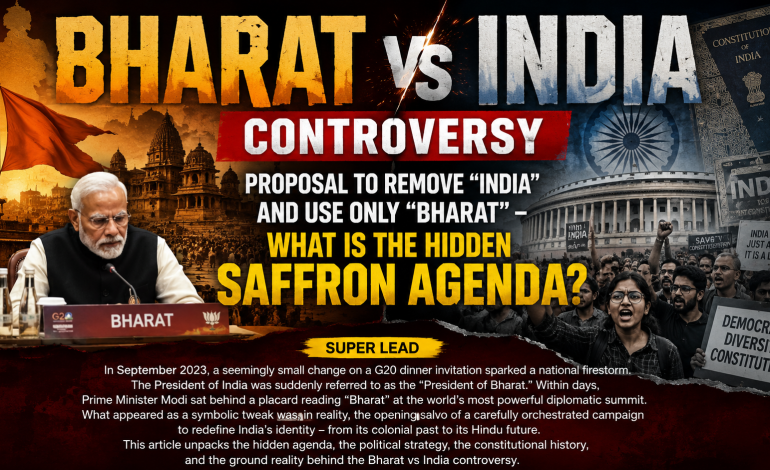
Part 01 Proposal to remove “India” and use only “Bharat” – What is the Hidden Saffron Agenda? In September 2023, a seemingly small change on a G20 dinner invitation sparked

Part 01
Proposal to remove “India” and use only “Bharat” – What is the Hidden Saffron Agenda?
In September 2023, a seemingly small change on a G20 dinner invitation sparked a national firestorm. The President of India was suddenly referred to as the “President of Bharat.” Within days, Prime Minister Modi sat behind a placard reading “Bharat” at the world’s most powerful diplomatic summit. What appeared as a symbolic tweak was, in reality, the opening salvo of a carefully orchestrated campaign to redefine India’s identity – from its colonial past to its Hindu future. This article unpacks the hidden agenda, the political strategy, the constitutional history, and the ground reality behind the Bharat vs India controversy.
WHAT – A sustained political and ideological campaign to replace the English name “India” with the Sanskrit-derived “Bharat” in official, diplomatic, and constitutional usage.
WHO – Led by the BJP and its ideological mentor RSS, supported by senior ministers, and amplified by a compliant media ecosystem.
WHEN – Intensified dramatically during the G20 Summit in September 2023 and continuing through 2025, with RSS affiliates launching signature campaigns for constitutional amendment.
WHERE – Across official government communications, G20 documentation, presidential invitations, and now proposed for constitutional changes.
WHY – To advance the Hindutva agenda of “decolonization” by erasing colonial-era nomenclature, while simultaneously neutralizing the opposition’s “INDIA” alliance branding ahead of the 2024 general elections.
HOW – Through strategic use of presidential invitations, diplomatic placards, government booklets, sustained RSS advocacy, and potential constitutional amendment.
THE CONSTITUTIONAL FRAMEWORK – WHAT THE FOUNDING FATHERS DEBATED
The controversy begins and ends with Article 1 of the Indian Constitution. Drafted after months of intense debate, Article 1 currently states: “India, that is Bharat, shall be a Union of States.”
The Constituent Assembly Debate (1949)
The matter was discussed at great length on September 17-18, 1949. Dr. B.R. Ambedkar proposed the formulation “India, that is, Bharat.” However, other members sought a more prominent place for “Bharat.”
H.V. Kamath moved an amendment seeking “Bharat or, in the English language, India, shall be a Union of States,” calling the original expression “somewhat clumsy.”
Seth Govind Das argued passionately for “Bharat known as India also in foreign countries,” stating that naming the country as Bharat was only “befitting our history and our culture.” He reminded the Assembly, “We had fought the battle of freedom under the leadership of Mahatma Gandhi by raising the slogan of ‘Bharat Mata Ki Jai.’”
Govind Ballabh Pant wanted “Bharat” or “Bharat Varsha” in place of “India.”
Ultimately, except Ambedkar’s amendment, all other proposals were either negatived or withdrawn. The Assembly thus adopted “India, that is, Bharat” – placing “India” first, followed by “Bharat” as its equivalent.
Key Historical Note: The Constitution, originally drafted in English, does not refer to “Bharat” in any other provision beyond Article 1. The Preamble refers to “We the People of India.”
THE G20 SUMMIT – THE CATALYST THAT IGNITED THE DEBATE
In September 2023, as India hosted the G20 Summit in New Delhi, a seemingly minor change sent shockwaves through the political establishment.
| Event | Details |
|---|---|
| Presidential Invitation | G20 dinner invitation referred to Head of State Droupadi Murmu as “President of Bharat” instead of “President of India” |
| PM’s Placard | Prime Minister Modi sat behind a name placard reading “Bharat” instead of “India” during the inaugural session |
| Government Booklet | A booklet titled “Bharat – The Mother of Democracy” was distributed, stating: “In Bharat that is India, the view or the will of the people in governance has been a central part of life” – notably inverting the constitutional order |
| Official Badges | Indian officials at the G20 event wore badges reading “Bharat Official” |
Prime Minister Modi used the opportunity to emphasize the need to “liberate ourselves from the slavery mindset,” directly linking the name change to his broader decolonization agenda.
THE SAFFRON AGENDA – BEYOND THE SYMBOLIC NAME CHANGE
1. The RSS Long-Term Campaign
The name “Bharat” campaign is not new. It has been a consistent ideological demand of the RSS for decades. The RSS has tagged the term “Bharat” into the title of many of its affiliates.
In March 2025, RSS national general secretary Dattatreya Hosabale reignited the debate, questioning why institutions like the Reserve Bank of India or the Constitution should still carry English names. “Desh ka naam Bharat hai, toh Bharat hi Bolo. India toh angrezi naam hai,” he declared.
Hosabale linked the issue to a broader need for “decolonisation of mind,” arguing that British rule left a deep imprint that continues to shape Indian consciousness. He cited historical instances of cultural erasure, from the destruction of temples and gurukuls during Mughal invasions to the imposition of English as a dominant language.
The RSS Argument:
-
“Bharat” is derived from two words: “Bha” (light) and “Rata” (devoted) – meaning a land devoted to the pursuit of knowledge and enlightenment
-
“India” allegedly lacks meaning; even the Oxford Dictionary associates it with definitions that some claim are demeaning
2. The Shiksha Sanskriti Utthan Nyas (SSUN) Campaign
In February 2025, SSUN, an RSS affiliate, launched a month-long national signature campaign titled “One nation one name: Bharat.” The campaign was launched at 200 locations across India with the aim of collecting one million signatures by March 21.
The campaign wrote to President Murmu urging the government to use “Bharat” in all official communications until a constitutional amendment to rename the country is passed.
3. The Political Counter to “INDIA” Alliance
Perhaps the most immediate trigger for the timing of the G20 rebranding was political.
In July 2023, 26 opposition parties formed a coalition called “INDIA” (Indian National Developmental Inclusive Alliance) to challenge the BJP in the 2024 general elections. The acronym was deliberately chosen to counter the BJP’s nationalist platform.
The Opposition’s Charge: The government’s sudden push for “Bharat” was a direct response to the formation of the INDIA alliance.
Rahul Gandhi stated in a video posted on social media: “Maybe we irritated the government a little because we named our coalition INDIA and that got them all heated up. So now they’ve decided to change the name of the country.”
AAP leader Priyanka Kakkar echoed: “The reality is that PM Modi and the BJP are nervous about the INDIA alliance. After the third meeting of our alliance, hatred is being spread against the name ‘INDIA.’”
GOVERNMENT’S OFFICIAL DEFENSE
BJP leaders have consistently refuted allegations that the “Bharat” push is politically motivated.
External Affairs Minister S. Jaishankar: “India is Bharat. It is there in the constitution. When you say Bharat, it evokes a sense, a meaning and a connotation.”
Union Minister Dharmendra Pradhan: “This should have happened earlier. This gives great satisfaction to the mind. ‘Bharat’ is our introduction. We are proud of it. The President has given priority to ‘Bharat’. This is the biggest statement to come out of the colonial mindset.”
Uttarakhand CM Pushkar Singh Dhami: Hailed the turn to Bharat as “another blow to the slavery mentality.”
Union Education Minister Dharmendra Pradhan: Called it the biggest blow to the “colonial mindset.”
The government’s consistent position: The name “India” is a colonial relic imposed by the British, whereas “Bharat” represents authentic Indian culture and heritage. Britain ruled India for about 200 years until independence in 1947, and the government has been keen to steer the country away from what it calls “vestiges of British rule.”
OPPOSITION’S CRITICISM – THE COUNTER-ARGUMENTS
Shashi Tharoor (Congress): “While there is no constitutional objection to calling India ‘Bharat’, which is one of the country’s two official names, I hope the government will not be so foolish as to completely dispense with ‘India’, which has incalculable brand value built up over centuries.”
Mamata Banerjee (TMC): “We all say ‘Bharat’, what is new in this? But the name ‘India’ is known to the world… What happened suddenly that the government had to change the name of the country?”
Rahul Gandhi (Congress): Called the debate “distraction tactics” and a sign of the BJP’s “fear” ahead of the 2024 Lok Sabha polls.
Key Opposition Arguments:
| Argument | Details |
|---|---|
| Political Motive | The timing confirms the move was triggered by the “INDIA” alliance formation |
| Brand Value | “India” has centuries of global brand recognition; “Bharat” lacks international cachet |
| Constitutional Respect | Article 1 already accommodates both names; no need for change |
| Distraction Tactic | The government is diverting attention from real issues (unemployment, inflation) |
| Majoritarian Agenda | “Bharat” represents the Hindu majoritarian vision, excluding minority identities |
INTERNATIONAL OBSERVATIONS
CNN (September 2023): Reported that the change “fueled a political row and public debate over what the country should be called, its history and colonial legacy.” The network noted that “Britain ruled India for about 200 years until it gained independence in 1947, and Modi has been keen to position himself as a disrupter of India’s colonial legacy.”
The Express Tribune (Pakistan): Quoted analysts who noted the “clever coinage” of the “INDIA” alliance to take on the BJP’s nationalist platform, and speculated that the government’s move was a direct counter.
Institute of Strategic Studies Islamabad (ISSI): In an October 2023 issue brief, stated that the BJP’s political adventure “has spurred a fractious debate about whether the country is going to officially change its name.” The brief noted that analysts worldwide are speculating on the possible rationale behind this semantics, calling it potentially the “BJP’s only card left for the upcoming Lok Sabha elections for majoritarian politics.”
Observations on International Precedents:
Countries have changed their names before – Myanmar (formerly Burma) in 1989, Turkiye (formerly Turkey), Czechia (formerly Czech Republic), Sri Lanka (formerly Ceylon). However, such changes typically require notification to the UN and acceptance by the international community.
SUPREME COURT POSITION
The Supreme Court has consistently refused to entertain petitions seeking a name change.
| Year | Outcome |
|---|---|
| 2015 | The BJP-led Centre told the Supreme Court there was “no change in circumstances since the Constituent Assembly debated the issue to warrant a review.” The Court dismissed the plea. |
| 2020 | Chief Justice S.A. Bobde dismissed a PIL seeking a name change, stating: “Bharat and India are both names given in the Constitution. India is already called ‘Bharat’ in the Constitution.” |
The Court has effectively held that no judicial intervention is required as the Constitution already accommodates both names.
WHAT WOULD A CONSTITUTIONAL AMENDMENT REQUIRE?
If the government were to formally change the name from “India” to “Bharat” in the English version of the Constitution, the following process would be required:
-
Constitutional amendment under Article 368
-
Two-thirds majority in both Houses of Parliament
-
Ratification by at least half of the states
Legal experts note that while possible, this would be a heavy lift politically and logistically.
THE “BHARAT” PUSH IN 2024 – BJP MANIFESTO
The BJP’s 2024 election manifesto prominently featured the word “Bharat” throughout its English version. The foreign policy section was titled “Bharat on the global stage.” One section was titled “Modi ki Guarantee for Vishwa Bandhu Bharat” – notably, not “India.”
Analysts noted that the manifesto’s repeated use of “Bharat” signaled the government’s intent to continue and intensify the rebranding effort in a potential third term.
GROUND REALITY – WHERE DOES THE PUBLIC STAND?
The Bharat vs India debate has revealed a deeply divided public opinion.
Arguments in Favor of “Bharat”:
-
Represents authentic Indian cultural identity
-
Sheds colonial baggage
-
Aligns with majority sentiment (Hindu population)
-
Supported by nationalist and Hindutva groups
Arguments Against Exclusive “Bharat”:
-
“India” has global brand recognition and economic value
-
The Constitution already accommodates both names
-
Minorities may feel alienated
-
The timing appears politically motivated
DATA TABLE: KEY TIMELINE OF THE BHARAT CONTROVERSY
| Year | Event |
|---|---|
| 1949 | Constituent Assembly adopts “India, that is Bharat” in Article 1 |
| 2004 | UP Assembly (Mulayam Singh Yadav) passes resolution for “Bharat, that is India” |
| 2012 | Congress MP Shantaram Naik moves bill in Rajya Sabha for name change |
| 2015 | Supreme Court dismisses PIL; Centre says no need for review |
| 2020 | Supreme Court again dismisses name change plea |
| July 2023 | Opposition forms “INDIA” alliance |
| September 2023 | G20 invites refer to “President of Bharat”; Modi sits behind “Bharat” placard |
| March 2025 | RSS leader Hosabale intensifies “decolonisation” campaign |
| Feb-Mar 2025 | SSUN launches signature campaign for constitutional amendment |
CONCLUSION – BEYOND THE NAME, A DEEPER TRANSFORMATION
The Bharat vs India controversy is not merely about semantics. It represents a fundamental struggle over India’s identity – between a colonial past and a Hindu future, between global recognition and cultural authenticity, between pluralism and majoritarianism.
What the Government Achieved:
-
Normalized “Bharat” in official and diplomatic discourse
-
Countered the opposition’s “INDIA” branding
-
Advanced the RSS’s long-standing ideological agenda
-
Energized the Hindu nationalist base ahead of elections
What Remains Unresolved:
-
Whether a constitutional amendment will actually be pursued
-
Whether “India” – with its global brand value – will be completely phased out
-
How minorities and opposition states will respond to the cultural shift
As External Affairs Minister Jaishankar noted, “When you say Bharat, it evokes a sense, a meaning and a connotation.” But for millions of Indians – and for the world – “India” evokes something equally powerful.
The question is not whether the country will be renamed. The question is: What does the nation lose – and who gains – when one name replaces another?
SUMMARY TABLE: BHARAT vs INDIA AT A GLANCE
| Aspect | “India” | “Bharat” |
|---|---|---|
| Origin | Derived from Sanskrit “Sindhu” (Indus River); adapted by British | Ancient Sanskrit term found in Puranas and Mahabharata |
| Constitutional Status | Article 1: “India, that is Bharat” | Article 1: “India, that is Bharat” |
| Global Recognition | Incurable brand value built over centuries | Limited international cachet |
| Political Association | Used by opposition “INDIA” alliance | Favored by BJP/RSS |
| Cultural Connotation | Secular, pluralistic, colonial-era | Hindu, authentic, decolonized |
| Legal Status | No change without constitutional amendment | Requires 2/3 majority + state ratification |
Continue Topic 2…