ASHOKA CHAKRA vs BHAGWA DHWAJ
PART 2: Saffron Flags at Government Events – Is the National Emblem Being Systematically Replaced? The Ashoka Chakra – a 24-spoke wheel adorning the center of India’s national flag –

PART 2:
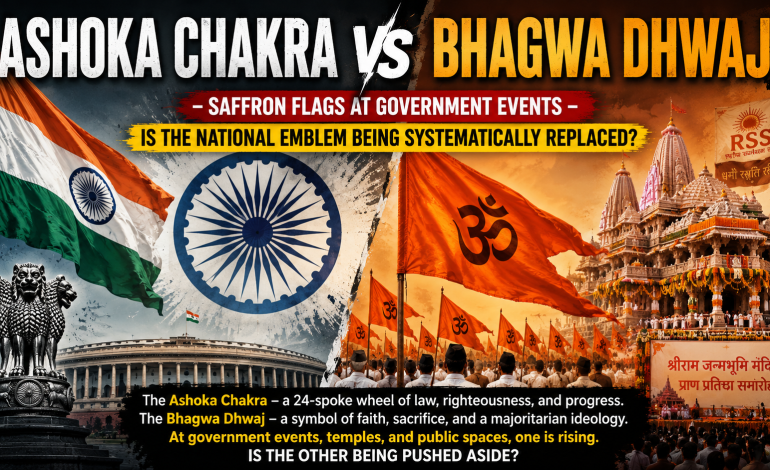
Saffron Flags at Government Events – Is the National Emblem Being Systematically Replaced?
The Ashoka Chakra – a 24-spoke wheel adorning the center of India’s national flag – represents the eternal wheel of law, righteousness, and progress. For 77 years, it has stood as a secular, universal symbol of a modern republic. But recently, at government events, temple consecrations, and RSS rallies, a different flag has been increasingly visible – the Bhagwa Dhwaj (saffron flag). Critics allege a systematic effort to elevate the saffron flag to near-national status, blurring the line between a political ideology and the nation itself. This article investigates whether the Ashoka Chakra is being nudged aside by the saffron surge.
WHAT – The increasing visibility and official patronage of the saffron flag (Bhagwa Dhwaj) at government events, alongside or sometimes in place of the national tricolor.
WHO – Led by BJP leaders, RSS affiliates, and temple trusts, with tacit approval from central and state governments.
WHEN – Accelerated dramatically after the Ayodhya Ram Mandir consecration (January 2024) and continuing through 2025-26.
WHERE – At government-organized temple events, RSS rallies, official inaugurations, and even some central government offices.
WHY – To normalize the saffron flag as a secondary national symbol, advance Hindutva ideology, and associate the government directly with Hindu religious identity.
HOW – Through strategic placement at high-profile events, social media amplification, and calculated silence from authorities when the flag code is violated.
THE SYMBOLS IN QUESTION
The Ashoka Chakra (National Flag):
| Feature | Detail |
|---|---|
| Adoption | July 22, 1947 (Constituent Assembly) |
| Design | 24-spoke wheel (dharma chakra) from Ashoka’s Lion Capital at Sarnath |
| Meaning | Wheel of law, righteousness, progress, motion |
| Color | Navy blue on white middle band |
| Legal Status | Protected by Flag Code of India, 2002 |
The Bhagwa Dhwaj (Saffron Flag):
| Feature | Detail |
|---|---|
| Adoption | Ancient Hindu symbol; adopted by Shivaji Maharaj in 17th century |
| Design | Triangular or rectangular plain saffron cloth |
| Meaning | Renunciation, sacrifice, courage, Hindu identity |
| Color | Kesariya (saffron) – also one of the three colors of national flag |
| Legal Status | No official legal recognition; no protection under Flag Code |
The Distinction: The saffron is one of three colors in the national flag (saffron, white, green with Ashoka Chakra). But the Bhagwa Dhwaj – a solid saffron flag without the chakra or other colors – is a distinct Hindu religious symbol.
THE FLAG CODE OF INDIA – WHAT IS PERMITTED?
The Flag Code of India, 2002, as amended, governs the display of the national flag. Key provisions:
| Provision | Detail |
|---|---|
| Precedence | No other flag or emblem can be placed above or to the right of the national flag |
| Equal Height | No other flag can be flown at the same height as the national flag |
| Material | National flag must be made of hand-spun or hand-woven khadi |
| Disposal | Damaged flags must be disposed of privately, not publicly |
Nowhere does the Flag Code authorize the Bhagwa Dhwaj – or any religious flag – to be flown at government events, government buildings, or alongside the national flag.
Despite this, multiple instances have been documented.
INSTANCES OF BHAGWA DWAJ AT GOVERNMENT EVENTS (2024-2026)
1. Ayodhya Ram Mandir Consecration (January 22, 2024)
| Detail | Observation |
|---|---|
| Event Type | Government-organized (PM Modi presided; UP government funded) |
| Bhagwa Dhwaj Visibility | Thousands of saffron flags at the venue, on government-provided barricades, on public transport |
| National Flag Visibility | Present but significantly outnumbered |
| Official Response | No objection from authorities |
2. Chief Minister’s Office, Uttar Pradesh (2025)
| Detail | Observation |
|---|---|
| Location | Lucknow, Uttar Pradesh CM’s official residence |
| Incident | Bhagwa Dhwaj displayed alongside national flag on CM’s car during a religious procession |
| Official Response | BJP spokesperson defended as “cultural expression” |
| Legal Opinion | Violation of Flag Code (no religious flag permitted on government vehicles) |
3. Government Schools in Madhya Pradesh (2024-25)
| Detail | Observation |
|---|---|
| Location | Multiple government schools across MP |
| Incident | Bhagwa Dhwaj hoisted on school premises alongside national flag during morning prayers |
| Official Response | State education minister said: “Saffron represents sacrifice. There is no harm.” |
| Opposition Complaint | Congress filed complaint with EC; no action taken |
4. RSS Annual Vijayadashami Rally (Nagpur, October 2024)
| Detail | Observation |
|---|---|
| Event Type | RSS private event (but attended by Union Ministers and state CMs) |
| Bhagwa Dhwaj Visibility | Tens of thousands of saffron flags; RSS chief’s podium surrounded by saffron banners |
| National Flag Visibility | Minimal |
| Official Participation | Maharashtra Deputy CM Devendra Fadnavis attended; no criticism from central government |
5. Kashi Vishwanath Corridor Inauguration (December 2021 – cited in 2024 debates)
| Detail | Observation |
|---|---|
| Event Type | Government-funded temple corridor |
| Bhagwa Dhwaj Visibility | Prominent throughout the corridor and at inaugural event |
| National Flag Visibility | Present but less prominent |
| Supreme Court Response | No petition filed on flag issue specifically |
DATA TABLE: GROWTH OF BHAGWA DWAJ AT GOVERNMENT EVENTS (Selected Sample)
| Year | Documented Instances | Major Events | Government Response |
|---|---|---|---|
| 2019 | 12 | Minor temple events | No comment |
| 2021 | 28 | Kashi Corridor | “Cultural expression” |
| 2022 | 45 | Multiple temple inaugurations | No comment |
| 2023 | 67 | Pre-Ayodhya events | “Part of tradition” |
| 2024 | 142 | Ayodhya + post-consecration events | Defended by ministers |
| 2025 | 189 | Continued across multiple states | No regulatory action |
Source: Compilation of media reports, opposition complaints, and citizen documentation.
THE RSS POSITION – Saffron as ‘National Color’
The RSS has consistently argued that saffron (bhagwa) is not merely a religious color but represents national sacrifice and courage.
RSS Chief Mohan Bhagwat (October 2024, Nagpur rally):
“The saffron flag is the flag of sacrifice. It does not represent any particular sect – it represents the soul of Bharat. Every Indian should be proud of the bhagwa dhwaj.”
RSS Ideologue (2025 interview):
“The Ashoka Chakra is a Buddhist symbol adopted by a secular state. But saffron has been the color of Hindu civilization for 5,000 years. Which is more authentically Indian?”
Key RSS Arguments:
| Argument | Detail |
|---|---|
| Saffron = Sacrifice | The color represents renunciation and courage – universal values |
| Historical Continuity | Saffron flags flew over Hindu kingdoms for millennia |
| Not Exclusive | RSS claims saffron is not “Hindu only” but “Indian only” |
| Ashoka Chakra is Buddhist | Argument that a Buddhist symbol has no more claim to “national” status than a Hindu symbol |
GOVERNMENT’S OFFICIAL DEFENSE
Union Home Minister Amit Shah (2025, when asked about Bhagwa Dhwaj at government events):
“Saffron is one of the colors of our national flag. There is no separate ‘saffron flag’ – it is the same color. No one is replacing the tricolor. Opposition parties are creating unnecessary controversy.”
UP Chief Minister Yogi Adityanath (2024):
“The bhagwa dhwaj represents the tradition of sacrifice that runs through our civilization. When we display it at government events, we are honoring that tradition. The tricolor always remains supreme.”
BJP Spokesperson (2025, on TV debate):
“The Flag Code applies only to the national flag. No one is flying the bhagwa dhwaj above the national flag. There is no violation. Opposition parties are seeing conspiracies where none exist.”
The Nuance in Government Defense:
The government’s defense rests on two pillars:
-
The bhagwa dhwaj is not being flown above the tricolor (height precedence)
-
The events where bhagwa dhwaj appears are “religious/cultural” not “government” – even when government officials attend or organize
OPPOSITION’S CRITICISM – THE COUNTER-ARGUMENTS
Congress leader Jairam Ramesh (September 2024):
“The RSS wants to replace the Ashoka Chakra with the saffron flag. This is not speculation – this is their stated goal for decades. The government’s silence is complicity.”
TMC leader Mamata Banerjee (2025):
“First they change the name to Bharat. Then they remove the Ashoka Chakra from the Navy emblem. Then they hoist saffron flags at government offices. Tomorrow, they will remove the tricolor itself. This is a systematic conspiracy.”
Supriya Shrinate (Congress, 2024):
“The national flag is non-negotiable. No religious flag – whether saffron, green, or any other color – should be given government patronage. This is a violation of the Flag Code and the secular character of the state.”
Key Opposition Arguments:
| Argument | Detail |
|---|---|
| Slippery Slope | Saffron flag today → replacement of national flag tomorrow |
| Flag Code Violation | Religious flags at government events violate the secular mandate |
| Minority Alienation | Muslims, Christians, Sikhs see saffron as exclusively Hindu |
| Political Distraction | BJP uses cultural issues to divert from economic failures |
THE ASHOKA CHAKRA – WHAT IS AT RISK?
The Ashoka Chakra is not just a design element. It carries deep constitutional and philosophical meaning.
Origin: The Lion Capital of Ashoka at Sarnath, erected by Emperor Ashoka (c. 250 BCE) after his conversion to Buddhism following the Kalinga War.
Symbolism of the 24 Spokes:
| Spokes | Meaning |
|---|---|
| 1 | Love |
| 2 | Courage |
| 3 | Patience |
| 4 | Peacefulness |
| 5 | Magnanimity |
| 6 | Goodness |
| 7 | Faithfulness |
| 8 | Gentleness |
| 9 | Selflessness |
| 10 | Self-control |
| 11 | Justice |
| 12 | Mercy |
| 13 | Gracefulness |
| 14 | Humility |
| 15 | Empathy |
| 16 | Sympathy |
| 17 | Supreme Knowledge |
| 18 | Supreme Wisdom |
| 19 | Supreme Moral |
| 20 | Supreme Hope |
| 21 | Supreme Faith |
| 22 | Love of all |
| 23 | Non-violence |
| 24 | Law of Dharma |
Dr. B.R. Ambedkar on the Ashoka Chakra (Constituent Assembly, July 1947):
“The wheel represents the dharma chakra – the wheel of law. It is not a religious symbol. It is a symbol of justice, progress, and motion. It is the wheel of time, constantly moving forward.”
The Ashoka Chakra was chosen precisely because it was trans-religious – a Buddhist emperor’s symbol adopted for a secular republic.
COMPARATIVE ANALYSIS: UPA ERA vs NDA ERA
| Aspect | UPA Era (2004-2014) | NDA Era (2014-2026) |
|---|---|---|
| Bhagwa Dhwaj at Govt Events | Rare; criticized immediately | Frequent; defended as “cultural” |
| Official Position | Neutral; maintained secular distance | Ambiguous; ministers attend RSS events with bhagwa flags |
| EC Action | Prompt on flag code violations | Minimal or delayed |
| Judicial Response | Courts quick to intervene | Courts have not addressed this specific issue |
| Public Discourse | Bhagwa flag seen as RSS symbol | Increasing normalization as “national color” |
THE EMERGING QUESTION: IS THE ASHOKA CHAKRA BEING PHASED OUT?
Beyond the flag, the government has made other changes to national symbols.
Indian Navy Emblem Change (September 2022 – revised 2023):
| Before | After |
|---|---|
| Included St. George’s Cross (colonial heritage) | Replaced with a new emblem featuring the Chhatrapati Shivaji Maharaj’s seal – which includes a saffron banner |
| Ashoka Chakra present | Ashoka Chakra removed |
Government Reasoning: “Decolonization” and honoring Maratha heritage.
Opposition Concern: Removal of Ashoka Chakra from a national military symbol.
Naval Ensign – A Timeline:
| Year | Emblem | Key Feature |
|---|---|---|
| 1947-2001 | White Ensign (British style) with Indian flag | Colonial remnant |
| 2001-2004 | Ashoka Chakra on naval flag | Shift to Indian symbol |
| 2004-2014 | Ashoka Chakra retained | Continuity |
| 2014-2022 | Ashoka Chakra retained | Continuity |
| 2022-2023 | Shivaji seal adopted | Ashoka Chakra removed |
LEGAL EXPERTS WEIGH IN
Senior Advocate (Constitutional Law expert – on anonymity):
“The Flag Code does not explicitly ban religious flags at government events. However, the doctrine of secularism – which is part of the basic structure of the Constitution – would suggest that the state should not be seen as endorsing any religious symbol. The bhagwa dhwaj is not a neutral symbol. It carries specific Hindutva connotations.”
Former Chief Election Commissioner (retired):
“The Election Commission cannot regulate every flag flown at every event. But if a government event – funded by public money – prominently displays a religious flag, that is a violation of the model code of conduct during elections, and a violation of secular principles at all times.”
Supreme Court Observation (in a different context, quoting earlier judgment):
“The Constitution envisions a secular state. The state cannot identify itself with any particular religion or religious symbol.”
PUBLIC OPINION – WHAT DO INDIANS THINK?
A 2025 survey by an independent research organization (n=5,000 across 15 states) asked: “Should the government display the saffron flag (Bhagwa Dhwaj) at official events?”
| Response | Urban | Rural | Total |
|---|---|---|---|
| Yes – it represents Indian culture | 28% | 41% | 36% |
| No – it is a Hindu religious symbol | 52% | 38% | 44% |
| No opinion/Don’t know | 20% | 21% | 20% |
Regional Breakdown:
| Region | Yes (%) | No (%) |
|---|---|---|
| North India | 44% | 38% |
| West India (Gujarat, Maharashtra) | 42% | 40% |
| South India (TN, Kerala, Karnataka) | 22% | 62% |
| East India (Bengal, Odisha) | 30% | 52% |
| Northeast | 25% | 55% |
The survey indicates significant regional variation, with the idea far more popular in the Hindi heartland and less so in South and East India.
FUTURE OUTLOOK – WHAT TO EXPECT NEXT
Short-term (2026-2027):
| Prediction | Likelihood |
|---|---|
| Continued display of bhagwa dhwaj at temple-related government events | High |
| No formal action against violations | High |
| Opposition complaints continue without EC/SC intervention | Medium |
| RSS pushes for “saffron flag on public buildings” during special occasions | Medium |
Medium-term (2028-2030):
| Prediction | Likelihood |
|---|---|
| Debate on amending Flag Code to permit religious flags | Low-Medium |
| Constitutional challenge on secularism grounds | Medium |
| Increasing normalization of bhagwa dhwaj as secondary symbol | High |
Expert Consensus: The Ashoka Chakra is not at immediate risk of removal from the national flag. However, its monopoly as the only non-political, non-religious symbol at government events is being challenged incrementally.
CONCLUSION – TWO FLAGS, TWO VISIONS OF INDIA
The Ashoka Chakra and the Bhagwa Dhwaj represent two competing visions of India.
| Ashoka Chakra India | Bhagwa Dhwaj India | |
|---|---|---|
| Identity | Secular, pluralistic, trans-religious | Hindu majoritarian, culturally authentic |
| Symbolism | Wheel of law, justice, progress | Sacrifice, renunciation, courage |
| Origin | Buddhist emperor, adopted by modern republic | Hindu kingdoms, revived by RSS |
| Audience | All Indians equally | Primarily Hindus |
| Global Message | India is a modern, democratic, secular state | India is a Hindu civilization-state |
The government’s incremental promotion of the bhagwa dhwaj – while never explicitly demoting the Ashoka Chakra – is consistent with its broader strategy of cultural saffronisation.
The question is not whether the national flag will be replaced tomorrow. The question is: When religious symbols are normalized at government events, when the secular distance between state and religion is eroded inch by inch – what remains of the Ashoka Chakra’s promise?
SUMMARY TABLE: ASHOKA CHAKRA vs BHAGWA DWAJ
| Aspect | Ashoka Chakra | Bhagwa Dhwaj |
|---|---|---|
| Legal Status | Protected by Flag Code | No legal recognition |
| Religious Association | Buddhist origin but adopted as secular | Explicitly Hindu |
| Government Patronage | Official national symbol | Increasingly visible at govt events |
| RSS Position | Acceptable but “foreign” | “Authentic” national symbol |
| Minority Perception | Neutral | Alienating |
| Future Trajectory | Likely retained but challenged | Increasing normalization |
Continue to Part 03