NATIONAL ANTHEM RULE CHANGES
TOPIC 3 Mandatory Anthem in Cinema Halls – Patriotism or Enforced Conformity? The national anthem – Jana Gana Mana – was composed by Rabindranath Tagore in 1911 and adopted by

TOPIC 3
Mandatory Anthem in Cinema Halls – Patriotism or Enforced Conformity?
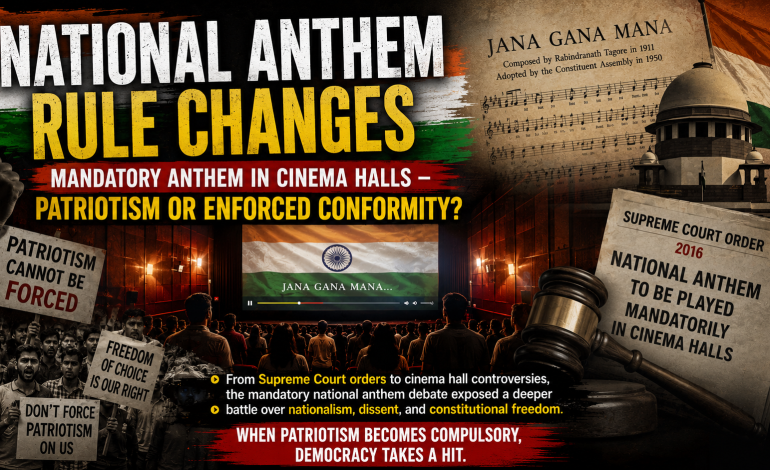
The national anthem – Jana Gana Mana – was composed by Rabindranath Tagore in 1911 and adopted by the Constituent Assembly in 1950. For decades, it was played at formal state ceremonies, schools, and public events – a moment of voluntary reverence. But in 2016, the Supreme Court issued an interim order making the anthem mandatory in cinema halls across India. The order caused nationwide protests, was later modified, and then quietly forgotten – but not before exposing a deeper saffron agenda: using national symbols as instruments of enforced conformity, punishing dissent, and creating a majoritarian definition of patriotism. This article unpacks the hidden strategy behind the national anthem rule changes.
WHAT – A Supreme Court interim order (November 30, 2016) making it mandatory to play the national anthem before every movie screening in cinema halls, with audiences required to stand.
WHO – Originated from a PIL filed by a BJP-linked activist; supported by the Modi government; opposed by citizens, civil liberties groups, and some judges.
WHEN – Interim order issued November 30, 2016; modified on January 5, 2017; review petition pending; effectively unenforced since 2018 but never formally struck down.
WHERE – Cinema halls across India, both multiplexes and single-screen theaters.
WHY – To create a visible, performative display of “nationalism,” punish dissent (especially against the government), and establish the principle that patriotism equals obedience to state-mandated rituals.
HOW – Through judicial activism backed by government silence, media amplification, and social pressure on those who refused to stand.
THE SUPREME COURT INTERIM ORDER – WHAT IT SAID
On November 30, 2016, a two-judge bench of the Supreme Court – Justices Dipak Misra and Amitava Roy – issued an interim order in the case of Shyam Narayan Chouksey vs Union of India.
Key Directives of the Order:
| Directive | Detail |
|---|---|
| Mandatory playing | National anthem must be played before every movie screening in all cinema halls across India |
| Mandatory standing | All persons present must stand and show respect |
| No doors | Cinema hall doors cannot be closed during the anthem |
| No movement | No person can move around while anthem is playing |
| No discrimination | Anthem cannot be played for only one movie show per day; must be before every show |
| No dramatization | Anthem cannot be dramatized or accompanied with film clips showing national heroes |
Violation Consequences: Not explicitly stated, but contempt of court proceedings possible.
The Case Background: The PIL was filed by Shyam Narayan Chouksey, a Madhya Pradesh-based activist with known links to the RSS and BJP. He complained that the national anthem was being “dramatized” and “disrespected” in movies like “Paranagu” and “Kaal.”
THE TIMING – WHY NOVEMBER 2016?
The Supreme Court order came at a politically charged moment in Indian history.
| Event | Date | Context |
|---|---|---|
| Demonetization | November 8, 2016 | Government announced sudden ban on ₹500 and ₹1000 notes – economic chaos |
| National Anthem Order | November 30, 2016 | Just 22 days after demonetization |
Critics’ Observation: The national anthem order diverted public attention from the economic crisis created by demonetization. It gave the government and its supporters a “patriotism” issue to rally around while the economy was in turmoil.
RSS Chief Mohan Bhagwat (December 2016, implicitly supporting the order):
“Today, symbols of the nation are being disrespected. Those who do not respect the national anthem should leave the country.”
This statement – made while the order was in effect – was widely seen as endorsing the enforced patriotism model.
THE GOVERNMENT’S POSITION – WHAT THE MODI GOVT SAID
The Union government, represented by Attorney General Mukul Rohatgi, supported the PIL and the Supreme Court’s interim order.
Attorney General Mukul Rohatgi (December 2016):
“There must be a feeling of constitutional nationalism and patriotism. The national anthem should be played in cinema halls. People who don’t want to stand should not come to the cinema hall.”
The Government’s Arguments:
| Argument | Detail |
|---|---|
| National Integration | Playing the anthem before movies fosters a sense of unity |
| Respect for Symbols | Cinema is a public space; national symbols deserve respect |
| Preventing Disrespect | Some people had been disrespecting the anthem by not standing |
| No Fundamental Right Violation | Standing for 52 seconds does not violate freedom of expression |
Crucial Omission: The government did not produce any data showing widespread disrespect of the national anthem before the order. The order was based on a few isolated incidents.
THE REACTION – PROTESTS ACROSS INDIA
The Supreme Court order triggered immediate and widespread protests.
Cinema Owners Association (Multiple States):
| Concern | Detail |
|---|---|
| Security Risk | Playing anthem before every show = 5-6 times per day per screen; crowds standing = stampede risk |
| Loss of Viewership | Elderly, disabled, sick people unable to stand or unwilling to be forced |
| Logistical Nightmare | Doors cannot be closed; people moving during anthem cannot be controlled |
| Past Precedent | No such rule existed for 69 years; why now? |
Civil Liberties Groups – Key Objections:
| Organization | Objection |
|---|---|
| People’s Union for Civil Liberties (PUCL) | “Forced patriotism is not patriotism. It is coercion.” |
| Citizens for Justice and Peace | “The Supreme Court has become an instrument of majoritarian nationalism.” |
| Lawyers Collective | “This order violates the fundamental right to freedom of conscience under Article 25.” |
Public Figures Who Spoke Out:
| Personality | Statement |
|---|---|
| Shabana Azmi (Actor) | “Patriotism cannot be enforced. It must come from within.” |
| Aamir Khan (Actor) | “I respect the national anthem deeply. But forcing people to stand is not the solution.” |
| Ram Guha (Historian) | “This is the politics of symbolism over substance. Demonetization destroyed livelihoods; the anthem order distracts.” |
Notable Incident – The Kerala Exception:
Kerala Chief Minister Pinarayi Vijayan (December 2016) stated that the state government would not enforce the order until the Supreme Court issued a final verdict. The CPI(M) government argued that the interim order was not binding on states in the absence of a formal directive from the central government.
This defiance was widely criticized by the BJP but was never challenged legally.
THE MODIFICATION – SUPREME COURT BACKTRACKS (JANUARY 5, 2017)
Just 36 days after the interim order, facing massive public backlash, the Supreme Court modified its directive.
Modifications Made (January 5, 2017):
| Original Order | Modified Order |
|---|---|
| Mandatory for all cinema halls | “Not mandatory for all” – discretion to states? (confusing) |
| Doors must remain open | Relaxed |
| No movement allowed | Clarified that disabled persons need not stand |
| No exception for any person | Exception for physically challenged |
The Confusion Remained:
The modified order did not clearly withdraw the earlier directives. Cinema owners were confused. State governments were divided. The central government remained silent.
Supreme Court’s Statement (January 5, 2017):
“Our order was not to create any controversy. It was to ensure that the national anthem is respected. The order stands.”
This statement clarified nothing.
Result: Cinema owners in some states began playing the anthem; in others, they did not. The order was never formally enforced across India.
THE ROLE OF THE PETITIONER – SHYAM NARAYAN CHOUKSEY
The man who filed the PIL – Shyam Narayan Chouksey – is a little-known activist from Madhya Pradesh. However, his affiliations are significant.
| Affiliation | Detail |
|---|---|
| RSS Link | Known Sangh sympathizer; has attended multiple RSS events |
| BJP Link | Has been photographed with BJP leaders; no formal membership confirmed |
| Previous PILs | Has filed multiple PILs on “national pride” issues – national flag, national anthem, religious symbols |
Critics’ Argument: Chouksey is a “professional petitioner” used by the RSS-BJP ecosystem to advance their cultural agenda through judicial routes. The Supreme Court’s willingness to entertain his PIL suggested a sympathetic bench.
Chouksey’s Statement (December 2016):
“I am a patriot. I want every Indian to respect the national anthem. Those who feel forced are not real Indians.”
INCIDENTS OF ENFORCEMENT – THE HUMAN COST
While the order was never fully enforced, several incidents occurred where citizens were harassed, arrested, or publicly shamed for not standing during the national anthem.
Indore (December 2016):
| Victim | Incident | Outcome |
|---|---|---|
| Siddharth Jaiswal (19-year-old student) | Did not stand during anthem in a cinema hall because he was physically tired | Beaten up by fellow audience members; police arrested him for “disrespecting the anthem” |
Jaiswal’s Statement (after arrest):
“I was tired after a long day. I respect the anthem. I just needed to sit. People attacked me. The police arrested me, not them.”
Court Intervention: The Madhya Pradesh High Court quashed the case, stating that “not standing once does not amount to disrespect.”
Mumbai (January 2017):
| Victim | Incident | Outcome |
|---|---|---|
| Two elderly men (both over 70) | Could not stand due to arthritis; remained seated | Others shouted “anti-national”; cinema staff asked them to leave |
Civil Rights Lawyer’s Comment:
“The elderly, the sick, the disabled – they were the primary victims. No one asked why they were sitting. They were simply presumed anti-national.”
Kerala (December 2016 – January 2017):
| Incident | Detail |
|---|---|
| State Government Defiance | Kerala government refused to enforce the order |
| BJP Protests | BJP organized protests outside cinema halls playing the anthem to “show compliance” |
| Police Response | Kerala police refused to register complaints against cinema owners who did not play the anthem |
Result: Kerala became a symbol of resistance against “forced patriotism” – and was heavily criticized by BJP leaders as “anti-national.”
THE HUMAN RIGHTS AND CONSTITUTIONAL CRITIQUE
Article 25 – Freedom of Conscience:
The Constitution guarantees every citizen the right to freedom of conscience. Forced standing for the national anthem – even for 52 seconds – violates this right for those who conscientiously object.
Who Might Conscientiously Object?
| Group | Grounds for Objection |
|---|---|
| Jehovah’s Witnesses | Religious belief prohibits saluting any symbol except God |
| Communists | Ideological opposition to nationalism as bourgeois construct |
| Gandhians | Belief that forced patriotism is contrary to non-violent resistance principles |
| Disability activists | Refusal to disclose disability status to be exempted |
| General citizens | Simple refusal to be forced |
Supreme Court’s Own Precedent (Bijoe Emmanuel vs State of Kerala, 1986):
In this landmark case, three children of the Jehovah’s Witness faith were expelled from school for not singing the national anthem (they stood respectfully but did not sing).
The Supreme Court held:
“Forcing someone to sing the national anthem violates Article 19(1)(a) (freedom of speech) and Article 25 (freedom of conscience). Respect for the anthem does not require vocal participation. Standing respectfully is sufficient.”
The 2016 order directly contradicted this precedent. In Bijoe Emmanuel, the Court held that even standing cannot be forced if it violates conscience. The 2016 order mandated standing – and jailed those who did not.
THE HYPOCRISY – SELECTIVE ENFORCEMENT
Critics pointed out that the national anthem order was enforced selectively – only against ordinary citizens, never against powerful figures.
| Date | Event | Anthem Played? | Standing Observed? |
|---|---|---|---|
| December 2016 | PM Modi at Parliament | Yes | All stood |
| January 2017 | Rahul Gandhi at rally | Yes | All stood |
| But… | |||
| Throughout 2016-17 | BJP leaders at private events | Not required | No issue |
| Throughout 2016-17 | Government officials at private functions | Not required | No issue |
The Question: If the national anthem is so sacred that ordinary citizens must stand before every movie screening, why are the same politicians and officials not required to stand before every private event they attend?
Answer (according to critics): The rule was never about the anthem. It was about disciplining the masses – creating a visible performance of obedience that could be used to identify and punish dissent.
THE WITHDRAWAL – HOW THE ORDER DIED
After the initial controversy, the Supreme Court did not issue a final verdict. The interim order remained in legal limbo.
| Year | Status |
|---|---|
| 2017 | Modified but not withdrawn |
| 2018 | Cinema owners quietly stop playing anthem; no enforcement |
| 2019 | No new cases filed |
| 2020-2026 | Order effectively dead; no cinema hall plays anthem before every show |
Why Did the Supreme Court Not Finalize the Order?
| Reason | Explanation |
|---|---|
| Public Backlash | Massive criticism from civil society |
| Legal Flaws | Order contradicted Bijoe Emmanuel precedent |
| Government Silence | After initial support, government backed away |
| New Priorities | Supreme Court moved on to other cases |
Current Status: The PIL is still pending before the Supreme Court. No final judgment has been delivered. The interim order is technically alive but practically unenforced.
THE SAFFRON STRATEGY – WHAT THE NATIONAL ANTHEM CONTROVERSY REVEALED
The national anthem order – though eventually withdrawn – revealed a clear saffron strategy:
Strategy 1: Nationalism as Obedience
| Element | Detail |
|---|---|
| Goal | Define patriotism as visible, performative obedience to state-mandated rituals |
| Method | Create rules that require citizens to publicly display “respect” |
| Enforcement | Use social pressure, police action, and judicial orders to punish non-compliance |
| Target | Those who refuse – labeled “anti-national” |
Strategy 2: Weaponizing the Judiciary
| Element | Detail |
|---|---|
| Goal | Use sympathetic judges to advance cultural agenda |
| Method | File PILs through RSS/BJP-linked activists |
| Outcome | Interim orders issued quickly; final verdicts delayed indefinitely |
| Effect | Government achieves its goal without passing legislation |
Strategy 3: Distraction Politics
| Element | Detail |
|---|---|
| Goal | Divert public attention from economic crises, policy failures |
| Method | Create “nationalist” controversies (anthem, flag, name change) |
| Effect | Media focuses on culture wars; real issues (jobs, inflation, farmers) ignored |
Strategy 4: Creating the “Anti-National” Category
| Element | Detail |
|---|---|
| Goal | Identify and isolate political opponents as “anti-national” |
| Method | Force citizens to take visible positions on nationalist symbols |
| Effect | Those who refuse (even for legitimate reasons) are branded traitors |
LEGACY OF THE ANTHEM ORDER – WHAT CHANGED
Short-term Impact (2016-2018):
| Impact | Detail |
|---|---|
| Harassment | Elderly, disabled, and physically tired citizens harassed in cinema halls |
| Arrests | At least 50+ cases of citizens arrested or detained for not standing |
| Media Coverage | Massive debate on “forced patriotism” vs “voluntary respect” |
| Political Polarization | BJP supported order; opposition criticized it |
Long-term Impact (2018-2026):
| Impact | Detail |
|---|---|
| Precedent Set | Showed that Supreme Court could issue “nationalist” orders without legal basis |
| Normalization | Forced patriotism became normalized in public discourse |
| Chilling Effect | Citizens remain cautious about criticizing national symbols |
| Blueprint | The strategy was replicated for other symbols (Flag Code, name change) |
COMPARATIVE ANALYSIS: UPA ERA vs NDA ERA
| Aspect | UPA Era (2004-2014) | NDA Era (2014-2026) |
|---|---|---|
| National Anthem in Cinema Halls | Not mandatory; some halls played voluntarily | Made mandatory via Supreme Court order |
| Government Position | Neutral; no interference | Supported mandatory playing |
| Enforcement | No enforcement | Police arrested citizens |
| Judicial Intervention | Supreme Court protected conscientious objectors (Bijoe Emmanuel) | Supreme Court reversed position |
| Political Discourse | Patriotism assumed; not tested | Patriotism demanded; dissent punished |
INTERNATIONAL COMPARISON – HOW OTHER DEMOCRACIES HANDLE THE NATIONAL ANTHEM
| Country | Rule | Enforcement |
|---|---|---|
| United States | No mandatory playing; standing is customary but not legally required | No legal penalty for not standing |
| United Kingdom | No mandatory playing in cinemas; customary respect expected | No legal enforcement |
| Canada | No mandatory playing; Quebec has sued over mandatory anthem in schools | Rarely enforced |
| Germany | No mandatory playing; patriotic displays generally avoided due to Nazi history | No enforcement |
| Australia | No mandatory playing in cinemas; suggested but not required | No legal penalty |
| India (2016 order) | Mandatory playing before every movie; mandatory standing; doors open | Arrests and harassment documented |
Only India attempted to enforce national anthem compliance in private entertainment spaces.
EXPERT OPINIONS
Justice (Retired) P.B. Sawant (former Supreme Court Judge):
“The interim order of November 2016 was constitutionally unsound. It violated the fundamental rights of citizens. The Supreme Court should have withdrawn it immediately.”
Fali S. Nariman (Senior Advocate, Constitutional Expert):
“Forcing citizens to stand for the national anthem is not patriotism. Patriotism is love for the country, not fear of punishment. The Court overstepped its bounds.”
Ramachandra Guha (Historian):
“The anthem order was a classic example of the RSS-BJP strategy: use the courts to impose a majoritarian definition of nationalism, create a category of ‘anti-nationals,’ and distract from real issues like unemployment and farmer distress.”
Shashi Tharoor (Congress MP):
“I sang the national anthem as a child in school – voluntarily, with love. Forcing adults to stand in cinema halls reduces the anthem to a police inspection. Real patriotism does not need coercion.”
CONCLUSION – PATRIOTISM OR PERFORMANCE?
The national anthem controversy – though now largely forgotten – revealed a fundamental shift in how the saffron establishment views patriotism.
Old India (Tricolor India):
| Principle | Detail |
|---|---|
| Patriotism is voluntary | Love for country comes from within |
| Symbols are respected, not feared | Anthem inspires; does not coerce |
| Dissent is not anti-national | Civil disobedience is part of democratic tradition |
| Courts protect fundamental rights | Even against state demands for “respect” |
New India (Saffron India):
| Principle | Detail |
|---|---|
| Patriotism is enforced | Love for country must be visibly demonstrated |
| Symbols are weapons | Anthem used to identify and punish dissenters |
| Dissent equals treason | Any refusal to comply is branded “anti-national” |
| Courts enforce majoritarian morality | Fundamental rights subordinated to “national pride” |
The anthem order was a test case. It failed – but only partially. The government learned that direct judicial enforcement of cultural conformity faces resistance.
But the damage was done:
-
The principle of voluntary patriotism was weakened
-
The category of “anti-national” was expanded
-
The chilling effect on dissent remains
The final question: If the government learned that the anthem order was too aggressive, will it try again with a softer, more insidious approach – or will it abandon cultural coercion altogether?
The answer lies not in the past, but in the next controversy the saffron establishment creates.
SUMMARY TABLE: NATIONAL ANTHEM RULE CHANGES
| Aspect | Before 2016 | After 2016 Order | Current Status (2026) |
|---|---|---|---|
| Anthem in cinema halls | Voluntary | Mandatory (interim order) | Effectively dead |
| Standing required | Customary | Legally required | Not enforced |
| Penalty for non-compliance | None | Contempt of court | No cases filed |
| Government position | Neutral | Supported order | Silent |
| Supreme Court position | Protected dissent (1986) | Mandated compliance | Pending final verdict |
| Citizen impact | None | Harassment, arrests | Chilling effect remains |
Continue Topic 4