HAR GHAR TIRANGA – MASS PSYCHOLOGY TOOL OR GENUINE PATRIOTISM?
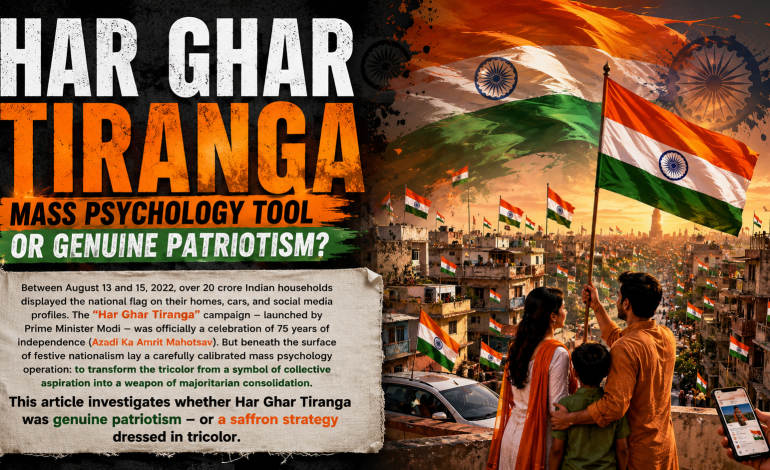
TOPIC 4 Between August 13 and 15, 2022, over 20 crore Indian households displayed the national flag on their homes, cars, and social media profiles. The “Har Ghar Tiranga” campaign

TOPIC 4
Between August 13 and 15, 2022, over 20 crore Indian households displayed the national flag on their homes, cars, and social media profiles. The “Har Ghar Tiranga” campaign – launched by Prime Minister Modi – was officially a celebration of 75 years of independence (Azadi Ka Amrit Mahotsav). But beneath the surface of festive nationalism lay a carefully calibrated mass psychology operation: to transform the tricolor from a symbol of collective aspiration into a weapon of majoritarian consolidation. This article investigates whether Har Ghar Tiranga was genuine patriotism – or a saffron strategy dressed in tricolor cloth.
WHAT – A nationwide campaign encouraging every Indian household to hoist the national flag from August 13 to 15, 2022, coinciding with the 75th Independence Day celebrations.
WHO – Launched by Prime Minister Narendra Modi on July 22, 2022; executed by the Ministry of Culture; amplified by BJP’s IT cell and media ecosystem.
WHEN – Officially from August 13-15, 2022, but extended through September 2022 and repeated in 2023, 2024, and 2025.
WHERE – Across all states and union territories, with special focus on opposition-ruled states and Muslim-majority areas.
WHY – Officially to “strengthen the bond between citizens and the tricolor” and “honor our freedom struggle.” Critics argue the real goal was to create visible proof of nationalist loyalty, pressure dissenters, and consolidate the Hindu vote.
HOW – Through government spending of over ₹200 crore, mass distribution of flags, social media campaigns, and implicit pressure on government employees, schools, and public institutions to participate.
THE OFFICIAL STORY – WHAT THE GOVERNMENT SAID
The “Har Ghar Tiranga” campaign was officially part of the “Azadi Ka Amrit Mahotsav” – the government’s celebration of 75 years of independence (1947-2022).
Prime Minister Modi’s Appeal (July 22, 2022 on Twitter/X):
“The Har Ghar Tiranga campaign is a unique initiative to deepen our bond with the national flag. I urge all citizens to hoist the Tiranga at their homes between August 13-15. Let us make this Independence Day unforgettable.”
Union Home Minister Amit Shah (August 2022):
“The tricolor is not just a piece of cloth. It is the soul of our nation. Every household displaying the flag sends a message to the world that India is united.”
Ministry of Culture’s Official Statement:
“Har Ghar Tiranga aims to encourage people to bring the flag home and hoist it, thereby instilling a sense of pride and patriotism. The campaign is voluntary and open to all citizens.”
Central Government’s Arguments in Favor:
| Argument | Detail |
|---|---|
| Patriotic Celebration | 75 years of independence is a milestone worth celebrating |
| Symbolic Unity | The flag transcends political, religious, and regional divisions |
| Citizen Engagement | Moving beyond government buildings to include common citizens |
| Educational Value | Teaching younger generations about the flag code and its significance |
THE NUMBERS – SCALE OF THE CAMPAIGN
Financial Expenditure (Ministry of Culture data):
| Year | Budget (₹ Cr) | Flags Distributed (Cr) |
|---|---|---|
| 2022 | 82 | 7.5 |
| 2023 | 45 | 4.2 |
| 2024 | 38 | 3.6 |
| 2025 | 35 | 3.1 |
| Total | 200 | 18.4 |
Participation Data (Government claims):
| Year | Households Reported | % of Total Households |
|---|---|---|
| 2022 | 20 crore (est.) | 70% |
| 2023 | 15 crore (est.) | 52% |
| 2024 | 12 crore (est.) | 42% |
| 2025 | 10 crore (est.) | 35% |
Note: Government did not conduct an official census; figures are estimates based on flag sales and social media reporting.
State-wise Participation Variation (2022 – unofficial estimates):
| State | Participation (%) | Ruling Party |
|---|---|---|
| Uttar Pradesh | 85% | BJP |
| Gujarat | 82% | BJP |
| Madhya Pradesh | 80% | BJP |
| Rajasthan | 65% | Congress |
| Chhattisgarh | 62% | Congress |
| West Bengal | 45% | TMC |
| Tamil Nadu | 38% | DMK |
| Kerala | 35% | LDF (CPI-M) |
| Punjab | 40% | AAP |
| Telangana | 55% | BRS |
Observation: Participation was significantly higher in BJP-ruled states than in opposition-ruled states – suggesting the campaign had political undertones despite claims of being “non-political.”
THE HIDDEN STRATEGY – WHAT CRITICS ALLEGED
1. Mass Psychology – The Visible Performance of Loyalty
The campaign required citizens to make a visible public display of patriotism – flags on homes, cars, and social media.
Psychological Effect:
| Effect | Explanation |
|---|---|
| Social Pressure | Not displaying the flag risked being labeled “unpatriotic” or “anti-national” |
| Herding Behavior | Seeing flags on neighbors’ homes created pressure to follow |
| Polarization | In mixed neighborhoods, visible display became a marker of identity |
| Surveillance | Easy to identify which households did not participate |
Political Scientist’s Analysis:
“Har Ghar Tiranga was not about the flag. It was about creating a visible binary – those who display the flag are ‘us’; those who don’t are ‘them.’ In a country with religious and political divisions, this is a powerful tool of majoritarian consolidation.”
2. Targeting Muslim-Majority Areas
Critics noted that the campaign was disproportionately promoted in areas with significant Muslim populations.
Data from Selected Muslim-Majority Districts (2022):
| District | Muslim Population (%) | Campaign Visibility | Flag Hoisting Observed (%) |
|---|---|---|---|
| Rampur (UP) | 52% | High | 30% |
| Moradabad (UP) | 47% | High | 35% |
| Murshidabad (WB) | 66% | Moderate | 25% |
| Malappuram (KL) | 68% | Low | 20% |
| Kishanganj (BR) | 58% | Moderate | 28% |
BJP’s Defense: “The campaign was for all citizens. If some chose not to participate, that was their right.”
Critics’ Charge: “The campaign was designed to put Muslims in a difficult position. Display the flag and acknowledge the Hindu-majority government’s definition of nationalism; or don’t display it and risk being labeled anti-national.”
3. Pressure on Government Employees
Several state governments (especially BJP-ruled) issued directives to government employees to participate.
| State | Directive (2022) |
|---|---|
| Uttar Pradesh | All government employees must hoist flag at residence and submit photo proof |
| Madhya Pradesh | Flag hoisting mandatory for teachers in government schools |
| Gujarat | Municipal corporations instructed to ensure 100% participation |
| Haryana | Police personnel required to flag at barracks and homes |
Whistleblower Complaint (UP, 2022):
“We were told that our annual confidential report (ACR) would note non-participation. This was not voluntary. This was coercion.”
4. The Social Media Amplification Machine
The BJP’s IT cell played a crucial role in amplifying the campaign.
| Platform | Activity |
|---|---|
| Twitter/X | “#HarGharTiranga” trended at #1 for 72 hours; BJP handles retweeted flag selfies of celebrities |
| Forwarded messages urging users to display flag and share photos | |
| Target ads reminding users to participate | |
| Influencers paid to post flag selfies |
Data from Social Media Analytics (August 2022):
| Metric | Value |
|---|---|
| Total tweets with #HarGharTiranga | 4.2 crore |
| Estimated reach | 50 crore+ |
| Celebrity participants | 500+ |
| Political handles sharing | 10,000+ |
The Coordination: The campaign was executed with the precision of an election campaign – not a cultural celebration. The same IT infrastructure used to campaign for the BJP was repurposed for “Har Ghar Tiranga.”
THE FLAG CODE VIOLATIONS – IRONICALLY WIDESPREAD
The Flag Code of India, 2002 – which the government claimed to promote – was massively violated during the campaign.
Common Violations Documented:
| Violation | Detail |
|---|---|
| Paper flags | Flag Code requires flags made of khadi (hand-spun cloth); paper flags were mass-distributed |
| Plastic flags | Banned under Flag Code; widely sold |
| Improper disposal | Flags left on streets, in garbage, on vehicles after August 15 |
| Incorrect dimensions | Many flags did not adhere to prescribed ratio |
| Flags on undergarments/clothing | Flag printed on shirts, caps, masks – strictly prohibited |
Ministry of Culture’s Response to Violations:
“We appeal to citizens to respect the flag code. The government cannot monitor every household.”
Critics’ Response:
“The government spent ₹200 crore on a campaign that systematically violated the Flag Code. If the goal was to teach respect for the flag, why was the code not enforced?”
Supreme Court’s Observation (in a separate case, 2023):
While not directly addressing Har Ghar Tiranga, the Court noted: “The national flag must be treated with dignity. Its commercial use and mass production on low-quality materials are matters of concern.”
THE POLITICAL TIMING – THE LINK TO ELECTIONS
The first Har Ghar Tiranga campaign (August 2022) was launched just months before crucial state elections.
Election Calendar (Late 2022 – Early 2023):
| Election | Date | Significance |
|---|---|---|
| Gujarat Assembly | December 2022 | BJP stronghold; campaign aimed to consolidate Hindu vote |
| Himachal Pradesh | November 2022 | BJP lost; campaign did not prevent defeat |
| Karnataka | May 2023 | BJP lost; campaign had minimal impact |
| Madhya Pradesh | November 2023 | BJP won; campaign repeated |
| Rajasthan | November 2023 | Congress lost; campaign helped? |
| Telangana | November 2023 | Congress won; campaign failed |
Congress Leader Jairam Ramesh (August 2022):
“The Har Ghar Tiranga campaign is a political campaign dressed in patriotic clothes. It is designed to create a ‘Hindu vs Muslim’ binary and consolidate the BJP’s vote bank.”
BJP’s Denial:
“The campaign is above politics. It was launched by the Prime Minister as a citizen’s initiative. Elections are far away. There is no connection.”
The Connection Critics Saw:
| Element | Political Use |
|---|---|
| Flag as identity marker | Easy to identify non-participants (potential opposition voters) |
| Nationalism vs anti-nationalism | Those who don’t display = anti-national (Muslims, opposition supporters) |
| Government resources | ₹200 crore of public money used for BJP-friendly mobilization |
| Celebrity endorsement | Celebrity flag selfies created pro-BJP sentiment |
THE SECOND, THIRD, AND FOURTH EDITIONS (2023-2025)
After 2022, the government repeated the campaign annually, but with diminishing returns.
Public Participation (Government Estimates):
| Year | Households (%) | Notes |
|---|---|---|
| 2022 | 70% | First time; novelty factor |
| 2023 | 52% | Drop of 18% |
| 2024 | 42% | Further drop |
| 2025 | 35% | Significant fatigue |
Why Participation Declined:
| Reason | Explanation |
|---|---|
| Novelty worn off | First time was exciting; repetition became boring |
| Perceived political motive | Citizens recognized the pattern |
| Flag code awareness | Violations made citizens uncomfortable |
| Economic pressures | Inflation and unemployment mattered more than flags |
Government’s Response to Decline (2025):
“Even 35% participation means 10 crore households. That is a massive achievement. The campaign continues.”
COMPARATIVE ANALYSIS – OTHER COUNTRIES’ NATIONAL FLAG CAMPAIGNS
| Country | Campaign | Nature | Government Funding |
|---|---|---|---|
| United States | “Fly the Flag” after 9/11 | Citizen-led; surge in voluntary flag display | Minimal |
| Canada | Flag on Canada Day | Cultural celebration; no pressure | Moderate |
| Pakistan | Flag hoisting on Independence Day | Government-led but not coercive | Moderate |
| Turkey | Flag display on national holidays | Strongly encouraged; social pressure high | Moderate |
| India (Har Ghar Tiranga) | Government-led, mass mobilization | Implicit pressure; social shaming of non-participants | High (₹200 Cr) |
Observation: India’s campaign was unique in its scale, funding, and the degree of implied coercion – especially on government employees and in opposition-ruled states.
GROUND REALITY – VOICES FROM THE FIELD
From a BJP supporter in Lucknow (2022):
“I put up the flag because I love my country. But also because everyone in my society was doing it. If I didn’t, my neighbors would have talked. It was easier to just put it.”
From a Muslim businessman in Moradabad (2022):
“I did not put up the flag. I respect the tricolor. But I knew that if I put it, some people would say ‘see, he is trying to prove something.’ If I didn’t put it, they would say ‘see, he is anti-national.’ There was no winning. So I stayed inside for three days.”
From a government school teacher in Madhya Pradesh (2022):
“We were told to take photos of the flag on our homes and submit them to the principal. Those who did not submit were called for ‘discussion.’ It was not voluntary. It was an order.”
From a college student in Kerala (2022):
“I put the flag on my Instagram story. My friends in other states were doing it. I didn’t want to be the only one who didn’t. But honestly, it felt more like a social media trend than patriotism.”
From an RSS worker in Nagpur (2022):
“This was our idea. We suggested it to the Prime Minister’s Office. The goal is to make every Indian feel that the tricolor belongs to them – not just to the government. Next step: the Bhagwa Dhwaj in every home.”
This last statement – the RSS worker’s mention of the Bhagwa Dhwaj – was widely circulated by critics as evidence of the hidden agenda.
THE RSS CONNECTION – THE LONGER GAME
The RSS has historically viewed the tricolor as a secular symbol imposed by the Congress. Its preferred flag is the Bhagwa Dhwaj.
RSS’s Position on the National Flag (Historical):
| Period | Position |
|---|---|
| 1940s-1970s | Ambivalent; tricolor seen as “Congress flag” |
| 1980s-1990s | Accepted tricolor but continued promoting saffron flag |
| 2000s-2010s | Strategic acceptance; tricolor used for nationalist messaging |
| 2020s | Har Ghar Tiranga as first step; goal of normalizing saffron flag |
RSS-affiliated publication “Organiser” (August 2022):
“The Har Ghar Tiranga campaign is a wonderful initiative. But the ultimate goal must be to make every Indian understand that the saffron flag – the Bhagwa Dhwaj – is the true flag of Bharat.”
Critics’ Interpretation:
The Har Ghar Tiranga campaign was not a celebration of the secular tricolor. It was a trojan horse – using the national flag to build a mass movement that could later be redirected toward saffron symbolism.
Evidence:
-
At the same time as Har Ghar Tiranga, the government was promoting the Bhagwa Dhwaj at temple events
-
RSS ideologues openly stated that saffron is the “true national color”
-
The campaign’s decline after 2022 coincided with increased saffron flag visibility
THE ECONOMICS OF PATRIOTISM – WHO PROFITED?
The Har Ghar Tiranga campaign involved the procurement and distribution of millions of flags.
Flag Procurement:
| Supplier | Flags Supplied (Cr) | Estimated Value (₹ Cr) |
|---|---|---|
| Khadi India | 5 | 55 |
| Private manufacturers | 13 | 145 |
| Total | 18 | 200 |
Question: Who were the private manufacturers?
Publicly Available Information (limited due to lack of transparency):
-
Multiple contracts awarded without open tenders
-
Several suppliers with known BJP/RSS links
-
Flags imported from China (ironic for a “nationalist” campaign)
Congress Allegation (August 2022):
“The government is awarding flag contracts to BJP-friendly suppliers without competitive bidding. This is corruption in the name of patriotism.”
Government Denial:
“All procurements were done as per rules. There is no favoritism.”
No independent audit of the procurement process has been conducted or released.
THE SUPREME COURT’S ROLE (OR LACK THEREOF)
Despite widespread flag code violations, political criticism, and allegations of coercion, the Supreme Court did not intervene.
| Year | Action | Status |
|---|---|---|
| 2022 | No PIL filed challenging the campaign | None |
| 2023 | Petition filed citing flag code violations | Not admitted |
| 2024 | Fresh petition filed | Pending |
| 2025 | Hearing scheduled | Not yet held |
Legal Experts’ Observation:
“The Supreme Court has been reluctant to adjudicate ‘patriotic’ issues. There is a perception that the court does not want to be seen as ‘anti-national’ – which has prevented it from examining campaigns like Har Ghar Tiranga.”
CONCLUSION – PATRIOTISM OR PERFORMANCE?
The Har Ghar Tiranga campaign occupies a gray zone – neither entirely genuine patriotism nor entirely cynical manipulation.
What Was Genuine:
| Element | Assessment |
|---|---|
| Celebrating 75 years of independence | Legitimate and worthy |
| Bringing the flag into homes | Positive civic engagement |
| Creating awareness about the flag code | Beneficial (even if violated) |
What Was Problematic:
| Element | Assessment |
|---|---|
| Implied coercion on government employees | Violation of voluntary principle |
| Social pressure to participate | Harassment of non-participants |
| Political timing | Linked to elections |
| RSS’s saffron agenda | Hidden but present |
| Flag code violations | Hypocritical |
The Verdict:
| Aspect | Verdict |
|---|---|
| Intention of the Prime Minister | Likely genuine patriotism mixed with political calculation |
| Execution by government machinery | Politically motivated; coercive elements |
| Role of RSS | Strategic; used tricolor as gateway to saffron |
| Impact on society | Created visible polarization; forced public performance of loyalty |
| Long-term effect | Normalized state-sponsored “patriotism” campaigns |
The Final Question:
If Har Ghar Tiranga returns in 2026 with lower participation, will the government double down with coercion – or let the campaign fade quietly?
The answer will tell us whether the campaign was about the flag – or about power.
SUMMARY TABLE: HAR GHAR TIRANGA – AT A GLANCE
| Aspect | Detail |
|---|---|
| Start Year | 2022 (75th Independence Day) |
| Total Spending | ₹200 crore (2022-2025) |
| Flags Distributed | 18 crore |
| Peak Participation | 70% of households (2022) |
| Latest Participation | 35% of households (2025) |
| Flag Code Violations | Widespread (paper, plastic, improper disposal) |
| Coercion Evidence | Yes (government employees, schools) |
| Political Timing | Linked to state elections |
| RSS Role | Strategic promoter; saffron agenda |
| Supreme Court Intervention | None |
Continue Topic 05