RENAMING HISTORICAL CITIES: Decolonization or Erasing India’s Muslim Heritage?
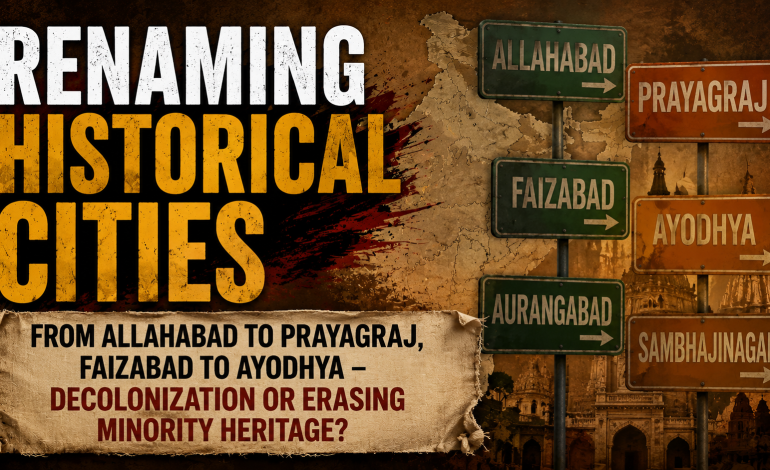
TOPIC 5 From Allahabad to Prayagraj, Faizabad to Ayodhya – Decolonization or Erasing Minority Heritage? What’s in a name? Shakespeare asked. In India under the BJP, the answer is: everything.

TOPIC 5
From Allahabad to Prayagraj, Faizabad to Ayodhya – Decolonization or Erasing Minority Heritage?
What’s in a name? Shakespeare asked. In India under the BJP, the answer is: everything. Since 2014, a quiet but relentless renaming revolution has swept across the country – Allahabad became Prayagraj, Faizabad became Ayodhya, Aurangabad is now Sambhajinagar, and even Mughal-era roads and villages are being stripped of their ‘Muslim-sounding’ identities. The government calls it “decolonization” and “reclaiming indigenous heritage.” Critics call it the saffron erasure of India’s pluralistic past – a systematic effort to replace Muslim and colonial names with Hindu-centric ones, reshaping collective memory one signboard at a time. This article investigates whether renaming is cultural restoration or cultural cleansing.
WHAT – A sustained campaign by BJP-led central and state governments to rename cities, towns, roads, villages, and institutions that bear Muslim, Mughal, or colonial-era names, replacing them with Hindu mythological, historical, or regional names.
WHO – Led by the BJP and its state governments (Uttar Pradesh, Madhya Pradesh, Maharashtra, Gujarat, etc.), supported by RSS affiliates, and endorsed by sections of the judiciary and intelligentsia.
WHEN – Accelerated dramatically after 2014, with major renaming waves in 2018-2019 (Prayagraj, Ayodhya), 2020-2023 (Aurangabad proposal), and 2024-2026 (village-level renaming in MP, UP).
WHERE – Across India, with particular intensity in the Hindi heartland (UP, MP) and Maharashtra, targeting Mughal-era names and Muslim-sounding villages.
WHY – Officially to shed “colonial and Mughal slavery,” restore “authentic Indian names,” and promote national pride. Critics argue the real goal is to erase Muslim heritage, assert Hindu majoritarianism, and consolidate the Hindutva vote bank.
HOW – Through state government resolutions, central government approvals, administrative orders, and – in some cases – unilateral announcements by chief ministers without legislative consultation.
THE CONSTITUTIONAL & LEGAL FRAMEWORK – CAN CITIES BE RENAMED?
Renaming cities in India is not unconstitutional, but it follows a specific legal process. The power to rename cities primarily rests with state governments, subject to central government approval for changes that affect national records.
Legal Process for Renaming a City:
| Step | Authority | Action |
|---|---|---|
| 1 | State Government | Proposes name change via state cabinet resolution |
| 2 | State Legislature | May pass resolution (not always required) |
| 3 | Central Government | Approves renaming and notifies the Registrar General of India |
| 4 | Ministry of Home Affairs | Issues official gazette notification |
| 5 | Various Departments | Update records (postal, railways, survey, etc.) |
Notable Renamings Under BJP Governments:
| Old Name | New Name | Year | State | Ruling Party |
|---|---|---|---|---|
| Allahabad | Prayagraj | 2018 | Uttar Pradesh | BJP |
| Faizabad | Ayodhya | 2018 | Uttar Pradesh | BJP |
| Mughalsarai | Pandit Deen Dayal Upadhyay Nagar | 2018 | Uttar Pradesh | BJP |
| Aurangabad | Sambhajinagar | Proposed (pending central approval) | Maharashtra | BJP-Shiv Sena |
| Gurgaon | Gurugram | 2016 | Haryana | BJP |
| Rajpath | Kartavya Path | 2022 | Delhi (Central) | BJP |
| Akbar Road (Delhi) | Dr. APJ Abdul Kalam Road | 2015 | Delhi (Central) | BJP |
| Fatehabad (town) | Sindoorapuram | Proposed (Zila Panchayat resolution) | Uttar Pradesh | BJP |
Source for renaming list:
ALLAHABAD TO PRAYAGRAJ – THE FLAGSHIP RENAME (2018)
The renaming of Allahabad to Prayagraj in 2018 was the most high-profile and controversial of the BJP’s renaming exercises.
Historical Background of “Allahabad”:
| Period | Name | Origin |
|---|---|---|
| Ancient | Prayag | Sanskrit for “place of sacrifice” – at the confluence of Ganga, Yamuna, and mythical Saraswati |
| Mughal Era (1575) | Ilahabad | Emperor Akbar founded the city and named it “Ilahabad” (City of Allah) |
| British Era | Allahabad | Anglicized version of Ilahabad; served as capital of United Provinces |
| Post-Independence | Allahabad | Retained; home to Allahabad High Court and Anand Bhavan (Nehru family home) |
The Renaming Process (2018):
| Date | Event |
|---|---|
| October 2018 | UP Cabinet (Yogi Adityanath government) approved renaming proposal |
| November 2018 | State legislature passed resolution |
| December 2018 | Central government approved |
| Kumbh Mela 2019 | New name “Prayagraj” officially used during the festival |
Justification Given by UP Government:
UP Minister Siddhartha Nath Singh stated: “The renaming of Allahabad as Prayagraj came for approval in the meeting and I am happy to say Allahabad will now be known as Prayagraj. Rig Veda, Mahabharat and Ramayana also mention Prayagraj (for Allahabad).”
Impact of the Rename:
| Area | Status Before | Status After |
|---|---|---|
| City name | Allahabad | Prayagraj |
| Division name | Allahabad | Prayagraj |
| High Court | Allahabad High Court | Still “Allahabad High Court” (not renamed) |
| University | Allahabad University | Still “Allahabad University” (not renamed) |
| Lok Sabha Constituency | Allahabad | Still “Allahabad” (unchanged) |
The Anomaly: As AAP MP Ashok Mittal noted in Parliament (March 2025): “The city has been renamed, but its high court and a prestigious university still carry the name ‘Allahabad’. Even the Lok Sabha constituency continues to be named Allahabad instead of Prayagraj.”
Akbar ‘Prayagraji’ Incident:
Perhaps the most absurd consequence of the renaming was documented in 2025: the famous Urdu poet Akbar Allahabadi was officially referred to as “Akbar Prayagraji” in some government records – changing the name of a deceased poet who never consented to the rename.
FAIZABAD TO AYODHYA – ERASING A MUSLIM-ERA DISTRICT (2018)
The renaming of Faizabad district to Ayodhya in 2018 was even more politically and religiously charged than Allahabad’s rename.
Historical Background:
| Period | Name | Significance |
|---|---|---|
| Ancient | Ayodhya | Hindu epic Ramayana’s capital of Lord Ram’s kingdom |
| 1528 CE | – | Babri Masjid built (disputed) |
| 18th Century | Faizabad | Nawab of Awadh, Saadat Ali Khan, established Faizabad as capital – a major center of Urdu culture, poetry, and Shiite Islam |
| 1850s | Faizabad | British retained name; district headquarters |
| 1992 | – | Babri Masjid demolished |
| 2018 | Ayodhya | District renamed from Faizabad to Ayodhya |
What Was Renamed:
| Entity | Old Name | New Name |
|---|---|---|
| District | Faizabad | Ayodhya |
| Division | Faizabad | Ayodhya |
| City | Faizabad (city) | Retained as Faizabad city (within Ayodhya district) |
The Erasure Concern:
The district of Faizabad was not just a colonial name – it was a Muslim-era administrative and cultural center. Faizabad was the first capital of the Nawabs of Awadh, a center of Urdu poetry, and home to important Shiite monuments and imambaras. By renaming the entire district to Ayodhya – a Hindu religious site – the government effectively submerged Faizabad’s Muslim heritage under a Hindu identity.
Academic Analysis:
A 2024 academic study published in the journal Antipode by Ghazala Jamil (JNU) analyzed the renaming: “The new Ayodhya, which lies at the heart of the Hindu nationalist (Hindutva) project, can arguably stand in as a metaphor for the project of transforming the secular Indian state into a Hindu nation (Hindu Rashtra).” The study documented the “legal-administrative erasure of Faizabad as a template for the effaced cultural history of Muslim urbanisms in India.”
Another academic analysis (Taylor & Francis, 2024) examined how the renaming of Allahabad and Faizabad functions “simultaneously as symbolic valorization, glorifying and legitimizing Hindu cultural supremacy, and as symbolic retribution, denigrating and erasing traces of the nearly thousand-year stretch when Muslim dynasties ruled large parts of the Indian subcontinent.”
AURANGABAD TO SAMBHAJINAGAR – THE LONG-PENDING RENAME
The renaming of Aurangabad to Sambhajinagar has a long and politically tangled history.
Historical Background:
| Period | Name | Origin |
|---|---|---|
| 1610 CE | Aurangabad | Founded by Malik Ambar; named after Mughal Emperor Aurangzeb |
| 1988 | Sambhajinagar | Shiv Sena first proposed renaming after Chhatrapati Sambhaji Maharaj (son of Shivaji) |
| 2020-2021 | – | Maharashtra (MVA government) passed resolution for rename |
| 2021-Present | – | Pending central government approval |
The Political Stalemate:
| Party | Position |
|---|---|
| Shiv Sena (Uddhav faction) | Supports rename; originally proposed it 30 years ago |
| Congress | Opposes rename; calls it divisive |
| BJP | Supports rename but accuses MVA of doing it for political reasons |
| Central Government | Has not approved rename despite MVA government’s resolution |
Shiv Sena MP Sanjay Raut (January 2021): “The Shiv Sena had renamed Aurangabad as Sambhajinagar 30 years ago but the Centre has not yet approved its renaming. If Allahabad can be renamed Prayagraj, Faizabad as Ayodhya, and Delhi’s Aurangzeb Road to Dr APJ Abdul Kalam Road, then why didn’t the BJP government approve the renaming of Aurangabad as Sambhajinagar?”
Congress’s Objection: Congress state chief Balasaheb Thorat stated that the renaming issue “is not part of the Common Minimum Programme of the MVA government” and that the party would oppose it if brought forward.
Status as of 2026: The central government has still not approved the rename, leading to accusations of political hypocrisy – supporting renaming when it suits the BJP (Prayagraj, Ayodhya) but delaying when initiated by rival parties.
VILLAGE-LEVEL RENAMING – THE NEW FRONTIER (2024-2026)
In 2024-2026, the renaming drive expanded from cities to villages – targeting ‘Muslim-sounding’ village names, often without legislative process.
Madhya Pradesh (January 2025):
Chief Minister Mohan Yadav unilaterally announced a slew of village name changes over two consecutive Sundays.
| Old Name | New Name | Justification |
|---|---|---|
| Mohammadpur | Mohanpur | Named after CM’s own name |
| Gajnikhedi | Chamunda Mata Nagar | “Naam atakta hai” (name sticks) |
| Jahangirpur | Jagdishpur | Removing ‘Muslim-sounding‘ name |
| Molana | Vikram Nagar | Removing Islamic reference |
| Nipaniya Hissamuddin | Nipaniya Dev | Removing Muslim identifier |
| Dhabla Hussainpur | Dhabla Ram | Replacing Hussain with Ram |
| Mohammadpur Pawadia | Rampur Pawadia | Hinduizing the name |
| Khajuri Allahabad | Khajuri Ram | Removing Allahabad reference |
| Hajipur | Hirapur | Homophone for ‘Haj’ pilgrimage |
| Khalilpur Silonda | Rampur Silonda | Removing Islamic name |
| Ghatti Mukhtiarpur | Ghatti | Truncated |
| Sheikhpur Bongi | Avadhpuri | Removing ‘Sheikh‘ identifier |
Source for MP renaming data:
CM Yadav’s Statement: At a public gathering, the chief minister read out the old and new names amidst enthusiastic applause by BJP leaders. He justified the changes because “naam atakta hai” (we stumble across the names) – essentially finding Muslim names difficult or uncomfortable to pronounce.
Lack of Due Process: Critics pointed out that there was no evidence of gram sabha deliberation or panchayat resolutions. The CM announced the changes unilaterally, apparently based on a list submitted by the local BJP MLA. “How democratic is it for the chief minister to announce the new names without any consultation or due process?” questioned opposition leaders.
The Dalit Angle Ignored: Former chairman of MP Scheduled Castes Commission Pradeep Ahirwar noted the hypocrisy: “While calling someone chamar is deemed a slur and may invite punishment, the government has been insensitive and indifferent to names like Chamariya, Chamrauha and Gadariya, which are on official records and humiliate the Dalit community. Why don’t Dalit-sounding names stick out?”
Uttar Pradesh – Fatehabad to Sindoorapuram (Proposed, 2025):
The Agra Zila Panchayat passed a unanimous resolution to rename Fatehabad town to Sindoorapuram. The BJP-led resolution called the names “remnants of the region’s symbolic slavery tied to historical invasions and foreign rule.” The aim was to “shed colonial-era names and reclaim indigenous heritage.”
DELHI – RENAMING ROADS AND MONUMENTS
The renaming drive extended to the national capital, targeting Mughal-era roads and colonial monuments.
| Old Name | New Name | Year | Notes |
|---|---|---|---|
| Aurangzeb Road | Dr. APJ Abdul Kalam Road | 2015 | Named after former President |
| Race Course Road | Lok Kalyan Marg | 2016 | PM’s official residence address |
| Rajpath | Kartavya Path | 2022 | Central Vista redevelopment |
| Akbar Road | (Proposed) | – | Under consideration |
AAP MP Ashok Mittal’s Praise (March 2025): “These steps reflect a nationalistic thought process and are crucial in shedding the colonial mindset.” He cited examples: Rajpath to Kartavya Path, Indian Penal Code to Bharatiya Nyaya Sanhita, and Allahabad to Prayagraj.
But Mittal also raised concerns: “Several institutions, roads and landmarks still bear British-era names. The Allahabad High Court still carries the name ‘Allahabad.’ Even the Lok Sabha constituency continues to be named Allahabad instead of Prayagraj.” He called for a parliamentary committee to examine further renaming efforts.
THE IDEOLOGICAL FRAMEWORK – WHY RENAME?
Government’s Official Rationale:
| Rationale | Explanation |
|---|---|
| Decolonization | Shedding names imposed by British and Mughal rulers |
| Restoring Authenticity | Reverting to names used in ancient Hindu texts (Rig Veda, Mahabharat, Ramayana) |
| National Pride | Creating a sense of cultural continuity and self-respect |
| Removing ‘Slavery Mindset’ | PM Modi’s phrase – liberating India from psychological colonization |
AAP MP Ashok Mittal (2025): “I expressed concern over what I described as ‘carrying the burden’ of colonial-era names, which symbolize India’s past under British rule.”
Critics’ Counter-Rationale:
| Critique | Explanation |
|---|---|
| Erasing Muslim Heritage | Deliberately targeting names associated with 1,000 years of Muslim rule in India |
| Hindutva Majoritarianism | Imposing Hindu-centric identity on a pluralistic nation |
| Political Distraction | Using cultural issues to divert attention from economic failures (inflation, unemployment) |
| “Us vs Them” Polarization | Creating visible markers of Hindu superiority and Muslim marginalization |
Academic Critique (Taylor & Francis, 2024): The renaming strategy is “rooted in the divisive politics of communal polarization and exclusion under the ruling Hindu nationalist Bharatiya Janata Party (BJP).” It shows how “this change from Muslim- to Hindu-centric place names functions simultaneously as symbolic valorization, glorifying and legitimizing Hindu cultural supremacy, and as symbolic retribution, denigrating and erasing traces of the nearly thousand-year stretch when Muslim dynasties ruled.”
THE SAFFRON STRATEGY – BEYOND NAMES
The renaming campaign is not isolated; it is part of a broader saffron strategy:
| Strategy Layer | Action | Goal |
|---|---|---|
| Names | Rename cities, roads, villages | Erase Muslim/colonial markers |
| Textbooks | Rewrite history, reduce Mughal content | Reshape generational memory |
| Monuments | Rediscover temples under mosques | Assert Hindu primacy |
| Symbols | Promote saffron flag, Ashoka Chakra replacement | Normalize Hindutva iconography |
| Language | Push Hindi, Sanskrit; marginalize Urdu | Linguistic majoritarianism |
The Erasure of Urdu:
The renaming of Allahabad to Prayagraj had a direct impact on Urdu – the city’s famous poet Akbar Allahabadi was being referred to as “Akbar Prayagraji,” erasing the very name he was known by for centuries.
Similarly, villages with ‘Hussain‘, ‘Mohammad‘, ‘Allah‘, ‘Sheikh‘, ‘Haj‘, ‘Khalil‘, and other Islamic markers are being systematically renamed. The message is clear: Muslim identity has no permanent place in the saffron map of India.
PUBLIC OPINION – DIVIDED AND REGIONAL
A 2025 survey on renaming:
| Question | Support | Oppose | No Opinion |
|---|---|---|---|
| Should Allahabad be Prayagraj? | 52% | 38% | 10% |
| Should Aurangabad be Sambhajinagar? | 41% | 47% | 12% |
| Should Muslim-sounding villages be renamed? | 34% | 55% | 11% |
Regional Breakdown (Support for renaming “Muslim-sounding” villages):
| Region | Support |
|---|---|
| North India (UP, MP) | 48% |
| West India | 35% |
| East India | 28% |
| South India | 22% |
| Northeast | 20% |
Support is highest in the Hindi heartland (where the renaming is most aggressive) and lowest in the South and Northeast – regions with stronger regional identities and less saffron penetration.
ARGUMENTS FOR AND AGAINST RENAMING
For Renaming (Government, RSS, supporters):
| Argument | Response to Critics |
|---|---|
| Names imposed by invaders should be changed | “Mughals and British were foreign rulers who conquered and imposed their culture. Restoring indigenous names is decolonization.” |
| Ancient texts support these names | “Prayag is mentioned in Rig Veda and Ramayana. Ayodhya is Ram’s birthplace. These are not new names – they are reclaimed names.” |
| Renaming builds national pride | “When we remove names associated with slavery and invasion, we free our minds from colonial mentality.” |
| It is a democratic process | “State governments passed resolutions; central government approved. Due process was followed.” |
Against Renaming (Opposition, academics, activists):
| Argument | Response to Government |
|---|---|
| India’s pluralistic history includes Muslim rule | “Muslims ruled India for 1,000 years – their contribution is Indian heritage, not ‘foreign invasion.’ Erasing it is denying history.” |
| Renaming is selective – only Muslim/colonial names | “Why are Hindu kings’ failures not highlighted? Why no renaming of villages with Brahmin or upper-caste dominance?” |
| It alienates minorities | “Muslims feel erased from India’s narrative. This feeds their sense of marginalization and insecurity.” |
| Expensive and administratively chaotic | “Renaming costs crores in updating records, signboards, maps. That money could fund schools, hospitals, roads.” |
The Constitutional Debate (Times of India legal analysis, March 2026): “To rename a city is not merely to change a word on a map, but to engage with the constitutional expression of identity, memory and democratic will…. Renaming, when undertaken with deliberation and responsibility, is not an act of erasure. It is an act of remembrance, one that aligns history with constitutional values and ensures that the stories we inherit are also the stories we choose to tell.” The article emphasized the need for “historical authenticity grounded in credible evidence, public consultation ensuring inclusivity, administrative feasibility, and sensitivity to India’s plural and diverse fabric.”
THE HINDU MARATHI VS SAFFRON NARRATIVE – AURANGABAD AS CASE STUDY
The Aurangabad/Sambhajinagar controversy reveals internal Hindu political tensions.
| Stance | Party | Position |
|---|---|---|
| Support Rename | Shiv Sena (Uddhav) | Renamed 30 years ago; supports it |
| Support Rename | BJP | Supports but delays approval because MVA proposed it |
| Oppose Rename | Congress | Opposes; calls it divisive |
The Hypocrisy Charge: Shiv Sena MP Sanjay Raut: “If Allahabad can be renamed Prayagraj, Faizabad as Ayodhya, and Aurangzeb Road to Kalam Road, then why didn’t the BJP government approve the renaming of Aurangabad as Sambhajinagar?”
The Answer: Politics. The BJP supports renaming when it controls the state government (UP, MP) but delays or obstructs when the proposal comes from rival parties (Maharashtra’s MVA). This reveals that renaming is not a principled “decolonization” drive – it is a political tool to consolidate Hindutva votes while denying the same political capital to opponents.
INTERNATIONAL COMPARISON – RENAMING AROUND THE WORLD
| Country | Renaming Examples | Nature |
|---|---|---|
| India (BJP) | Allahabad→Prayagraj, Faizabad→Ayodhya | Hindu majoritarian, erasing Muslim heritage |
| Myanmar | Burma→Myanmar (1989) | Military regime; ethnic cleansing context |
| Sri Lanka | Ceylon→Sri Lanka (1972) | Post-colonial reclamation |
| Turkey | Constantinople→Istanbul (1930) | Secular nation-building |
| Zimbabwe | Salisbury→Harare (1982) | Post-colonial Africanization |
| Ireland | Kingstown→Dún Laoghaire (post-independence) | De-anglicization |
Observation: India’s renaming under the BJP is unique in its selective targeting of Muslim names (not colonial names only) and its association with a religious majoritarian political project – rather than a purely post-colonial or linguistic reclamation.
SUMMARY TABLE: MAJOR RENAMINGS UNDER BJP (2014-2026)
| Old Name | New Name | Year | State | Category | Status |
|---|---|---|---|---|---|
| Allahabad | Prayagraj | 2018 | UP | City | Completed |
| Faizabad (district) | Ayodhya | 2018 | UP | District | Completed |
| Mughalsarai | Pt. Deen Dayal Upadhyay Nagar | 2018 | UP | Town | Completed |
| Gurgaon | Gurugram | 2016 | Haryana | City | Completed |
| Rajpath | Kartavya Path | 2022 | Delhi | Road | Completed |
| Aurangzeb Road | Dr. APJ Abdul Kalam Road | 2015 | Delhi | Road | Completed |
| Akbar Road | (Proposed) | – | Delhi | Road | Pending |
| Aurangabad | Sambhajinagar | Proposed | Maharashtra | City | Pending central approval |
| Fatehabad (town) | Sindoorapuram | Proposed | UP | Town | Zila Panchayat resolution |
| Mohammadpur (MP) | Mohanpur | 2025 | MP | Village | Unilateral CM announcement |
CONCLUSION – NAMES AS BATTLEGROUNDS
The renaming of cities, villages, and roads under the BJP is not an innocent exercise in cultural restoration. It is a systematic political project with clear characteristics:
-
Selective Targeting: Only Muslim, Mughal, and colonial names are targeted – never Hindu or Brahminical names, even when they are equally ‘imposed’ or historically contentious.
-
Majoritarian Assertion: Hindutva ideology seeks to replace India’s pluralistic, multi-religious identity with a single Hindu-centric narrative – and names are the most visible markers of that identity.
-
Collective Memory Engineering: By erasing Muslim names from maps, textbooks, and official records, the government ensures that future generations grow up without visible reminders of India’s 1,000-year Muslim-ruled past.
-
Political Consolidation: Renaming is used to energize the Hindutva base before elections, to assert dominance over opposition-ruled states, and to deny political rivals the same ‘nationalist’ capital.
The Fundamental Question:
Is India a nation that remembers its entire history – Hindu, Muslim, Sikh, Christian, Buddhist, Jain, colonial, and post-colonial – or a nation that selectively erases the parts that do not fit the saffron narrative?
The renaming revolution says: erase.
But names have a way of persisting. The older generation will always call Allahabad by its name. The poet Akbar Allahabadi will not become “Akbar Prayagraji” in the hearts of Urdu lovers. And the Muslims of Faizabad will remember that their city was once a center of Shiite culture, even if the map now says only Ayodhya.
The saffron brush is painting over history. But history bleeds through.
SUMMARY TABLE: RENAMING – FOR AND AGAINST
| Aspect | Government Position | Opposition/Independent Position |
|---|---|---|
| Justification | Decolonization, restoring indigenous names | Erasing Muslim heritage, majoritarianism |
| Target | Muslim and colonial names | Only Muslim names targeted, not Brahminical ones |
| Process | Democratic (state resolutions) | Often unilateral (MP villages, no gram sabha) |
| Cost | Minimal (signboards, records) | Significant (admitting cost is ignored) |
| Impact on Muslims | None – all Indians benefit | Alienating, erasing, marginalizing |
| Political Use | National pride | Pre-election Hindutva consolidation |
Continued Topic 6