DEMOLITION OF BRITISH LEGACY MONUMENTS
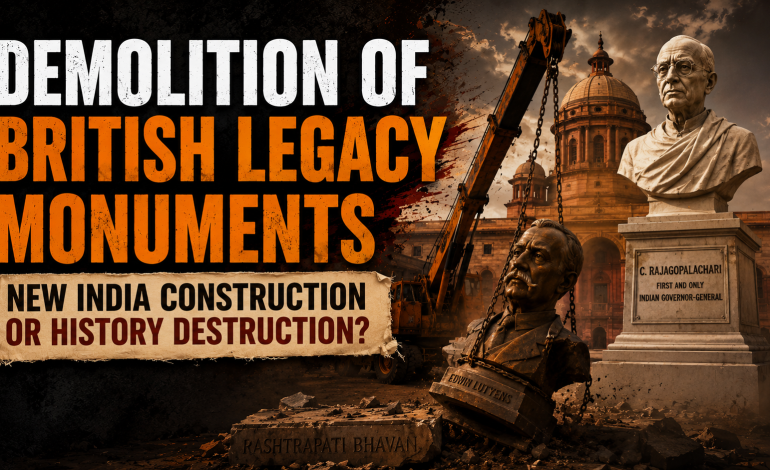
TOPIC 6 New India Construction or History Destruction? In February 2026, a bronze bust of British architect Edwin Lutyens was quietly removed from the central courtyard of Rashtrapati Bhavan —

TOPIC 6
New India Construction or History Destruction?
In February 2026, a bronze bust of British architect Edwin Lutyens was quietly removed from the central courtyard of Rashtrapati Bhavan — a building he himself designed nearly a century ago. In its place now stands C. Rajagopalachari, India‘s first and only Indian Governor-General. Prime Minister Modi called it “freedom from the mentality of slavery.” Critics call it the selective erasure of history — a politically motivated demolition of India’s pluralistic, layered past. This article investigates whether the removal of colonial monuments is genuine decolonisation or a saffron strategy to rewrite history.
WHAT – A systematic government-led effort to remove, relocate, or recontextualise monuments, statues, and architectural symbols associated with British colonial rule, replacing them with figures and symbols from India‘s Hindu and nationalist heritage.
WHO – Led by Prime Minister Modi and the BJP government, executed through the Ministry of Housing and Urban Affairs, Ministry of Culture, and central public works departments.
WHEN – Accelerated dramatically after 2014, with major projects in 2022 (Central Vista/Kartavya Path), 2023 (new Parliament, Sengol installation), and 2026 (Lutyens bust removal).
WHERE – Primarily in New Delhi’s Central Vista (Rashtrapati Bhavan, Parliament complex, Rajpath/Kartavya Path), but also across state capitals and colonial-era institutions nationwide.
WHY – Officially to “decolonise” public spaces, shed “colonial baggage,” and “reclaim Indian heritage.” Critics argue the real goals are: (1) erasing visible reminders of India‘s Muslim and colonial past; (2) consolidating Hindutva political identity; and (3) rewriting collective memory for electoral gain.
HOW – Through executive orders, redevelopment projects, museum relocations, and — controversially — bypassing parliamentary oversight and heritage conservation protocols.
THE LANDMARK CASE: LUTYENS BUST REMOVED, RAJAJI INSTALLED (FEBRUARY 2026)
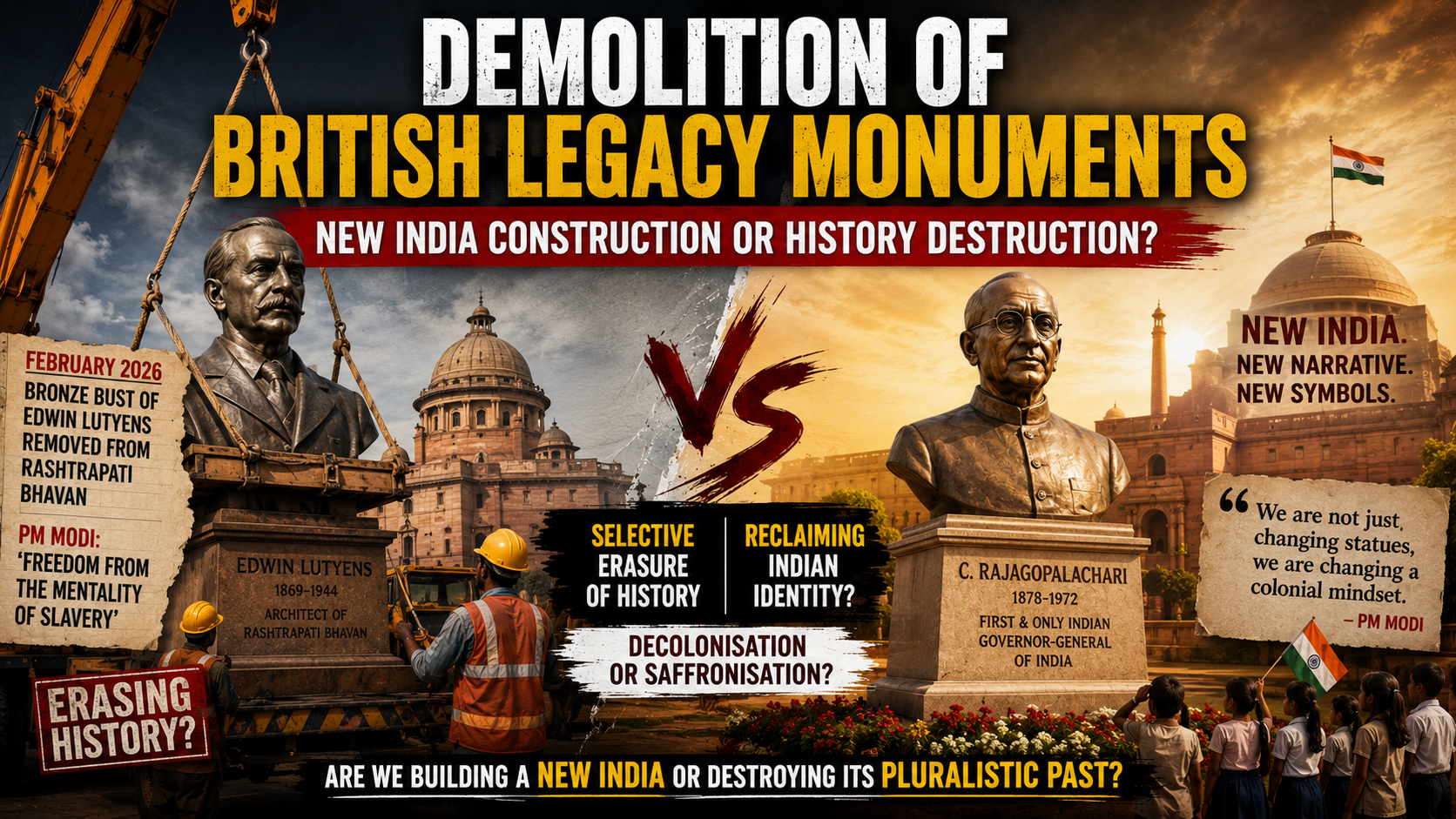
The most symbolic and recent act in this campaign occurred on February 23, 2026, when President Droupadi Murmu unveiled a bust of Chakravarti Rajagopalachari at the Rashtrapati Bhavan Cultural Centre, replacing the bronze bust of Sir Edwin Lutyens that had stood there for decades .
Who Was Edwin Lutyens?
| Attribute | Detail |
|---|---|
| Role | Chief architect of New Delhi (1912-1931) |
| Key Works | Rashtrapati Bhavan (Viceroy‘s House), India Gate, Parliament House (original), Rajpath (now Kartavya Path) |
| Legacy | “Lutyens‘ Delhi” — the administrative heart of the capital — bears his name |
| Symbolism | Embodiment of British imperial power and architectural ambition |
The Government‘s Justification:
Prime Minister Modi, in his monthly “Mann Ki Baat” broadcast on February 22, 2026, framed the move as essential to national liberation: “During the Azadi Ka Amrit Mahotsav, I spoke of the ‘Panch-Pran’ from the Red Fort. One of them is freedom from the mentality of slavery. Today, the country is leaving behind the symbols of slavery and has begun to value symbols related to Indian culture” .
President Murmu‘s office issued a statement: “This initiative is part of series of steps being taken towards shedding the vestiges of colonial mindset and embracing, with pride, the richness of India‘s culture, heritage, timeless traditions and honouring those who served Bharat Mata with their extraordinary contributions” .
Why Rajaji?
Rajagopalachari was India‘s first and only Indian Governor-General (1948-1950), a close associate of Gandhi, and a respected statesman who once lived in the same building . The choice was also politically strategic: with Tamil Nadu assembly elections approaching, honoring a Tamil icon — especially one not associated with Dravidian parties — was widely seen as outreach to the state where the BJP has historically struggled .
Opposition Criticism:
Shiv Sena (UBT) MP Sanjay Raut attacked the government‘s inconsistency, asking why India engages with the United States and Donald Trump if it truly opposes “ghulami” (slavery). “If you hate ‘ghulami’ so much, then you should cancel the India-US trade deal… Many people, including Lutyens, contributed to the building of New Delhi,” he said .
PDP leader Iltija Mufti questioned the entire premise: “How does it help India to continue with this warped misplaced sense of anger towards its history? This constant obsession of wiping off the ‘colonial hangover’? Lutyens makes Delhi what it is. You cannot efface heritage or history by removing busts & plaques. Most of India‘s architectural marvels are British & Mughal. Big deal” .
The Great-Grandson‘s Objection:
Matt Ridley, a British biologist and Lutyens’ great-grandson, expressed sadness over the removal: “Sad to read that the bust of Lutyens (my great-grandfather) is to be removed from the presidential palace he designed in Delhi. Here I am with it last year. I wondered at the time why his name had been removed from the plinth” . After the removal, he clarified: “I understand India‘s wish to remove colonial statues but he was an architect, not a viceroy” .
Where Did the Bust Go?
The Lutyens bust was not destroyed — it was relocated to the Rashtrapati Bhavan Museum, where it will be displayed alongside other colonial-era artefacts including statues of King George V and Queen Mary . This museum placement, while preserving the object, removes it from public prominence — effectively demoting it from celebration to contextualisation.
THE CENTRAL VISTA REDEVELOPMENT: RAJPATH TO KARTAVYA PATH (2022)
The renaming of Rajpath to Kartavya Path in September 2022 was the flagship project of the government‘s decolonisation drive, announced as part of the Azadi Ka Amrit Mahotsav .
What Changed:
| Old Name | New Name | Year |
|---|---|---|
| Rajpath (Kingsway) | Kartavya Path | 2022 |
| North Block/South Block | Kartavya Bhavan/Seva Teerth | 2025-26 |
| PMO location | Relocated from South Block to “Seva Teerth” | 2025 |
The ₹2.7 billion ($2.7 billion) Central Vista project — which included a new Parliament building, reorganized ministerial offices, and major landscaping changes — was heavily criticised by urban planners, architects, and conservationists .
The Redevelopment Justification:
Union Minister of Urban Affairs framed the project as building “New India” and argued that North Block and South Block “remind us of colonial rule” . Yet as one critic noted: “If we make South Block a museum of colonial rule, are we not perpetuating the memory of the colonial rule which we wish to erase?” .
The Conservation Controversy:
The Indian National Trust for Art and Cultural Heritage (INTACH) was reportedly unaware of the redevelopment plans until they were announced . Urban planners pointed out that the existing buildings — nearly a century old — are solid, earthquake-proof, and perfectly functional. “In several decades, no earthquake did any damage to these two buildings… There was no occasion to feel any discomfort or inefficiency in any way,” wrote a former civil servant .
The Real Issue:
Beyond conservation, critics argued the project was a form of “state-sponsored architectural nationalism” — using the built environment to project a new, majoritarian vision of India . The timing, during the COVID-19 pandemic when resources were scarce, was also questioned.
KINGSWAY CAMP TO GURU TEG BAHADUR NAGAR: A HISTORICAL PRECEDENT
The renaming and redevelopment of colonial spaces is not new — Kingsway Camp in Delhi was officially renamed Guru Teg Bahadur Nagar by the Municipal Corporation of Delhi on December 12, 1970 .
Historical Significance of Kingsway Camp:
| Period | Event | Significance |
|---|---|---|
| 1911 | Delhi Durbar | King George V announced shift of capital from Calcutta to Delhi |
| 1911 | Foundation stone | Laid for Viceroy‘s residence (now Rashtrapati Bhavan) at this site |
| 1947-49 | Refugee camp | Largest in Delhi — housed 300,000 Partition refugees |
| 1970 | Renamed | Guru Teg Bahadur Nagar (after 9th Sikh Guru) |
The 1970 renaming was a post-independence, pre-BJP act of decolonisation — suggesting that the desire to shed colonial names is not exclusively saffron. However, critics note that the current BJP campaign goes beyond renaming: it involves the active removal and replacement of colonial-era statues and memorials, often without public consultation or legislative process.
OTHER DECOLONISATION MEASURES UNDER MODI (2014-PRESENT)
| Year | Action | Description |
|---|---|---|
| 2015 | Aurangzeb Road renamed | Became Dr. APJ Abdul Kalam Road |
| 2022 | Indian Navy ensign changed | St. George‘s Cross removed, Shivaji seal adopted |
| 2022 | Rajpath renamed | Became Kartavya Path |
| 2023 | New Parliament inaugurated | Old building repurposed as Samvidhan Sadan |
| 2024 | Railway uniform changed | 19th-century British-era uniform discontinued |
| 2025 | Raj Bhavans renamed | Official governor residences rechristened Lok Bhavans |
| 2025-26 | PMO relocated | From colonial South Block to “Seva Teerth” |
| 2026 | Lutyens bust removed | Replaced by Rajagopalachari bust |
Modi‘s Statement on the Navy Ensign (2022): “The new Navy ensign has removed the ‘slavery mindset‘ and is in line with the country‘s rich marine heritage” .
The Railway Uniform Change (January 2026): Indian railway employees were prohibited from wearing a 19th-century British-era uniform .
THE ACADEMIC AND LEGACY DEBATE: MONUMENTS AS PROBLEMATIC OBJECTS
Academic scholarship has grappled with the question of what to do with “problematic” colonial monuments long before India‘s current debate . The case of two British colonial monuments — to Cornwallis and Wellesley — at Mumbai‘s Dr. Bhau Daji Lad Museum offers an instructive precedent.
The Mumbai Precedent (1965):
| Monument | Fate |
|---|---|
| Cornwallis statue | Decapitated, limbs removed before museum display |
| Wellesley statue | Decapitated, limbs removed before museum display |
Both statues were “decapitated and had several limbs removed” by Indian authorities in the 1960s before being moved to the museum . The museum’s subsequent restoration (2003-2008) raised questions about “institutional responsibility around the ‘preservation‘ of problematic objects” .
The Contemporary Framework:
The academic debate has intensified globally following movements like “Rhodes Must Fall” in South Africa and the toppling of the Edward Colston statue during Black Lives Matter protests in Bristol (2020) . India‘s approach — removing colonial statues from central public spaces while preserving them in museums — follows the “recontextualisation” model rather than outright destruction.
Critics of the Indian Approach: The removal of Lutyens‘ bust, unlike the destruction of Colston‘s statue (thrown into Bristol Harbour), was orderly and legal. However, critics argue that the government is conflating architecture with politics — Lutyens was an architect, not a Viceroy or military commander. “He was not a symbol of oppression; he was a designer,” his great-grandson noted .
THE POLITICAL MESSAGE: BEYOND DECOLONISATION
The removal of Lutyens‘ bust and the installation of Rajaji’s, according to political analysis, carries a deliberate political message — especially for Tamil Nadu .
The Tamil Nadu Outreach:
| Element | BJP Strategy |
|---|---|
| Rajaji | Tamil icon, not tied to Dravidian parties |
| Sengol (2023) | Chola tradition linked to Tamil identity |
| Kashi Tamil Sangamam | Cultural ties between Varanasi and Tamil Nadu |
| 2026 Assembly Elections | Potential BJP entry-point into Dravidian politics |
As one analyst noted: “Replacing Lutyens with Rajaji rather than placing Rajaji alongside him makes the gesture sharper. It turns a tribute into a statement” . Whether this will translate into votes remains unclear.
BJP vs Congress on Colonial Symbols:
| Party | Position |
|---|---|
| BJP | Aggressively removing/replacing colonial symbols; framing as “slavery mindset” |
| Congress | Ambivalent — some leaders praise individual moves (Tharoor on Rajaji), others criticise the broader approach |
BJP spokesperson Shehzad Poonawalla used Tharoor‘s praise of Rajaji to jab Congress: “Sad that some in Congress put Lutyens above Rajaji. Videshi above Swadeshi. Colonial above Bharatiya” .
ARGUMENTS FOR AND AGAINST
For Removal (Government, RSS, supporters):
| Argument | Response to Critics |
|---|---|
| Colonial symbols represent oppression | “Why should Indian citizens be forced to daily encounter statues of those who enslaved us?” |
| Decolonisation is incomplete | “Political independence (1947) was only the first step. Cultural decolonisation is equally important.” |
| Public spaces should reflect Indian heroes | “Rajaji, Patel, Bose — these are the figures our children should see in Rashtrapati Bhavan.” |
| Recontextualisation in museums is appropriate | “We are not destroying history. We are putting it in proper context, not celebration.” |
Against Removal (Opposition, conservationists, critics):
| Argument | Response to Government |
|---|---|
| History cannot be selectively erased | “Removing statues does not change history — it merely hides it from public view.” |
| Architecture is not politics | “Lutyens was an architect, not a Viceroy. His buildings are heritage, not oppression.” |
| Selective targeting reveals bias | “Why only colonial symbols — why not Mughal symbols next?” |
| Cost and priority | “₹2.7 billion on Central Vista during a pandemic was misallocated when people were dying.” |
The ‘Slippery Slope’ Concern:
As one columnist noted: “If we destroy what the British made, what comes next? Red Fort, Jama Masjid, and other iconic structures built by Mughals?” . The government has not clarified where the line will be drawn — raising concerns that Hindu majoritarianism could eventually target India‘s rich Muslim architectural heritage.
COMPARATIVE ANALYSIS: INDIA VS OTHER NATIONS
| Country | Approach to Colonial Monuments | Current Status |
|---|---|---|
| India (BJP) | Removal from public spaces → museum storage/display | Accelerating since 2022 |
| South Africa | “Rhodes Must Fall” movement — statue removal | Rhodes statue removed from UCT (2015) |
| United Kingdom | Debates ongoing; Colston statue toppled by protesters (2020), later displayed in museum | Mixed — some statues removed, others retained with explanatory plaques |
| United States | Confederate statues removed from public spaces (post-2020) | Many removed to museums or storage |
| Australia | Captain Cook statues debated; some removed, others retained | Mixed |
India‘s approach — legal, state-led removal and recontextualisation — is more orderly than protest-driven topplings in the UK and US but more aggressive than many Western European nations that have retained colonial statues with additional explanatory plaques.
THE UNANSWERED QUESTION: WHERE DOES IT END?
The government has not announced a comprehensive policy on colonial monuments. This creates uncertainty:
-
Will statues of all British officials be removed — or only some?
-
Will Lutyens-designed buildings (which remain standing) eventually be demolished or renamed?
-
Will Mughal-era monuments (Red Fort, Jama Masjid) be targeted next?
A 2019 Warning: “If we make South Block a museum of colonial rule, are we not perpetuating the memory of the colonial rule which we wish to erase?” .
The Government‘s Silence: No systematic guideline has been issued. Decisions appear to be made case-by-case, often announced by the PM directly.
CONCLUSION – NEW INDIA OR ERASED INDIA?
The removal of colonial monuments under the BJP cannot be dismissed as mere “saffron propaganda” — decolonisation is a legitimate post-colonial project. However, the manner, timing, politicisation, and selectivity of the campaign raise serious concerns.
What Is Genuine:
| Element | Assessment |
|---|---|
| Decolonisation as a goal | Legitimate — India should not be forced to celebrate its colonisers |
| Recontextualisation in museums | Reasonable — preserving history while removing celebration |
| Honouring Indian figures | Positive — Rajaji, Patel, and Bose deserve public recognition |
What Is Problematic:
| Element | Assessment |
|---|---|
| Selective targeting | Why only colonial symbols — not Mughal or even problematic Hindu figures? |
| Political timing | Moves consistently timed before elections (especially in Tamil Nadu) |
| Lack of public consultation | Heritage bodies (INTACH) were not consulted |
| Vague criteria | No clear policy — decisions made arbitrarily |
The Central Question:
Is India building a “New India” that respects all layers of its history — Hindu, Muslim, Sikh, Christian, Buddhist, Jain, colonial, and post-colonial — or is it constructing a “Saffron India” that selectively erases the parts that do not fit the majoritarian narrative?
The removal of Lutyens‘ bust is a small act — a few hundred kilograms of bronze relocated to a museum. But as a symbol, it is enormous: it announces that the architecture of power will no longer be associated with British names. The building remains — but the name on the pedestal changes.
History cannot be demolished — but it can be curated. Who curates it, and for whom, defines the nation.
SUMMARY TABLE: COLONIAL MONUMENTS REMOVAL UNDER BJP
| Aspect | Detail |
|---|---|
| Key Action (2026) | Lutyens bust removed from Rashtrapati Bhavan, replaced by Rajagopalachari |
| Earlier Actions | Rajpath→Kartavya Path (2022), Navy ensign changed (2022), railway uniform changed (2026) |
| Government Justification | “Shedding colonial mindset,” “freedom from slavery mentality” |
| Opposition Criticism | Selective erasure of history, political opportunism (Tamil Nadu elections), hypocrisy (dealing with US/Trump) |
| Heritage Concern | INTACH not consulted; architects, planners opposed Central Vista project |
| Fate of Removed Objects | Placed in museum (recontextualised, not destroyed) |
| Unanswered Question | Where does it end? Mughal monuments next? |
Continue with Toipc 7