
Germany’s Housing Crisis: Causes, Evidence, and Social Impact
Germany is currently experiencing one of the deepest housing crises in its post-war history. What was once a relatively stable rental market has transformed into a severe affordability and availability
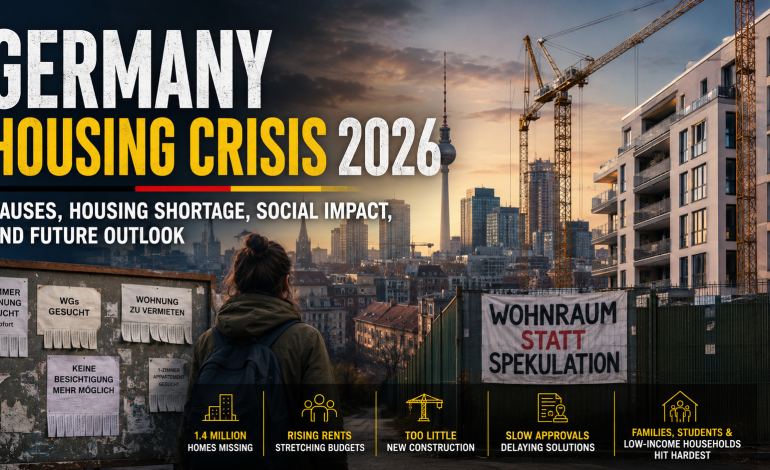

Germany is currently experiencing one of the deepest housing crises in its post-war history. What was once a relatively stable rental market has transformed into a severe affordability and availability crisis affecting millions of residents. The shortage of affordable housing has become especially critical in major urban centers such as Berlin, Munich, Hamburg, Frankfurt, and Cologne. Recent housing studies estimate that Germany is missing approximately 1.4 million apartments and homes, particularly in the categories of affordable rental housing and social housing. This shortage is not merely a temporary market imbalance; researchers increasingly describe it as a structural crisis caused by long-term underinvestment, policy delays, rising costs, demographic shifts, and financial pressures. The crisis has significant social and economic consequences. Young adults struggle to leave their parents’ homes, students face homelessness-like conditions, low-income families spend disproportionate shares of their income on rent, and employers increasingly find it difficult to attract workers to high-cost urban regions.
1. Scale of the Housing Shortage
National Housing Deficit – Germany’s housing shortage has accumulated over many years. According to economic and housing research institutions, the country requires between 350,000 and 400,000 new housing units annually to meet population growth and replacement demand. However, actual construction output has fallen substantially below this target in recent years. Reuters and German housing research organizations reported that Germany needs approximately 320,000–400,000 new homes annually. Building permits and construction starts have declined sharply since 2022. The cumulative shortage may exceed 1.4 million housing units by the end of the decade. This deficit is concentrated mainly in metropolitan regions where employment, universities, and infrastructure attract continuous population growth.
2. Too Little New Construction
Construction Levels Far Below Demand – One of the central causes of the housing crisis is insufficient residential construction. Germany’s federal government previously announced a goal of constructing 400,000 new homes annually, including 100,000 social housing units. However, the construction sector has consistently failed to meet these targets.
Key Reasons for Low Construction Output
A. High Construction Costs – Construction expenses have risen dramatically due to inflation in building materials, energy price increases, supply chain disruptions, skilled labor shortages, and stricter environmental regulations. The cost of cement, steel, insulation materials, and energy-efficient technologies has significantly increased since the COVID-19 pandemic and the European energy crisis. Developers increasingly report that projects are no longer financially viable because expected rental income cannot cover financing and construction expenses. Reuters reported that many German developers halted or postponed residential projects because profitability collapsed under higher costs and interest rates.
B. Rising Interest Rates – The European Central Bank’s interest rate increases significantly affected the real estate sector. For years, low borrowing costs encouraged housing investment. However, mortgage financing became more expensive, investors reduced activity, developers faced financing difficulties, and homebuyers lost purchasing power. Housing associations argue that many affordable housing projects became economically impossible under current financing conditions.
C. Insolvencies in Construction Sector – Several German construction firms and real estate developers have experienced financial distress or insolvency in recent years. This has caused delayed projects, abandoned developments, reduced investor confidence, and lower housing supply entering the market.
3. Rising Demand for Housing
While construction slowed, demand continued to increase rapidly.
A. Urbanization – Large German cities continue attracting residents because of employment opportunities, universities and education centers, public transport systems, technology and startup ecosystems, and healthcare infrastructure. This concentration of economic opportunity in metropolitan regions has intensified pressure on urban housing markets. Research published in housing economics journals shows that population growth is highly concentrated in economically successful urban areas, while many rural regions experience stagnation or decline.
B. Growth of Single-Person Households – Germany has experienced a major demographic shift toward smaller households. More people now live alone due to delayed marriage, aging population, lifestyle changes, and higher divorce rates. This means that even without large population growth, the number of required housing units increases significantly because more apartments are needed per capita. For example, one family of four may occupy one apartment, while four single adults may require four separate apartments. This structural demographic change substantially increases housing demand.
C. Immigration and Refugee Movements – Germany has received large numbers of migrants and refugees over the past decade, including Syrian refugees, Ukrainian displaced persons, Afghan refugees, EU labor migrants, and international students. Research on migration and housing indicates that immigration increased pressure on already strained urban housing systems. However, most researchers emphasize that migration alone did not create the crisis. Important evidence shows that Germany already faced housing shortages before recent migration waves. The deeper issue was long-term underconstruction and declining affordable housing stock. Migration acted more as an amplifier of existing structural weaknesses rather than the sole cause.
4. Decline of Social Housing
Loss of Affordable Rental Units – Germany once maintained a stronger social housing system. Publicly subsidized apartments provided affordable rents for low- and middle-income residents. However, over recent decades, many social housing units lost protected status, subsidy agreements expired, privatization increased, and public investment declined. As older subsidized apartments returned to the private market, rents increased substantially. At the same time, the construction of new social housing failed to compensate for these losses. This created a widening affordability gap, especially in major cities.
Why Social Housing Matters – Social housing is important because it protects vulnerable households from excessive rent burdens, stabilizes communities, reduces homelessness risk, supports workforce mobility, and limits extreme market speculation. Researchers increasingly argue that affordable housing should be treated as essential public infrastructure rather than purely a market commodity.
5. Bureaucracy and Slow Approval Processes
Germany’s housing sector is also slowed by administrative complexity. Developers frequently cite lengthy permit approvals, environmental assessments, zoning restrictions, local opposition, and complex building regulations. In many cities, projects can take years before construction even begins. This delays urgently needed housing supply and increases development costs further. Housing industry organizations argue that bureaucratic inefficiency has become one of the largest structural barriers to solving the crisis.
6. Groups Most Affected
The housing crisis does not affect all groups equally. Vulnerable populations experience disproportionately severe consequences.
A. Young People and Students – Students in cities like Berlin, Munich, and Hamburg often struggle to secure accommodation before university semesters begin. Common issues include extremely long waiting lists for student housing, temporary couch-surfing arrangements, overcrowded shared apartments, rising rents in private student housing, and increased financial dependence on parents. Some students reportedly spend months searching for apartments while living in hostels or temporary shelters.
B. Families with Low Incomes – Low-income households face severe rent burdens. Many families now spend 40–50% or more of their income on housing costs. Consequences include reduced spending on food and healthcare, overcrowded living conditions, risk of eviction, and relocation to distant suburban areas. Affordable apartments in central urban locations are increasingly inaccessible to working-class families.
C. Single Parents – Single parents are among the most vulnerable groups because they often face lower household income, childcare responsibilities, difficulty relocating for work, and limited housing flexibility. Many landlords prefer tenants with higher and more stable incomes, which further disadvantages single-parent households.
D. Migrants and International Workers – Migrants frequently face language barriers, lack of German credit history, discrimination in apartment selection, and limited access to formal rental networks. In competitive markets where hundreds apply for one apartment, newcomers are often disadvantaged.
E. Elderly Residents – Older residents with fixed pensions increasingly struggle with rising utility costs, modernization-related rent increases, and limited availability of accessible apartments. Some elderly residents are forced to relocate away from long-established communities.
7. Economic Consequences
The housing crisis is increasingly viewed as an economic risk for Germany.
Labor Market Effects – Companies in high-cost cities report recruitment difficulties because workers cannot afford local rents. This affects sectors including healthcare, education, hospitality, technology, and public services. Housing shortages reduce labor mobility and weaken economic competitiveness.
Reduced Social Stability – Researchers warn that severe housing inequality can contribute to social frustration, political polarization, declining trust in institutions, and increased homelessness. Housing insecurity also affects mental health, educational outcomes, and long-term social integration.
8. Government Responses
Germany has introduced several policy measures including rent control regulations, housing subsidies, support for social housing construction, tax incentives, and faster permitting initiatives. However, critics argue that measures remain insufficient relative to the scale of demand, construction incentives alone cannot solve affordability issues, and stronger public investment may be necessary.
9. Future Outlook
Most experts expect the housing crisis to continue in the near future because construction remains weak, financing conditions remain difficult, demand remains high, and urban concentration continues. Long-term improvement likely requires large-scale affordable housing programs, faster approvals, public-private cooperation, expanded social housing investment, and regional economic development outside major cities.
Conclusion
Germany’s housing crisis is not a short-term disruption but a deep structural problem shaped by years of underbuilding, rising costs, demographic changes, and declining affordable housing stock. The crisis increasingly affects not only low-income populations but also students, middle-class workers, families, and skilled professionals. Without substantial reforms and long-term housing investment, affordability pressures may continue worsening across Germany’s major urban regions. Housing has become one of the defining social and economic challenges facing modern Germany, with implications extending far beyond real estate into labor markets, inequality, migration, and social stability.