REPUBLIC DAY THEMES AND CULTURAL REPRESENTATION
TOPIC 8: From Secular Celebration to Saffron Spectacle – Evaluating the Increasing Visibility of Religious-Cultural Motifs in National Celebrations For decades, January 26 was a day of sober military precision

TOPIC 8:
From Secular Celebration to Saffron Spectacle – Evaluating the Increasing Visibility of Religious-Cultural Motifs in National Celebrations
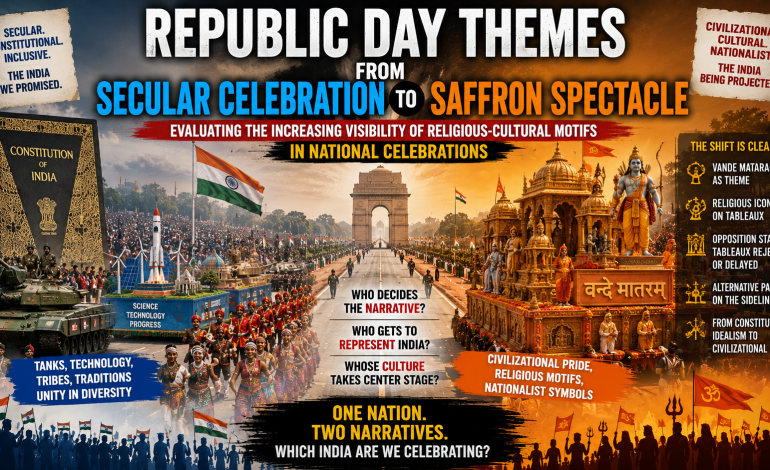
For decades, January 26 was a day of sober military precision and secular cultural display — a celebration of the Constitution, of democracy, of unity in diversity. India showcased its tanks, its tableaux, its tribal dances, and its technological achievements, all under the watchful eyes of ambassadors and citizens on Rajpath. But in recent years, the Republic Day parade has undergone a quiet transformation. The themes have shifted from constitutional idealism to civilizational pride. Tableaux from opposition-ruled states are rejected or delayed while those from BJP states sail through. The national anthem of the freedom struggle — Vande Mataram — is now the official theme, celebrated with religious fervor. And on the sidelines, alternative parades — of farmers, of protestors — have emerged as counter-narratives to the state-sponsored spectacle. This article investigates how Republic Day has become a battleground for India‘s soul — secular or saffron.
WHAT – The increasing infusion of religious, civilizational, and Hindutva-aligned themes into India‘s Republic Day parade, alongside selective approval and rejection of state tableaux based on political affiliation.
WHO – The Ministry of Defence (which oversees the parade), the Expert Committee on Tableaux (whose composition and criteria are opaque), the BJP-led central government, and state governments (both BJP and opposition-ruled) who submit proposals.
WHEN – Tensions escalated notably in 2021 (the farmers’ tractor parade and the Ram temple tableau), intensified through 2022-2024 (rejections of Kerala, Tamil Nadu, Bengal tableaux), and culminated in the 2026 parade themed around 150 years of Vande Mataram.
WHERE – Kartavya Path (formerly Rajpath), New Delhi, and simultaneously at Delhi‘s borders (farmers‘ protests) and state capitals.
WHY – Officially, to honor India‘s freedom struggle, showcase cultural diversity, and display military strength. Critics argue the real goals are: (1) replacing the Constitution-centric Republic Day with a civilizational Hindutva narrative; (2) punishing opposition-ruled states by excluding their representations; (3) symbolically aligning the state with Hindu religious identity; and (4) marginalizing alternative, secular visions of the republic.
HOW – Through an opaque tableau selection process dominated by a central “Expert Committee,” systematic rejection of opposition states‘ proposals on technical or thematic grounds, and the promotion of themes centered on Hindu religious figures, Vedic heritage, and the Ram temple.
SECTION 1: THE VISION OF THE FOUNDING FATHERS – SECULARISM AS CONSTITUTIONAL MORALITY
To understand what is changing, we must first understand what is being changed. Republic Day is not Independence Day. August 15 celebrates freedom from colonial rule. January 26 celebrates freedom to govern ourselves under a Constitution that enshrines secularism, democracy, and justice as its foundational pillars.
Nehru‘s Precaution to President Rajendra Prasad (1951):
A little-known but crucial episode in Indian history illuminates the original understanding of the relationship between the state and religion on Republic Day. When President Rajendra Prasad expressed his desire to attend the consecration ceremony of the Somnath Temple, Prime Minister Jawaharlal Nehru, C. Rajagopalachari, and S. Radhakrishnan all advised him against it.
Nehru specifically wrote to Prasad that while there was no problem if the President visited any shrine, his attendance at a special religious ceremony like a consecration would, in effect, lend the state’s legitimacy to one particular religion, setting an unfair and dangerous precedent.
Prasad argued that he would participate in his “personal capacity” and not as President. But Nehru, Rajagopalachari, and Radhakrishnan made it clear that the office of the President of India cannot be separated from his personal capacity in the context of special religious functions. The line between state and religion was deliberately maintained.
Ambedkar‘s Warning:
B.R. Ambedkar, the architect of the Constitution, provided in his draft that the state would have no religion and that any call for comprehensively boycotting minorities in India would be treated as a cognizable offense. He also prescribed that the future legislature must frame laws to punish those who would “commit the crime of leading people to boycott minorities from social and economic domains.”
Ambedkar would have been “deeply worried at the irreparable impairment done to its constitutional vision” by the current government, as one columnist noted. His call to the people to “resist and fight against the calamity of the Hindu Rashtra” stands in stark contrast to the saffronization of Republic Day.
The Pre-2014 Baseline:
Prior to 2014, Republic Day parades focused on:
-
Military hardware and capability (neutral, non-religious)
-
Tableaux depicting states‘ cultural diversity (folk dances, crafts, cuisine)
-
Themes centered on the Constitution, freedom struggle, and national integration
-
Presidential addresses that avoided explicit religious endorsement
Religious motifs, when present, were embedded within broader cultural displays — never as the central theme of the parade.
SECTION 2: THE SHIFT – TABLEAUX AS POLITICAL BATTLEGROUNDS
The most visible site of contestation has been the state tableaux — 45-foot-long moving displays that roll down Kartavya Path, each representing a state‘s unique identity.
2.1 The Opaque Selection Process
The selection of tableaux is overseen by an “Expert Committee” under the Ministry of Defence. However, the composition of this committee, its criteria, and its deliberations are not transparent.
What We Know:
| Fact | Implication |
|---|---|
| Committee appointed by Ministry of Defence | Controlled by central government |
| Composition not publicly disclosed | Potential for political bias |
| Decisions final and not appealable | States have no recourse |
| States submit proposals months in advance | Ample time for communication, yet conflicts arise |
The CPI(M) Critique (2022):
In an editorial in People‘s Democracy, the CPI(M) charged that “motivated rejections” of opposition states‘ tableaux revealed the government‘s “deep anti-federal attitude.” The rejection of tableaux from Kerala, Tamil Nadu, and West Bengal had “practically led to the non-representation of southern states at the national day celebrations.”
“The partisan and sectarian outlook of the Modi government has led to practically the entire south Indian states being non-represented in the tableaus at the Republic Day parade,” the editorial stated. “The motivated rejection of the tableaus of three opposition state governments shows the deep anti-federal attitude of the government. January 26 marks the advent of the Indian Republic and the Constitution which defines India as a Union of States. The Modi government is violating this basic precept of the Constitution.”
2.2 The Kerala vs Adi Shankaracharya Controversy (2022)
The most explicit example of religious imposition on a secular state display came in 2022, when Kerala‘s tableau was rejected because it featured a statue of Sree Narayana Guru — a 20th-century anti-caste social reformer and renaissance figure.
The Dispute:
| Kerala‘s Proposal | Expert Committee‘s Demand |
|---|---|
| Statue of Sree Narayana Guru (1856-1928) – social reformer, anti-caste activist | Statue of Adi Shankaracharya (8th century CE) – restored “Brahmanical order” |
Kerala refused to replace Narayana Guru with Shankaracharya. The tableau was rejected.
The CPI(M) Editorial:
“How an 8th century AD religious figure, who restored the Brahmanical order, is more relevant than an early 20th-century social reformer, who contributed to the renaissance and freedom movement, can only be explained by the Hindutva outlook of the ruling establishment,” the editorial charged.
“The insistence by the expert committee to impose Adi Sankaracharya on the Kerala tableau is an insult not only to Sree Narayana Guru but to the entire progressive socio-cultural traditions of Kerala,” it said.
The Deeper Issue: This was not a dispute about artistic merit or technical requirements. It was an ideological battle. The central government wanted Kerala to showcase an 8th-century Hindu philosopher who reinforced caste hierarchy. Kerala wanted to showcase a 20th-century anti-caste reformer. The central committee had the power to impose its will.
2.3 West Bengal: Netaji and the Vande Mataram Tug-of-War (2022 and 2026)
West Bengal has faced persistent difficulties in getting its tableaux approved — a pattern critics attribute to the adversarial relationship between the Mamata Banerjee-led TMC government and the BJP-led Centre.
The 2022 Controversy:
West Bengal submitted a tableau depicting Netaji Subhas Chandra Bose and the Indian National Army‘s (INA) role in the freedom struggle. It was rejected. The Defence Minister justified the rejection by stating that the Central Public Works Department (CPWD) would be honoring Bose in its own tableau.
The CPI(M) editorial commented: “As if a department of the central ministry should get precedence over the state of West Bengal, which can be proud of having produced a preeminent leader of the independence struggle, like Netaji.”
The 2026 Controversy – Bengal‘s Tableau Finally Cleared:
For the 2026 parade (77th Republic Day), West Bengal submitted a tableau titled “Bengal in India‘s Struggle for Independence,” designed to commemorate the 150th anniversary of Bankim Chandra Chattopadhyay‘s Vande Mataram.
The clearance process was protracted and contentious. Sources from the Resident Commissioner‘s Office in Delhi confirmed that the selection panel repeatedly tried to block West Bengal‘s proposal on various pretexts. There were at least five meetings between the expert panel and state representatives before the final decision.
During these meetings, committee members raised multiple questions and objections to the design and content of the tableau. This led to significant doubts about West Bengal‘s participation.
State Government‘s Counter-Argument:
A senior official from Banga Bhavan (Bengal‘s Delhi house) stated: “The state‘s argument was irrefutable. During the meeting, the state raised the question why the committee did not raise any questions on the themes and subjects of the proposals from BJP-ruled states like Assam, Odisha, Rajasthan, or Maharashtra even though they have no direct connection with the country‘s struggle for independence or the 150th anniversary of Vande Mataram. Why then is such scrutiny being applied only to Bengal?”
In the light of this counter-argument, the committee had “practically no option but to give its approval.” After extensive discussions, the theme and design were finally green-lit.
The Approved Tableau:
The tableau showcases the contributions of Rishi Bankim Chandra Chattopadhyay and his creation, the mantra Vande Mataram. It depicts how this mantra “ignited the blood of revolutionaries in colonial India, illustrating how they sang this song while facing the gallows, embracing death.”
The front and various sections of the tableau feature portraits of Rabindranath Tagore, Kazi Nazrul Islam, and Netaji Subhas Chandra Bose, along with revolutionary figures of the Agni Yuga such as Binoy-Badal-Dinesh.
Why This Matters:
The central government‘s theme for the 2026 parade was the 150th anniversary of Vande Mataram. Bengal‘s tableau — directly aligned with this theme — was still subjected to intense scrutiny. The state had to fight for months to be included. BJP-ruled states, whose proposals had “no direct connection” with the theme, were cleared without objection.
The approval was described in political circles as a “significant moral victory” for West Bengal.
2.4 Karnataka‘s Exclusion (2026) – Congress-Ruled State Penalized?
Karnataka‘s tableau, themed “Millets to Microchip,” was dropped from the 2026 Republic Day parade. The tableau was conceived to showcase the state‘s journey from traditional agriculture to technological innovation, featuring crops such as ragi, jowar, navane, and sajje alongside its globally recognized IT and semiconductor ecosystem.
The Political Blame Game:
| Party | Position |
|---|---|
| BJP (Yaduveer Wadiyar, Mysuru MP) | Attributed exclusion to “procedural lapses” and “no proper correspondence… which led to confusion.” |
| Congress (Pradeep Eshwar, MLA) | Questioned why Karnataka was left out while tableaux from Kerala, Tamil Nadu, and even Puducherry (where elections are due) were approved. “Our ‘Millets to Microchip‘ tableau represents Karnataka. BJP leaders should speak up instead of remaining silent spectators.” |
Officials described the exclusion as “unfortunate,” given the meticulous effort invested. While the tableau will not feature at Kartavya Path, it will be displayed at the Bharat Parv event at the Red Fort.
The Pattern: Karnataka became the latest in a growing list of opposition-ruled states (Bengal 2022, Kerala 2022, Tamil Nadu 2022, Karnataka 2026) whose tableaux faced rejection or intense scrutiny, while BJP-ruled states proceed without objection.
2.5 Jammu & Kashmir‘s Silver Medal and Regional Controversy (2026)
Jammu & Kashmir‘s tableau, named ‘Living Canvas,‘ secured the second position in the main Republic Day Parade. It showcased a houseboat in walnut wood carving, a samovar, hand weavings, Basohli miniature paintings, and folk dances performed to a musical fusion of rabab, santoor, and flute, accompanied by saffron blossoms.
But the tableau sparked controversy within the Union Territory itself.
BJP Kashmiri Pandit leader Ashwani Kumar Chrungoo criticized the display, calling the samovar and houseboat “imported” and “not reflective of J&K‘s classical music and folk traditions.”
“What is Jammu and Kashmir‘s connection with Samovar? It comes from Samarkand and was introduced by those who brutally ruled over Kashmir. Similarly, Houseboat has nothing to do with Jammu and Kashmir‘s heritage. Our heritage is the Donga or the Shikara. Houseboat has been introduced from the Netherlands, and similarly, Rabab has arrived from Central Asia. There was an overemphasis on things which are not indigenous in the tableau. It is a misrepresentation of facts and heritage,” he added.
Echoing the sentiment, Neeraj Singh Dogra of the Jammu Pradesh Peoples Movement lamented that Jammu was “completely missed” in the tableau, calling for protection from the “Kashmirisation” of the region.
Designer‘s Response:
Padma Shri awardee Balwant Thakur, who conceptualized the tableau, defended it: “Art and culture should be left outside politics. Politically, you can divide people, but not arts.”
He noted that he had wanted to showcase chajja instead of saffron, but the national expert panel “sought its documentary and scholarly proof, which we lacked.” The committee “rightly rejected it,” he admitted.
This nuanced controversy reveals that even when a tableau is approved, the politics of representation — which region, which culture, which symbols — remains deeply contested, often along lines the central committee does not anticipate.
SECTION 3: THE THEMATIC SHIFT – FROM CONSTITUTION TO CIVILIZATION
Beyond the political battles over state participation, the thematic content of the Republic Day parade has itself undergone a significant transformation.
3.1 2026: 150 Years of Vande Mataram as Central Theme
The 77th Republic Day parade (2026) marked the 150th anniversary of Bankim Chandra Chattopadhyay‘s Vande Mataram.
What the Parade Showcased:
| Element | Description |
|---|---|
| Thematic Focus | 150 years of Vande Mataram, paying tribute to the national song that rallied freedom fighters |
| Artistic Displays | Tableaux illustrating the song‘s significant verses |
| Cultural Performances | Nearly 2,500 artists from various states and Union Territories |
| Military Focus | Phased battle array format, Tri-Services tableau “Operation Sindoor: Victory Through Jointness” |
President Droupadi Murmu led the ceremony, with European Commission President Ursula von der Leyen and European Council President Antonio Costa as chief guests, highlighting India‘s growing strategic relationship with the European Union.
The Symbolism: Vande Mataram is undoubtedly a patriotic song — it was a rallying cry for freedom fighters. However, its association with Hindu nationalism (particularly its opening verses addressing the land as “mother goddess”) has made it a contested symbol. By making it the central theme of Republic Day, the government explicitly foregrounded a Hindu-inflected nationalism over a secular, Constitution-centric one.
3.2 2024: The Ram Temple Consecration and Republic Day
The 2024 Republic Day came just days after the consecration of the Ram Temple in Ayodhya — an event presided over by Prime Minister Modi and his entire Cabinet.
The Contrast with 1951:
| Year | Event | State-Religion Boundary |
|---|---|---|
| 1951 | Somnath Temple consecration | Nehru, Rajagopalachari, Radhakrishnan advised President not to attend in official capacity |
| 2024 | Ram Temple consecration | PM and entire Cabinet presided; Republic Day celebrations infused with temple imagery |
A columnist in The Indian Express observed: “Moving across the national capital, one is inundated with saffron flags etched with Ram‘s pictures, in many places as a replacement for the tricolour — the fulfilment of one aspect of the political project of the Sangh Parivar.”
“The Ram temple consecration being led by the head of the government is a move intended to unravel secularism from the tapestry of the constitutional values that have sustained India as a democracy in progress. Hinduism, marked and built around the idea of hierarchy in the form of graded inequality, is fast replacing the fundamental tenets of our Preamble. ‘We the people‘ are sought to be segregated and otherised by the immense might of the state.”
3.3 The Rise of the Tri-Services Tableau – “Operation Sindoor”
The 2026 parade featured a Tri-Services tableau named “Operation Sindoor: Victory Through Jointness,” showcasing coordinated efforts by the Army, Navy, and Air Force.
The Name‘s Significance: Sindoor (vermillion) is a Hindu religious symbol — the red powder applied by married women along their hair parting. By naming a joint military operation after a Hindu ritual object, the government explicitly infused a religious symbol into what is otherwise a purely military display.
This is not accidental. It reflects a deliberate policy of aligning military symbolism with Hindu cultural motifs — reinforcing the idea of India as a “Hindu nation” rather than a secular republic.
SECTION 4: THE COUNTER-NARRATIVE – FARMERS‘ TRACTOR PARADE AND ALTERNATIVE REPUBLICS
While the official parade unfolded on Kartavya Path, an alternative parade took shape at Delhi‘s borders — and it fundamentally challenged the state‘s narrative.
4.1 The Tractor Parade of January 26, 2021
For the first time in the history of postcolonial India, two different parades marked Republic Day in 2021.
| Location | Event | Nature |
|---|---|---|
| Kartavya Path (Official) | Government parade: military hardware, Ram temple tableau, cultural displays | State-sponsored |
| Delhi Borders (Farmers) | Tractor parade protesting three farm laws | Citizen-led protest |
The Contrasting Receptions:
At the Rashtrapati Bhavan, the government “organised a public spectacle of Hindu nationalism, parading tableaus of new temples and artilleries, and sanctifying them as emblems of the emergent ‘Hindu nation.‘”
On the outskirts, “thousands of farmers and agrarian workers took out a ‘tractor parade,‘ protesting the new farm bills.” While the political establishment applauded the official tableaux, “the police forces publicly brutalised the country‘s farmers and agrarian workers, assailing them with a barrage of lathis and tear gas.”
“Long after the official parade was over, the police violence continued unabated. And soon, the tableaus of bloodied farmers and workers suffocating in the plumes of tear gas became the unofficial postscript to the nationalist pomp of the Bharatiya Janata Party‘s Republic Day celebrations.”
4.2 Rath Yatra vs Tractor Parade – A Moral Comparison
An analysis in The Wire (2021) drew a powerful contrast between the BJP‘s historical Rath Yatra (which led to the Babri Masjid demolition) and the farmers‘ tractor parade.
| Aspect | Rath Yatra (1992) | Tractor Parade (2021) |
|---|---|---|
| Purpose | Religious – destroy Babri Masjid, build Ram temple | Economic – protest farm laws threatening livelihoods |
| Human Cost | ~2,000 deaths in ensuing communal riots; 20 killed in Ayodhya that day | One death (tractor accident) |
| Leadership | L.K. Advani, Murli Manohar Joshi, Uma Bharti – became Deputy PM and ministers | Farmer unions – no political leadership |
| State Response | BJP leaders celebrated | Police brutality, arrests |
“The rath yatra is directly responsible for at least 2,000 deaths in the ensuing communal conflagration that swept the country after December 6, 1992,” the analysis noted. “And in the tractor parade of January 26, 2021, only one, yes one person, died.”
The Moral Difference:
“The farmers‘ protest is not merely against the three farm laws. It is against the ‘coercive‘ nature of law-making by an authoritarian government. The farmers‘ protest and the tractor parade raises a moral issue, unlike the rath yatra that raised a religious issue. While religious issues by their nature divide people, moral issues unify them. And this government, founded on the Hindutva cause and the identity politics of Hindus versus the rest, has no moral compass and is acutely lacking in ethical empathy.”
SECTION 5: THE DEFENCE MINISTRY‘S DISCRETION – A LEGAL BLACK HOLE
The selection of tableaux is governed not by statute but by administrative discretion. This creates a legal and democratic deficit.
5.1 What Law Governs Tableau Selection?
| Question | Answer |
|---|---|
| Is there a parliamentary act governing tableau selection? | No. |
| Are the Expert Committee‘s criteria publicly available? | No. |
| Can a state appeal a rejection? | No. |
| Can the public access committee minutes? | No. |
This lack of transparency enables selective exclusion. A state government can invest months of effort and crores of rupees into designing a tableau, only to have it rejected on unspecified grounds, with no recourse.
5.2 The Defence Minister‘s Power
The Expert Committee reports to the Ministry of Defence. The Defence Minister has the final say — but this power is rarely exercised in favour of opposition states.
In 2022, Defence Minister Rajnath Singh defended the rejection of West Bengal‘s Netaji tableau by stating that Bose‘s contribution would be depicted in the CPWD tableau — as if “a department of the central ministry should get precedence over the state of West Bengal, which can be proud of having produced a preeminent leader of the independence struggle, like Netaji.”
SECTION 6: THE INTERNATIONAL GAZE – CHIEF GUESTS AND GLOBAL MESSAGES
Republic Day is not merely a domestic celebration. It is India‘s primary diplomatic showcase to the world. The choice of chief guest — and the message conveyed through the parade — signals India‘s self-image to the international community.
2026 Chief Guests:
European Commission President Ursula von der Leyen and European Council President Antonio Costa attended, highlighting India‘s growing strategic relationship with the European Union.
The Message to Europe: India is a rising power, militarily strong, technologically advanced, and culturally confident. But is the Europe seeing India‘s secular, constitutional face — or its saffron, Hindutva face?
The presence of saffron flags, Ram temple imagery, and Vande Mataram themes alongside discussions of trade and defense partnerships sends a complex, perhaps contradictory, signal.
SECTION 7: THE LONG VIEW – FROM RAJPATH TO KARTAVYA PATH
The renaming of Rajpath to Kartavya Path in 2022 (discussed in Topic 6) is symbolically linked to the transformation of Republic Day.
| Element | Before (UPA/Early NDA) | After (Modi Era) |
|---|---|---|
| Venue Name | Rajpath (Kingsway) – colonial name | Kartavya Path – duty, not power |
| Parade Theme | Military + cultural diversity + Constitution | Military + civilizational heritage + Vande Mataram |
| Tableau Selection | Relatively non-controversial | Repeated conflicts with opposition states |
| Chief Guests | Diverse (political, diplomatic) | Often aligned with India‘s strategic interests |
| Religious Content | Minimal, embedded within cultural displays | Central (Ram temple, Vande Mataram, Hindu iconography) |
The Symbolic Shift:
As one columnist noted in 2005, long before the current controversies: “What‘s particularly ironic is that a day which is supposed to celebrate the supremacy of the citizen has come to be totally appropriated by the sarkar.”
Today, that sarkar has appropriated the day not just for itself, but for its specific ideological vision — replacing the citizen with the devotee, the Constitution with the Ram temple.
CONCLUSION – TWO REPUBLICS, ONE DATE
The Republic Day parade no longer represents a single, unified vision of India. It has become a site of contestation between two competing republics:
| Constitutional Republic | Civilizational/Hindutva Republic | |
|---|---|---|
| Sovereignty | Derived from Constitution, democratic will | Derived from ancient Hindu civilization, Sanatan Dharma |
| Identity | Secular, pluralistic, citizenship-based | Hindu majoritarian, culture-based |
| Symbols | Tricolor, Ashoka Chakra, Constitution | Saffron flag, Ram temple, Vande Mataram |
| Heroes | Ambedkar, Nehru, Gandhi, Tagore, Bose | Shankaracharya, Shivaji, Savarkar, Ram |
| Republic Day Meaning | Celebration of democratic self-rule | Assertion of civilizational continuity |
What Has Been Lost:
| Loss | Explanation |
|---|---|
| The secular pageantry of diversity | States‘ unique cultures overshadowed by top-down Hindutva themes |
| The constitutional anchor | January 26 increasingly disconnected from its constitutional meaning |
| Federal representation | Opposition-ruled states excluded or forced to conform |
| The citizen as sovereign | Citizen replaced by devotee; protestors excluded, even brutalized |
What Has Been Gained (for the saffron project):
| Gain | Explanation |
|---|---|
| Normalization of Hindu symbolism | Ram temple, Vande Mataram, Sindoor now routine on national day |
| Punishment of opposition states | Tableau rejection as political weapon |
| Erasure of secular founding moment | Constitution increasingly secondary to civilizational narrative |
| Global image management | Diplomatic showcase of “New India” as culturally confident Hindu nation |
The Unanswered Question:
As the 2026 tractor parade — an echo of 2021 — once again demonstrated, there are two Indias commemorating January 26. One lines Kartavya Path, waving saffron flags. The other lines the borders, demanding that the republic remember its constitutional promise: to secure for all its citizens justice, liberty, equality, and fraternity.
For 77 years, the parade went on. For 77 years, the protestors were elsewhere. Now, they share the same date, the same national attention, the same question: Whose republic is this?
SUMMARY TABLE: REPUBLIC DAY PARADE – SECULAR VS SAFFRON
| Aspect | Secular Era (Pre-2014, UPA) | Saffron Era (2014-Present, NDA) |
|---|---|---|
| Central Theme | Constitution, democracy, military strength, cultural diversity | Civilizational heritage, Vande Mataram, Ram temple, “New India” |
| Tableau Selection | Generally non-controversial | Repeated conflicts, opposition states excluded, BJP states prioritized |
| Religious Content | Minimal, embedded within cultural displays | Central and explicit (Ram temple, saffron flags, Hindu iconography) |
| Federal Representation | All states represented | Opposition states face scrutiny, rejection, or forced modification |
| Alternative Parades | None | Farmers’ tractor parade (2021, 2026) as counter-narrative |
| International Message | India as rising democratic power, secular, diverse | India as culturally confident Hindu civilization-state |
| Constitutional Morality | Nehru-Rajendra Prasad boundary between state and religion observed | Boundary eroded; PM presides over temple consecration days before R-Day |
Next Topic (Topic 9): “The Changing Face of August 15 – Independence Day as Saffron Platform”
To be continued tomorrow with in-depth analysis of how the Red Fort address has been transformed from constitutional report to campaign rally.