USE OF PRESIDENT‘S RULE IN OPPOSITION STATES
TOPIC 11 Analyzing the Political and Constitutional Use of Article 356 “There is a provision in the Constitution that if the government of a State cannot be carried on in

TOPIC 11
Analyzing the Political and Constitutional Use of Article 356
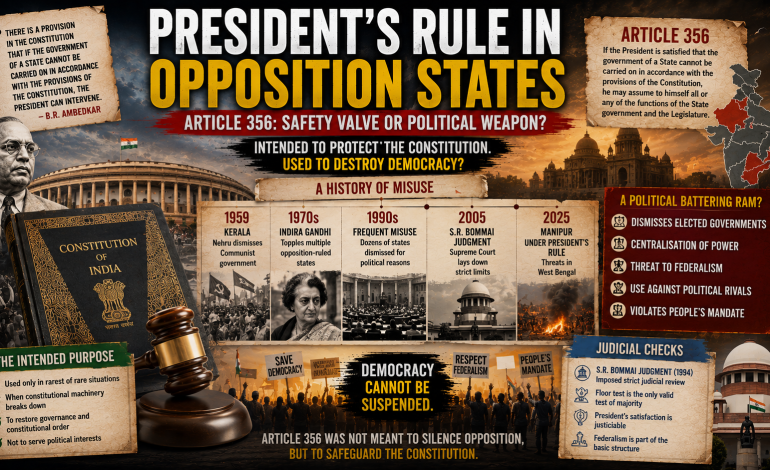
“There is a provision in the Constitution that if the government of a State cannot be carried on in accordance with the provisions of the Constitution, the President can intervene.” With these words, B.R. Ambedkar introduced the most controversial article of the Indian Constitution — Article 356. Intended as a “safety valve” for extreme constitutional breakdown, it has become a political battering ram. From Jawaharlal Nehru dismissing the Communist government in Kerala (1959) to Indira Gandhi toppling opposition states in the 1970s, and now, the Modi government imposing President‘s Rule in Manipur (2025) and threatening it in West Bengal — Article 356 has been weaponized against political rivals far more often than it has been used to save democracy. This article traces the constitutional design, the historical misuse, the judicial checks imposed by the Supreme Court, and the contemporary battles over central rule in opposition states.
WHAT – Article 356 of the Constitution empowers the President to assume control of a state government — suspending or dissolving the state legislature and transferring all executive and legislative powers to the Centre — if the President is “satisfied that a situation has arisen in which the government of the State cannot be carried on in accordance with the provisions of this Constitution.”
WHO – The central government (through the President, who acts on the aid and advice of the Council of Ministers) imposes President‘s Rule; the Governor submits reports to trigger the provision; Parliament approves extensions; the Supreme Court reviews legality.
WHEN – President’s Rule has been imposed over 130 times since 1950. The Modi government (2014-2026) has invoked it multiple times, most recently in Manipur (February 2025, extended to August 2026), with threats of invocation in West Bengal (2025).
WHERE – Across India, but targeted most frequently at opposition-ruled states — Jammu & Kashmir (multiple times), Maharashtra (2019), Manipur (2025), and West Bengal (2025 threat).
WHY – Constitutionally, to restore governance when a state cannot function. Politically, critics argue, to punish opposition governments, destabilize rivals, or exploit political crises for central consolidation.
HOW – Through Governor‘s reports highlighting law and order breakdown, political instability, or constitutional violations, followed by presidential proclamation and parliamentary approval.
SECTION 1: THE CONSTITUTIONAL FRAMEWORK – ARTICLE 356 AND THE CONSTITUENT ASSEMBLY DEBATE
1.1 What Article 356 Says
Article 356 provides that if the President, on receipt of a report from the Governor of a State or otherwise, is satisfied that a situation has arisen in which the government of the State cannot be carried on in accordance with the provisions of this Constitution, the President may by Proclamation:
Assume to himself all or any of the functions of the Government of the State
Declare that the powers of the Legislature of the State shall be exercisable by or under the authority of Parliament
Make such incidental and consequential provisions as may be necessary
The Proclamation must be laid before each House of Parliament and ceases to operate at the expiration of two months unless approved by both Houses. Once approved, it continues for six months and can be extended for a maximum of three years with parliamentary approval every six months .
1.2 The Constituent Assembly Debate – Ambedkar vs. Opponents
The Constituent Assembly debated Articles 355 and 356 (then draft Articles 277-A and 278) on August 3-4, 1949. The debate was intense and revealed deep philosophical divisions .
Ambedkar‘s Defense:
Introducing the provision, Ambedkar stated: “I think the House has agreed that the Constitution should provide some machinery for the breakdown of the Constitution… as a necessary consequence, we must also give liberty to the President to act even when there is no report by the Governor and when the President has got certain facts within his knowledge on which he thinks, he ought to act in the fulfilment of his duty.”
Ambedkar envisioned Article 356 as a “safety valve” — akin to Section 93 of the Government of India Act, 1935 — to be used only in extreme circumstances, not as a routine political tool. On August 4, 1949, he responded to critics: “If at all they are brought into operation, I hope the President, who is endowed with these powers, will take proper precautions before actually suspending the administration of the provinces” .
The Opposition:
H.V. Kamath strongly opposed it, calling it “a constitutional crime to empower the President to interfere.” He feared that Article 356 would become a weapon for the central government to dismiss democratically elected state governments on flimsy grounds .
Alladi Krishnaswami Ayyar defended the provision: “If there is any unit … any difficulty with regard to the proper working of the Constitution, it would be the obvious duty of the Union government to intervene and set matters right” .
K. Santhanam articulated the legitimate use case: “There may be a physical breakdown of the Government in the State, as for instance, when there is widespread internal disturbance or external aggression… In that case, it is obvious that there is no provincial authority which can function and the only authority which can function is the Central Government” .
The Ambedkar-Bhargava Exchange:
Thakur Das Bhargava noted that the provision covered situations where “the entire machinery has failed, and ordinary people do not enjoy the common liberties” — including internal disturbance to peace and tranquillity .
Ambedkar‘s Meaning of “Breakdown”:
On August 4, 1949, Ambedkar clarified: “The expression ‘failure of machinery’ I find has been used in the Government of India Act, 1935. Everybody must be quite familiar therefore with its de facto and de jure meaning.” He trusted that the President would exercise this power with “proper precautions” .
The article was thus passed — but from its inception, the safeguards were procedural (parliamentary approval), not substantive (judicial review of the President‘s satisfaction).
SECTION 2: HISTORICAL MISUSE – THE WEAPONIZATION OF ARTICLE 356
Ambedkar‘s “safety valve” quickly became a political crowbar.
2.1 The First Dismissal: Kerala (1959)
The first-ever invocation of Article 356 was against the democratically elected Communist government of Kerala led by E.M.S. Namboodiripad in July 1959. The central government, led by Jawaharlal Nehru and the Congress party, dismissed the state government citing “law and order breakdown” and “political instability.” Critics have long argued that the real reason was ideological — removing India‘s first Communist government from power.
2.2 The Indira Gandhi Era – Mass Dismissals (1970s)
The most infamous period of Article 356 misuse occurred during Indira Gandhi‘s tenure. After the 1971 general elections, the central government dismissed opposition-ruled state governments en masse — including those led by the Janata coalition, the Socialists, and regional parties. In several cases, the governments were dismissed despite commanding clear majorities in their assemblies.
2.3 The 1980s-1990s – Routine Abuse
The misuse continued under successive governments. Between 1950 and 2014, Article 356 was invoked over 120 times. State governments were dismissed for reasons ranging from “political instability” and “corruption” to “disrespect to the central government“ and ”failure to implement central schemes.“ Many of these dismissals were overturned by courts or condemned by political opponents.
2.4 The S.R. Bommai Case (1994) – Judicial Checks
In the landmark S.R. Bommai vs. Union of India (1994) case, the Supreme Court fundamentally altered the constitutional landscape. The Court held that:
Principle Holding Not Absolute Article 356 is not absolute — President‘s power is subject to judicial review Breakdown Test The breakdown must be of the constitutional machinery, not mere law and order problems Floor Test In cases of disputed majority, the Governor must conduct a floor test before recommending President’s Rule Basic Structure Proclamation under Article 356 can be struck down if it violates the basic structure Limited Duration The Court imposed strict timelines and conditions on extensions As one analysis notes, the Supreme Court underlined that Article 356 should only be invoked as “a last resort” .
SECTION 3: THE MODI GOVERNMENT‘S USE OF ARTICLE 356 – PATTERNS AND TRENDS
The BJP under Prime Minister Modi has invoked Article 356 in both BJP-ruled and opposition-ruled states — but the pattern reveals a targeted approach.
3.1 Data: Article 356 Proclamations (BJP Era)
Based on the Dataful dataset of President‘s Rule instances :
State Date of Proclamation Date of Revocation Party in Power at Centre Party in Power at State Reason Jammu & Kashmir 19 June 2018 30 Oct 2019 NDA (BJP) PDP+BJP coalition (collapsed) Political instability — CM resigned after coalition partner withdrew support Maharashtra 12 Nov 2019 23 Nov 2019 NDA (BJP) NDA (pre-poll alliance) Political instability — hung Assembly after elections; no party could form government Jammu & Kashmir 31 Oct 2019 13 Oct 2024 NDA (BJP) Governor Rule (converted) Imposed under Section 73 of JK Reorganisation Act (Article 356 does not apply to UTs) — state reorganised into UTs Manipur 13 Feb 2025 4 Feb 2026 (extended to Aug 2026) NDA (BJP) BJP (CM N. Biren Singh resigned) Law and order crisis — ethnic violence since May 2023; CM resigned to avoid no-confidence motion 3.2 Manipur (2025-2026) – The Most Significant Invocation
The imposition of President‘s Rule in Manipur in February 2025 represents the most significant and controversial invocation of Article 356 under the Modi government.
Background – The Ethnic Violence (2023-2025):
Since May 3, 2023, Manipur has been engulfed in large-scale ethnic violence between the majority Meitei community and the minority Kuki-Zomi tribes. The violence was triggered by protests over the Meitei community‘s demand for Scheduled Tribe (ST) status, which would give them reservations in education and government jobs — a status the Kuki-Zomi feared would dilute their existing benefits .
Between May 3, 2023, and November 2024, more than 250 people were killed, and over one lakh people displaced from their homes. Hundreds of temples, churches, homes, and other properties were destroyed. Over 5,000 weapons were taken from police stations and other locations during the chaos .
The Governor‘s Report and CM‘s Resignation:
On February 9, 2025, Chief Minister N. Biren Singh resigned from his post. Insiders said Singh — a BJP member — resigned “to quell dissidence within the party and to avert the possibility of a no-confidence motion against him by the Congress-led opposition in the state assembly” . A legislative assembly session was scheduled to begin on February 10.
Following his resignation, the state Governor submitted a report to the President recommending imposition of President‘s Rule, citing the breakdown of law and order and the inability to carry on governance in accordance with the Constitution .
The Proclamation:
On February 13, 2025, President Droupadi Murmu imposed President‘s Rule in Manipur under Article 356 . The proclamation:
Suspended the Manipur Legislative Assembly (powers transferred to Parliament)
Placed all executive functions under the President‘s direct control (administered through the Governor)
Disabled specific articles concerning legislative procedures and governance to enable central administration
President‘s Rule was initially imposed for six months. In August 2025, Parliament approved a six-month extension. The state remained under central rule until February 2026, with a further extension possible .
The Constitutional Debate – Was Manipur a Valid Case?
The Manipur case has sparked intense constitutional debate. Senior Advocate Dushyant Dave argued in The Hindu (November 2024) that Manipur represented “a classic case of the failure of the constitutional machinery, necessitating invocation of Article 356” .
Dave noted that the President can act under Article 356 “if, ‘otherwise,’ satisfied that a situation has arisen” — meaning the President need not wait for a Governor‘s report. He reminded readers that Ambedkar gave the President “liberty to act even when there is no report by the Governor” .
However, critics raised two counterarguments:
Counterargument Explanation BJP-led Government Failed The violence occurred under the watch of a BJP Chief Minister (N. Biren Singh) and a BJP-led central government. If the central government failed to prevent or control the violence for nearly two years, does it deserve credit for finally invoking Article 356? Punishing the State, Not the Government President‘s Rule punishes the entire state — suspending its legislature — not just the failed Chief Minister. The people of Manipur lost their elected representatives because their CM resigned. The Supreme Court‘s Role (or Lack Thereof):
The Supreme Court was criticized for its delayed and ineffective response. After the May 2023 violence, the Court held hearings but largely accepted the government‘s assurances. On May 8, 2023, the Court recorded the Solicitor General‘s statement that “no violence has been reported in the State during the course of the previous two days and the situation is gradually returning to normalcy” .
By July 2023, the Court was forced to take suo motu notice of horrific incidents — including a video of women being paraded naked by a mob. The Court observed: “What is portrayed in the media would indicate gross constitutional violations and infractions of human rights. Using women as instruments for perpetrating violence is simply unacceptable in a constitutional democracy” .
Despite 27 hearings, the violence continued. Dave noted: “It is shocking that under the watchful eyes of the ultimate protector of fundamental rights, the mayhem continues, depriving the three million people of Manipur of fundamental rights” .
SECTION 4: THE WEST BENGAL THREAT – POLITICAL MANOEUVRING (2024-2025)
While Manipur saw actual imposition of President‘s Rule, West Bengal witnessed threats of its invocation — revealing the political weaponization of Article 356.
4.1 The RG Kar Hospital Incident (August 2024)
Following the rape and murder of a trainee doctor at RG Kar Hospital in Kolkata (August 2024), the BJP demanded the resignation of Chief Minister Mamata Banerjee and threatened to seek President‘s Rule. BJP leaders argued that the state government had failed to maintain law and order and that central intervention was necessary .
4.2 Governor C.V. Ananda Bose’s Report (May 2025)
In May 2025, West Bengal Governor C.V. Ananda Bose sent a report to Union Home Minister Amit Shah on communal violence in Murshidabad district. The report reportedly suggested that the Union government consider invoking Article 356 if the situation worsened, and recommended deployment of Central forces, a judicial inquiry, and central intervention .
4.3 Opposition Unity – A Rare Sight
The Governor‘s report triggered rare political unity among opposition parties.
Party Position Trinamool Congress (TMC) Strongly criticized the report as “biased and aligned with the BJP‘s political agenda.” State general secretary called it an instruction from the Union government. CPI(M) State secretary Mohammed Salim argued that transferring power to the Governor under President’s Rule would not solve problems. “The people of this state have had bitter experiences with President‘s rule,” he noted. He cited Manipur as an example: “In Manipur, despite a ‘double-engine’ government, people’s lives remain endangered” . Congress Called the Governor‘s statement “constitutionally unwanted,” “politically motivated,” and “against the federal structure.” Congress alleged that the “broader context of the ideological objectives of the RSS and the BJP” included the “long-term plan of fragmenting West Bengal — culturally rich and politically resilient — into smaller administrative units” . The Congress statement added: “The imposition of President‘s rule, therefore, is not just a question of governance — it is a calculated attempt to undermine Bengal’s political autonomy and pave the way for divide-and-rule politics. It must be opposed unequivocally by all democratic forces” .
4.4 Why President‘s Rule Was Not Imposed
Despite the Governor‘s report and BJP rhetoric, President’s Rule was not imposed in West Bengal. The reasons likely included:
The Mamata Banerjee government retained a majority in the Assembly
The Supreme Court‘s Bommai precedent would have required a floor test, which the TMC would likely have won
Political cost — imposition would have triggered massive protests and further opposition unity
The 2025 proposed legislation (discussed below) offered an alternative mechanism
SECTION 5: THE NEW FRONTIER – ARTICLE 356 “THROUGH THE BACKDOOR” (2025)
Perhaps the most significant development in the constitutional battle over Article 356 is not the article itself, but the government‘s attempt to achieve the same outcome through new legislation.
5.1 The Proposed Constitutional Amendment (August 2025)
On August 20, 2025, Home Minister Amit Shah introduced three bills in the Lok Sabha that would provide a legal framework for the removal of the Prime Minister, Union Ministers, Chief Ministers, and ministers who are “arrested and detained in custody on account of serious criminal charges” .
Key Provisions of the 130th Constitutional Amendment Bill:
Provision Detail Trigger Arrest and detention in custody for 30 consecutive days Charges Allegation of committing an offence punishable with imprisonment for five years or more Effect The CM/Minister shall be removed from office by the 31st day Return Could return to their posts once freed from jail 5.2 The Exception – Arvind Kejriwal
The proposed law was explicitly modeled on the case of Arvind Kejriwal, who was arrested in March 2024 — the first serving Chief Minister in India‘s history to be arrested and remain in office. All previous CMs facing arrest (Lalu Prasad, Hemant Soren) had resigned beforehand, putting a replacement in the CM‘s chair. Kejriwal was the exception .
Kejriwal was arrested by the Enforcement Directorate (ED) in the Delhi excise policy case on March 21, 2024. He was granted interim bail to campaign from May 10 to June 1, then re-arrested by the CBI on June 26 — a move the Supreme Court itself said raised “serious questions about timing.” After over five months in custody, he secured bail in both cases in September .
5.3 Critics: “Article 356 Through the Back Door”
Opposition leaders and constitutional experts reacted with alarm:
Critic Statement Priyanka Gandhi (Congress MP) “I see the bill for the removal of CMs and ministers as draconian, undemocratic and unconstitutional… Tomorrow, you can put any kind of a case on a CM, have him arrested for 30 days without conviction, and he ceases to be the Chief Minister” MK Stalin (Tamil Nadu CM) “The 130th Constitutional Amendment is not reform — this is a Black Day and this is a Black Bill. 30-day arrest = Removal of an elected CM. No trial, no conviction — just BJP‘s diktat. This is how dictatorships begin: Steal votes, Silence rivals and Crush States” MK Sharmila (Social activist) “One more devious and draconian bill whose primary objective is to target opposition ruled states… Democracy in India has become a pathetic joke” 5.4 The Data Problem – ED‘s Dismal Conviction Rate
The government‘s own data undercut the rationale for the bill. In March 2025, the government presented data in Parliament showing that in the last 10 years, the ED had filed cases against 193 politicians but had secured only two convictions. The ED‘s success rate against politicians was a miserable 1% .
Chief Justice of India B.R. Gavai noted that the ED had been “successful” in incarcerating people for years without convictions. Justice Ujjal Bhuyan pointed to the ED‘s dismal conviction rate and observed: “There is a difference between law enforcing and law violating…” .
The proposed bill, critics argued, would allow the government to remove elected CMs based on ED arrests — an agency that convicts only 1% of politicians it charges — without trial, without conviction, and without judicial review.
SECTION 6: THE BATTLE OVER GOVERNOR‘S REPORTS – PUNCHHI COMMISSION RECOMMENDATIONS
The role of Governors in recommending President’s Rule has been a persistent concern. The Justice Madan Mohan Punchhi Commission (2007-2010) — whose report was submitted to the government but never fully implemented — made several radical recommendations regarding Articles 355 and 356 .
Key Punchhi Commission Recommendations:
Recommendation Detail Localised Emergency Instead of imposing President‘s Rule on an entire state, the Centre should be able to bring specific “trouble-torn areas” (a district or parts of a district) under central rule for a limited period (not exceeding three months) Override Structure Create an overriding structure to maintain internal security along the lines of the US Homeland Security department Central Forces Deployment State consent should not be a hurdle in deploying central forces during communal conflagration; deployment should be for only one week, with post-facto state consent Governor‘s Tenure Governors should have a fixed five-year tenure and be removed only through impeachment by the state Assembly Governor‘s Discretion The scope of Governor’s discretionary powers under Article 163(2) should be limited by constitutional amendment Time Limit for Decisions Governors should not sit on decisions and must decide matters within a four-month period The Punchhi Commission‘s recommendations were never implemented. The current government‘s handling of Governor‘s reports — particularly in West Bengal (2025) — suggests that the problem of gubernatorial overreach remains unresolved.
SECTION 7: THE SARKARIA COMMISSION AND BJP‘S HISTORICAL POSITION (1997)
The irony of the current BJP government‘s invocation of Article 356 is that the party once led the charge against its misuse.
The Jaipur Resolution (June 1997):
In June 1997, Chief Ministers of BJP-ruled states — Delhi, Haryana, Punjab, Maharashtra, and Rajasthan — adopted the Jaipur Resolution under the leadership of Rajasthan Chief Minister Bhairon Singh Shekhawat. The resolution demanded the implementation of the Sarkaria Commission‘s recommendations and issued an ultimatum to the Centre to do so by December 31 .
The Resolution‘s Demands:
The misuse of Article 356 by the Centre to bring down elected governments should be stopped
Punjab Chief Minister Prakash Singh Badal demanded the scrapping of the article altogether
The resolution observed that the issue was important and other states should also put up a forceful demand
The Abandoned Position:
Today, the same party that once demanded the scrapping of Article 356 has:
Imposed President‘s Rule in Manipur (2025)
Threatened President’s Rule in West Bengal (2025)
Proposed a law to remove arrested CMs (2025) — effectively achieving Article 356‘s outcome without invoking the article itself
This abandonment of principle has not gone unnoticed by political observers.
SECTION 8: COMPARATIVE ANALYSIS – ARTICLE 356 IN HISTORICAL CONTEXT
Decade Number of Impositions Key Targets Dominant Party Pattern 1950s ~10 Kerala (1959) Congress Ideological (Communist government) 1960s ~15 Multiple Congress Political instability 1970s ~40 Opposition states en masse Congress (Indira Gandhi) Mass dismissals after 1971 elections 1980s ~35 Multiple Congress & others Routine political weapon 1990s ~20 Multiple Various Reduced after Bommai (1994) 2000s ~10 Limited Various Relatively restrained 2014-2026 ~7 J&K, Maharashtra, Manipur BJP Selective (opposition states + coalition crises) Observation: While the raw number of impositions has declined under the Modi government compared to the 1970s-1980s, the political significance of each imposition has increased. The Manipur imposition (2025) — the longest continuous President‘s Rule in recent history — represents a qualitative shift in the use of Article 356.
SECTION 9: CONSTITUTIONAL SAFEGUARDS – WHY ARTICLE 356 IS STILL CONTROLLED
Despite political misuse, several safeguards remain:
Safeguard Mechanism Effectiveness Parliamentary Approval Proclamation must be approved by both Houses within two months Weak — government usually has majority Six-Month Limit Proclamation lapses after six months unless extended Weak — extensions are routine Judicial Review (Bommai) Supreme Court can strike down mala fide proclamations Strong — but requires petition and litigation Floor Test Requirement In disputed majority cases, Governor must conduct floor test Strong — but often avoided through resignation Public Opinion Political cost of dismissing elected government Moderate — depends on media and opposition The Bommai precedent remains the most significant check. As the Supreme Court held, Article 356 should only be invoked as “a last resort.” The Court can examine whether the President‘s satisfaction was based on relevant material, whether it was mala fide, and whether it violated the basic structure.
SECTION 10: THE FUTURE – ARTICLE 356 IN THE SAFFRON ERA
The trajectory of Article 356 under the BJP government suggests three trends:
Trend 1: Selective but Strategic Use
Unlike the mass dismissals of the 1970s, the Modi government has used Article 356 selectively — but each use has been strategically significant: J&K (reorganisation), Maharashtra (coalition crisis), Manipur (law and order breakdown).
Trend 2: Governor-Driven Initiation
In both Manipur and West Bengal (threatened), the Governor‘s report was the trigger. The Punchhi Commission‘s recommendations on limiting Governor discretion — never implemented — would have addressed this concern.
Trend 3: Circumventing Article 356 Through New Legislation
The proposed 130th Constitutional Amendment Bill (2025) — removing arrested CMs — represents a new frontier. If passed, it would allow the central government to achieve the outcome of President‘s Rule (removing an elected CM) without invoking Article 356, without parliamentary approval, and without the safeguards of the Bommai precedent.
As one analysis noted: “This proposed legislation is being seen as an opportunity for the Centre to impose Article 356 through the back door. When the Centre could use it to sack a CM and her/his ministers after the politicians are just charged, and not convicted” .
CONCLUSION – THE SAFETY VALVE THAT BECAME A POLITICAL WEAPON
Article 356 was conceived as a safety valve — a provision of last resort for constitutional breakdown. In practice, it has become a political weapon, used by governments of all ideological stripes to dismiss rival state governments.
Under the Modi government, the use of Article 356 has been more restrained in frequency than the excesses of the 1970s, but more strategic in intent. The Manipur imposition (2025) — following nearly two years of ethnic violence and the resignation of a BJP Chief Minister — occupies a constitutional gray zone: legitimate in its stated justification, but compromised by the central government‘s failure to prevent the crisis it now claims to resolve.
The proposed 130th Amendment (2025) represents a more fundamental shift: circumventing Article 356 altogether, allowing the removal of elected CMs based on arrests by central agencies — agencies that convict only 1% of politicians they charge.
The central question is no longer whether Article 356 will be misused. It is whether India‘s constitutional democracy will evolve toward greater federal autonomy — or toward a centralized system where opposition-ruled states can be destabilized, suspended, and dissolved at the Centre‘s discretion.
The Bommai judgment‘s warning echoes: Article 356 is a “last resort.” But in saffron India, the last resort is becoming the first option.
SUMMARY TABLE: ARTICLE 356 – CONSTITUTIONAL DESIGN VS. POLITICAL REALITY
Aspect Constitutional Design (Ambedkar) Political Reality (Modi Era) Purpose “Safety valve” for extreme constitutional breakdown Political tool to destabilize opposition governments Trigger Governor‘s report or President’s “otherwise” satisfaction Governor‘s report (often politically aligned) Famous Cases Hypothetical — Ambedkar hoped never used Manipur (2025), West Bengal (threatened 2025) Judicial Check Not in original design; Bommai (1994) added judicial review SC can strike down, but delays and deference limit effectiveness Parliamentary Approval Strong safeguard Weak — government controls both Houses BJP‘s Historical Position Demanded scrapping of Article 356 (1997) Imposes President’s Rule selectively (2025) Alternative Mechanism None envisioned Proposed 130th Amendment (2025) — removal of arrested CMs without Article 356
END OF TOPIC 11
Next Topic (Topic 12): “The Speaker‘s Gavel – How Parliamentary Presiding Officers Became Partisan Actors