ABSENCE OF OFFICIAL OPPOSITION STATUS IN PARLIAMENT
TOPIC 13 Impact of Prolonged Denial of Leader of Opposition Recognition For a decade — from 2014 to 2024 — India‘s Lok Sabha functioned without a formally recognized Leader of

TOPIC 13
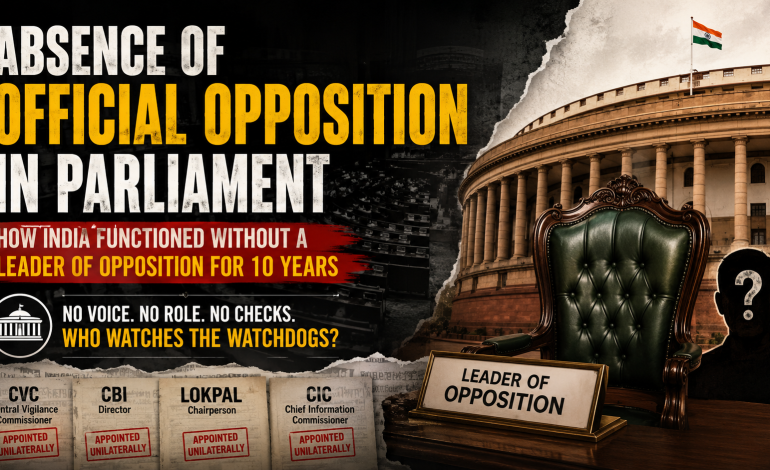
Impact of Prolonged Denial of Leader of Opposition Recognition
For a decade — from 2014 to 2024 — India‘s Lok Sabha functioned without a formally recognized Leader of the Opposition. The Congress party, reduced to 44 seats in 2014 and 52 seats in 2019, fell below the 10% threshold required for official recognition (55 seats in a 543-member House). The result was not merely a procedural inconvenience; it was a constitutional hemorrhage. Without an LoP, the parliamentary opposition lost its voice in the selection of India’s most powerful watchdogs — the Central Vigilance Commissioner, the CBI Director, the Lokpal Chairperson, and the Chief Information Commissioner. The ruling party appointed these officials unilaterally, eroding the cross-party consensus that had historically preserved institutional independence. This article examines the statutory framework, the decade of exclusion, and the profound consequences for India‘s system of checks and balances.
WHAT – The prolonged absence of a recognized Leader of the Opposition (LoP) in the Lok Sabha from 2014 to 2024, due to the largest opposition party (Congress) failing to meet the 10% seat threshold (55 seats in a 543-member House).
WHO – The Congress party (reduced to 44 seats in 2014, 52 seats in 2019); the Modi government; Lok Sabha Speakers Sumitra Mahajan and Om Birla; and key statutory bodies whose selection committees require LoP participation.
WHEN – The position was vacant from May 2014 to June 2024 — a full decade — until Rahul Gandhi was formally recognized as LoP following the 2024 general elections in which Congress won 99 seats.
WHERE – Across the Lok Sabha, and indirectly across key statutory institutions (CVC, CBI, Lokpal, CIC, NHRC) whose selection processes involve the LoP.
WHY – Officially, because the Congress fell below the statutory threshold. Critically, the absence allowed the government to appoint key oversight officials without opposition input, eroding the cross-party consensus that had historically protected institutional independence.
HOW – Through strict application of the 10% rule under the Salary and Allowances of Leaders of Opposition in Parliament Act, 1977, and the government’s refusal to appoint a LoP from the single largest opposition party when it fell below the threshold.
SECTION 1: THE STATUTORY FRAMEWORK – WHAT THE LAW REQUIRES
1.1 The Constitution‘s Silence
The Constitution of India is conspicuously silent on the Leader of the Opposition. It defines with great care the roles of the Prime Minister, the Council of Ministers, the Speaker, and the Governor, but nowhere does it mention the opposition or its leader. This omission was no inadvertence. It reflected the framers’ conviction that democracy would evolve not through exhaustive textual enumeration but through practice, precedent, and political morality.
1.2 The 1977 Act – Statutory Recognition
The Salary and Allowances of Leaders of Opposition in Parliament Act, 1977, conferred legal recognition on the office for the first time — with a significant caveat. To qualify, the opposition party had to command at least one-tenth of the total membership of the House (55 seats in a 543-member Lok Sabha). This numerical threshold, intended to prevent the office from being splintered among micro-parties, soon hardened into a parliamentary convention and was reflected in the Speaker‘s directions.
Key Provisions of the 1977 Act:
| Provision | Detail |
|---|---|
| Definition of LoP | Member who leads the party in opposition to the government having the greatest numerical strength |
| Minimum Threshold | Party must have at least 10% of total House seats |
| Recognition | By the Speaker of the Lok Sabha / Chairman of Rajya Sabha |
| Salary & Allowances | Equivalent to a Cabinet Minister |
| Protocol Status | Ranks 7th in the Order of Precedence of India |
Source:
1.3 The 10% Rule – Origin and Rationale
The 10% rule originated not from the Constitution but from the first Speaker of the Lok Sabha, G.V. Mavalankar, who framed the rules of conducting business in parliament. It was he who incorporated the rule requiring a minimum 10% strength for a party to be recognized as the principal opposition.
The rationale, as originally conceived:
-
To prevent the office from being fragmented among numerous micro-parties
-
To ensure that the LoP genuinely represents a substantial opposition voice
-
To maintain the credibility and authority of the office
However, as the Frontline analysis notes, “the 10-per-cent rule is not chiselled into constitutional granite. The 1977 Act prescribes eligibility thresholds only for the purpose of salary and allowances; it does not extinguish the Speaker’s interpretive authority.”
SECTION 2: THE DECADE OF ABSENCE (2014-2024)
2.1 The Arithmetic Reality
| Election Year | Congress Seats | % of House | 10% Threshold Met? | LoP Status |
|---|---|---|---|---|
| 2014 | 44 | 8.1% | No (needs 55) | Not recognized |
| 2019 | 52 | 9.6% | No (needs 55) | Not recognized |
| 2024 | 99 | 18.2% | Yes | Recognized |
Source:
The Lok Sabha did not officially recognize a Leader of the Opposition for a full decade. The position had been vacant previously — between 1970 and 1977, between 1980 and 1989 — but never for this continuous length of time.
2.2 The Government‘s Legal Justification
The government, supported by Speakers Sumitra Mahajan and Om Birla, maintained that the 10% threshold was binding. In 2014, when the Congress requested the LoP post despite having only 44 seats, Speaker Sumitra Mahajan denied the request on the ground that the party fell below the required number.
BJP Rajya Sabha member G.V.L. Narasimha Rao articulated the position: “As per law, the leader of the opposition party with most number of seats will get the Leader of the Opposition designation. Any party with less than 10% of seats is not given opposition party status. Even during 2014-19, when Congress party did not get 10% seats, they did not get opposition party status.”
2.3 The Constitutional Morality Argument
The decision to strictly enforce the 10% rule during 2014-2024 stood in stark contrast to the political morality practiced by Jawaharlal Nehru in the 1950s. When the Communist Party of India won only 16 seats in the 1952 Lok Sabha — far below any numerical threshold — Nehru nevertheless recognized A.K. Gopalan as the Leader of the Opposition.
As Frontline observes: “Nothing in law obliged Nehru to recognise a Leader of the Opposition, yet he ensured that A.K. Gopalan of the CPI was accorded that status. That gesture was more than personal magnanimity: it embodied Nehru’s conviction that democracy demanded institutional respect for dissent.”
2.4 A Pattern Across States — The Andhra Pradesh Parallel
The denial of LoP status to the principal opposition party was not confined to the national level. In Andhra Pradesh, following the 2024 assembly elections, the ruling Telugu Desam Party (TDP) refused to recognize Y.S. Jagan Mohan Reddy‘s YSR Congress Party — which won 11 seats in a 175-member House — as the official opposition. The 10% threshold would require 18 seats; the government invoked strict arithmetic to deny recognition.
The irony was not lost on observers: “The TDP itself was born in opposition, fashioned in 1982 by N.T. Rama Rao as a challenge to the entrenched dominance of the Congress. In those formative years, the party relied heavily on the visibility and stature that opposition recognition conferred. That a party once nourished by the dignity of opposition should now deny the same recognition to its rival is not merely opportunistic; it is a historical inversion.”
SECTION 3: CONSEQUENCES – INSTITUTIONS DEPRIVED OF OVERSIGHT
The absence of a recognized LoP was not merely symbolic. It had profound practical consequences for India‘s system of checks and balances.
3.1 Key Appointments Made Without Opposition Consensus (2014-2024)
| Institution | Role of LoP | Consequence of Absence |
|---|---|---|
| Central Vigilance Commission (CVC) | LoP is member of selection committee | Government appointees selected without opposition input |
| Central Bureau of Investigation (CBI) | LoP part of high-powered committee | CBI Director appointed without cross-party consensus |
| Lokpal | LoP on selection committee | Anti-corruption ombudsman appointed unilaterally |
| Central Information Commission (CIC) | LoP on selection committee | Transparency watchdog appointments one-sided |
| National Human Rights Commission (NHRC) | LoP on selection committee | Rights body appointments lacking opposition voice |
Source:
3.2 The LoP‘s Statutory Role – What Was Lost
The Leader of the Opposition‘s role in these appointments is not a matter of convention but of statute. Various acts, including the Central Vigilance Commission Act, 2003, explicitly include the LoP (or the leader of the largest opposition party) as a member of the selection committee.
Rahul Gandhi, upon assuming the LoP role in 2024, gained the right to be a member of:
-
Public Accounts Committee
-
Public Undertakings Committee
-
Estimates Committee
-
Several Joint Parliamentary Committees
-
Selection committees for CVC, CBI, CIC, NHRC, Lokpal, and other statutory bodies
For a decade, the largest opposition party — despite having 44 to 52 seats — was excluded from these statutory committees. The government filled these appointments unilaterally.
3.3 The Constitutional Deficit
As the Frontline analysis notes: “The exclusion carried consequences far beyond symbolism: it denied the opposition its rightful place in crucial appointments to institutions such as the Central Bureau of Investigation (CBI), the Lokpal, and the Central Vigilance Commission, thereby corroding the principle of collective oversight.”
SECTION 4: THE RETURN OF THE LoP (2024) — SYMBOLIC BATTLES CONTINUE
Following the 2024 general elections, the Congress won 99 seats — well above the 10% threshold — and Rahul Gandhi was formally recognized as Leader of the Opposition in the Lok Sabha.
4.1 The Protocol Controversy at Republic Day 2026
On Republic Day 2026, a controversy erupted when Rahul Gandhi and Congress president Mallikarjun Kharge (LoP in Rajya Sabha) were seated in the third row at the official celebrations, rather than in the front rows reserved for key constitutional functionaries.
Congress‘s Objection:
Senior Congress figures argued that the seating arrangement departed from established protocol and diminished the stature of constitutionally recognized offices. Under the Salary and Allowances of Leaders of Opposition in Parliament Act, the Leader of Opposition enjoys a status equivalent to that of a Cabinet minister for protocol purposes. By convention, this status has translated into prominent seating at national ceremonies, alongside senior ministers and constitutional office holders.
Congress general secretary Jairam Ramesh said the seating decision sent an “unfortunate signal” about how dissenting voices were viewed, adding that the issue was not about personal prominence but about institutional respect.
4.2 The Government‘s Position
The Centre did not issue a detailed public explanation on the seating arrangement. Officials pointed to a mix of security considerations, precedence lists, and logistical constraints. However, Congress leaders countered that such explanations cannot override codified protocol, especially when the roles involved are explicitly recognized by statute.
The Broader Pattern:
Congress framed the issue as part of a pattern rather than an isolated lapse: “Leaders cited earlier instances where opposition figures alleged they were sidelined at official functions or consultations. They argue that such actions, taken together, risk normalizing a diminished public role for the opposition, even as Parliament relies on it for scrutiny and accountability.”
SECTION 5: COMPARATIVE ANALYSIS – WESTMINSTER TRADITION VS. INDIAN PRACTICE
| Aspect | Westminster (UK) | India |
|---|---|---|
| Constitutional Status | Recognized by convention | Statutory (1977 Act) |
| Threshold Requirement | None — largest opposition party regardless of size | 10% of House seats (55 in Lok Sabha) |
| Historical Precedent | LoP recognized even with small numbers | Nehru recognized CPI with 16 seats (1952); post-2014, strict arithmetic applied |
| Recognition | Relies on political morality | Relies on statutory interpretation, often rigid |
Source:
The Westminster system recognizes the Leader of the Opposition irrespective of party strength, on the principle that the opposition is a structural component of democracy rather than a privilege contingent on arithmetic. In India, by tethering recognition to thresholds, the law has ironically stripped dignity from those opposition voices most in need of protection.
SECTION 6: THE WAY FORWARD – REFORM PROPOSALS
6.1 Lowering or Eliminating the Threshold
Constitutional experts have proposed lowering the threshold to 5% (approximately 27 seats) or eliminating it entirely, reverting to the Westminster model where the largest opposition party is automatically recognized regardless of its numerical strength.
6.2 Codifying LoP Role in Statutory Appointments
While the LoP‘s role in key appointments is already statutory, the absence of a LoP for a decade exposed a gap: there is no provision for an alternative mechanism when no party meets the 10% threshold. Some have proposed that in such cases, the leader of the largest opposition party (regardless of numbers) should serve on selection committees.
6.3 The Judicial Route – Supreme Court Intervention?
The Supreme Court in 2014 dismissed a petition challenging the 10% rule, stating that a decision by the Speaker to run the House is not amenable to judicial review. The Court held that since the ruling is not notified anywhere, the courts cannot verify the correctness of such a ruling.
Whether a future challenge could succeed remains an open question.
CONCLUSION – THE HOLLOWING OF INSTITUTIONAL COUNTERWEIGHTS
The decade without a Leader of the Opposition (2014-2024) was not a gap in parliamentary procedure. It was a systematic hollowing of institutional counterweights.
What Was Lost:
| Loss | Explanation |
|---|---|
| Institutional Oversight | CVC, CBI, Lokpal, CIC, NHRC appointments made without opposition input |
| Parliamentary Balance | No LoP to negotiate with Speaker on House proceedings |
| Shadow Cabinet | No formal alternative government prepared to take over |
| Cross-Party Consensus | Key appointments lost the legitimacy of multi-party agreement |
What Remains of the Westminster Ideal:
The Westminster tradition holds that the opposition is not a nuisance but a constitutional counterweight — “His Majesty‘s Loyal Opposition.” In India, the opposition‘s statutory recognition depends on crossing a numerical threshold that the framers never intended. The result is a system in which a strong government can, by electoral mathematics alone, weaken the very institutions designed to hold it accountable.
The Irony of 2024:
When Rahul Gandhi finally assumed the LoP role in 2024, he walked into an office whose powers had been diminished by a decade of disuse. The institutions that depend on LoP participation — the CVC, the CBI, the Lokpal — had operated for ten years without opposition oversight. Restoring their balance would require not just a recognized LoP, but a fundamental rebuilding of cross-party trust.
The Unanswered Question:
If a future election reduces the largest opposition party below 10% again, will India endure another decade without official opposition? And what will remain of its democratic institutions if it does?
SUMMARY TABLE: LoP STATUS – STATUTORY FRAMEWORK AND IMPACT
| Aspect | Detail |
|---|---|
| Constitutional Provision | None — the Constitution is silent on LoP |
| Statutory Basis | Salary and Allowances of Leaders of Opposition in Parliament Act, 1977 |
| Minimum Threshold | 10% of House seats (55 in 543-member Lok Sabha) |
| Period of Absence | 2014-2024 (full decade) |
| Largest Opposition Party | Congress (44 seats 2014; 52 seats 2019) |
| Key Appointments Affected | CVC, CBI, Lokpal, CIC, NHRC, and other statutory bodies |
| LoP’s Role in Committees | Public Accounts, Public Undertakings, Estimates, Joint Parliamentary Committees |
| Protocol Status | Equivalent to Cabinet Minister (7th in Order of Precedence) |
| Current LoP (2024-) | Rahul Gandhi (Congress) |
END OF TOPIC 13
Next Topic (Topic 14): “The Governor‘s Office – Constitutional Neutrality or Political Tool?”