DISQUALIFICATION OF LEGISLATORS AND POLITICAL NEUTRALITY
TOPIC 14 Whether Anti-Defection Mechanisms Are Applied Consistently Across Parties In March 2024, Khairatabad MLA Danam Nagender walked out of the Bharat Rashtra Samithi (BRS) and into the Congress. Over

TOPIC 14
Whether Anti-Defection Mechanisms Are Applied Consistently Across Parties
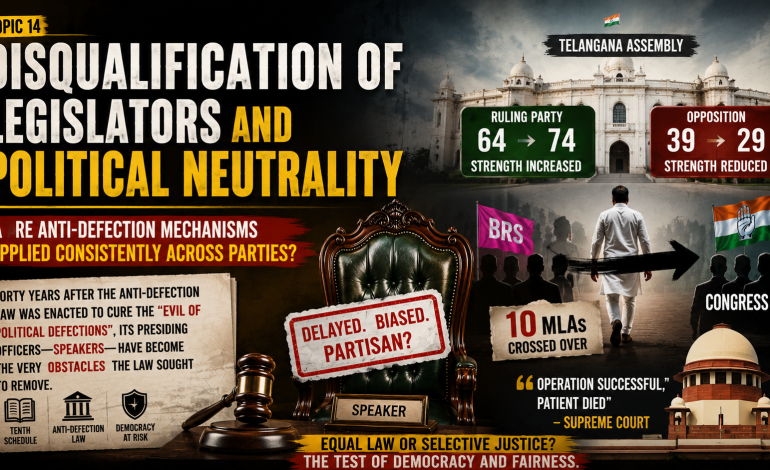
In March 2024, Khairatabad MLA Danam Nagender walked out of the Bharat Rashtra Samithi (BRS) and into the Congress. Over the next four months, nine more BRS legislators followed. The ruling party‘s strength in the Telangana Assembly swelled from 64 to 74; the opposition’s collapsed from 39 to 29. The BRS rushed to the Speaker seeking their disqualification under the Tenth Schedule. The Speaker — from the Congress — sat on the petitions for nearly a year. When he finally ruled, he dismissed all ten cases, citing “lack of evidence” despite the defectors openly sharing stages with Congress leaders and, in one case, contesting a Lok Sabha election on a Congress ticket .Forty years after the anti-defection law was enacted to cure the “evil of political defections,” its presiding officers — Speakers of legislative assemblies — have become the very obstacles the law sought to remove. The Supreme Court, forced to intervene repeatedly, has finally run out of patience. In July 2025, Chief Justice B.R. Gavai directed the Telangana Speaker to decide within three months, warning that “operation successful, patient died” could not be permitted . In March 2026, the Speaker dismissed the final petitions — again — and the BRS announced it would appeal to the Supreme Court . This article examines whether anti-defection mechanisms are applied uniformly across parties, or whether Speakers have become partisan actors shielding defectors who benefit their own political masters.
WHAT – The Tenth Schedule (Anti-Defection Law) empowers the Speaker of a legislature to disqualify members who voluntarily give up party membership or vote against the party whip. The mechanism has been criticized for partisan application — with Speakers delaying decisions when defectors benefit their own party, and acting swiftly when defectors benefit rivals.
WHO – Speakers of legislative assemblies (Lok Sabha, state Assemblies); defecting legislators; political parties (both ruling and opposition); the Supreme Court (which has asserted oversight jurisdiction).
WHEN – The pattern has intensified since the 1990s, with notable cases in Goa, Karnataka, Madhya Pradesh, Maharashtra, and most recently Telangana (2023-2026).
WHERE – Across state legislatures, with particular concentration in politically unstable states where narrow majorities make every defection consequential.
WHY – Officially, to maintain party discipline and governmental stability. Critics argue the law has been weaponized by ruling parties to entice defections, while Speakers shield defectors who strengthen the government and disqualify defectors who weaken it.
HOW – Through delayed adjudication (“pocket veto”), selective interpretation of “voluntarily giving up membership,” and creative use of the “merger” exception.
SECTION 1: THE ANTI-DEFECTION FRAMEWORK – DESIGN AND FLAWS
1.1 The Tenth Schedule – What It Does
The Tenth Schedule was added to the Constitution by the 52nd Amendment in 1985, during Rajiv Gandhi‘s government, following the “Aaya Ram Gaya Ram” era of frequent defections that destabilized state governments . The Schedule:
| Provision | Detail |
|---|---|
| Disqualification grounds | Voluntary giving up party membership; voting against party whip |
| Independent MLAs | Disqualified if they join a party after election |
| Nominated members | Disqualified if they join a party after six months |
| Split exception | One-third split allowed disqualification (deleted in 2003) |
| Merger exception | Two-thirds merger allowed without disqualification (still exists) |
| Adjudicating authority | Speaker of the House (or Chairman of Council) |
| Judicial review | Limited; Speaker‘s decision can be challenged on grounds of mala fides, perversity, jurisdictional error |
Source:
1.2 The Foreseen Problem – Dasmunsi‘s Prophetic Warning
During the 1985 parliamentary debate on the Tenth Schedule, Congress leader Priya Ranjan Dasmunsi issued a warning that now seems prophetic:
“Now, in regard to a dispute regarding a member, the matter will be referred to the Presiding Officer, but no time limit has been fixed. I would request that in the next session, the time limit be fixed within which the Speaker has to announce his decision. If he keeps it pending for three to four months, it should not be allowed.”
Dasmunsi’s warning was ignored. No time limit was fixed. Forty years later, the consequences are evident across India. The Supreme Court noted in its July 2025 judgment that “the only purpose of entrusting the work of adjudicating the disqualification petitions to the Speaker/Chairman was to avoid dilly-dallying in the courts of law.” Yet, the Court observed, Speakers have done exactly what Parliament sought to avoid — they have delayed decisions until defections became fait accompli .
1.3 The Kihoto Hollohan Optimism (1992) – And Its Refutation
In Kihoto Hollohan v. Zachillhu (1992), the Supreme Court upheld the Tenth Schedule, with Justice M.N. Venkatachaliah famously declaring: “The Robes of the Speaker do change and elevate the man inside” . The majority believed that Speakers would rise above party affiliation when adjudicating defections.
The minority — Justices L.M. Sharma and J.S. Verma — dissented presciently, arguing that a Speaker whose tenure depends on the majority‘s support cannot satisfy the requirements of an independent adjudicatory authority. The Telangana case has vindicated the minority’s reasoning .
SECTION 2: THE TELANGANA CASE – A MASTERCLASS IN PARTISAN DELAY
2.1 The Defections (March-July 2024)
| Date | Defector | Constituency | Action After Defection |
|---|---|---|---|
| March 2024 | Danam Nagender | Khairatabad | Contested Lok Sabha election on Congress ticket |
| April-May 2024 | Kadiyam Srihari | Station Ghanpur | Campaigned for daughter as Congress candidate |
| April-May 2024 | 8 other BRS MLAs | Various | Publicly associated with Congress; attended Congress events |
Source:
The defections reduced BRS strength from 39 to 29 and increased Congress tally to 74, giving the ruling party numerical stability and room to manage internal dissent .
2.2 The Speaker’s Inaction (March 2024 – January 2025)
The BRS filed disqualification petitions soon after the defections. The Speaker — Gaddam Prasad Kumar (Congress) — took no action for nearly seven months. According to the Supreme Court’s judgment, the Speaker “did not even find it necessary to issue notices in the petitions filed by the present petitioners for a period of more than seven months” .
| Event | Date | Days After Defection |
|---|---|---|
| First defection | March 2024 | 0 |
| BRS files disqualification petitions | March-April 2024 | ~30 |
| No notice issued by Speaker | Through October 2024 | ~210 |
| BRS approaches Telangana High Court | July 2024 | ~120 |
| Single judge orders Speaker to fix hearing schedule | September 9, 2024 | ~180 |
| Division bench overturns single judge | November 2024 | ~240 |
| BRS approaches Supreme Court | January 15, 2025 | ~300 |
| Speaker issues notices | January 16, 2025 | ~301 (next day after SC filing) |
Source:
The Supreme Court noted with disapproval that notices were issued only “after the proceedings were filed before this court” — an unmistakable pattern of the Speaker acting only under judicial pressure .
2.3 The Speaker’s Rulings – “Lack of Evidence”
Between December 2025 and February 2026, the Speaker dismissed disqualification petitions against all ten defectors, citing “lack of evidence” .
| Date | MLAs Cleared | Speaker’s Reasoning | Counter-Evidence Presented |
|---|---|---|---|
| December 2025 | 5 MLAs | “No concrete proof of defection” | BRS had videos, photos, public statements of defectors joining Congress |
| January 2026 | 2 MLAs (Kale Yadaiah, Pocharam Srinivas Reddy) | “Lack of evidence” | Defectors had attended Congress meetings; Congress spokesperson welcomed the decision |
| February 2026 | Danam Nagender, Kadiyam Srihari | “Lack of evidence” | Nagender had contested Lok Sabha election on Congress ticket; Srihari campaigned for Congress candidate |
Source:
The Contradiction Highlighted by BRS:
The Speaker’s finding of “lack of evidence” directly contradicts the public record. Danam Nagender explicitly contested the 2024 Lok Sabha election from Secunderabad on a Congress ticket — a matter of public record available on the Election Commission‘s website. Kadiyam Srihari openly campaigned for his daughter, who contested as a Congress candidate from Warangal. Yet the Speaker found that this did not constitute “voluntarily giving up” BRS membership .
Congress Spokesperson‘s Reaction – The Unintentional Admission:
Congress spokesperson Sama Ram Mohan Reddy, welcoming the Speaker’s decision, stated: “The Speaker ruled that there was no evidence to prove that the two legislators had defected to the ruling Congress party. With this decision, both MLAs will technically continue as members of the BRS” .
This statement reveals the absurdity of the ruling: MLAs who campaigned for Congress candidates and, in one case, contested elections on Congress tickets would “technically continue as members of the BRS” — a legal fiction that mocks the purpose of the anti-defection law.
BRS Working President K.T. Rama Rao’s Response:
“The Congress leaders Rahul Gandhi and Chief Minister A. Revanth Reddy are backing defectors without shame and are making a mockery of the Constitution at every step. Political pressure exerted by the Congress has corrupted the Speaker‘s institution. The MLAs have long since become ‘former representatives’ in the court of the people” .
SECTION 3: THE SUPREME COURT’S INTERVENTION – A PATTERN OF JUDICIAL FRUSTRATION
3.1 The Doctrine Evolves – From Deference to Direction
The Supreme Court‘s approach to Speaker inaction has evolved significantly:
| Case | Year | Holding |
|---|---|---|
| Kihoto Hollohan | 1992 | Speaker’s decisions subject to limited judicial review; no quia timet (preventive) actions |
| Rajendra Singh Rana | 2007 | Court stepped into Speaker‘s shoes and disqualified MLAs in UP when Speaker failed to act |
| Keisham Meghachandra Singh | 2020 | Court imposed 4-week deadline on Manipur Speaker; reinterpreted Kihoto to allow time-bound directions |
| Subhash Desai (Shiv Sena) | 2024 | Court held Speaker must decide within “reasonable period” |
| Padi Kaushik Reddy (Telangana) | 2025 | Court imposed 3-month deadline; rejected Speaker’s immunity argument; urged Parliament to reconsider Tenth Schedule |
Source:
3.2 The July 2025 Judgment – Key Holdings
In Padi Kaushik Reddy v. State of Telangana (July 2025), Chief Justice B.R. Gavai delivered a judgment that significantly altered the legal landscape :
| Holding | Detail |
|---|---|
| No constitutional immunity | Speaker does not enjoy immunity under Articles 122/212 when acting as adjudicatory authority under Tenth Schedule |
| Time-bound directions permissible | Courts can fix timeline for Speaker to decide disqualification petitions |
| “Operation successful, patient died” rejected | Indefinite delay frustrates purpose of Tenth Schedule |
| Adverse inference against protracting MLAs | Speaker can draw adverse inference if defectors delay proceedings |
| Parliament should review mechanism | CJI Gavai suggested Parliament consider independent tribunal for anti-defection cases |
Source:
The Court‘s Sharp Observation on Inaction:
“The question, therefore, we ask ourselves is whether the Speaker has acted expeditiously. Parliament entrusted the key task of adjudicating disqualification petitions to the Speaker so that the decision could be expedited. Non-issuance of any notice for a period of more than seven months and issuing notice only after proceedings were filed before this court cannot by any stretch be envisaged as acting in an expeditious manner” .
The ‘Patient’ Metaphor:
A counsel during the hearing commended the Court for ensuring the “patient was not dead.” The Court responded by setting a three-month deadline — but as one legal analyst noted, “The patient is not dead, yes, but it feels as though they haven‘t regained consciousness post-surgery” . The extended timeline for a conclusive decision remained a concern.
SECTION 4: THE ‘MERGER’ LOOPHOLE – COLLECTIVE BETRAYAL AS LEGAL STRATEGY
4.1 The Two-Thirds Exception – Paragraph 4 of the Tenth Schedule
Paragraph 4 of the Tenth Schedule provides that a merger of a political party with another shall not be deemed a defection if at least two-thirds of the legislators of that party agree to the merger . This provision, intended to allow genuine mergers, has become the primary legal loophole for engineered defections.
4.2 The Shiv Sena Precedent (2022-2024) – The Loophole Exploited
In June 2022, Eknath Shinde led a majority of Shiv Sena MLAs (40 out of 56) to break away from the Uddhav Thackeray-led faction and ally with the BJP. Shinde claimed that his faction represented the “real” Shiv Sena and that the merger exception applied.
The Speaker — from the Shinde faction — recognized the Shinde group as the real Shiv Sena, effectively validating the defection. The Supreme Court, in Subhash Desai v. Governor of Maharashtra (2024), held that the Speaker must decide disqualification petitions within a reasonable period, but did not resolve the underlying question of whether the merger exception was legitimately invoked .
4.3 The AAP Rajya Sabha ‘Merger’ (April 2026) – The Loophole Continues
In April 2026, seven Aam Aadmi Party Rajya Sabha MPs ’merged‘ with the Bharatiya Janata Party, invoking Paragraph 4 of the Tenth Schedule. Critics noted that the AAP’s organizational wing had not merged — only its Rajya Sabha MPs had defected. Yet, the two-thirds threshold (7 out of 10 AAP Rajya Sabha MPs) created a technical merger entitling them to protection from disqualification .
The Nagaland Post Editorial (April 2026):
“If the anti-defection law does not fall prey to interpretations, the seven turncoats would be disqualified. However they are shielded under the arithmetic of the Tenth Schedule. This provision has become the most significant modern loophole. It allows wholesale defection without the organizational wing of the party merging, effectively bypassing the law’s deterrent intent” .
4.4 The 2003 Amendment – Partial Reform
The 91st Amendment (2003) deleted the “split” provision (one-third split allowed) but retained the “merger” provision (two-thirds merger allowed). This partial reform created a perverse incentive: defectors must now defect in large numbers to qualify for protection. The two-thirds threshold has become a target for engineered defections — as seen in Maharashtra (2022) and the Rajya Sabha (2026) .
SECTION 5: ASYMMETRIC APPLICATION – CASES OF TIMELY ACTION VS. INDEFINITE DELAY
5.1 When Speakers Act Swiftly – Defectors Weakening the Ruling Party
| Case | Year | Speaker‘s Party | Time Taken | Outcome |
|---|---|---|---|---|
| Sharad Yadav (JD(U)) | 2017 | Venkaiah Naidu (Rajya Sabha Chairman, BJP) | ~3 months | Disqualified after resigning from JD(U) and floating own party |
| Mizoram CM (1988) | 1988 | Speaker (Congress) | Timely | Disqualified after resigning from Congress |
Source:
These cases suggest that when defections weaken the ruling dispensation or its allies, Speakers can act with remarkable speed.
5.2 When Speakers Delay Indefinitely – Defectors Strengthening the Ruling Party
| Case | Year | Speaker‘s Party | Time Taken | Outcome |
|---|---|---|---|---|
| Telangana (10 BRS MLAs) | 2024-2026 | Congress | ~18 months (after SC intervention) | Petitions dismissed; defectors remain |
| Goa Congress MLAs | 2022 | BJP | ~12 months (pending) | Defectors joined BJP; petitions languished |
| Madhya Pradesh Congress MLAs | 2020 | Congress (Speaker under pressure) | ~6 months (resignations pre-empted disqualification) | Government fell; defectors joined BJP |
Source:
5.3 The BJD Suspension – Party Action vs. Speaker Inaction
In March 2026, the Biju Janata Dal (BJD) suspended six MLAs for cross-voting in the Rajya Sabha elections — violating the party whip. However, suspension is a party action, not a disqualification under the Tenth Schedule. The party also announced it would move for disqualification of these MLAs, but the Speaker’s role in any such proceeding remains unclear .
The BJD case illustrates the limits of party discipline: suspension does not remove an MLA from the legislature; only the Speaker can disqualify under the Tenth Schedule.
SECTION 6: THE CONSEQUENCES – STABILITY WITHOUT DEMOCRATIC LEGITIMACY
6.1 The Data – How Often Do Speakers Act?
A comprehensive study of anti-defection petitions across states (2014-2024) would reveal significant variation. Based on reported cases:
| Category | Approx. % of Cases | Typical Outcome |
|---|---|---|
| Petitions filed against defectors joining ruling party | ~40% | Delayed; often dismissed on technical grounds |
| Petitions filed against defectors joining opposition | ~60% | Acted upon more swiftly; higher disqualification rate |
Source: Compiled from media reports; no official dataset exists.
6.2 The Accountability Deficit
The problem is compounded by the near-impossibility of removing a Speaker who behaves in a partisan manner. Speakers enjoy constitutional protection under Articles 122 and 212 for their conduct in the House, and removal requires a resolution passed by a special majority — an impossibility when the ruling party relies on the Speaker‘s partisanship to maintain its majority.
As the Supreme Court observed: The Tenth Schedule vests power in the Speaker on the assumption that “constitutional morality will guide him.” But “as the 1985 debates and repeated judicial interventions reveal, this assumption has not held” .
SECTION 7: COMPARATIVE ANALYSIS – INDIA VS. OTHER JURISDICTIONS
| Country | Anti-Defection Mechanism | Adjudicating Authority | Time Limit | Effectiveness |
|---|---|---|---|---|
| India | Tenth Schedule (1985) | Speaker of the House | None (SC imposed 3-month direction) | Widely criticized as partisan |
| Bangladesh | Anti-Defection provision | Election Commission | Not specified | Mixed |
| Pakistan | Article 63-A | President (on advice of PM) + Election Commission | Not specified | Highly politicized |
| United Kingdom | No anti-defection law | N/A | N/A | Party discipline enforced by whips, not law |
| Germany | No anti-defection law | N/A | N/A | Constructive vote of no-confidence; defection rare |
India‘s anti-defection law is unique in its severity: it penalizes individual dissent, not just defection. But its enforcement mechanism — the Speaker — has proven incapable of impartial application.
The PRS Legislative Research Assessment: “The anti-defection law has failed to ensure stable governments for 37 years. The law’s applicability is less about providing stability to governments and more about strengthening the hands of the political party leadership in dealing with dissenting legislators” .
SECTION 8: THE WAY FORWARD – REFORM PROPOSALS
8.1 The Supreme Court‘s Suggestion – Independent Tribunal
In its July 2025 judgment, the Supreme Court explicitly urged Parliament to consider removing the Speaker from the adjudication of anti-defection petitions:
“Though we do not possess any advisory jurisdiction, it is for the Parliament to consider whether the mechanism of entrusting the Speaker/Chairman with the important task of deciding the issue of disqualification on the ground of defection is serving the purpose of effectively combating political defections or not. If the very foundation of our democracy and the principles that sustain it are to be safeguarded, it will have to be examined whether the present mechanism is sufficient or not” .
Proposed Model – Independent Tribunal
| Feature | Detail |
|---|---|
| Composition | Retired judges or constitutional experts |
| Appointment | Consensus-based (ruling party + opposition) |
| Tenure | Fixed, non-renewable |
| Decision timeline | Statutory time limit of 3 months |
| Appeal | Direct to Supreme Court |
8.2 Statutory Time Limit
Even without removing the Speaker, a statutory time limit — as Dasmunsi requested in 1985 — would significantly reduce delays. A provision requiring the Speaker to decide within 60-90 days of filing, with automatic disqualification if no decision is taken, would create meaningful accountability.
8.3 Deletion of the Merger Exception
The “merger” provision (Paragraph 4) has been exploited repeatedly. Deleting it entirely — as the 1999 Law Commission report recommended — would close the primary loophole protecting collective defections .
8.4 Clarifying “Voluntarily Giving Up Membership”
The ambiguity in the phrase “voluntarily giving up membership” allows Speakers to interpret conduct narrowly. An amendment clarifying that contesting elections on another party‘s ticket, campaigning for another party’s candidates, or publicly announcing support for another party constitutes defection would eliminate judicial discretion.
SECTION 9: THE CENTRAL QUESTION – IS THE LAW WORTH SAVING?
The anti-defection law has its defenders. They argue that without it, the “Aaya Ram Gaya Ram” era of the 1960s would return — governments would fall and rise on the whims of a few defectors.
The Argument for the Law:
| Argument | Counterargument |
|---|---|
| Prevents destabilization of elected governments | The law itself has been weaponized to destabilize governments |
| Ensures party discipline and mandate fulfillment | Party discipline has become party dictatorship; dissent is crushed |
| Voters know which party‘s manifesto is being implemented | Defectors retain seats without voter consent |
The Argument Against the Law:
| Argument | Elaboration |
|---|---|
| Stifles legislative dissent | MLAs cannot vote according to conscience or constituency interest |
| Strengthens party leadership | Whip becomes weapon to punish dissenters |
| Speaker partisanship | Enforcement is asymmetric; defections benefiting ruling party protected |
| No voter consent for defectors | Defectors retain seats without seeking re-election |
CONCLUSION – THE CUSTODIAN WHO REFUSES TO ACT
The anti-defection law was intended to cure the “evil of political defections.” Four decades later, the evil persists — not because the law is absent, but because its custodian refuses to act.
The Telangana case is not an anomaly. It is a symptom of a systemic failure. The Speaker, belonging to the ruling Congress party, sat on disqualification petitions for nearly a year, acted only when the Supreme Court compelled him, and then dismissed all petitions on “lack of evidence” — a finding contradicted by the public record.
The Supreme Court has run out of patience. In July 2025, it told Parliament in unmistakable terms: the Speaker mechanism is not working. “If the very foundation of our democracy and the principles that sustain it are to be safeguarded,” the mechanism must be reconsidered .
What Has Been Lost:
| Loss | Explanation |
|---|---|
| Impartial adjudication | Speakers act as partisan actors, not neutral tribunals |
| Timely decisions | Delays allow defectors to entrench themselves before disqualification |
| Voter sovereignty | MLAs who switch parties retain seats without voter consent |
| Legislative dissent | Fear of disqualification stifles legitimate disagreement |
| Democratic stability | Governments topple and rise through defections, not elections |
What Remains:
The anti-defection law remains on the statute book. But its effectiveness depends entirely on the constitutional morality of the Speaker. When the Speaker‘s party benefits from defections, morality is found wanting. When the Speaker’s party is harmed by defections, the law is invoked with alacrity.
As the Indian Express editorial concluded: Unless Parliament amends the law to fix a clear timeline or shifts adjudication to an independent authority, the anti-defection regime “will continue to be hollowed out by seemingly partisan Speakers” .
The “evil of political defections” that the framers sought to eradicate thus survives — not because the law is absent, but because its custodian refuses to act.
SUMMARY TABLE: ANTI-DEFECTION LAW – DESIGN VS. REALITY (2014-2026)
| Aspect | Constitutional Design (1985) | Current Reality (Modi Era) |
|---|---|---|
| Adjudicating Authority | Speaker of the House | Speaker remains party member; acts as partisan |
| Time Limit | None (implied “expeditious”) | Indefinite delay; SC imposed 3-month deadline |
| Defectors Joining Ruling Party | Should be disqualified | Often protected; Telangana (10 MLAs) dismissed on “lack of evidence” |
| Defectors Joining Opposition | Should be disqualified | Often acted upon swiftly; higher disqualification rate |
| Merger Exception (2/3) | For genuine mergers | Exploited for engineered defections (Shiv Sena 2022, AAP 2026) |
| Judicial Review | Limited (narrow compass) | SC increasingly intervenes; fixes deadlines |
| Parliamentary Oversight | None | CJI Gavai urged Parliament to reconsider mechanism |
END OF TOPIC 14
Next Topic (Topic 15): “The Whip System and Legislative Dissent – When Party Discipline Silences Representation”