PARLIAMENTARY DISRUPTIONS AND SHORTENED SESSIONS
TOPIC 15 How Adjournments, Walkouts, and Curtailed Sittings Affect Debate, Accountability, and Democratic Functioning On the morning of November 25, 2024, as the Winter Session of Parliament commenced, Opposition MPs

TOPIC 15
How Adjournments, Walkouts, and Curtailed Sittings Affect Debate, Accountability, and Democratic Functioning
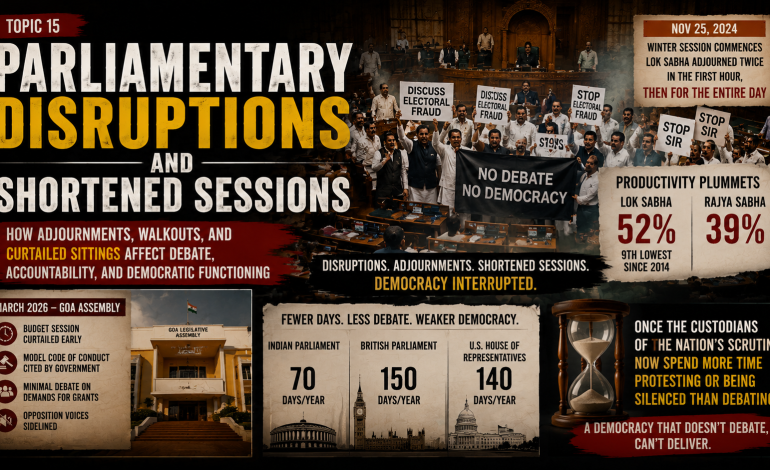
On the morning of November 25, 2024, as the Winter Session of Parliament commenced, Opposition MPs stormed the Well of the House demanding an immediate discussion on electoral fraud and the Special Intensive Revision (SIR) of voter rolls. The Lok Sabha was adjourned twice within the first hour, and then for the entire day. The session that followed would see productivity plummet to 52% in the Lok Sabha — the ninth lowest since 2014 . In the Rajya Sabha, productivity fell to just 39% .Two months later, in March 2026, the Goa Legislative Assembly witnessed a Budget Session scheduled to run until March 27 abruptly curtailed. The government cited the Model Code of Conduct triggered by a by-poll. The budget passed with minimal debate on demands for grants, opposition voices were sidelined, and elected representatives were denied the time to scrutinize spending priorities .These are not isolated incidents. They are symptoms of a deeper democratic malaise: the systematic erosion of parliamentary deliberation through disruptions, adjournments, and shortened sessions. Forty years ago, the Lok Sabha sat for an average of 120 days a year. Today, that number has fallen to 70 . The British Parliament meets for 150 days; the US House of Representatives for 140. India’s parliamentarians, once the custodians of the nation‘s scrutiny, now spend more time protesting or being silenced than debating .This article examines how parliamentary disruptions — whether by the Opposition demanding accountability or the government avoiding it — have undermined the very foundations of India’s democratic functioning.
WHAT – The systematic disruption of parliamentary proceedings through adjournments, walkouts, slogan-shouting, and the consequent shortening of legislative sessions — often resulting in laws being passed without debate, Question Hour being largely non-functional, and the government evading accountability.
WHO – Both the Opposition (which uses disruptions to force discussions on pressing issues) and the ruling party (which has been accused of steamrolling legislation, bypassing committees, and curtailing sessions to avoid scrutiny). Speakers and Chairmen preside over the chaos, often unable or unwilling to restore order.
WHEN – The trend has intensified since 2014. The Winter Session of 2024 was among the least productive since the NDA came to power, with lost hours often exceeding productive hours .
WHERE – Across the Lok Sabha, Rajya Sabha, and State Legislative Assemblies (with Goa‘s truncated Budget Session in 2026 serving as a recent case study) .
WHY – Officially, disruptions are caused by the Opposition’s refusal to allow the House to function until their demands are met. Critics argue the government also benefits: when the House is disrupted, Question Hour is cancelled, ministers avoid oral questioning, and controversial legislation can be passed in minutes without meaningful scrutiny.
HOW – Through the use of adjournment motions, walkouts, slogan-shouting in the Well, the invocation of Rule 374-A (mass suspension of MPs), and the executive‘s power to summon and prorogue Parliament at will.
SECTION 1: THE DECLINING PRODUCTIVITY OF PARLIAMENT – DATA AND TRENDS
1.1 The Winter Session of 2024 – A Case Study in Lost Time
The Winter Session of 2024, which ran from November 25 to December 20, was marked by daily protests, scuffles, and eventually an FIR against the Leader of Opposition Rahul Gandhi . Data from PRS Legislative Research reveals a dramatic drop in productivity:
| House | Scheduled Hours | Hours Worked | Productivity | Hours Lost to Disruptions |
|---|---|---|---|---|
| Lok Sabha | ~119 hours | 62 hours | 52% | 65 hours |
| Rajya Sabha | ~113 hours | 44 hours | 39% | ~69 hours |
While the Winter Session held 20 sittings — the most of any session that year — it was the least productive since the Monsoon Session of 2023. Only two sessions since 2014 have seen more hours lost to disruptions: 78 hours in the 2021 Monsoon Session and 96 hours in the 2023 Budget Session .
Of the time the Lok Sabha actually functioned, just 23 hours were dedicated to legislative business — the actual work of passing laws. Much of the functioning time was spent on a discussion marking 75 years of the Constitution . In the Rajya Sabha, just 9 hours were spent on legislative business.
1.2 The Budget Session Contrast – When the House Wants to Work
The preceding session — the post-election Budget Session of 2024 — tells a different story. The Lok Sabha worked for 135% of its scheduled time, or over 115 hours, sitting for 34 extra hours to make up for lost time . This suggests that when political will exists, Parliament can function efficiently. The question is: why does that will disappear so frequently?
1.3 The Long-Term Decline – From 120 Days to 70 Days
PRS Legislative Research has documented a steady decline in the number of sitting days:
| Decade | Average Sitting Days per Year (Lok Sabha) |
|---|---|
| 1950s-1960s | ~120 days |
| 2014-2024 | ~70 days |
In the United Kingdom, the House of Commons meets for an average of 150 days a year. The US House of Representatives meets for 140 days. Canada‘s Parliament meets for 127 days. Germany’s Bundestag meets for 104 days. Only Australia (65 days) is comparable to India‘s 68-70 days .
When Parliament meets for fewer days, and when a significant portion of those days is lost to disruptions, the institution’s ability to hold the government accountable is fundamentally weakened.
SECTION 2: THE CONSEQUENCES – WHAT IS LOST WHEN PARLIAMENT DOES NOT FUNCTION
2.1 The Death of Question Hour – Accountability Silenced
Question Hour, where Members of Parliament (MPs) quiz ministers about the functioning of their ministries, is the most visible mechanism for executive accountability. It is also the first casualty of parliamentary disruption .
During the monsoon session of 2021, Question Hour barely took place. Ministers neither had to answer oral questions nor face pointed follow-ups on the work done by their ministries. While MPs could still get written answers, the dynamic, adversarial nature of oral questioning — the ability to press a minister, to demand clarification, to catch them off-guard — was entirely lost .
As PRS Legislative Research noted: “The first casualty of a non-functioning Parliament is accountability of the government” .
2.2 The Ten-Minute Law – Legislation Without Debate
Perhaps the most alarming consequence of parliamentary disruption is the speed with which laws are passed. During the monsoon session of 2021, amid continuing disruptions, the Lok Sabha took an average of less than 10 minutes to pass a law. The Rajya Sabha passed each law in less than half an hour .
| House | Average Time to Pass a Law | Number of Bills with No MP Speaking |
|---|---|---|
| Lok Sabha | <10 minutes | 13 (only minister spoke) |
| Rajya Sabha | <30 minutes | — |
In 13 bills passed by the Lok Sabha during that session, no Member of Parliament other than the minister in charge of the bill spoke at all . The passage of these laws was “more in form than in substance.”
2.3 The Bypassing of Parliamentary Committees – The Death of Scrutiny
The most significant institutional casualty of the post-2014 era has been the parliamentary committee system. When a bill is referred to a standing committee, it undergoes detailed scrutiny: experts are consulted, citizens can make representations, and opposition and ruling party members work together to refine the legislation.
Since the BJP-led NDA came to power in 2014, the percentage of bills being referred to committees has dramatically declined :
| Lok Sabha (Years) | % of Bills Referred to Committees |
|---|---|
| 14th (2004-09, UPA) | 60% |
| 15th (2009-14, UPA) | 71% |
| 16th (2014-19, NDA) | 27% |
| 17th (2019-24, NDA) | ~25% |
| 18th (2024-present) | 26% |
In the winter session of 2025, the government introduced 11 bills and pushed them through Parliament without scrutiny by standing committees. Only 12% of the government‘s legal proposals in the current Lok Sabha have been sent to committees. This number was 71% under the UPA .
The Consequence: Critical legislations are rushed through with scant deliberation. The Viksit Bharat Guarantee for Rozgar and Ajeevika Mission Bill (replacing MNREGS) was passed in 48 hours. The Insurance Amendment Bill (allowing 100% FDI) and the Nuclear Energy Bill (allowing private companies to operate nuclear plants) were passed amid opposition protests and walkouts. None were referred to committees .
The Jammu and Kashmir Reorganisation Bill (2019), which effectively abrogated Article 370, was not referred to a committee. The three farm bills (2020), which triggered widespread protests across India, were first promulgated as ordinances and then passed without committee scrutiny .
Dr Ronojoy Sen of the NUS Institute of South Asian Studies notes: “The circumvention of committees has led to demands by some for mandatory scrutiny of legislation. These suggestions are unlikely to be implemented since improvements to the committee system have not been the highest priority of the government or the parliament in recent times” .
2.4 The Truncated Session – When Governments Run Away from Accountability
The Goa Legislative Assembly‘s Budget Session in March 2026 offers a stark example of executive overreach. The session, originally scheduled to run until March 27, was abruptly curtailed. The government cited the Model Code of Conduct triggered by a by-poll .
The Outcome:
-
The budget passed with minimal debate on demands for grants
-
Opposition voices were largely sidelined
-
Elected representatives were denied time to scrutinize spending priorities
-
Questions on alleged fiscal mismanagement, environmental concerns, and regional disparities went unasked
As Fr Victor Ferrao observed in an analysis of the episode:
“A government that chooses curtailment over creative accommodation chooses convenience over conviction. It signals contempt for the very idea that elected representatives owe the public a thorough accounting. Goa’s truncated session is therefore not merely an administrative decision but a symptom of a deeper democratic malaise: the creeping substitution of executive efficiency for legislative accountability” .
2.5 The Casualty of Parliamentary Oversight – The Medha Patkar Incident
The erosion of parliamentary scrutiny extends beyond the floor of the House to committees themselves. In July 2025, a meeting of the Standing Committee on Rural Development was abruptly cancelled after BJP MPs walked out to protest the committee‘s decision to hear activist Medha Patkar .
The committee had convened to review the implementation of the land acquisition law. Patkar and actor Prakash Raj were invited as experts to share their views. Before proceedings formally began, NDA MPs protested their presence. As the invited guests entered the committee hall, five BJP MPs walked out.
Despite the walkout, the remaining members continued — only to receive an official communication from the Speaker‘s office declaring that the meeting could not proceed due to lack of quorum .
CPI(M) MP K Radhakrishnan called it unprecedented: “It needs to be examined if this is the first time in the history of Indian democracy that a standing committee meeting was disrupted and cancelled after a political walkout despite the presence of invited experts. Such a precedent undermines the very spirit of parliamentary oversight and democratic consultation” .
CPI MP P Sandosh Kumar added: “The BJP has become so intolerant that it can‘t even hear the words of Medha Patkar and Prakash Raj. This is unbecoming of the ruling party; it should hear all sides. An alarming sign of the BJP’s future India concept” .
SECTION 3: THE STRUCTURAL PROBLEMS – WHY PARLIAMENT IS SO EASILY DISRUPTED
3.1 The Executive‘s Power to Summon and Prorogue
Parliament does not have the power to convene itself. The President, on the advice of the Council of Ministers, summons Parliament. This means the government decides when Parliament meets .
As PRS Legislative Research notes: “As a body that is entrusted to be the ‘watchdog‘ of our democracy, these restraints result in its weakening. Since parliament does not have the power to convene itself, it has been suggested that it should meet for a minimum number of working days in a year” .
The National Commission to Review the Working of the Constitution recommended a minimum of 120 working days for Lok Sabha and 100 for Rajya Sabha. Vice President Hamid Ansari suggested 130 days. These recommendations have never been implemented .
3.2 The Time Lost to Disruptions – A Two-Way Street
Disruptions are not the monopoly of any single party. Both the ruling party and the opposition have been responsible for adjournments, walkouts, and slogan-shouting. However, the consequences are asymmetrical.
When the ruling party benefits from the status quo, it has little incentive to restore order. As PRS noted: “The normalisation of disruption and the steamrolling of legislation in the monsoon session are warning signs that parliamentary functioning needs an urgent overhaul. If this pattern continues, the new Parliament building will be a modern and spacious venue for a dysfunctional institution” .
3.3 The Ineffectiveness of Disciplinary Mechanisms
Parliament has mechanisms to discipline disruptive MPs — suspension, expulsion, denial of entry. But these have proven largely ineffective. MPs disrupt Parliament on the instruction of their political parties, and disciplining them has not worked as a deterrent .
The mass suspension of 146 Opposition MPs in December 2023 under Rule 374-A — without a formal motion — was a dramatic escalation. It raised questions about whether the rules themselves have become weapons to silence dissent rather than tools to maintain order.
3.4 The Deliberative Deficit – Ambedkar‘s Warning
Dr B.R. Ambedkar, the chief architect of the Indian Constitution, was unambiguous that democracy is not merely the counting of votes on election day but the continuous, rigorous working of institutions through debate and accountability. He insisted that a legislature must have adequate time and space to examine every demand for grants, question executive proposals, and ventilate public grievances .
“Without this,” Ambedkar argued, the Constitution becomes a mere “grammar of politics” devoid of life .
Ambedkar drew a sharp distinction between formal democracy (elections and majorities) and substantive democracy (deliberation that keeps power on trial). He feared that executive convenience could erode legislative sovereignty, turning elected representatives into passive endorsers of the government‘s will .
In the curtailed Goa session, Ferrao argues, we see precisely the danger Ambedkar foresaw: “The government did not merely shorten proceedings; it pre-empted the constitutional obligation (under Articles 202 and 203) to allow full financial scrutiny. By invoking the Model Code of Conduct as a shield, the ruling dispensation appeared to flee the very accountability that Dr Ambedkar placed at the centre of republican governance” .
SECTION 4: INTERNATIONAL COMPARISON – INDIA vs. OTHER DEMOCRACIES
| Country | Average Sitting Days per Year | Disruption Culture |
|---|---|---|
| India | ~70 days | Frequent; sessions often wash out |
| United Kingdom | ~150 days | Rare; cross-party consensus on procedure |
| United States | ~140 days | Rare; partisan but functional |
| Canada | ~127 days | Uncommon |
| Germany | ~104 days | Very rare |
| Australia | ~65 days | Less frequent than India |
India‘s Parliament sits for fewer days than almost any other major democracy. And of the days it does sit, a significant portion — sometimes the majority — is lost to disruptions .
The UK Comparison: The British Parliament is in session throughout the year. Its session begins in the spring and meets for 12 months, with breaks for festivals and holidays. India’s convention of three sessions (Budget, Monsoon, Winter) is a colonial legacy but has been increasingly truncated .
As PRS notes: “When Parliament is in session, members have the opportunity to put questions to Government ministers and participate in debates. If the number of days for which Parliament meets is limited, its ability to hold the Government accountable is weakened” .
SECTION 5: THE POLITICAL ECONOMY OF DISRUPTION
5.1 Why the Opposition Disrupts
Opposition parties disrupt Parliament for a straightforward reason: they cannot force the government to debate issues through normal channels. When the government refuses to schedule a debate on a contentious issue (e.g., electoral fraud, rising fuel prices, ethnic violence in Manipur), the opposition‘s only tool to gain attention is disruption.
As socialist leader Madhu Dandavate once remarked, asense of accommodation by the treasury benches and a sense of responsibility by the Opposition benches is the balance essential for the smooth running of Parliament. When that balance breaks, both sides blame the other .
5.2 Why the Government Tolerates (or Encourages) Disruption
The ruling party also benefits from disruption in specific ways. A non-functioning Parliament means:
-
No Question Hour → ministers avoid accountability
-
No committee scrutiny → laws pass without debate
-
No opposition speeches → negative news cycles are avoided
-
Session curtailment → government controls the narrative
As the 2021 monsoon session demonstrated, the government accomplished almost all of its legislative agenda amid the slogan-shouting and placard-waving. The one significant law it did not bring before Parliament was an amendment to delicense electricity distribution — suggesting that when the government truly wants to pass a bill, it finds a way, disruptions notwithstanding .
5.3 The Zero-Sum Game
The current dynamic is a zero-sum game: the opposition disrupts to force accountability; the government tolerates disruption because it can pass laws anyway. Neither side has an incentive to restore deliberative democracy.
The result, as PRS notes, is that “Parliament can change its rules to give MPs more teeth in questioning the government and empower its committees to become critical stakeholders in the law-making process. This will increase the stake that MPs have in the effective functioning of the institution, and disincentivise them from disrupting it. But this alone will not stop parliamentary disruptions” .
SECTION 6: THE WAY FORWARD – REFORM PROPOSALS
6.1 Fix Minimum Sitting Days
The most straightforward reform is to fix a minimum number of sitting days by statute. As PRS notes, if Parliament were to meet more frequently, “the pressure of completing legislative business in a limited time will also ease up leading to lesser number of pending bills. More parliamentary sitting days will allow both the treasury and opposition benches adequate time to bring their issues to the floor of the House” .
6.2 Mandatory Committee Scrutiny
The decline in bills referred to committees — from 71% under UPA to 26% under NDA — is a constitutional scandal. Requiring that all government bills be automatically referred to standing committees for scrutiny (with exceptions only for urgent national security matters) would restore the deliberative character of Parliament.
6.3 Empower the Speaker to Act Impartially
The Speaker‘s inability to maintain order without appearing partisan is a structural flaw. Reforms that insulate the Speaker from party control — such as requiring the Speaker to resign from their party upon election — could restore the neutrality of the Chair.
6.4 The Dandavate Formula
Madhu Dandavate‘s formula remains the ideal: a sense of accommodation by the treasury benches and a sense of responsibility by the Opposition benches. This balance “can only be achieved by both sides working together to uphold the dignity of Parliament” .
CONCLUSION – THE GRAND INQUEST THAT FALLS SILENT
Two hundred and seventy years ago, British parliamentarian William Pitt described the House of Commons as the “grand inquest of the nation.” The legislature, he argued, has a duty “to inquire into every step of public management, either abroad or at home, in order to see that nothing has been done amiss” .
Over the last decade, India‘s grand inquest has increasingly fallen silent. When it does speak, it speaks in shouts and slogans, not in debate. When it passes laws, it passes them in ten minutes, not ten hours. When the government faces scrutiny, it cancels Question Hour. When the opposition demands accountability, it storms the Well.
This is not the democracy Ambedkar envisioned. This is not the Parliament that Sardar Patel, Nehru, and the Constituent Assembly designed.
What Has Been Lost:
| Loss | Explanation |
|---|---|
| Executive accountability | Question Hour non-functional; ministers avoid oral questioning |
| Legislative scrutiny | Laws passed in minutes, often with only the minister speaking |
| Committee oversight | Percentage of bills referred to committees dropped from 71% to 26% |
| Deliberative democracy | Shouting and slogan-shouting replace debate and argument |
| Public trust | Citizens see Parliament as a circus, not a serious institution |
What Remains:
Dr B.R. Ambedkar and Jürgen Habermas, despite their different contexts, agreed on one fundamental principle: legitimacy requires genuine deliberation.
Ambedkar supplied the institutional safeguard: legislatures must be allowed to function fully lest democracy degenerate into elected oligarchy. Habermas supplied the normative standard: legitimacy requires genuine deliberation, not its simulation .
In the truncated sessions and disrupted Houses of modern India, both standards have been breached. The budget, however technically legal, lacks the moral and discursive weight that sustained debate would have conferred. Citizens are left wondering whether allocations reflect careful scrutiny or partisan expediency.
The Unanswered Question:
Democracy dies not with dramatic coups but with quiet erosions — shortened debates, muted voices, budgets passed in haste. If Goan democracy is to retain its vitality, the Assembly must be restored as a forum of robust contestation. Citizens, civil society, and the judiciary have the challenge to insist that sessions are not privileges to be doled out at executive pleasure but rights to be fiercely guarded .
As the new Parliament building rises in New Delhi — a modern, spacious edifice — the question is not about its architecture. The question is whether the institution it houses will recover its voice, its purpose, and its constitutional duty to be the grand inquest of the nation.
Or whether it will remain a modern, spacious venue for a dysfunctional institution.
SUMMARY TABLE: PARLIAMENTARY PRODUCTIVITY – NDA ERA (2014-2026)
| Aspect | 2014-2019 (16th LS) | 2019-2024 (17th LS) | 2024-2026 (18th LS) |
|---|---|---|---|
| Avg. Sitting Days/Year | ~70 | ~68 | ~65 (projected) |
| Bills Referred to Committees | 27% | ~25% | 26% |
| Notable Low Productivity Session | 2021 Monsoon (78 hrs lost) | 2023 Budget (96 hrs lost) | 2024 Winter (65 hrs lost) |
| Question Hour Functionality | Often disrupted | Frequently cancelled | Sporadic |
| Committees Bypassed | Increasing trend | Continued | Accelerated |
| Session Curtailment | Occasional | Frequent | becomes standard practice (Goa 2026) |
END OF TOPIC 15
Next Topic (Topic 16): “Ordinance Raj – When the Executive Legislates Instead of Parliament”
To be continued tomorrow with in-depth analysis of how the government has increasingly used ordinances to bypass parliamentary scrutiny, particularly during the pandemic and political crises.