SPEAKER’S OFFICE AND POLITICAL NEGOTIATIONS
TOPIC 16: Examining Neutrality Concerns Surrounding Parliamentary Leadership Roles The Speaker’s gavel is meant to be the symbol of parliamentary neutrality — an impartial arbiter who, upon assuming the chair,
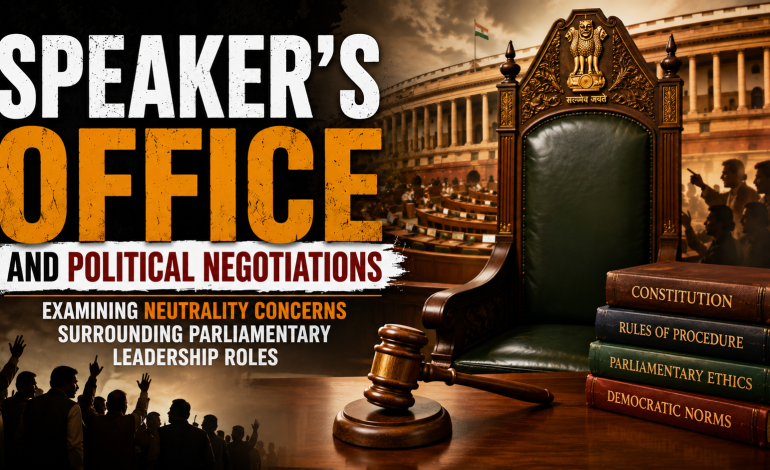

TOPIC 16:
Examining Neutrality Concerns Surrounding Parliamentary Leadership Roles
The Speaker’s gavel is meant to be the symbol of parliamentary neutrality — an impartial arbiter who, upon assuming the chair, belongs to the entire House, not to the ruling party. Yet in India, this ideal has remained elusive for over seven decades. Unlike Britain, where the Speaker resigns from their party and is re-elected unopposed, India’s presiding officers remain party loyalists, dependent on the ruling majority for their tenure, and vulnerable to its pressures. The result is a crisis of credibility: Speakers accused of partisan conduct, mass suspensions of opposition MPs, selective enforcement of rules, and the growing perception that the Speaker’s gavel has become the government‘s bulldozer. This article examines the structural flaws, historical attempts at reform, contemporary controversies, and proposed remedies for India ’s most politically fraught constitutional office.
WHAT – The Speaker‘s office in India’s Parliament and state legislatures, the controversy over its lack of neutrality, and the systemic pressures that turn presiding officers into partisan actors, as well as ongoing debates about reforming the office.
WHO – Lok Sabha Speaker Om Birla, his predecessors G.V. Mavalankar and others, opposition MPs (particularly Mahua Moitra and Rahul Gandhi), constitutional experts, PRS Legislative Research, the Vidhi Centre for Legal Policy, and political parties across the spectrum.
WHEN – The issue has been debated since 1952, with significant flashpoints in 1954 (Mavalankar no-confidence motion), 1979 (Balayogi motion), 2023 (mass suspension of 146 MPs), 2024-2025 (anti-defection controversies), and the 2026 no-confidence motion against Om Birla.
WHERE – The Lok Sabha in New Delhi, as well as state legislative assemblies (particularly Telangana, Maharashtra, Karnataka).
WHY – Officially, the Speaker must maintain order and facilitate government business. Critics argue the Speaker has become an instrument of the ruling party — using discretionary powers to silence dissent, shield defectors, and steamroll legislation — thereby eroding the foundational principle of legislative accountability.
HOW – Through partisan application of anti-defection powers under the Tenth Schedule, unilateral mass suspensions under Rule 374-A, selective recognition of MPs for speaking, control over committee referrals, and the strategic non-election of a Deputy Speaker.
SECTION 1: THE CONSTITUTIONAL FRAMEWORK AND THE BRITISH IDEAL
1.1 What the Constitution Says
The Constitution of India provides for the election of a Speaker and a Deputy Speaker (Article 93). It empowers the House to frame its own rules of procedure (Article 118). It bars courts from inquiring into parliamentary proceedings (Article 122). But it is conspicuously silent on the neutrality of the presiding officer .
Unlike the British Constitution, where conventions have evolved over centuries to ensure impartiality, India‘s constitutional text places no restrictions on the Speaker’s party affiliation, re-election, or conduct. The Speaker is not required to resign from their party — and no Speaker ever has .
1.2 The Westminster Model – What India Could Have Adopted
In the United Kingdom, the Speaker follows two cardinal conventions that have evolved over 300 years:
| Convention | Practice | Purpose |
|---|---|---|
| Resignation from party | Upon election as Speaker, the MP resigns from their political party and severs all ties | To ensure the Speaker owes allegiance only to the House |
| Uncontested re-election | No major party fields a candidate against the Speaker in subsequent general elections; the Speaker is re-elected unopposed | To remove electoral dependency on the ruling party |
As the Vidhi Centre for Legal Policy notes: “Such reforms, though repeatedly voiced, have not been brought to implementation, suggesting a lack of political incentive for the same” .
1.3 The Critical Distinction
| Aspect | British Speaker | Indian Speaker |
|---|---|---|
| Party membership after election | Resigns | Remains member |
| Re-election | Uncontested | Contested as party candidate |
| Voting | Does not vote (except tie-breaking) | Votes as party member |
| Anti-defection adjudication | Not applicable | Speaker decides disqualification |
| Tenure security | High (by convention) | Dependent on ruling party‘s preference |
The British Speaker can afford to be impartial because they face no electoral or political consequences for rulings that displease the government. The Indian Speaker, by contrast, knows their political future depends on the party that nominated them. The result, as PRS notes, is that “the Speaker is dependent on his or her political party for reelection. This makes the Speaker susceptible to pulls and pressures from her/his political party in the conduct of the proceedings” .
SECTION 2: THE UNFULFILLED PROMISE – G.V. MAVALANKAR’S ATTEMPT AT REFORM
2.1 The First Speaker’s Vision
G.V. Mavalankar, the first Speaker of the Lok Sabha (1952-1956), was acutely aware of the challenge. In his 1952 acceptance speech, he said:
“We have yet to evolve political parties and healthy conventions about Speakership, the principle of which is that, once a Speaker he is not opposed by any party in the matter of his election, whether in the constituency or in the House, so long as he wishes to continue as Speaker” .
Mavalankar understood that the British model could not be transplanted overnight. The conventions had to be built. He tried to build them.
2.2 The Conference of Presiding Officers (1951-1953)
In 1951 and 1953, the Conference of Presiding Officers of legislatures in India passed resolutions calling for the adoption of the British convention. Mavalankar personally championed the issue, trying to create consensus among political parties .
2.3 The Congress Working Committee’s Decision (1954)
Mavalankar‘s efforts failed. The Working Committee of the Indian National Congress — the dominant party of the era — decided that adopting the British convention was “not a feasible proposition for the present in view of other political parties being involved in the question” .
As PRS notes: “The 1954 decision of the Working Committee of Congress in response to Mavalankar’s attempt sealed the fate of the issue” .
2.4 Mavalankar‘s Prophetic Warning
Mavalankar had foreseen the consequence. In his 1952 speech, he warned:
“To expect the Speaker to be out of politics altogether without the corresponding convention is perhaps entertaining contradictory expectations” .
Without the security of an uncontested re-election and without the obligation to resign from the party, the Speaker would remain a political actor — not a neutral arbiter.
SECTION 3: THE SPEAKER‘S POWER – WHY THE OFFICE IS SO CONTENTIOUS
3.1 The Anti-Defection Law – Making or Breaking Governments
The Tenth Schedule (Anti-Defection Law), added in 1985, gave the Speaker the power to decide on the disqualification of MPs for voting against the party whip or for voluntarily giving up party membership.
As PRS observes: “They could now make or break parties and govt” .
This power is immense. A Speaker who delays action against defectors benefiting their own party (as in Telangana) or acts swiftly against defectors benefiting the opposition can determine the survival of governments. The Maharashtra political crisis of 2022, where Speaker Rahul Narwekar ’s decisions effectively validated the Shinde faction‘s defection, is a prime example .
3.2 Rule 374-A – Unilateral Mass Suspension
Rule 374-A, introduced in 2001, empowers the Speaker to unilaterally suspend a member for up to five sittings or the remainder of the session — without a formal motion — in cases of “grave disorder.”
The 2023 winter session saw the most dramatic use of this rule: 146 opposition MPs were suspended en masse after demanding a discussion on a major security breach in Parliament . The Vidhi Centre notes: “This event clearly demonstrates the extent to which the Speaker’s unfettered powers can be exercised” .
3.3 Discretion Over Committee Referrals
The Speaker has discretion in deciding whether a bill is sent to a parliamentary committee for scrutiny. Under the UPA (2004-2014), 60-71% of bills were referred to committees. Under the NDA (2014-present), that percentage has dropped to approximately 25%. This decline has been criticised as a deliberate strategy to bypass detailed scrutiny .
3.4 Recognition of MPs for Speaking
The Speaker decides which MPs get to speak, for how long, and on what subjects. When a Leader of Opposition‘s microphone is repeatedly cut off — as Rahul Gandhi alleged during the 2026 budget session — the perception of bias is inevitable .
3.5 The Deputy Speaker Vacancy – A Constitutional Vacuum
Article 93 requires the Lok Sabha to elect a Speaker and a Deputy Speaker “as soon as may be.” Yet the 18th Lok Sabha, constituted in 2024, entered its third year without a Deputy Speaker — a term that has spanned March 2026, into the eighth month of the calendar year .
The Deputy Speaker, by convention, comes from the opposition. Its absence means:
-
No opposition member in the presiding officers‘ panel
-
The Speaker controls all panel chairpersons
-
No independent presiding officer to hear motions against the Speaker
As the Nagaland Post editorial notes: “Her critique extended to the vacant Deputy Speaker post, a constitutional norm left unfulfilled, further eroding institutional balance” .
SECTION 4: THE 2026 NO-CONFIDENCE MOTION AGAINST OM BIRLA
4.1 The Motion
In March 2026, approximately 120 opposition MPs submitted a no-confidence motion against Lok Sabha Speaker Om Birla — only the fourth such motion in Indian parliamentary history. The motion was spearheaded by Trinamool Congress MP Mahua Moitra and invoked Article 94(c) of the Constitution .
4.2 The Allegations
| Allegation | Detail |
|---|---|
| Selective suspension | Moitra highlighted that over 40% of all Lok Sabha suspensions since 2004 occurred under Birla‘s tenure, almost exclusively targeting opposition MPs |
| Leniency to allies | When BJP MP Ramesh Bidhuri used communal slurs in 2023, no serious action followed |
| Microphone cuts | Rahul Gandhi’s microphone was repeatedly cut off during the budget session and the Motion of Thanks debate |
| The ‘Epstein files’ controversy | The Speaker cited intelligence inputs suggesting opposition MPs posed a physical threat to the PM, effectively justifying the PM‘s absence from Parliament |
| Non-election of Deputy Speaker | The constitutional office remains vacant, depriving the House of an opposition presiding officer |
4.3 The ‘Gherao’ Controversy
The immediate trigger for the motion was Speaker Birla‘s extraordinary public statement that intelligence inputs suggested opposition MPs planned to “gherao” (surround) Prime Minister Modi. As one analysis notes: “Traditionally, the Speaker is the custodian of the House, protecting the rights of members against the overreach of the executive. By citing intelligence inputs to justify the Prime Minister’s absence… he has transformed from the protector of the MPs into the ‘government’s shield’“ .
4.4 The Voice Vote Defeat
The motion was defeated by a voice vote — not a recorded division. The opposition could not even force a recorded vote. As the Vidhi Centre notes, the use of voice votes is a classic example of “legislative dysfunction,” where “a law is deemed to be passed merely on the audible volume of ‘ayes’ & ‘noes’, without a clear, recorded majority“ .
4.5 The Government’s Defense
Home Minister Amit Shah defended Speaker Birla, arguing:
“The speaker symbolises parliamentary dignity, his decision is the last word not liable to scrutiny or criticism, maintaining order and decorum is the speaker‘s first task and democracy comes under a cloud if the chair is questioned” .
Critics responded that this “bogus theory… that the speaker’s decisions can’t be questioned is a dangerous ploy to cripple democracy” .
SECTION 5: ASYMMETRIC APPLICATION – DISSENT PUNISHED, ALLIES PROTECTED
5.1 The Bidhuri vs. Opposition Comparison
| MP | Offence | Year | Action |
|---|---|---|---|
| Ramesh Bidhuri (BJP) | Used communal slurs against BSP MP Danish Ali | 2023 | No serious action |
| Opposition MPs | Protested demanding discussion on security breach | 2023 | 146 suspended en masse |
As the Nagaland Post editorial notes: “Selective enforcement… reveals a troubling pattern: swift punishment for dissent, leniency for allies. Such asymmetry violates the Speaker‘s constitutional duty of neutrality” .
5.2 The Anti-Defection Asymmetry
| Case | Speaker‘s Party | Defectors Benefiting | Outcome |
|---|---|---|---|
| Telangana (10 BRS MLAs) | Congress | Congress | Petitions dismissed after 18-month delay |
| Shiv Sena (Maharashtra 2022) | BJP (Rahul Narwekar) | Shinde faction (BJP) | Faction recognised as ‘real‘ Shiv Sena |
| Goa Congress MLAs | BJP | BJP | Petitions languished for months |
The pattern is consistent across states: when defectors strengthen the ruling party, the Speaker delays. When defectors weaken the ruling party, the Speaker acts.
SECTION 6: THE THEORY OF LEGISLATIVE DUE PROCESS
The Vidhi Centre for Legal Policy has proposed a framework called ‘Legislative Due Process’ — the principle that a law enacted without sufficient opportunity for open debate, rushed through the House by the majority, may be procedurally illegitimate and open for judicial scrutiny .
6.1 The Israeli Precedent – Quantinsky v. Knesset
The Israeli Supreme Court invalidated a tax law that was rushed through the Knesset at midnight, not giving members enough time to examine and debate the bill. The Court relied on the doctrine of ‘misuse of constituent power‘ — analogous to India’s Basic Structure Doctrine — holding that the legislative process is subject to unwritten fundamental democratic principles, including the ‘Principle of Participation’ .
6.2 Application to India
Translated to the Indian context, mass suspensions would “fall squarely within this categorization, where a legislator‘s very opportunity to participate in a debate is taken away” .
The Court would examine:
-
Whether members were denied any practical possibility of knowing what they were voting on
-
Whether they were denied any practical possibility of formulating their position
-
Whether they could adopt a substantive position, not a mere passive one
Mass suspensions — by removing MPs from the House entirely — violate the Principle of Participation at its most fundamental level.
SECTION 7: THE WAY FORWARD – REFORM PROPOSALS
7.1 Adopt the British Convention
| Reform | Implementation | Likelihood |
|---|---|---|
| Speaker resigns from party | Constitutional amendment or binding parliamentary resolution | Low (no political incentive) |
| Uncontested re-election | Convention among major parties | Low (parties value electoral advantage) |
| Deputy Speaker from opposition | Enforce constitutional norm | Medium (currently unfilled) |
As the Vidhi Centre notes: “Such proposals, though repeatedly voiced, have not been brought to implementation, suggesting a lack of political incentive for the same” .
7.2 Remove Anti-Defection Adjudication from the Speaker
PRS asks a pertinent question: “Why should the constitutional office of Speaker be required to solve the internal struggles of a political party? Perhaps it‘s time to abolish the law to save the office of Speaker from aspersions of partisan behaviour” .
If the anti-defection law is retained, adjudication should be transferred to an independent tribunal of retired judges — as the Supreme Court itself has suggested.
7.3 Mandatory Committee Scrutiny
Currently, the Speaker has discretion in referring bills to committees. Making committee scrutiny mandatory for all bills (except urgent national security matters) would “insulate Speakers from unnecessary controversy in how they exercise their discretion” .
7.4 Recorded Votes, Not Voice Votes
In most developed countries, all House decisions are recorded. As PRS notes: “In most developed countries, all legislation is scrutinised by committees, and all House decisions are recorded. These changes in India can insulate Speakers from unnecessary controversy” .
7.5 Fix a Minimum Number of Sitting Days
The National Commission to Review the Working of the Constitution recommended a minimum of 120 sitting days for Lok Sabha. A statutory requirement would reduce the pressure to rush legislation through truncated sessions.
CONCLUSION – THE GAVEL THAT MUST BELONG TO THE HOUSE
The Speaker‘s office survives on trust, not just the majority. As the New Indian Express editorial observed: “Speakers must not just be neutral, they must also be seen to be so“ .
The 2026 no-confidence motion against Om Birla — though numerically doomed to fail — was not about winning the vote. It was about documenting a broken relationship. It was about recording for history that a significant portion of the House no longer views the chair as a neutral arbiter.
What Has Been Lost:
| Loss | Explanation |
|---|---|
| Neutrality | Speaker remains party loyalist, dependent on ruling majority |
| Accountability | No Deputy Speaker, no independent oversight |
| Opposition voice | Mass suspensions, muted microphones, selective recognition |
| Anti-defection integrity | Speakers delay to protect defectors benefiting their party |
| Public trust | Citizens see Parliament as a circus, not a serious institution |
What Remains:
Sir William Harcourt once described the ideal Speaker:
“We expect dignity and authority tempered by urbanity and kindness; firmness to control and persuasiveness to counsel; promptitude of decision and justness of judgment… a natural superiority combined with an inbred courtesy, so as to give by his own bearing an example and model to those over whom he presides — an impartial mind, a tolerant temper, and a reconciling disposition” .
For 75 years, India has struggled to produce such a Speaker — not because of individual failings, but because the system makes impartiality almost impossible.
The Unanswered Question:
Will India continue to expect neutrality from a Speaker who remains a party loyalist, who depends on the ruling majority for re-election, who retains party membership and votes along party lines?
Or will it finally have the courage to reform the office — to adopt the British conventions that Mavalankar championed in 1952, to remove anti-defection adjudication from the Speaker‘s purview, and to restore the gavel as a symbol of impartiality, not partisanship?
The gavel belongs to the House, not to the government. Until the Speaker belongs to the House in practice as well as in rhetoric, India’s Parliament will remain a house of suspicion — where the security of the executive is used to silence the voice of the people.
SUMMARY TABLE: SPEAKER’S OFFICE – DESIGN VS. REALITY
| Aspect | Constitutional Design | Current Reality (Modi Era) |
|---|---|---|
| Party affiliation | Not prohibited | Speaker remains party member, votes with party |
| British convention | Considered but rejected (1954) | Not adopted |
| Deputy Speaker | Required (“as soon as may be”) | Not elected in 18th Lok Sabha |
| Anti-defection adjudication | Speaker as tribunal | Delayed when defectors benefit ruling party |
| Suspension power | For “grave disorder” | Rule 374-A used to suspend 146 opposition MPs |
| Committee referral | Speaker‘s discretion | Dropped from 71% to 25% |
| No-confidence against Speaker | Permitted under Article 94(c) | Only 4th in history (March 2026) |
| Judicial review | Barred by Article 122 | Courts intervene only on narrow grounds |
Next Topic (Topic 17): “Anti-Defection Law – Saviour of Democracy or Shackle on Dissent?”
To be continued tomorrow with in-depth analysis of the Tenth Schedule’s impact on legislative independence, party discipline, and the right to dissent.