
ANTI-DEFECTION LAW – SAVIOUR OF DEMOCRACY OR SHACKLE ON DISSENT?
TOPIC 17: The Tenth Schedule at 40 – Promise, Performance, and the Case for Fundamental Reform In 1967, Haryana MLA Gaya Lal changed his party three times in a single

TOPIC 17:
The Tenth Schedule at 40 – Promise, Performance, and the Case for Fundamental Reform
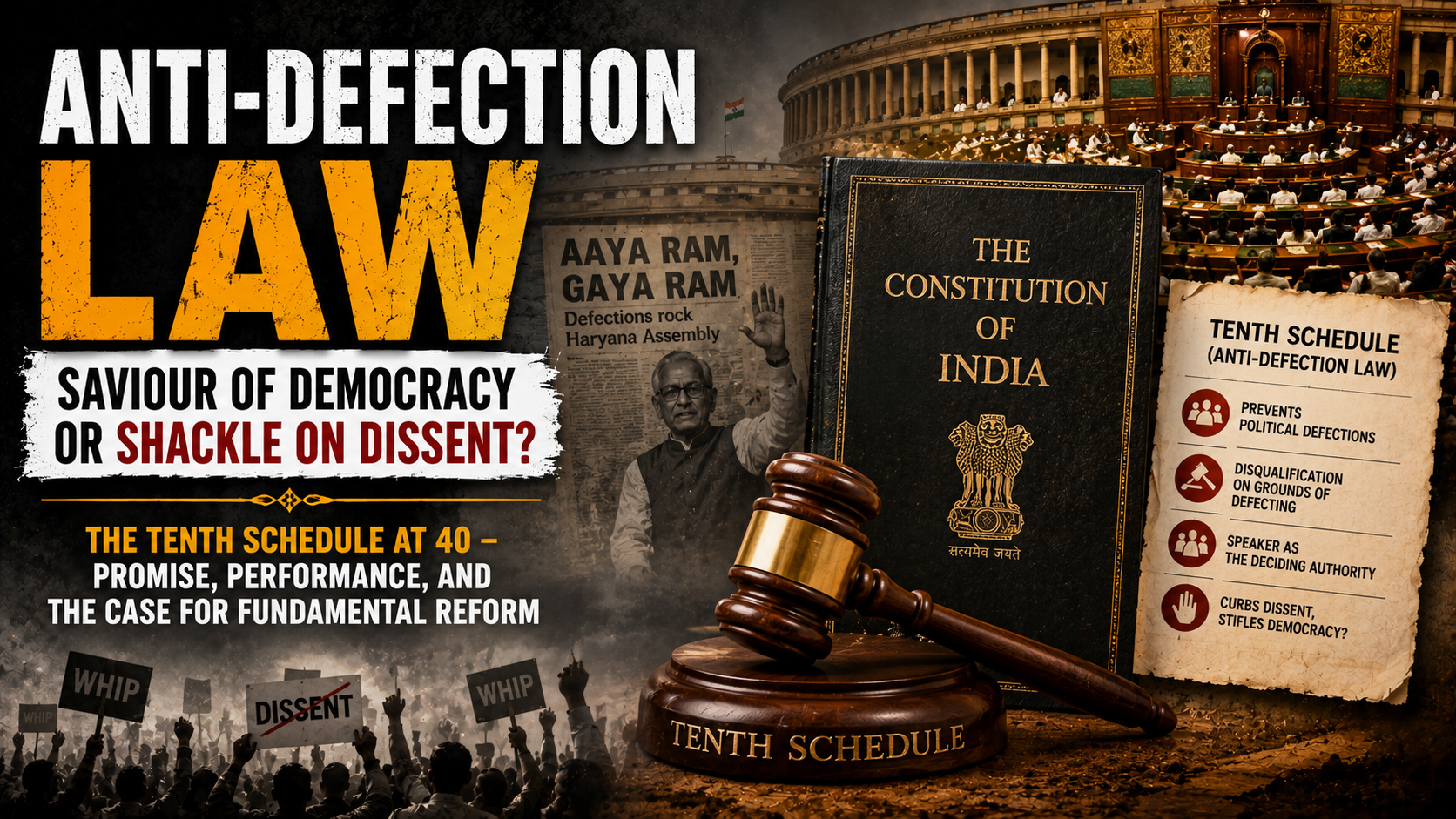
In 1967, Haryana MLA Gaya Lal changed his party three times in a single day – coining the infamous phrase “Aaya Ram, Gaya Ram” that came to define India’s politics of opportunism. In response, Parliament enacted the Tenth Schedule in 1985, the Anti-Defection Law, to cure the “evil of political defections.” Forty years later, the cure has proven worse than the disease. The law has not stopped defections – it has merely changed their form, from retail to wholesale, from individual opportunism to engineered mergers. It has turned legislators into “lobotomised numbers” beholden to party whips, silenced dissent, and made Speakers – political appointees – the arbiters of who keeps their seat. The Supreme Court, forced to intervene repeatedly, has now urged Parliament to reconsider the entire mechanism, questioning “whether the present mechanism is sufficient or not” . This article examines whether the Anti-Defection Law has been a saviour of democratic stability or a shackle on legislative independence – and proposes a path forward.
WHAT – The Tenth Schedule of the Constitution, inserted by the 52nd Amendment in 1985 and amended by the 91st Amendment in 2003, which disqualifies legislators for “voluntarily giving up” party membership or voting against the party whip, with the Speaker as the adjudicating authority.
WHO – Legislators (MPs and MLAs) across all parties, political party leaderships (who issue whips), Speakers of legislatures (who decide disqualification petitions), and the Supreme Court (which has asserted judicial review over Speaker decisions).
WHEN – Enacted in 1985; amended in 2003; repeatedly challenged and interpreted since; facing renewed calls for reform in 2025-2026 following multiple high-profile defection crises in Telangana, Maharashtra, and the Rajya Sabha.
WHERE – Across the Lok Sabha, Rajya Sabha, and all state legislative assemblies.
WHY – Officially, to bring stability to governments by preventing legislators from changing parties for personal gain. Critics argue it has become a tool for party leaderships to crush internal dissent, for Speakers to act as partisan gatekeepers, and for engineered “mergers” to bypass the law entirely – while failing to stop the very defections it was meant to prevent.
HOW – Through disqualification proceedings initiated by parties against dissenting members; through the “merger” exception (Paragraph 4) allowing two-thirds of a legislature party to switch en masse without penalty; through deliberate delay by Speakers in deciding petitions; and through the resignation workaround where defectors resign, contest by-elections, and return to power.
SECTION 1: THE ORIGINS – WHY INDIA NEEDED AN ANTI-DEFECTION LAW
1.1 The Aaya Ram Gaya Ram Era
The seeds of the anti-defection law were sown after the 1967 general elections . The Congress Party, which had dominated Indian politics since independence, saw its strength in the Lok Sabha fall from 361 to 283. More significantly, it lost control of seven state governments as MLAs shifted their political allegiance .
In the twelve months between February 1967 and March 1968 alone, there were 438 defections across India . A report by the Y.B. Chavan Committee, set up to examine the problem, noted a stark pattern: out of 210 defecting legislators in seven states, 116 were given ministerial berths in the governments they helped form .
The Chavan Committee’s Findings:
| Finding | Detail |
|---|---|
| Primary driver | “The lure of office played a dominant part in decisions of legislators to defect” |
| Scale | 438 defections in 12 months (1967-68) |
| Reward structure | 116 of 210 defectors became ministers in new governments |
| Impact | Multiple state governments toppled; political instability became routine |
The “Aaya Ram Gaya Ram” Incident:
The phrase that came to symbolize the era originated with Haryana MLA Gaya Lal, who changed his party affiliation three times in a single day in 1967 . His name became synonymous with the political opportunism that plagued Indian democracy – legislators switching sides not on principle but for personal gain.
1.2 The Failed Attempts (1973 and 1978)
Following the Chavan Committee report, two legislative attempts were made to curb defections – both unsuccessful . The first was made by Indira Gandhi‘s Home Minister Uma Shankar Dikshit in 1973; the second, in 1978, by Shanti Bhushan, Law Minister in the Janata Party government of Morarji Desai. Both attempts failed to gather sufficient political consensus .
1.3 The Successful Enactment (1985)
The third attempt – which succeeded – was made in 1985, after the Congress Party won more than 400 seats in the Lok Sabha in the aftermath of Indira Gandhi’s assassination . The Bill was introduced by Rajiv Gandhi’s Law Minister Ashoke Kumar Sen.
The Statement of Objects and Reasons declared:
“The evil of political defections has been a matter of national concern. If it is not combated, it is likely to undermine the very foundations of our democracy and the principles which sustain it” .
The Bill was debated in the Lok Sabha on January 30, the death anniversary of Mahatma Gandhi – a date Prime Minister Rajiv Gandhi noted as symbolically significant, invoking the Mahatma’s list of “seven social sins,” the first being “politics without principles” . It was passed by the Rajya Sabha the following day.
SECTION 2: WHAT THE ANTI-DEFECTION LAW DOES – THE MECHANISM
The Tenth Schedule, as originally enacted, did four things :
| Provision | Detail |
|---|---|
| Defines defection | Voluntary giving up of party membership; voting or abstaining against party whip; independent candidates joining a party after election |
| Provides exceptions | One-third split (later removed); two-thirds merger (still exists) |
| Designates authority | Speaker of the House decides disqualification petitions |
| Prescribes penalty | Loss of seat in the legislature |
The law applies equally to MPs in the Lok Sabha and Rajya Sabha, and to MLAs in all state legislative assemblies.
2.1 Key Definitions – The Ambiguity Problem
The Tenth Schedule disqualifies a legislator if they “voluntarily give up” membership of their political party. Notably, the law does not define what constitutes “voluntarily giving up” . The courts have interpreted this provision liberally, holding that conduct both inside and outside the legislature – such as attending a rally of another party, publicly criticizing one‘s own party leadership, or campaigning for an opposition candidate – can constitute “voluntarily giving up” membership .
The Chilling Effect: PRS Legislative Research notes that this ambiguity gives political parties “immense power to stamp out internal dissent by threatening its MPs and MLAs with disqualification from the legislature. Lawmakers who do not see eye to eye with the party’s leadership risk losing their seat in the legislature for voicing their opinion” .
2.2 The Whip System – When Dissent Becomes Defection
The Tenth Schedule also disqualifies a legislator who votes or abstains from voting “contrary to any direction” issued by their political party – i.e., the party whip. There is no exception for votes of conscience, constituency interest, or reasoned disagreement .
Congress MP Manish Tewari, who has introduced three private member‘s bills to reform the law, describes the current system as “whip-driven tyranny” that reduces legislators to “mere lobotomised numbers and dogmatic ciphers responding to a division bell” .
2.3 The Exceptions – Split and Merger
Originally, the Tenth Schedule provided two exceptions where defection would not attract disqualification :
| Exception | Original Provision | Current Status |
|---|---|---|
| Split | One-third of legislators split from party | Deleted by 91st Amendment (2003) |
| Merger | Two-thirds of legislators merge with another party | Still exists (Paragraph 4) |
The 2003 amendment, recommended by the Law Commission of India‘s 170th report, deleted the split provision after it was found to be “grossly misused to engineer multiple divisions in the party.” However, the merger provision was retained – a decision critics now call a catastrophic loophole .
As the PRS analysis notes: “The removal of the split provision prompted political parties to engineer wholesale defections (to merge) instead of smaller ‘retail‘ ones” .
SECTION 3: THE ABUSE – HOW THE LAW HAS BEEN WEAPONIZED
3.1 The Merger Loophole – Collective Betrayal as Legal Strategy
The merger provision under Paragraph 4 of the Tenth Schedule is the single most significant loophole in the current law. It provides that a merger of a political party with another shall not be deemed a defection if at least two-thirds of the legislators of that party agree to the merger.
The AAP Rajya Sabha ‘Merger‘ (April 2026):
A recent and stark example occurred in April 2026, when seven Aam Aadmi Party (AAP) Rajya Sabha MPs “merged” with the Bharatiya Janata Party (BJP) . Critics immediately noted that the AAP’s organizational wing had not merged – only its Rajya Sabha MPs had defected. Yet the two-thirds arithmetic (7 out of 10 AAP Rajya Sabha MPs) created a technical merger entitling them to protection from disqualification.
The Nagaland Post editorial observed: “If the anti-defection law does not fall prey to interpretations, the seven turncoats would be disqualified. However they are shielded under the arithmetic of the Tenth Schedule. This provision-Paragraph 4 of the law-has become the most significant modern loophole. It allows wholesale defection without the organizational wing of the party merging, effectively bypassing the law‘s deterrent intent” .
The Maharashtra Shiv Sena Crisis (2022-2024):
The merger loophole was also central to the Maharashtra political crisis of 2022. Eknath Shinde led a majority of Shiv Sena MLAs (40 out of 56) to break away and ally with the BJP. The Shinde faction claimed that it represented the “real” Shiv Sena and that the merger exception applied. Speaker Rahul Narwekar, from the Shinde faction, recognized the Shinde group as the real Shiv Sena, effectively validating the defection. The Supreme Court did not resolve the underlying question of whether the merger exception was legitimately invoked .
The Tribune’s Assessment: “The anti-defection law carries a design flaw that has only grown sharper: it placed decisive power in the hands of the Speaker. While originally the law sought to insulate the Speaker’s decision from judicial review, the Supreme Court corrected that in Kihoto Hollohan. But the essential problem remains – Speakers have increasingly behaved as political actors rather than neutral constitutional authorities” .
3.2 The Speaker‘s Delay – “Operation Successful, Patient Died”
The second major abuse of the anti-defection law is the deliberate delay by Speakers in deciding disqualification petitions.
The Telangana Case (2024-2026):
Following the 2023 Telangana assembly elections, ten BRS MLAs defected to the ruling Congress party. The BRS filed disqualification petitions. The Speaker – from the Congress – took no action for nearly seven months, failing to even issue notices on the petitions .
| Event | Date | Days After Defection |
|---|---|---|
| First defection | March 2024 | 0 |
| BRS files disqualification petitions | March-April 2024 | ~30 |
| No notice issued by Speaker | Through October 2024 | ~210 |
| Supreme Court hearing | January 2025 | ~300 |
| Speaker issues notices | January 16, 2025 | ~301 (next day after SC filing) |
The Supreme Court noted with disapproval that notices were issued only “after the proceedings were filed before this court” – a pattern of the Speaker acting only under judicial pressure .
The Supreme Court’s Frustration:
Chief Justice B.R. Gavai, writing for the bench, observed:
“The question, therefore, we ask ourselves is whether the Speaker has acted expeditiously. Parliament entrusted the key task of adjudicating disqualification petitions to the Speaker, also the chairman of the House, so that the decision could be expedited. Non-issuance of any notice for a period of more than seven months and issuing notice only after proceedings were filed before this court cannot by any stretch be envisaged as acting in an expeditious manner” .
The Court warned against “operation successful, but patient died” – a situation where the Speaker delays so long that the term of the assembly ends, allowing defectors to escape unscathed .
The Remedy Imposed – Three-Month Deadline:
The Supreme Court directed the Telangana Speaker to decide the pending disqualification petitions within three months, holding that constitutional courts can fix a reasonable timeframe for Speakers when they have failed to act . The Court rejected the argument that it cannot fix a timeframe, holding that the Speaker acts as a tribunal under the Tenth Schedule but does not enjoy “constitutional immunity” .
3.3 The Resignation Workaround – Defection Through the Back Door
The third major abuse is the resignation workaround. Instead of defecting and facing disqualification proceedings, legislators resign en masse, reducing the effective strength of the House, bringing down a government, and then contesting again under a new banner .
The Tribune notes: “Defectors often resign, contest bypolls, and return as ministers in newly formed governments, rendering disqualification a temporary inconvenience rather than a punishment” .
3.4 The Asymmetric Application – Serving the Ruling Party
Studies of anti-defection enforcement reveal a troubling asymmetry: when defectors weaken the ruling party, Speakers act swiftly; when defectors strengthen the ruling party, Speakers delay .
| Case | Speaker‘s Party | Defectors Benefiting | Outcome |
|---|---|---|---|
| Telangana (2024-26) | Congress | Congress | Speaker delayed ~7 months; petitions pending |
| Shiv Sena (2022) | Shinde faction (BJP ally) | Shinde faction | Faction recognized as ‘real’ Shiv Sena |
| Goa Congress MLAs (2022) | BJP | BJP | Petitions languished |
| Sharad Yadav (JD(U), 2017) | Venkaiah Naidu (Rajya Sabha Chairman, BJP) | JD(U) dissidents disqualified | Disqualified within 3 months |
The Nagaland Post notes: “These instances were exceptions in a system where delay and distortion are the norm” .
SECTION 4: THE COLLATERAL DAMAGE – SILENCING DISSENT AND STIFLING DEBATE
The anti-defection law‘s most pernicious effect may not be its failure to stop defections, but its success in silencing legitimate dissent.
4.1 Legislators as “Lobotomised Numbers”
Congress MP Manish Tewari, in introducing his reform bill, argued:
“What is happening is when Parliament assembles at 2 o’clock in the afternoon, for government business, there is at times not even a quorum in the House. The reason for this is that parliamentarians do not see a role for themselves in lawmaking which is one of their essential functions. So the law is made by some joint secretary in some ministry. It is brought to Parliament, a minister will read out a prepared statement explaining what it is. Then it‘s put to a pro forma discussion and then as a consequence of a whip-driven tyranny, those on the Treasury benches invariably vote for it and those on the opposition benches vote against it. So good lawmaking where members of Parliament would actually spend time looking at best practices around the world, researching legal precedent and then contributing to the proceedings, that has all become history” .
The Question Tewari Raises: “Who has primacy in a democracy – the elector who stands in the sun for hours to vote, or the political party whose whip turns their representative into a helot?” .
4.2 Applying the Whip to Non-Government Votes
PRS Legislative Research notes a fundamental absurdity in the current law: legislators who disagree with their political party do not always destabilize a government .
For example:
-
An opposition MLA‘s dissent does not impact the government’s stability
-
Rajya Sabha MPs have no role in forming or continuing a government
-
Members of Legislative Councils in states do not affect government survival
Yet the anti-defection law applies equally to all of them .
“This makes it clear that the law‘s applicability is less about providing stability to governments and more about strengthening the hands of the political party leadership in dealing with dissenting legislators” .
4.3 The “Conscience, Constituency, Common Sense” Argument
Tewari’s bill – introduced three times (2010, 2021, 2025) – seeks to amend the Tenth Schedule to allow legislators to vote independently on most bills and motions, reserving disqualification only for votes affecting government stability: confidence motions, no-confidence motions, adjournment motions, money bills, and financial matters .
“This bill seeks to return conscience, constituency and common sense to the echelons of the legislature so that an elected representative actually functions as the representative of the people who elected him and not as an instrument of a whip issued by his party” .
SECTION 5: THE SUPREME COURT’S ROLE – FROM DEFERENCE TO DIRECTION
The Supreme Court‘s approach to the anti-defection law has evolved significantly over four decades.
5.1 Kihoto Hollohan (1992) – Upholding the Law
In the landmark Kihoto Hollohan v. Zachillhu (1992) case, the Supreme Court upheld the Tenth Schedule, with Justice M.N. Venkatachaliah famously declaring that “the Robes of the Speaker do change and elevate the man inside” .
However, the Court also held that the Speaker‘s decisions are subject to judicial review – a crucial safeguard given that “Speakers – regrettably – have increasingly behaved as political actors rather than neutral constitutional authorities” .
5.2 The Shift – Time-Bound Directions (2020-2026)
The Court has moved from deferring to Speakers toward imposing binding timeframes.
| Case | Year | Key Holding |
|---|---|---|
| Keisham Meghachandra Singh | 2020 | Court imposed 4-week deadline on Manipur Speaker |
| Rajendra Singh Rana | 2007 | Court stepped into Speaker’s shoes and disqualified MLAs when Speaker failed to act |
| Padi Kaushik Reddy (Telangana) | 2025 | Court imposed 3-month deadline; rejected Speaker‘s immunity argument |
5.3 The July 2025 Judgment – “Operation Successful, Patient Died” Rejected
In the Telangana case, the Supreme Court delivered a judgment that significantly altered the legal landscape .
Key Holdings:
| Holding | Detail |
|---|---|
| No constitutional immunity | Speaker does not enjoy immunity under Articles 122/212 when acting as adjudicatory authority under Tenth Schedule |
| Time-bound directions permissible | Courts can fix a timeline for Speaker to decide disqualification petitions |
| Adverse inference against delaying MLAs | Speaker can draw adverse inference if defectors prolong proceedings |
| Judicial review available | Speaker’s actions are subject to court scrutiny |
The Court observed:
“The only purpose of entrusting the role of adjudication to the Speaker of the legislature was to avoid delay tactics in the courts of law and to ensure expeditious decisions on disqualification petitions before the end of the term of the assembly. It therefore can be seen that the only purpose of entrusting the work of adjudicating the disqualification petitions to the Speaker/Chairman was to avoid dilly-dallying in the courts of law or the Election Commission office” .
5.4 The Court‘s Appeal to Parliament
Most significantly, the Supreme Court urged Parliament to reconsider the entire mechanism of Speaker adjudication .
Chief Justice Gavai stated:
“Though we do not possess any advisory jurisdiction, it is for the Parliament to consider whether the mechanism of entrusting the Speaker/Chairman with the important task of deciding the issue of disqualification on the ground of defection is serving the purpose of effectively combating political defections or not. If the very foundation of our democracy and the principles that sustain it are to be safeguarded, it is necessary to examine whether the present mechanism is sufficient or not. At the cost of repetition, we observe that it is for the Parliament to take a call on that” .
SECTION 6: THE 2003 AMENDMENT – PARTIAL REFORM, UNFINISHED BUSINESS
6.1 What the 91st Amendment Changed
The 91st Constitutional Amendment (2003) made two significant changes :
| Change | Detail |
|---|---|
| Deleted the split provision | One-third split no longer protected from disqualification |
| Capped Council of Ministers | Limited size of central and state cabinets (based on Chavan Committee recommendation) |
| Bar on defectors joining ministry | Defecting legislators cannot become ministers until re-elected |
6.2 The Unfinished Reform – Why the Merger Loophole Remains
The Law Commission of India, in its 170th report (1999), had recommended deletion of both the split and merger provisions . However, only the split provision was deleted. The merger provision (Paragraph 4) survives.
During the debate on the 2003 amendment, Telugu Desam MP Ravula Chandra Sekar Reddy urged deleting the merger provision as well :
“Let this legislation be extended and made applicable to mergers as well since, in my opinion, merger is a hiatus and a respectable name for defection. They would have fought the election on a particular plan and manifesto. By merging the parties, they will be defeating the mandate of the people. If you want to cleanse politics, we should prohibit this type of mergers also.”
The warning went unheeded. Today, as the AAP Rajya Sabha “merger” demonstrates, the loophole remains wide open .
SECTION 7: REFORM PROPOSALS – RESTORING THE BALANCE
7.1 Tewari’s Bill – Narrowing the Whip’s Reach
Congress MP Manish Tewari‘s private member’s bill proposes :
| Proposal | Detail |
|---|---|
| Limit disqualification | Only for votes on confidence motions, no-confidence motions, adjournment motions, money bills, and financial matters |
| Free vote on all other legislation | MPs and MLAs can vote based on conscience and constituency interest |
| Public announcement of binding directions | Speaker/Chairman must announce any party direction in the House |
| Appeal mechanism | 15 days to appeal disqualification; 60 days for Speaker to dispose of appeal |
| Independent tribunal | Proposes judicial tribunal outside Parliament to hear Tenth Schedule matters |
Tewari argues that the bill “seeks to return conscience, constituency and common sense to the echelons of the legislature” .
7.2 The Tribune’s Three-Pronged Reform
The Tribune editorial (December 2025) proposes three simultaneous reforms :
| Reform | Detail |
|---|---|
| Independent adjudication | Move defection adjudication from Speaker to independent tribunal, with transparent procedure, reasoned orders, and judicial review |
| Statutory deadline | Impose hard 90-day deadline for deciding petitions, so that “delay cannot launder illegality into fait accompli” |
| Six-year disqualification | Bar defecting legislators from contesting for six years – spanning at least one full electoral cycle |
On the six-year bar, the editorial argues:
“Currently, defectors resign, trigger byelections and return on their new party’s ticket within months, sometimes with ministerial berths as reward. A six-year disqualification breaks this cycle. It tells legislators: if you betray your mandate, you cannot simply re-contest and claim renewal. You sit out an entire term. That is the minimum price for switching sides after an election” .
7.3 PRS Legislative Research – Restoring Legislative Independence
PRS Legislative Research notes that the anti-defection law has failed to ensure stable governments for 37 years and that “its applicability is less about providing stability to governments and more about strengthening the hands of the political party leadership in dealing with dissenting legislators” .
The fundamental question PRS poses is: “whether our representatives are responsible only to their political organisation. Or do they also have some responsibility for voicing the opinion of the people who elected them?” .
7.4 Clarity on “Voluntarily Giving Up”
A statutory definition of what constitutes “voluntarily giving up” membership – limiting it to explicit, documented acts of joining another party – would end the current practice where speeches, social media posts, or even attending opposition rallies are treated as defection.
SECTION 8: THE CENTRAL QUESTION – SAVIOUR OR SHACKLE?
8.1 Has the Law Stopped Defections?
The evidence is clear: the law has not stopped defections; it has merely changed their form .
| Era | Form of Defection | Scale |
|---|---|---|
| Pre-1985 | Individual floor-crossing (“Aaya Ram Gaya Ram”) | 438 defections in 12 months (1967-68) |
| 1985-2003 | Splits (one-third provision) | Bulk defections engineered |
| 2003-Present | Mergers (two-thirds provision); resignations | “Mega mall” – entire parties bought and sold |
As Tewari notes: “If defections were a retail activity in the 1960s, they became a wholesale activity by the 1990s after the introduction of the anti-defection law and subsequently by the year 2000s, especially after 2014 it has become a mega mall activity where entire parties are bought and sold wholesale, lock, stock and barrel” .
8.2 Has the Law Silenced Dissent?
Yes. The threat of disqualification for voting against the party whip has made legislators “mere headcounts,” unable to vote according to conscience, constituency interest, or reasoned judgment on ordinary legislation .
8.3 Has the Law Strengthened Party Leaderships?
Yes. As PRS notes, the law’s primary effect has been “strengthening the hands of the political party leadership in dealing with dissenting legislators” – not providing governmental stability .
8.4 Has the Law Protected Democratic Mandates?
No. When a legislator defects – whether individually or through an engineered merger – they retain their seat without seeking re-election, directly violating the principle that the voter‘s mandate belongs to the candidate, not the party .
CONCLUSION – A LAW IN NEED OF RADICAL RETHINKING
The Anti-Defection Law, forty years after its enactment, stands at a crossroads. Designed to cure the “evil of political defections,” it has instead transformed the nature of the disease – from individual opportunism to engineered mergers, from floor-crossing to wholesale party purchases.
What Has Been Lost:
| Loss | Explanation |
|---|---|
| Legislative independence | MPs and MLAs cannot vote according to conscience or constituency interest on ordinary legislation |
| Internal party democracy | Dissent is crushed by threat of disqualification |
| Speaker neutrality | Speakers have become partisan actors, delaying or expediting decisions to suit ruling parties |
| Voter sovereignty | Defectors retain seats without seeking re-election |
| Public trust | Citizens see defections as proof that democracy is bought, not earned |
What Remains:
The Supreme Court has run out of patience. In July 2025, it told Parliament in unmistakable terms: the Speaker mechanism is not working. “If the very foundation of our democracy and the principles that sustain it are to be safeguarded,” the mechanism must be reconsidered .
The Path Forward:
Any meaningful reform must do three things simultaneously :
-
Independent adjudication – Remove the Speaker from defection proceedings. An independent tribunal of retired judges, with transparent procedure and strict timelines, would restore impartiality.
-
Close the loopholes – Delete the merger provision (Paragraph 4) and clarify that resignations triggered by defection do not immunize defectors.
-
Meaningful deterrence – A defecting legislator should be barred from contesting elections for six years – an entire electoral cycle – making defection a genuine political cost, not a short detour to higher office.
-
Restore legislative freedom – Limit whip-enforced voting to motions that directly affect government stability (confidence, no-confidence, money bills). On ordinary legislation, allow MPs and MLAs to vote freely .
The Unanswered Question:
As the Tribune editorial concluded: “The anti-defection law was meant to protect stability and integrity. We must now protect it from manipulation – and restore the simplest principle of representative democracy: a voter’s mandate is not transferable property. Changing sides mid-term must carry a cost heavy enough to make the transaction unviable – because without that, we do not have elections; we have auctions” .
When the Supreme Court, after four decades of experience, urges Parliament to reconsider the entire mechanism – signaling that it lacks confidence in the very institution it once trusted – the crisis is no longer theoretical. The question is not whether the Anti-Defection Law needs reform. The question is whether Parliament has the will to reform it.
SUMMARY TABLE: ANTI-DEFECTION LAW – DESIGN VS. REALITY (1985-2026)
| Aspect | Constitutional Design (1985) | Current Reality (2026) |
|---|---|---|
| Purpose | Curb “evil of political defections” | Defections continue in new forms (mergers, resignations) |
| Adjudicating Authority | Speaker of the House | Speakers act as partisan actors; SC imposes deadlines |
| Whip Coverage | All votes, including ordinary legislation | Legislators reduced to “lobotomised numbers”; dissent silenced |
| Split Provision | One-third split protected | Deleted in 2003 |
| Merger Provision | Two-thirds merger protected | Still exists – primary loophole for engineered defections |
| Time Limit for Decision | None | SC has imposed 3-month deadline in specific cases |
| Judicial Review | Limited | SC increasingly intervenes; fixes deadlines; urges reform |
| Defector Penalty | Loss of seat | Defectors resign, contest bypolls, return as ministers |
| Reform Proposals | None enacted | Multiple proposals pending (Tewari bill, tribunal, 6-year bar) |
Next Topic (Topic 18): “The Whip System and Coalition Stability – Does Party Discipline Strengthen or Weaken Governments?”
To be continued tomorrow with in-depth analysis of how the anti-defection law‘s whip provisions affect coalition governments, floor coordination, and the stability of ruling alliances.