DECENTRALIZATION AND THE WEAKENING OF LOCAL GOVERNANCE
TOPIC 18 The Gap Between Constitutional Promises and Actual Power Transfer to Local Bodies In 1992, India passed its most ambitious democratic reforms since Independence. The 73rd and 74th Constitutional

TOPIC 18
The Gap Between Constitutional Promises and Actual Power Transfer to Local Bodies
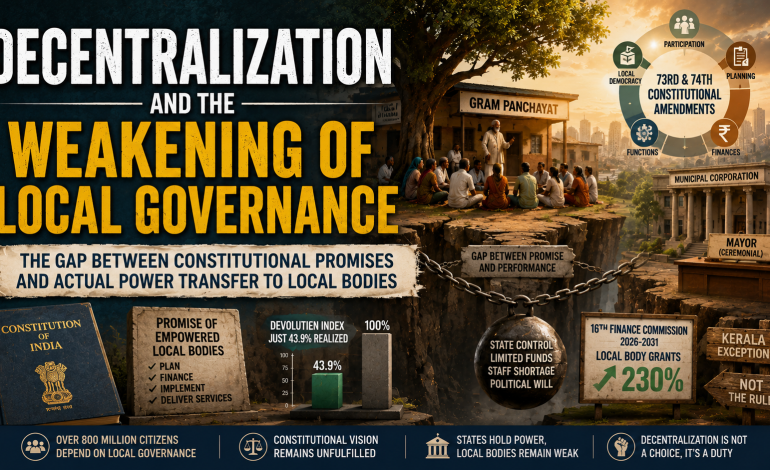
In 1992, India passed its most ambitious democratic reforms since Independence. The 73rd and 74th Constitutional Amendments promised a revolution – the creation of a third tier of governance, with elected local bodies empowered to plan, finance, and deliver services to over 800 million citizens. Three decades later, the promise remains largely unfulfilled. Panchayats and municipalities exist on paper, but their powers are circumscribed by state governments unwilling to part with control. Mayors are ceremonial figureheads. Funds are tied to centrally dictated schemes. Skilled staff remain with state governments. The Devolution Index shows only 43.9% of the constitutional vision has been realized . Kerala stands as the exception, not the rule . As the 16th Finance Commission for 2026-2031 increases grants to local bodies by 230%, the question is not whether India needs decentralization – it is whether India‘s state governments will finally surrender the power they were constitutionally required to share . This article examines the constitutional design of decentralization in India, the gap between promise and performance, and the structural barriers that continue to weaken local governance.
WHAT – The 73rd and 74th Constitutional Amendments (1992), which gave constitutional status to Panchayati Raj Institutions (rural local bodies) and Urban Local Bodies (municipalities), mandating regular elections, reservation for women and marginalized groups, and devolution of 29 functions (Eleventh Schedule) to local governments.
WHO – State governments (which retain constitutional authority over local bodies), the Union Government (which provides grants through Finance Commissions), Panchayats and Municipalities (the local bodies), State Finance Commissions (which recommend devolution), and citizens (who elect local representatives).
WHEN – Amendments passed in 1992, came into force on April 24, 1993; implemented over three decades with varying success; ongoing debates and reform efforts in 2025-2026.
WHERE – Across all states and union territories, with significant variation – Kerala having the most robust decentralization (29% state plan devolution), other states lagging.
WHY – Officially, to deepen democracy, improve service delivery, and empower local communities. Constitutionally mandated but resisted by state governments who fear loss of control over funds, functions, and functionaries.
HOW – Through constitutional provisions (Part IX for Panchayats, Part IXA for Municipalities), State Finance Commissions (SFCs) recommending devolution, Central Finance Commissions (CFC) providing grants, and state legislatures enacting Panchayati Raj Acts.
SECTION 1: THE CONSTITUTIONAL REVOLUTION – WHAT THE 73RD AND 74TH AMENDMENTS PROMISED
1.1 The Pre-1992 Reality – A Two-Tier State
Before 1992, India‘s Constitution mentioned only a two-tier form of government: the Union at the centre and the States at the provincial level . Local institutions were relegated to the Directive Principles of State Policy (Article 40) – which are not enforceable by courts but meant only to guide governments. Panchayats existed in some states but lacked constitutional protection; elections were irregular; powers were minimal.
1.2 The 73rd Amendment – Panchayati Raj Institutions
The Constitution (Seventy-third Amendment) Act, 1992 added Part IX (Articles 243-243O) to the Constitution, establishing a three-tier Panchayati Raj system at the village, intermediate, and district levels .
Key provisions included:
| Provision | Detail |
|---|---|
| Regular elections | Elections every five years; if dissolved, fresh elections within six months |
| Reservation for women | Not less than one-third of total seats (including SC/ST seats) reserved for women |
| Reservation for SC/ST | Proportionate to population |
| State Election Commission | Independent body to conduct local body elections |
| State Finance Commission | Appointed every five years to recommend devolution of funds |
| Eleventh Schedule | 29 subjects to be devolved to Panchayats (agriculture, land reforms, irrigation, animal husbandry, fisheries, social forestry, minor forest produce, small-scale industries, drinking water, poverty alleviation, education, health, sanitation, etc.) |
1.3 The 74th Amendment – Urban Local Bodies
The Constitution (Seventy-fourth Amendment) Act, 1992 added Part IXA (Articles 243P-243ZG), establishing three types of urban local bodies: Nagar Panchayats (transitional areas), Municipal Councils (smaller urban areas), and Municipal Corporations (larger urban areas) .
Key provisions paralleled the 73rd Amendment:
-
Regular elections every five years
-
One-third reservation for women (including SC/ST women)
-
Reservation for SC/ST proportionate to population
-
State Election Commission and State Finance Commission
-
Twelfth Schedule – 18 subjects (urban planning, land use, water supply, sanitation, solid waste management, etc.)
1.4 The Critical Distinction – “Constitutional Status” vs. “Empowerment”
The amendments gave local bodies constitutional status – meaning they cannot be abolished or ignored – but did not mandate how much power, function, or funds must be devolved. Article 243G for Panchayats provides:
“The Legislature of a State may, by law, endow Panchayats with such powers and authority as may be necessary to enable them to function as institutions of self-government…”
The word “may” (not “shall”) is the constitutional loophole. State legislatures can decide the extent of devolution. As a result, devolution varies wildly across states .
SECTION 2: THE DEVOLUTION GAP – PROMISE VS. PERFORMANCE
2.1 The Devolution Index – Measuring the Gap
The Ministry of Panchayati Raj released the “Status of Devolution to Panchayats in States – An Indicative Evidence-Based Ranking, 2024” in February 2025 . The report presents a Devolution Index based on six dimensions:
| Dimension | What It Measures |
|---|---|
| Framework | Constitutional and legal framework for devolution |
| Functions | Transfer of 29 Eleventh Schedule subjects to Panchayats |
| Finances | Funds devolved to Panchayats |
| Functionaries | Staff transferred to Panchayat control |
| Capacity Enhancement | Training and capacity building |
| Accountability | Transparency and grievance redress mechanisms |
The Key Finding: The extent of devolution increased from 39.9% to 43.9% between 2013-14 and 2021-22 . In nearly three decades since the amendments, less than half of the constitutional vision has been realized.
2.2 Functions – The Unfinished Transfer
The Constitution‘s Eleventh Schedule lists 29 subjects – from agriculture to sanitation – that are supposed to be devolved to Panchayats. In reality, most states have devolved only a handful of these subjects . Functions remain with state government departments, with Panchayats acting as implementing agencies rather than decision-making bodies.
The PRS Legislative Research note on “Functions”: States vary in the extent to which they have devolved powers to the Panchayats and Gram Sabhas . The Ministry of Panchayati Raj has “continuously urged all States…to devolve powers to the Panchayats in accordance with the constitutional stipulation” – a message repeated for decades .
2.3 Finances – The Fiscal Constraint
The 15th Finance Commission (2021-2026) recommended:
-
₹2.36 lakh crore for Rural Local Bodies
-
₹1.21 lakh crore for Urban Local Bodies
-
₹70,051 crore for health grants to Local Self Governments
The 16th Finance Commission (2026-2031) has increased allocations by 230% for urban local bodies, adopting a projected urban population share of 40.73% by 2031 .
But central grants alone do not solve the problem. The real issue is that state governments control the vast majority of local finance. State Finance Commissions – constitutionally mandated to recommend devolution – are often ignored by state governments. As the academic study notes, there are “persistent vertical and horizontal fiscal imbalances” and “limited fiscal capacity of local institutions” .
2.4 Kerala‘s Exception – 29% State Plan Devolution
Kerala stands as the exception to India’s decentralization failure. The 7th State Finance Commission (headed by K.N. Harilal) recommended devolution of 29% of the State Plan to local bodies in 2026-27, exclusive of the outlay for the Kerala Solid Waste Management Project . The Commission endorsed raising the allocation by 0.5% of the State Plan every year until it reaches 30% .
The Kerala government has accepted most of the SFC recommendations, including:
-
Creation of a Board of Finance for Local Governments
-
Permission for municipal bonds and borrowings on a project-to-project basis
-
Increased honorarium for elected representatives
As the Hindustan Times editorial notes: “Kerala may be the exception, having witnessed a political movement towards decentralisation of powers – the mayor, not the commissioner, is the effective authority here” .
2.5 The Weak Mayor Problem
The 74th Amendment was supposed to transform urban governance, creating directly responsible mayors with executive authority. It did not happen. As the Hindustan Times editorial observes:
“That transfer of power did not happen: The mayor remains mostly a ceremonial figure, an ineffectual office with real authority resting with the bureaucracy” .
The structural problems with urban governance:
| Problem | Explanation |
|---|---|
| Ceremonial mayor | Real power lies with municipal commissioner (state government appointee) |
| No direct election | Mayor elected by councillors, not by citizens – reduces legitimacy |
| State control | State government retains power over key decisions (budget, appointments, contracts) |
| Limited revenue | Property tax rates controlled by state; cannot raise resources independently |
The solution proposed: “The mayor must be the CEO and face of the city – not the commissioner or the CM. India‘s parliamentary system discourages direct elections to executive office… That will change only if the office is endowed with executive and financial powers” .
SECTION 3: WOMEN‘S RESERVATION – THE ONE SUCCESS STORY
3.1 The Constitutional Mandate
Article 243D (Panchayats) and Article 243T (Municipalities) mandate reservation of not less than one-third of total seats for women, including seats reserved for SC/ST women . Offices of chairpersons at all three levels – not less than one-third reserved for women.
3.2 The Magnitude
As of 2025-2026:
-
Over 28 lakh elected representatives in Panchayats
-
Over 10 lakh women elected representatives – more than 37% of seats
-
National average: ~46% women representatives in panchayats and gram sabhas
-
21 states have raised reservation to 50% for women in Panchayati Raj Institutions
States with 50% women‘s reservation (21 states): Andhra Pradesh, Assam, Bihar, Chhattisgarh, Gujarat, Haryana, Himachal Pradesh, Karnataka, Kerala, Madhya Pradesh, Maharashtra, Odisha, Punjab, Rajasthan, Sikkim, Tamil Nadu, Telangana, Tripura, Uttarakhand, West Bengal .
3.3 Impact
Positive outcomes:
-
Legitimated entry of women in critical mass into mainstream politics at grassroots level
-
Created political space for women across caste and class
-
Acts as “nurseries” for cultivating women politicians for higher-level politics
-
Brought attention to previously neglected issues (water, sanitation, health, nutrition)
-
Catalyzed socio-economic development in rural communities
Persistent challenges:
-
Proxy representation (“Sarpanchpati” issue persists, though reduced)
-
Elite capture by dominant groups; marginalised women remain excluded
-
Patriarchy and seat rotation restrict real decision-making and continuity
3.4 The Contrast – Parliament vs. Local Bodies
Women‘s representation in Lok Sabha remains less than 14% . The defeat of the Constitution (131st Amendment) Bill, 2026 – which sought to implement 33% women‘s reservation in Parliament – highlights the difficulty of implementing quotas at higher levels. As the IASbaba analysis notes, this demonstrates “the effectiveness of constitutional mandates vs. voluntary party nominations” .
The 2026 bill was defeated, but the precedent of local body reservation shows that quotas work when mandated. The path forward for parliamentary reservation remains blocked by delimitation and census debates .
SECTION 4: THE FINANCE COMMISSION MECHANISM – CENTRAL GRANTS AS LIFELINE
4.1 The Constitutional Mandate
Under Articles 280(3)(bb) and 280(3)(c), the Constitution mandates the Finance Commission to recommend grants from the Consolidated Fund of India to States to supplement the resources of Panchayats and Municipalities .
4.2 The 15th Finance Commission (2021-2026)
| Category | Allocation | Details |
|---|---|---|
| Rural Local Bodies (interim 2020-21) | ₹60,750 crore | – |
| Rural Local Bodies (2021-26) | ₹2,36,805 crore | – |
| Urban Local Bodies (2021-26) | ₹1,21,055 crore | – |
| Health grants to LSGs | ₹70,051 crore | For primary healthcare infrastructure |
The Commission prescribed distribution bands for states with three tiers of Panchayats :
| Tier | Minimum Allocation | Maximum Allocation |
|---|---|---|
| Gram Panchayats | 70% | 85% |
| Block Panchayats | 10% | 25% |
| District Panchayats | 5% | 15% |
4.3 The 16th Finance Commission (2026-2031)
The XVI Finance Commission submitted its report in November 2025, accepted by the government in February 2026 . Key features:
| Feature | Detail |
|---|---|
| Increase in allocations | 230% increase for urban local governments compared to XV FC |
| Urban population share | 40.73% projected by 2031 (increases ULBs‘ share to 45% of total local body allocation) |
| Special grants | Planned rural-urban transition grant; Special infrastructure grants for wastewater treatment in 22 cities |
| Untied grants primacy | 60% of total grants as untied funds – local bodies decide spending needs |
| State transfer mandate | States must transfer at least 20% of FC grants to local bodies |
| Rural-urban transition incentivization | Systematic approach to manage urbanization |
As the CPPR analysis notes, these measures are “welcoming measures for improving financial sustainability, accountability, transparency and service delivery performance of ULGs, thus firmly putting India‘s Urban Future and Urban Local Governments in the forefront” .
SECTION 5: THE STATE FINANCE COMMISSION PROBLEM
5.1 Constitutional Requirement vs. Reality
Article 243I requires every State to constitute a State Finance Commission every five years to review the financial position of Panchayats and recommend devolution of funds. In practice:
-
Many states delay constituting SFCs
-
Recommendations are often ignored by state governments
-
Recommendations that are accepted are implemented partially or with delay
5.2 Kerala‘s Compliance – The Exception
Kerala’s 7th State Finance Commission (2025-2026) is a model of compliance. It recommended:
-
29% State Plan devolution to local bodies (2026-27)
-
Increase by 0.5% annually until reaching 30%
-
Creation of Board of Finance for Local Governments
-
Municipal bonds and borrowings for revenue-generating projects
-
50-100% honorarium increase for elected representatives
The state government accepted most recommendations – a rarity in India.
SECTION 6: THE INDIAN MAYORS‘ COUNCIL – VOICES FOR EMPOWERMENT
In February 2025, the Madhya Pradesh chapter of the All India Council of Mayors (AICM) held its maiden meeting, with attendance from 13 of 16 mayors in the state .
Key demands raised by mayors:
| Demand | Detail |
|---|---|
| Financial independence | Freedom to adjust property tax rates; revise octroi compensation grant |
| Administrative control | State not to undertake works through MPUDC; immediate appointment of technical staff |
| Security | Provision of security guards for mayors |
| Tourism development | Maximum grant assistance for local tourism projects |
| Cost reduction | Solar energy adoption; reduce electricity expenses |
CM Mohan Yadav‘s Response: Urged financial independence; praised Indore’s solar energy initiative for water supply .
Urban Administration Minister Kailash Vijayvargiya‘s Message: “Take some courage, impose taxes… Good work will be remembered for decades.” He compared a mayor to the ‘father of the city‘ with the opportunity to serve constituents. He expressed support for the formation of “city governments” .
Opposition Mayors‘ Critique: Rewa and Singrauli mayors questioned why investigations were being hindered when both state and central governments are led by the BJP .
SECTION 7: THE STRUCTURAL PROBLEMS – WHY DEVOLUTION HAS FAILED
7.1 State Government Reluctance
State governments – regardless of political party – have been reluctant to devolve power to local bodies. Reasons include:
-
Loss of control over funds and patronage
-
Fear of local strongmen capturing panchayats
-
Bureaucratic resistance to new power centers
-
Political parties benefit from centralizing power
7.2 The “Functions, Funds, Functionaries” Problem
The Ministry of Panchayati Raj repeatedly urges states to devolve all three Fs – Functions, Funds, Functionaries . Most states devolve some functions, some funds, and few functionaries. Without skilled staff, Panchayats cannot perform devolved functions effectively – creating a self-fulfilling prophecy that “Panchayats are not capable.”
7.3 Inadequate Own-Source Revenue
As the fiscal decentralization study notes: Panchayats and municipalities have limited own-source revenue – property tax, user charges, fees – and remain dependent on state and central transfers . Without fiscal autonomy, they cannot make independent decisions.
7.4 Elite Capture
Reservation for marginalized groups has helped, but elite capture persists. Dominant caste and class groups continue to influence Panchayat decisions, excluding the most marginalized .
SECTION 8: THE WAY FORWARD – REFORM PROPOSALS
8.1 Strengthen the Devolution Index
The Ministry of Panchayati Raj‘s Devolution Index, ranking states on devolution, creates healthy competition. Regular publication and linking to Central Finance Commission grants could incentivize states to improve.
8.2 Mandatory SFC Implementation
Legislation requiring states to implement SFC recommendations within a specified timeframe – or face reduction of Central Finance Commission grants – would create real accountability.
8.3 Empower Mayors – Direct Election and Executive Authority
As the Hindustan Times editorial argues: “The mayor must be the CEO and face of the city – not the commissioner or the CM… That will change only if the office is endowed with executive and financial powers” . Direct election of mayors (not by councillors) with executive authority over municipal administration would transform urban governance.
8.4 Untied Grants as Norm
The 16th Finance Commission‘s 60% untied grants provision is a step in the right direction . Local bodies know local needs best; central and state governments should trust them to spend accordingly – with accountability mechanisms, not pre-approval of every expenditure.
8.5 Capacity Building
Devolution without capacity is counterproductive. The 16th Finance Commission‘s increased grants must be accompanied by systematic capacity building – training elected representatives, strengthening accounting systems, improving project management.
8.6 Municipal Bonds and Borrowings
Kerala‘s SFC recommendation to permit municipal bonds and project-specific borrowings should be adopted nationally . Revenue-generating projects (water supply, solid waste management) can be financed through bonds, reducing dependence on state transfers.
CONCLUSION – DECENTRALIZED ON PAPER, CENTRALIZED IN PRACTICE
Three decades after the 73rd and 74th Amendments, India‘s local governance remains decentralized on paper but centralized in practice. The constitutional revolution promised a third tier of empowered, autonomous, accountable local governments. The reality is a system where:
-
States control functions (what local bodies can do)
-
States control funds (how much local bodies can spend)
-
States control functionaries (who works for local bodies)
The Devolution Index‘s 43.9% score – up from 39.9% in 2013-14 – shows slow, incremental progress . At this rate, full devolution will take another three decades.
What Has Been Lost:
| Loss | Explanation |
|---|---|
| Local agency | Communities cannot decide their own priorities |
| Service delivery | State-controlled services often fail local needs |
| Accountability | Citizens cannot hold local leaders accountable for performance |
| Democratic depth | Two-tier democracy (Centre and State) is not enough for 1.4 billion people |
| Innovation | State templates stifle local experimentation and innovation |
What Remains:
The 16th Finance Commission‘s 230% increase in urban local body grants , Kerala‘s 29% state plan devolution , and the AICM‘s demands for mayoral empowerment suggest that the tide may be turning. But structural change requires state governments – across parties – to surrender power they have held for 75 years.
The Unanswered Question:
Why have state governments – including those led by parties that champion decentralization – refused to implement the constitutional mandate? The answer lies not in lack of constitutional provision but in lack of political will.
As the Hindustan Times editorial concluded: “State governments prefer centralisation and run cities through civil servants” . Until citizens demand local control – and until state governments respond – India‘s local bodies will remain what they have been for 30 years: constitutional structures without constitutional substance.
SUMMARY TABLE: DECENTRALIZATION IN INDIA – DESIGN VS. REALITY (1993-2026)
| Aspect | Constitutional Design (1993) | Current Reality (2026) |
|---|---|---|
| Constitutional Status | Third tier of governance | Achieved – local bodies constitutional |
| Regular Elections | Every five years | Generally achieved |
| Women‘s Reservation | 33% minimum (Article 243D, 243T) | Exceeded – 46% national average; 21 states at 50% |
| Functions (29 subjects) | Devolution to local bodies | Partial – most functions retained by states |
| Finances | Independent revenue + state devolution | Dependent on central grants; limited own revenue |
| Functionaries | Staff transferred to local control | Minimal – most staff remain with states |
| Mayoral Authority | Executive authority envisioned | Ceremonial; real power with state-appointed commissioners |
| Devolution Index (2024) | 100% target | 43.9% |
| State Finance Commissions | Every five years | Delayed or ignored in many states |
| Exception | None | Kerala – 29% state plan devolution; empowered mayors |
Next Topic (Topic 19): “Seventeenth Finance Commission and the Future of Fiscal Federalism”