
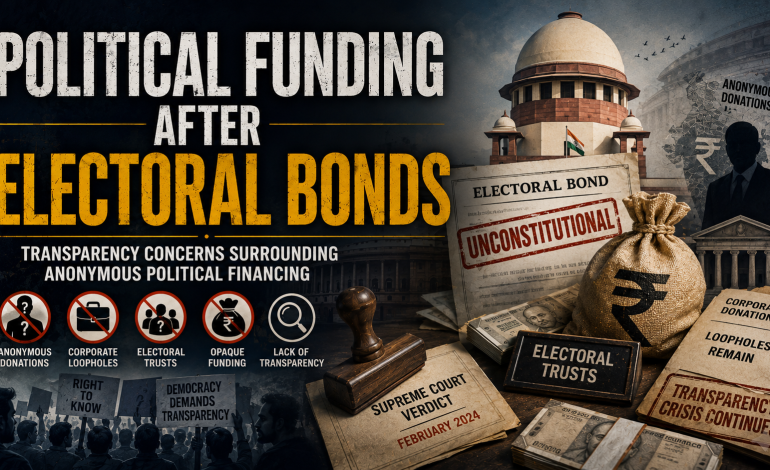
POLITICAL FUNDING AFTER ELECTORAL BONDS
TOPIC 19 Transparency Concerns Surrounding Anonymous Political Financing In February 2024, India‘s Supreme Court struck down the Electoral Bond Scheme, calling it “unconstitutional” and a violation of citizens’ right to

TOPIC 19
Transparency Concerns Surrounding Anonymous Political Financing
In February 2024, India‘s Supreme Court struck down the Electoral Bond Scheme, calling it “unconstitutional” and a violation of citizens’ right to know . The scheme, which had allowed unlimited anonymous donations to political parties for nearly six years, was a “turning point” that “institutionalized opacity” . But the striking down of the scheme did not end the controversy. It only changed its form.
Even as the court delivered its verdict, the Ministry of Finance ordered the printing of 8,350 new electoral bonds—after the scheme had been declared unconstitutional . The State Bank of India (SBI) defied the Supreme Court‘s order to disclose donor data, forcing a contempt petition . And when the data finally emerged, it revealed that over 50% of all electoral bond donations—₹8,252 crore out of ₹16,492 crore—had gone to a single party: the Bharatiya Janata Party (BJP) .
The scheme is gone. But the loopholes remain. The Companies Act still allows corporate donations without naming the beneficiary party . Electoral trusts—opaque intermediaries—have surged in prominence, with ₹3,811 crore flowing through them in 2024-25 alone, 82% of it to the BJP . And political parties still hide the majority of their income under “voluntary contributions” and “sale of coupons”—sources that reveal nothing about the donor‘s identity . As the ADR’s 2026 report warns: “There is no dearth of solutions. What is required is courage and will to reform the existing system” .
This article examines the electoral bonds scandal, the loopholes that survived the Supreme Court‘s verdict, and the transparency crisis that continues to haunt Indian democracy.
WHAT – The Electoral Bond Scheme (2018-2024) allowed individuals and companies to donate unlimited, anonymous funds to political parties through special bonds purchased from the State Bank of India. Struck down by the Supreme Court in February 2024, the scheme‘s legacy—and the structural loopholes that enabled it—continue to shape political funding.
WHO – The BJP (which received over 50% of all electoral bond funds), opposition parties (which received significantly less), corporate donors (including loss-making and shell companies), the State Bank of India (which administered the scheme and defied court orders), the Supreme Court (which struck down the scheme), and the Association for Democratic Reforms (ADR, which has tracked political funding for two decades).
WHEN – Scheme introduced in 2017, first bonds sold in 2018; struck down by Supreme Court on February 15, 2024; data disclosed in March 2024 after contempt proceedings; ongoing transparency concerns in 2025-2026.
WHERE – Across India, affecting all political parties and electoral processes nationally.
WHY – Officially, to bring “clean money” into politics and reduce cash donations. Critics argue the scheme legalized corruption, allowed unlimited corporate influence, and created a quid pro quo economy where donors received favorable policies, contracts, or relief from enforcement agencies in exchange for donations.
HOW – Through anonymous bonds purchasable by anyone; through amendments to the Companies Act removing caps on corporate donations; through electoral trusts that channel funds while obscuring ultimate beneficiaries; and through the “voluntary contribution” loophole that allows parties to hide donor identities.
SECTION 1: THE ELECTORAL BONDS SCHEME – DESIGN AND CRITIQUE
1.1 What Were Electoral Bonds?
The Electoral Bond Scheme was introduced in the Finance Bill, 2017, and implemented in 2018. The stated objective: to bring “clean money” into political funding and reduce the prevalence of untraceable cash donations .
Key features of the scheme :
| Feature | Detail |
|---|---|
| Denominations | ₹1,000 to ₹1 crore |
| Purchaser | Any individual or company (including loss-making companies) |
| Vendor | State Bank of India (SBI) exclusively |
| Anonymity | Donor‘s name not recorded on bond; party could not know donor, but SBI and government could track |
| Tax exemption | Donations tax-exempt for both donor and recipient |
| Validity | 15 days; must be encashed within this period |
| Eligible parties | Parties registered with Election Commission and securing at least 1% of votes in last election |
1.2 The Government’s Defense – And Its Flaws
The government, led by then Finance Minister Arun Jaitley, argued that electoral bonds would bring “transparency” by channeling donations through the banking system rather than through cash . Jaitley claimed that anonymity was necessary to protect donors from “any retribution from political parties” .
The critique that emerged:
| Government Claim | Counter-Argument |
|---|---|
| “Brings clean money into politics” | The scheme simply shifted cash donations into banking channels without addressing source; 90% of bonds were of the highest denomination (₹1 crore) |
| “Protects donors from retribution” | Anonymity also protected corrupt donors from public exposure; the scheme created a perfect vehicle for quid pro quo |
| “Routed through banks ensures traceability” | Only SBI and government could trace donors; voters could not. The Supreme Court held that voters‘ right to know overrides donor privacy |
| “Prevents foreign funding” | Amendments to FCRA allowed foreign companies with Indian subsidiaries to fund parties |
1.3 The Secret Tracking Number – A Hidden Feature
A critical detail about electoral bonds was hidden from public knowledge until an investigative journalist exposed it. Poonam Agarwal purchased a bond herself and subjected it to forensic examination using ultraviolet light. She discovered that each bond carried a unique number—invisible to the naked eye—that could be used by authorities to track donors .
This meant that while donors were “anonymous” to the public and to rival parties, the government—through SBI—could identify them. As Common Cause‘s analysis notes, “the ruling party at the centre had a way of knowing” . This created a powerful tool for political coercion: donors knew their contributions were not truly anonymous to the party in power.
SECTION 2: THE SUPREME COURT VERDICT – A LANDMARK JUDGMENT
2.1 The Key Holdings (February 15, 2024)
A five-judge Constitution bench of the Supreme Court, led by Chief Justice D.Y. Chandrachud, delivered a unanimous 232-page judgment striking down the Electoral Bond Scheme .
Key holdings :
| Holding | Reasoning |
|---|---|
| Violates Right to Information | Citizens have a right to know who funds political parties; anonymous donations infringe on this right under Article 19(1)(a) |
| Unlimited corporate donations violate political equality | Companies have far greater ability to influence elections than individuals; unlimited contributions undermine “one person, one vote” |
| Loss-making companies donating | The court noted it was “more plausible that loss-making companies will contribute to political parties with quid pro quo” |
| Amendment to Companies Act arbitrary | Removing the 7.5% profit cap on corporate donations violated Article 14 (Right to Equality) |
The court declared: “The electoral bond scheme infringes upon the right of information of the voter. The information about the funding of political parties is essential for the effective exercise of the choice of voting” .
2.2 Immediate Directions
The Supreme Court ordered :
-
SBI to immediately stop issuing electoral bonds
-
SBI to submit details of all bonds purchased since April 2019 to the Election Commission
-
Election Commission to publish all details (purchaser name, bond denomination, beneficiary party) by March 13, 2024
2.3 SBI‘s Defiance and Contempt Proceedings
The State Bank of India did not comply promptly. It requested “unreasonable time” to “decipher and match” datasets. Civil society petitioners—the Association for Democratic Reforms (ADR) and Common Cause—filed a contempt of court petition against SBI for “wilful non-compliance” with the court‘s order .
The Supreme Court acted firmly, ordering immediate disclosures by the next day, March 12, 2024 .
SECTION 3: THE DATA – WHAT THE DISCLOSURES REVEALED
3.1 Overall Figures
Between March 2018 and January 2024, political parties redeemed electoral bonds worth over ₹16,492 crore (approximately $1.98 billion USD) .
Party-wise distribution :
| Party | Amount Received (₹ Cr) | Share of Total |
|---|---|---|
| BJP | 8,252 | 50.6% |
| Congress | ~1,600 | ~10% |
| Trinamool Congress (TMC) | Significant but far lower | — |
| All other parties combined | Remainder | — |
The BJP received more than all other parties combined—a staggering concentration of political funding.
3.2 Corporate Dominance
As the ADR‘s 2026 report notes: “Big corporations voluntarily fund political parties, especially the government in power, to essentially use their clout to shape laws, policies, regulations and contracts in their favor. This exchange between corporates and political parties comes at the cost of public interest” .
3.3 Quid Pro Quo – The Pattern of Suspicious Donations
When the data was made public, investigative journalists began connecting dots. The findings were damning :
-
Shell companies: At least 20 donations were made by entities that were barely a few months old—some only a few days old—violating the Companies Act requirement of three years‘ existence
-
Loss-making companies: Dozens of companies with no profits made massive donations
-
Timing of donations: Many donations were made close in time to companies receiving government contracts, licenses, or regulatory clearances
-
Enforcement agency actions: At least 14 out of 30 major donors had faced raids by the Enforcement Directorate, CBI, or Income Tax authorities before making donations. The charges against them were mysteriously stalled or dropped after the donations
Opposition leaders described this as “hafta vasooli”—extortion through enforcement agencies. The Congress party alleged that “raids by multiple federal agencies were conducted to first target the entities and then coerce them into making donations” .
3.4 The Two Biggest Donors – Shadowy Beneficiaries
The largest donor was not a Fortune 500 company but a virtually unknown entity: Future Gaming and Hotel Services, which donated ₹1,368 crore. Its owner, known as India‘s “Lottery King”, went on an “electoral bonds buying spree” within 10 days of the central government alerting states about the company‘s “frauds” and “irregularities” .
The second largest donor was Megha Engineering and Infrastructure Ltd, which donated ₹980 crore. The company was awarded government projects worth thousands of crores of rupees in roughly the same period. A CAG report found that on one of the company‘s projects, the original cost had escalated by 400% by the time of completion .
3.5 The Perpetual Loophole – Bonds Printed After the Ban
Even after the Supreme Court declared the scheme unconstitutional, the government continued printing bonds. RTI responses revealed :
-
On January 12, 2024 (before the verdict), the Ministry of Finance approved SBI‘s request to print 10,000 bonds of ₹1 crore each
-
On February 21, 2024 (6 days after the verdict), the Indian Security Press printed 8,350 bonds
-
Only after SBI reminded the department did the Ministry order a halt to printing on February 28, 2024
-
The cost of printing—₹3.72 lakh—was borne by… unknown. The government has not disclosed who paid
SECTION 4: THE LOOPHOLES THAT SURVIVED – POST-BOND OPACITY
The striking down of electoral bonds did not end the problem of anonymous political funding. Multiple structural loopholes remain.
4.1 The Companies Act Loophole – Donations Without Beneficiary Disclosure
As Moneylife‘s analysis by Ranganathan V notes: “Under the present Section 182, companies making donations need not specify the beneficiary. The only requirement is to disclose the sum of the political donations made” .
This is a critical gap. Before 2013, under Section 293A of the Companies Act, 1956, companies had to disclose both the amount and the name of the political party receiving the donation. The 2013 Act removed this requirement. The Supreme Court struck down the electoral bond scheme but did not address this underlying statutory provision.
As a result, corporate India can still donate anonymously—they just cannot use electoral bonds to do so. They can donate directly through cheques, and their annual reports need only disclose the total amount, not the recipient party.
4.2 Electoral Trusts – The New Anonymity Vehicle
Electoral trusts—intermediary organizations that collect corporate donations and distribute them to parties—have surged in prominence since the bond scheme was struck down .
Key data on electoral trusts (2024-25) :
| Metric | Figure |
|---|---|
| Total donations via electoral trusts | ₹3,811 crore |
| Increase from previous year | 3x (₹1,218 crore in 2023-24) |
| BJP‘s share | ₹3,112 crore (82%) |
| Congress‘s share | ₹299 crore (8%) |
| All other parties combined | ₹400 crore (10%) |
Major electoral trusts and their beneficiaries :
| Trust | Total Donated (₹ Cr) | Beneficiaries |
|---|---|---|
| Prudent Electoral Trust | 2,668 | BJP (2,181), Congress (216), TMC (92), YSR Congress (88) |
| Progressive Electoral Trust (Tata Group) | 915 | BJP (758), Congress (77), 8 other parties (80) |
| New Democratic Electoral Trust (Mahindra Group) | 160 | BJP (150), Congress (5), Shiv Sena (UBT) (5) |
| Harmony Electoral Trust | 30 | BJP solely |
The shift from electoral bonds to electoral trusts is a shift in form, not substance. Trusts disclose donor identities, but not in a way that is accessible or transparent to voters. As Moneylife notes, “the name of the electoral trust means nothing to any reader of the reports” . The ultimate corporate donors—Tata, Mahindra, Kalyani, Bharat Forge—are known, but the link between specific donations and specific policy outcomes remains opaque.
4.3 The “Voluntary Contribution” Loophole – “Unknown Sources” Dominance
Even before electoral bonds, political parties hid the majority of their income under categories like “voluntary contributions,” “sale of coupons,” “relief fund,” “miscellaneous income,” and “contribution from meetings” .
The scale of the problem :
Between 2014-15 and 2016-17 (pre-bonds), 66% of party funds came from “unknown sources”—donors contributing less than ₹20,000 (later reduced to ₹2,000), whose identities did not need to be disclosed.
After bonds were introduced, disclosure of “unknown sources” actually increased—because bonds replaced cash, not because transparency improved. In 2021-22, 60% of BJP‘s income was from “unknown sources,” of which electoral bonds accounted for 89% .
With bonds gone, the “sub-₹2,000 cash donation” loophole returns. Parties can still receive unlimited cash donations in small amounts, aggregate them, and report them as “voluntary contributions” without disclosing a single donor name.
4.4 State Capture – The 93% Millionaire Winner Statistic
The ADR‘s 2026 report reveals the real-world consequence of opaque political funding :
| Indicator | 2009 | 2024 | Change |
|---|---|---|---|
| Winners who are millionaires | 58% | 93% | +35% |
| Candidates with assets > ₹1 crore | — | 19.6% chance of winning | — |
| Candidates with assets < ₹1 crore | — | 0.7% chance of winning | — |
As the report notes: “Wealthy candidates (having criminal antecedents) are more likely to contest and win elections.” In 2024, 44% of Congress candidates and 43% of BJP candidates had declared criminal cases against themselves. “Parties’ search for rich candidates has also opened doors for criminalization of elections as a candidate with criminal antecedents is more likely to raise funds and afford the soaring costs of elections,” the report states .
SECTION 5: THE ADR‘S 2026 REPORT – A COMPREHENSIVE ASSESSMENT
The Association for Democratic Reforms, in collaboration with the University of Melbourne‘s Electoral Regulation Research Network, published “Political Finance in India: Assessment and Recommendations” in March 2026 .
5.1 Key Findings
| Finding | Detail |
|---|---|
| Money dominates politics | Financial dominance has become the primary determinant of political success, not ideology or public service |
| Unknown sources still dominate | Since 2004-05, over 64% of national party funds came from sources donors do not have to disclose |
| Corporate funding disparity | BJP received direct corporate donations four times greater than all other national parties combined |
| Criminalization linked to funding | Parties seek rich candidates, who are more likely to have criminal antecedents |
| Voter inducement surge | ECI seized illicit items worth ₹8,889 crore in 2024 elections—155% increase over 2019 |
5.2 Eleven Recommendations
The ADR report calls for a complete overhaul of the political finance system :
| Recommendation | Detail |
|---|---|
| Comprehensive political party law | Regulate finances, internal democracy, leadership accountability |
| Bring parties under RTI | Current exemption shields party finances from public scrutiny |
| Limit private donations | Impose caps; mandate full disclosure of donors |
| Ban anonymous and cash donations | All contributions must be through digital transactions |
| Strengthen EC powers | Allow de-recognition/deregistration of non-compliant parties |
| Public funding of polls | Reduce dependence on private money |
| CAG audit of party accounts | Independent verification of party finances |
| Stricter campaign expenditure limits | Enforce existing caps |
| Align EC appointments with SC directive | Ensure independence of election management |
| Maintain public database of sanctions | Transparency on penalties for non-compliance |
| Define bribery as corrupt practice | Address freebies and voter inducement |
“There is no dearth of solutions. What is required is courage and will to reform the existing system. The only way to remedy the existing problems in political finance is to immediately act upon the plausible solutions offered by the judiciary, constitutional bodies, committees, civil society, and citizens” .
SECTION 6: COMPARATIVE ANALYSIS – INDIA VS. OTHER DEMOCRACIES
| Country | Donation Disclosure Threshold | Corporate Donations | Public Funding |
|---|---|---|---|
| India | ₹20,000 (~$240) – no disclosure below; corporate donations unlimited | Unlimited; no beneficiary disclosure required | Minimal via NCEP |
| United Kingdom | £7,500 (~$9,500) – donations above must be disclosed | Permitted but disclosed | Yes (policy development grants) |
| Germany | €10,000 (~$11,000) – donations above must be disclosed | Permitted but disclosed | Yes (matching funds for small donations) |
| United States | $200 – donations above disclosed to FEC | Banned (corporations cannot donate directly; can form PACs) | Presidential public funding system (opt-in) |
| Canada | $200 – donations above disclosed; strict annual limits | Banned (corporations cannot donate) | Yes (quarterly allowance to parties) |
India‘s disclosure threshold of ₹20,000 is among the highest in the world. The UK threshold is £7,500; Germany‘s €10,000—but in both countries, parties must disclose all donations above these thresholds. India‘s problem is not the threshold; it is that the majority of donations are funnelled through loopholes (sub-threshold cash, electoral trusts, “voluntary contributions”) that bypass disclosure entirely.
As ADR founder Jagdeep Chhokar notes: “The simplest and only way to make political funding clean is to stop cash payment to political parties. Everything has to be through the digital mode of payment. The prime minister has been advocating cashless payments. Why exclude political parties?” .
SECTION 7: THE POLITICAL CONSEQUENCES – A RIGGED PLAYING FIELD
7.1 Financial Dominance = Electoral Dominance
The BJP‘s overwhelming financial advantage has translated into electoral dominance. As the ADR notes, “financial dominance, rather than ideology or public service, has become the primary determinant of political success” .
Data on declared donations (FY 2024-25) :
| Party | Declared Donations (₹ Cr) | % of Total |
|---|---|---|
| BJP | 6,074 | 91.4% |
| Congress | 517 | 7.8% |
| AAP | 27 | 0.4% |
| CPI-M | N/A | — |
The BJP declared ₹6,074 crore in donations above ₹20,000—more than ten times the combined total of all other national parties . Corporate donations accounted for 92% of all declared contributions .
7.2 The Enforcement Agency Nexus
One of the most disturbing revelations from the electoral bonds data was the pattern of donors who faced enforcement agency actions. As Common Cause documented, at least 14 out of 30 major donors had faced raids by the ED, CBI, or tax authorities before making their donations. After the donations, charges were mysteriously stalled or dropped .
Opposition politicians have repeatedly alleged that the Modi government uses enforcement agencies to “compel” donations from businesses. As a Congress leader charged, the raids were conducted “to first target the entities and then coerce them into making donations” .
The government has denied these charges, maintaining that “enforcement agencies are doing their job without interference” .
SECTION 8: THE WAY FORWARD – REFORM PROPOSALS
8.1 Lower the Disclosure Threshold – And Close the Cash Loophole
Professor Jagdeep Chhokar‘s proposal is straightforward: “Stop cash payment to political parties. Everything has to be through the digital mode of payment” .
All donations—of any amount—should be made through banking channels and disclosed publicly. The distinction between “small donations” and “large donations” is meaningless when small donations can be aggregated into large sums without disclosure.
8.2 Require Beneficiary Disclosure for Corporate Donations
The Companies Act, 2013, must be amended to restore the pre-2013 requirement that companies disclose not just the amount but the name of the political party receiving the donation .
8.3 Regulate Electoral Trusts
Electoral trusts should be required to disclose:
-
All donors (including parent companies)
-
All recipients
-
All amounts
No trust should be allowed to act as a pass-through vehicle without full transparency.
8.4 Bring Parties Under RTI
The ADR‘s recommendation to bring political parties under the Right to Information Act—repeated for years—remains unimplemented . Parties currently enjoy a legal exemption from RTI scrutiny, shielding their finances from public oversight.
8.5 Independent Audit of Party Accounts
Party accounts should be audited by the Comptroller and Auditor General (CAG), not by private auditors appointed by the parties themselves .
8.6 Strengthen Election Commission Powers
The ECI should have the power to de-recognize or deregister parties that fail to comply with financial disclosure requirements .
CONCLUSION – FROM BONDS TO LOOPHOLES, THE CRISIS CONTINUES
The Supreme Court‘s verdict striking down electoral bonds was a landmark victory for transparency and voters‘ right to know. The court correctly held that anonymous political funding violates the fundamental right of citizens to make informed electoral choices.
But the verdict did not solve the problem. It merely closed one door—while leaving several others wide open.
What Has Been Lost:
| Loss | Explanation |
|---|---|
| Voters‘ right to know | Citizens still cannot trace the majority of political donations |
| Level playing field | One party‘s financial dominance creates insurmountable electoral advantage |
| Accountability | Quid pro quo arrangements between donors and parties remain hidden |
| Rule of law | Donors who face enforcement action mysteriously receive relief after donations |
| Public trust | Citizens believe elections are bought, not won |
What Remains:
The ADR‘s 2026 report concludes ominously: “The Supreme Court has observed in a landmark 1958 case that ‘democracy would be vitiated if results were to be arrived at not on their merits but because money played a part in the bringing about of those decisions.’ This principle is now under grave threat” .
The electoral bonds scheme legalized corruption for six years. The data it generated—reluctantly disclosed only under court pressure—revealed a system in which political funding is not about ideology or public support but about access, influence, and quid pro quo.
The Unanswered Question:
Will Parliament—which benefits from the current opaque system—ever summon the political will to enact the reforms the ADR and the Supreme Court have demanded?
Or will India continue to have elections that are “free” and “fair” in form—but decided in substance by anonymous money, corporate influence, and a playing field tilted beyond repair?
As the ADR notes: “There is no dearth of solutions. What is required is courage and will to reform the existing system” .
That courage has yet to arrive.
SUMMARY TABLE: POLITICAL FUNDING – PRE-BONDS, BONDS ERA, AND POST-BONDS
| Aspect | Pre-Electoral Bonds (Before 2018) | Electoral Bonds Era (2018-2024) | Post-Bonds (2024-2026) |
|---|---|---|---|
| Anonymous donations | Cash donations under ₹20,000; “voluntary contributions” | Unlimited anonymous corporate bonds | Cash loophole returns; electoral trusts surge |
| Corporate donation cap | 7.5% of average three-year profits | Unlimited | Unlimited (Companies Act unchanged) |
| Beneficiary disclosure | Not required (pre-2013 Act removed it) | Not required | Not required |
| Major beneficiary | Congress historically | BJP (50.6% of bond funds) | BJP (82% of electoral trust funds) |
| Voter right to know | Minimal | None (ruled unconstitutional) | Minimal |
| Supreme Court intervention | — | Scheme struck down (Feb 2024) | None on remaining loopholes |
| Transparency rating | Poor | Worst | Poor |
END OF TOPIC 19
Next Topic (Topic 20): “Electoral Trusts – The New Anonymity Vehicle”
To be continued tomorrow with in-depth analysis of how electoral trusts have become the primary channel for corporate political funding after the ban on electoral bonds, and why they represent an ongoing threat to transparency.