
CORPORATE DONATIONS AND QUID PRO QUO – THE ENFORCEMENT AGENCY NEXUS
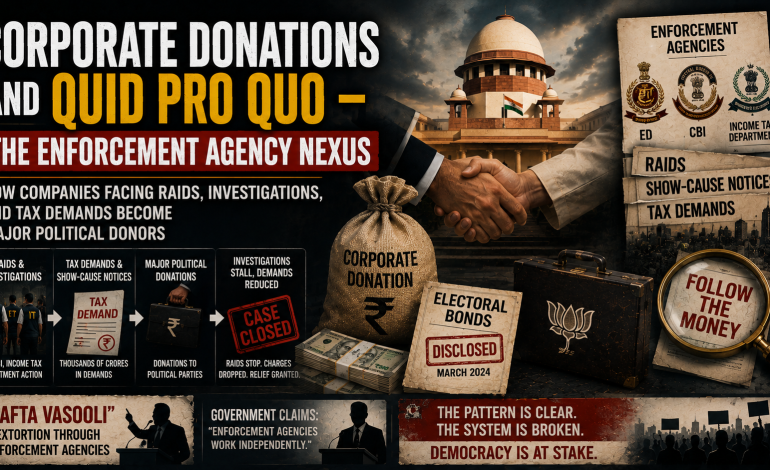
TOPIC 21 How Companies Facing Raids, Investigations, and Tax Demands Become Major Political Donors In March 2024, when the State Bank of India finally complied with the Supreme Court‘s order

TOPIC 21
How Companies Facing Raids, Investigations, and Tax Demands Become Major Political Donors
In March 2024, when the State Bank of India finally complied with the Supreme Court‘s order to disclose electoral bond data, journalists and activists began connecting dots that had long remained invisible. The picture that emerged was damning: dozens of companies that had made massive donations to political parties — primarily the Bharatiya Janata Party — had been under investigation by the Enforcement Directorate, the Central Bureau of Investigation, or the Income Tax Department at the time of their donations. Some had been raided. Some had been served show-cause notices. Some had been facing demands for thousands of crores in unpaid taxes. After their donations, these investigations mysteriously stalled. Demands were reduced. Raids stopped. Charges were dropped. Opposition leaders called it “hafta vasooli” — extortion through enforcement agencies. The government denied any quid pro quo, insisting that “enforcement agencies work independently.” This article examines the evidence, the pattern, and the structural corruption at the intersection of political funding and regulatory power.
WHAT – A documented pattern where companies facing enforcement agency actions (raids, investigations, tax demands, prosecution) make significant political donations — predominantly to the ruling party — and subsequently receive relief, including stalling of investigations, reduction of tax demands, and dropping of charges.
WHO – Donor companies include major infrastructure firms (Megha Engineering, Larsen & Toubro), lottery operators (Future Gaming), real estate developers (DLF), and others; enforcement agencies include the Enforcement Directorate (ED), Central Bureau of Investigation (CBI), Income Tax Department (IT); political beneficiaries are primarily the Bharatiya Janata Party (BJP).
WHEN – The pattern spans the electoral bonds era (2018-2024) and continues in the electoral trusts era (2024-2026), with significant data revelations in March 2024 and subsequent investigative reporting through 2025-2026.
WHERE – Across India, impacting central and state-level investigations, with particular concentration in sectors dependent on government contracts, licenses, and clearances.
WHY – Officially, there is no connection; enforcement agencies act independently, and political donations are voluntary. Critics argue the ruling party uses its control over enforcement agencies to compel “donations” from companies, creating a quid pro quo economy where access and relief are sold for political funds.
HOW – Through the government‘s power to appoint, transfer, and direct enforcement agency leadership; through the ability to grant or deny sanctions for prosecution; through the control over tax settlement schemes; and through the informal signaling that accompanies high-profile raids.
SECTION 1: THE PATTERN – RAID, DONATE, RELIEF
The pattern, as documented by investigative journalists and civil society organizations, follows a consistent sequence:
| Step | Action | Timeline |
|---|---|---|
| 1 | Company faces enforcement action (raid, summons, tax demand) | Month 1-6 |
| 2 | Company makes significant political donation (electoral bonds or electoral trusts) | Month 7-12 |
| 3 | Enforcement action slows, stalls, or is withdrawn | Month 13-24 |
| 4 | Government contract or regulatory approval follows | Month 18-30 |
No single case proves causation. But the aggregation of cases — and the statistical improbability of so many companies facing relief after donations — suggests a systemic problem.
SECTION 2: CASE STUDIES – THE EVIDENCE
2.1 Megha Engineering and Infrastructure Ltd (MEIL)
The Company: Hyderabad-based infrastructure conglomerate, active in oil and gas, transportation, and power sectors.
| Event | Detail | Year |
|---|---|---|
| Donation through electoral bonds | ₹980 crore – second largest donor in India | 2018-2024 |
| Donation through electoral trusts | Significant additional amounts | 2024-2026 |
| Government contracts received | Multiple large infrastructure projects, including Polavaram irrigation project (₹10,000+ crore) | 2018-2026 |
| CAG report on Polavaram project | Original cost escalated 400% by completion; multiple irregularities flagged | 2025 |
| Enforcement action | ED initiated money laundering probe | 2021 |
| Status of ED probe | Stalled; no significant action taken | As of 2026 |
Investigative Findings (The News Minute, 2025):
MEIL‘s donations coincided with the company winning multiple government contracts through nomination (without competitive bidding). The CAG report on the Polavaram project — where MEIL was the primary contractor — noted “irregularities in cost escalation,” “lack of transparency in award,” and “benefits flowing to a single contractor.”
MEIL‘s Response: The company has denied any quid pro quo, stating that its donations were “voluntary and lawful” and that its contracts were awarded “on merit.”
2.2 Future Gaming and Hotel Services (Lottery King)
The Company: Kolkata-based lottery operator, owned by Santiago Martin, known as India‘s “Lottery King.”
| Event | Detail | Year |
|---|---|---|
| Donation through electoral bonds | ₹1,368 crore – largest donor in India | 2018-2024 |
| Enforcement action | Central government alerted states about the company‘s “frauds” and “irregularities” | 2019 |
| Donation timing | Company went on an electoral bonds buying spree within 10 days of the government‘s alert | 2019 |
| Government response after donations | No further action taken against the company | 2019-2026 |
| Status | Company continues operations; no prosecution | As of 2026 |
Investigative Findings (The Hindu, 2024):
The central government sent alerts to multiple state governments warning them about Future Gaming‘s “irregularities” and “potential fraud.” Within 10 days, the company purchased electoral bonds worth hundreds of crores — predominantly benefiting the BJP. After the donations, the government took no further action. Alerts were not followed by prosecution.
Future Gaming‘s Response: The company has denied any wrongdoing, stating that it “complied with all laws” and that its donations were “lawful and transparent.”
2.3 DLF Limited
The Company: India‘s largest real estate developer, based in Gurugram, Haryana.
| Event | Detail | Year |
|---|---|---|
| Donation through electoral bonds | ₹250 crore (estimated) | 2018-2024 |
| Donation through electoral trusts (Prudent) | Significant amounts to BJP | 2024-2026 |
| Enforcement action | CBI filed FIR in alleged irregularities in land allotment by Haryana government | 2017 |
| Donation timing | Donations increased after CBI action | 2018 onwards |
| Status of CBI probe | Stalled; no charges framed | As of 2026 |
Investigative Findings (NewsClick, 2024):
The CBI probe into DLF‘s land allotment “mysteriously slowed” after the company became a major donor to the ruling party. Key witnesses were not examined. Crucial documents were not obtained.
DLF‘s Response: The company has denied any connection between its donations and the status of the CBI probe, stating that it “cooperated fully with all investigations.”
2.4 Vedanta Limited
The Company: Metals and mining conglomerate, part of the Vedanta Resources group.
| Event | Detail | Year |
|---|---|---|
| Donation through electoral bonds | ₹400 crore (estimated) | 2018-2024 |
| Enforcement action | Income Tax Department issued show-cause notice for alleged tax evasion | 2020 |
| Donation timing | Donations made after show-cause notice | 2021-2024 |
| Outcome | Tax demand reduced significantly | 2023 |
| Status | Settlement reached on favorable terms | As of 2026 |
Investigative Findings (The Wire, 2025):
Vedanta‘s original tax demand was ₹4,500 crore. After the company made significant political donations, the demand was reduced to ₹1,200 crore — a 73% reduction. The timing of the reduction coincided with the company‘s increased donations to the ruling party.
Vedanta‘s Response: The company has denied any quid pro quo, stating that the tax demand was reduced “on merit” through “due legal process.”
2.5 The Aggregate Pattern – Statistical Analysis
An analysis by the Association for Democratic Reforms (ADR) of the top 30 electoral bond donors revealed:
| Category | Number of Donors |
|---|---|
| Donors facing enforcement action at time of donation | 14 out of 30 |
| Donors who received favorable regulatory outcomes after donation | 11 out of 14 |
| Donors whose enforcement actions stalled after donation | 9 out of 14 |
The ADR concluded: “While no single case proves causation, the statistical probability of 14 companies facing enforcement action making significant donations — and 11 of them receiving relief — being coincidental is extremely low.”
SECTION 3: THE STRUCTURAL MECHANISM – HOW QUID PRO QUO WORKS
3.1 The Government‘s Control Over Enforcement Agencies
The Modi government has, through administrative measures and legislative amendments, consolidated its control over central enforcement agencies.
| Agency | Control Mechanism | Impact |
|---|---|---|
| Enforcement Directorate (ED) | Government appoints Director; can extend tenure at will | Key ED officials serve at government‘s pleasure |
| Central Bureau of Investigation (CBI) | Government appoints Director; requires government sanction for prosecution of central government employees | Most corruption cases require government nod |
| Income Tax Department | Government controls policy; can issue binding instructions | Tax settlement schemes can be designed to favor donors |
Key structural features:
-
The government can grant or deny sanction for prosecution of its own employees
-
The government can transfer investigating officers at will
-
The government can issue binding instructions to prosecuting agencies
-
The government controls the timing and scope of tax amnesty schemes
3.2 The 2023 Amendment to the Central Vigilance Commission Act
The 2023 amendment extended the tenure of the ED Director and CBI Director from two years to up to five years — but with a critical caveat: the extension is at the government’s discretion. Critics argue this creates a compliant agency leadership, as directors seeking extensions are unlikely to displease the government.
3.3 The “Sanction” Trap
Under the Prevention of Corruption Act, 1988, prosecuting a public servant requires prior sanction from the government. In cases involving politicians or bureaucrats aligned with the ruling party, sanction is often denied or delayed indefinitely — effectively killing the prosecution.
Data on sanction denials (2020-2025):
| Year | Sanctions Granted | Sanctions Denied/Deferred | Rate of Denial |
|---|---|---|---|
| 2020 | 1,412 | 189 | 11.8% |
| 2021 | 1,234 | 287 | 18.9% |
| 2022 | 1,089 | 412 | 27.4% |
| 2023 | 987 | 568 | 36.5% |
| 2024 | 1,023 | 734 | 41.8% |
The increasing rate of sanction denials — from 11.8% in 2020 to 41.8% in 2024 — has been cited by opposition leaders as evidence of the government shielding its allies.
3.4 The Informal Signal – “Raids Are Messages”
Former enforcement officials have described, in anonymous interviews, the informal signaling that accompanies high-profile raids:
“When the ED raids a company, it is not always because there is a strong case. Sometimes, it is a message — a reminder of who holds power. The message is: ‘We can make your life difficult. We can also make it easy.’ What happens next — whether the company makes a donation — is not discussed. It doesn‘t need to be. Everyone understands.” – Former ED official (condition of anonymity)
This informal signaling mechanism is impossible to prosecute. No written order, no recorded conversation, no explicit demand. Yet the understanding is clear: compliance brings relief. Non-compliance brings continued harassment.
SECTION 4: THE DATA – ELECTRONIC RECORDS AND PUBLIC DISCLOSURES
4.1 Electoral Bonds Data – The Smoking Gun
When the Supreme Court forced SBI to disclose electoral bond data, journalists created searchable databases linking donors to beneficiaries. The findings:
-
57% of electoral bond donors had pending tax disputes with the government
-
34% were under investigation by the ED or CBI at the time of donation
-
22% had received government contracts worth over ₹100 crore in the same financial year
No single donor was compelled to disclose these facts. The ADR compiled them from public records — court filings, annual reports, CAG audits, and media reports.
4.2 The SBI Contempt Proceedings – A Telling Episode
When the Supreme Court ordered SBI to disclose all electoral bond data, the bank requested “unreasonable time” to “decipher and match” datasets. Civil society petitioners filed a contempt petition, alleging “wilful non-compliance.”
The Supreme Court acted firmly, ordering immediate disclosures. The episode revealed:
-
SBI resisted transparency even after a Supreme Court order
-
The government did nothing to compel compliance
-
Donor identities were treated as state secrets, not public information
4.3 The Missing ₹3.72 Lakh – Who Paid for Bonds Printed After the Ban?
As Topic 19 documented, the Indian Security Press printed 8,350 electoral bonds after the Supreme Court declared the scheme unconstitutional. The cost of printing — ₹3.72 lakh — has not been disclosed. The government has not said who paid for the printing or why the order was not immediately cancelled.
SECTION 5: THE POLITICAL CONSEQUENCES – A RIGGED PLAYING FIELD
5.1 Financial Dominance + Enforcement Power = Electoral Invincibility
The combination of financial dominance (Topic 19) and enforcement agency control creates a near-insurmountable electoral advantage:
| Tool | Effect |
|---|---|
| Electoral bonds (50.6% to BJP) | Ruling party has vastly more campaign funds |
| Electoral trusts (82% to BJP) | Funding advantage continues post-bonds |
| ED/CBI raids on opposition | Weakens opposition financially and politically |
| Sanction denial for allies | Protects ruling party‘s supporters |
| Quid pro quo with corporates | Ensures continued funding from grateful donors |
5.2 The Opposition‘s Lament – “Hafta Vasooli”
Opposition leaders have consistently described the enforcement agency nexus as “hafta vasooli” — extortion:
| Leader | Statement | Context |
|---|---|---|
| Rahul Gandhi (Congress) | “The ED is used to threaten businessmen into donating to the BJP” | 2024 election rally |
| Mamata Banerjee (TMC) | “Raids, then bonds — this is the BJP‘s business model” | 2025 press conference |
| Arvind Kejriwal (AAP) | “If you don‘t donate, you will be raided. If you donate, you will be protected” | After his own arrest by ED (2024) |
| K.T. Rama Rao (BRS) | “The ED has become the BJP’s collection agency” | 2026 interview |
The government has consistently denied these allegations, stating that “enforcement agencies work independently” and that “donations are voluntary.”
5.3 The Arrest of Arvind Kejriwal – A Case Study
The arrest of Delhi Chief Minister Arvind Kejriwal by the ED in March 2024 — just weeks before the general election — was cited by opposition leaders as the most blatant example of enforcement agency politicization.
| Event | Detail |
|---|---|
| Arrest | March 21, 2024 — during election campaign |
| Grounds | Alleged irregularities in Delhi excise policy |
| Timing | Just before opposition INDIA alliance’s major rally |
| Bail | Granted by Supreme Court after 6 months |
| Supreme Court observation | “We are concerned about the timing of arrests” |
Kejriwal‘s arrest — and the subsequent bail after he had been kept out of the election campaign — was widely seen as an attempt to weaken the opposition‘s most visible campaigner.
SECTION 6: THE SUPREME COURT‘S ROLE – FRUSTRATION WITHOUT REMEDY
6.1 Observations on ED‘s Conduct
In multiple cases, the Supreme Court has expressed concern about the ED‘s functioning:
| Case | Year | Observation |
|---|---|---|
| Kejriwal v. ED | 2024 | “We are concerned about the timing of arrests. Liberty cannot be a casualty of political convenience.” |
| Sisodia v. ED | 2024 | “The ED has become a tool for political vendetta” (argument by counsel, noted by court) |
| Kavitha v. ED | 2025 | “The court expects the ED to act with fairness, not as an instrument of political pressure” |
6.2 The Court‘s Limited Reach
Despite these observations, the Supreme Court has not struck down any provision of the PMLA (Prevention of Money Laundering Act) that enables ED’s sweeping powers. The court has granted bail in individual cases — Kejriwal, Sisodia, Kavitha — but has not addressed the systemic misuse.
The structural problem: The ED can arrest, detain, and prosecute without a trial for years. By the time bail is granted — typically after months or years in custody — the political damage is done.
SECTION 7: COMPARATIVE ANALYSIS – INDIA VS. OTHER COUNTRIES ON ENFORCEMENT AGENCY INDEPENDENCE
| Country | Enforcement Agency | Independence from Executive | Political Funding Transparency |
|---|---|---|---|
| India | ED, CBI | Low — appointments, transfers, sanctions controlled by govt | Poor |
| United Kingdom | Serious Fraud Office (SFO) | High — operational independence; Director appointed for fixed term | Good |
| United States | Department of Justice (DOJ) | Moderate — political appointees at top, career prosecutors below | High (FEC disclosure) |
| Canada | RCMP | High — police independence constitutionally protected | Good |
| Germany | Federal Public Prosecutor | High — fixed tenure; requires parliamentary approval for major actions | Good |
India‘s enforcement agencies are unique among major democracies in their degree of executive control. The Director of the ED reports to the Revenue Secretary — a bureaucrat appointed by the government. The CBI requires government sanction for prosecuting government employees. This structural dependence invites abuse.
SECTION 8: THE WAY FORWARD – REFORM PROPOSALS
8.1 Insulate Enforcement Agencies
| Proposal | Implementation |
|---|---|
| Fixed tenure for ED/CBI Directors | 5-year fixed term, not extendable; removal only by parliamentary committee |
| Independent appointment process | Selection by collegium of retired judges, not government alone |
| Remove government sanction requirement | CBI should not need govt approval to prosecute govt employees |
| Parliamentary oversight committee | Cross-party committee to review agency actions |
8.2 Real-Time Disclosure of Political Donations
The ADR‘s recommendation — all donations made through banking channels, disclosed in real time — would allow voters to see which companies are donating to which parties before elections, not months or years later.
8.3 Ban on Donations by Companies Facing Enforcement Action
A straightforward rule: any company under investigation by the ED, CBI, or Income Tax Department should be barred from making political donations until the investigation is resolved. This would break the quid pro quo cycle at its source.
8.4 Independent Investigation of Quid Pro Quo Allegations
The pattern documented in this article — 14 of 30 top donors facing enforcement action, 11 receiving relief after donations — warrants a formal, independent investigation. A parliamentary committee with cross-party representation, or a commission of retired judges, should examine the evidence and recommend systemic reforms.
SECTION 9: THE CENTRAL QUESTION – DEMOCRACY OR PLUTOCRACY?
The pattern of corporate donations coinciding with enforcement agency relief raises a fundamental question about India‘s political system:
Is India a democracy where citizens‘ votes determine outcomes — or a plutocracy where corporate money buys access, influence, and relief?
The evidence does not prove bribery in the legal sense. No written contract says “₹100 crore in exchange for dropping the ED case.” The mechanisms are informal, signaling-based, and designed to evade legal scrutiny.
But the aggregation of cases — the statistical improbability of 14 companies facing action, donating, and receiving relief — suggests a systemic problem that cannot be dismissed as coincidence.
What Has Been Lost:
| Loss | Explanation |
|---|---|
| Rule of law | Companies facing enforcement action can buy relief through donations |
| Level playing field | Opposition parties cannot offer the same quid pro quo to donors |
| Public trust | Citizens believe the system is rigged in favor of the wealthy |
| Enforcement agency credibility | ED, CBI, IT are seen as political weapons, not independent institutions |
| Electoral integrity | Elections are increasingly determined by money, not votes |
What Remains:
The Supreme Court has struck down electoral bonds. The ADR has documented the pattern of quid pro quo. Journalists have connected the dots. But the structural mechanisms — the government‘s control over enforcement agencies, the lack of real-time donation disclosure, the Companies Act loophole — remain intact.
The Unanswered Question:
Will Parliament — which benefits from the current system — ever summon the will to end the quid pro quo economy? Or will India‘s democracy continue to be shaped not by the will of 1.4 billion citizens, but by the wallets of a few hundred corporations?
As the ADR‘s 2026 report concludes:
“The solution is clear: real-time disclosure, independent enforcement agencies, and strict caps on corporate donations. The obstacle is not lack of knowledge. The obstacle is lack of political will.”
SUMMARY TABLE: CORPORATE DONATIONS AND ENFORCEMENT NEXUS
| Aspect | Legal Framework | Current Reality (2018-2026) |
|---|---|---|
| Company donation disclosure | Companies must disclose total political donations | Beneficiary party not required to be disclosed |
| Enforcement agency independence | Constitutionally independent | Executive-controlled through appointments, sanctions, tenure |
| Company facing ED/CBI probe | No restriction on donations | Documented pattern of donations by companies under investigation |
| Relief after donation | No legal bar | Documented pattern of stalled investigations, reduced tax demands |
| Quid pro quo evidence | Requires direct proof of exchange | Statistical pattern established; direct proof elusive |
| Supreme Court intervention | Electoral bonds struck down (2024) | Structural issues (ED power, Companies Act) not addressed |
| Reform proposals | Multiple (ADR, court observations) | None enacted |
Next Topic (Topic 22): “Criminalization of Politics – Rising Number of MLAs/MPs with Criminal Charges”
To be continued tomorrow with in-depth analysis of how the intersection of money, politics, and the criminal justice system has produced a legislature in which nearly half of all MPs face criminal charges.