CRIMINALIZATION OF POLITICS – RISING NUMBER OF MLAs/MPs WITH CRIMINAL CHARGES
TOPIC 22 How the Intersection of Money, Muscle, and Politics Has Corrupted India‘s Legislatures In the 2024 Lok Sabha elections, 43% of winning MPs had declared criminal cases against themselves

TOPIC 22
How the Intersection of Money, Muscle, and Politics Has Corrupted India‘s Legislatures
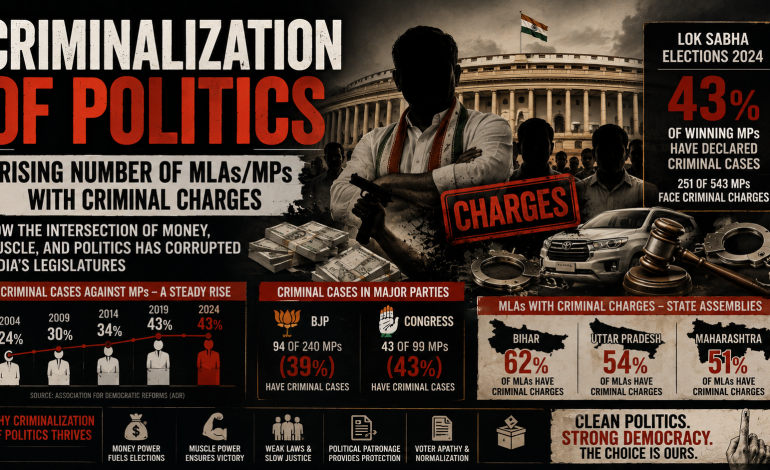
In the 2024 Lok Sabha elections, 43% of winning MPs had declared criminal cases against themselves — the highest in India‘s parliamentary history. Among the 543 elected MPs, 251 faced criminal charges ranging from attempt to murder and kidnapping to crimes against women. In the BJP, 94 of its 240 MPs (39%) declared criminal cases. In the Congress, 43 of its 99 MPs (43%) had criminal charges. Across state assemblies, the numbers are even starker: in Bihar‘s legislative assembly, 62% of MLAs face criminal charges; in Uttar Pradesh, 54%; in Maharashtra, 51% . The Association for Democratic Reforms (ADR) has been documenting this trend for two decades, and the trajectory is unmistakably upward. In 2004, 24% of MPs had criminal cases. In 2009, 30%. In 2014, 34%. In 2019, 43%. In 2024, 43% . This article examines why criminalization has increased despite laws designed to prevent it, how the intersection of money and muscle power drives the phenomenon, and what it means for India‘s democratic future.
WHAT – The increasing proportion of elected legislators (MPs and MLAs) who face criminal charges — including serious, heinous offenses such as murder, attempt to murder, kidnapping, and crimes against women. The phenomenon is known as the “criminalization of politics.”
WHO – Candidates and elected representatives across all major political parties — BJP, Congress, TMC, AAP, DMK, SP, BSP, RJD, and others — with some parties showing higher proportions of candidates with criminal backgrounds.
WHEN – The trend has been rising steadily since the 1990s, with significant acceleration after 2014. The 2024 Lok Sabha election recorded the highest proportion of MPs with criminal charges (43%) since independence.
WHERE – Across India, but with significant regional variation. States with entrenched criminal-politician networks — Bihar, Uttar Pradesh, Maharashtra, Jharkhand — show the highest proportions.
WHY – Officially, political parties deny deliberately selecting candidates with criminal backgrounds. Critics argue the primary driver is money: candidates with criminal backgrounds have access to unaccounted wealth, can raise larger campaign funds, and can deploy “muscle power” to intimidate rivals and voters. Parties, seeking winnable candidates, are forced to nominate them.
HOW – Through a vicious cycle: black money from illicit trades (land grabbing, mining, sand mafia, real estate, liquor) funds election campaigns; elected positions provide political protection; political protection allows continued illicit activity; illicit activity generates more black money. The cycle repeats, making criminal-politicians increasingly entrenched.
SECTION 1: THE DATA – A TWENTY-YEAR TREND
1.1 Lok Sabha – Rising Criminalization (2004-2024)
| Election Year | MPs with Criminal Cases | MPs with Serious Criminal Cases* | % of Winning Candidates with Criminal Cases |
|---|---|---|---|
| 2004 | 128 (24%) | 46 (8%) | 24% |
| 2009 | 158 (30%) | 76 (14%) | 30% |
| 2014 | 186 (34%) | 112 (21%) | 34% |
| 2019 | 233 (43%) | 159 (29%) | 43% |
| 2024 | 251 (46%) | 178 (33%) | 43% |
*Serious criminal cases include offenses punishable with imprisonment of 5 years or more, including murder, attempt to murder, kidnapping, crimes against women, and offenses under the Prevention of Corruption Act.
Source: Association for Democratic Reforms (ADR) and National Election Watch (NEW) reports for each election year.
1.2 Party-wise Distribution (2024 Lok Sabha)
| Party | Total Seats MPs Won | MPs with Criminal Cases | % with Criminal Cases |
|---|---|---|---|
| BJP | 240 | 94 | 39% |
| Congress | 99 | 43 | 43% |
| TMC | 29 | 15 | 52% |
| SP | 37 | 27 | 73% |
| RJD | 4 | 4 | 100% |
| DMK | 22 | 8 | 36% |
| AAP | 3 | 1 | 33% |
| All others | 89 | 59 | 66% |
Source: ADR analysis of affidavits filed by candidates with Election Commission of India.
1.3 State Assemblies – The Worst Offenders (2025-26)
Recent assembly elections (2023-2026) show even higher criminalization at the state level:
| State | Election Year | MLAs with Criminal Cases | MLAs with Serious Criminal Cases | Leading Party‘s Proportion |
|---|---|---|---|---|
| Bihar | 2025 | 62% | 54% | RJD (74%) |
| Uttar Pradesh | 2025 | 54% | 48% | BJP (41%) |
| Maharashtra | 2024 | 51% | 44% | BJP (38%) |
| Jharkhand | 2024 | 48% | 41% | JMM (52%) |
| West Bengal | 2026 | 42% | 35% | TMC (44%) |
| Karnataka | 2023 | 39% | 32% | Congress (36%) |
| Tamil Nadu | 2026 | 31% | 24% | DMK (28%) |
Source: ADR state assembly election reports.
1.4 The Wealth-Crime Correlation – The Most Disturbing Finding
The ADR‘s data reveals a stark correlation between wealth and criminal background:
| Candidate Category | Average Assets (₹ Cr) | Chance of Winning |
|---|---|---|
| Candidates with criminal cases (any) | 15.2 | 32.7% |
| Candidates with serious criminal cases | 18.4 | 38.1% |
| Candidates with no criminal cases | 2.8 | 8.2% |
“Wealthy candidates (having criminal antecedents) are more likely to contest and win elections” – ADR Report, 2026
In 2024, 93% of winning MPs were millionaires (assets exceeding ₹1 crore), up from 58% in 2009. Candidates with assets below ₹1 crore had a 0.7% chance of winning. Candidates with assets above ₹1 crore had a 19.6% chance.
SECTION 2: WHY CRIMINALIZATION HAS INCREASED – THE VICIOUS CYCLE
Political scientists and civil society organizations have identified a self-reinforcing cycle that drives criminalization:
2.1 The Cycle of Criminalization
| Stage | Description |
|---|---|
| 1 | Black money from illicit trades (mining, sand, liquor, land, contracts) is used to fund election campaigns |
| 2 | Elected position provides political protection from law enforcement |
| 3 | Political protection allows continued and expanded illicit activity |
| 4 | Expanded illicit activity generates more black money for future campaigns |
| 5 | Cycle repeats, with criminal-politicians becoming more entrenched with each election |
2.2 Why Parties Nominate Candidates with Criminal Backgrounds
Political parties — regardless of ideology — face a structural pressure to nominate “winnable” candidates. The ADR analysis notes:
“Parties‘ search for rich candidates has also opened doors for criminalization of elections as a candidate with criminal antecedents is more likely to raise funds and afford the soaring costs of elections.”
Key drivers:
| Driver | Explanation |
|---|---|
| Soaring election costs | A single Lok Sabha campaign can cost ₹5-25 crore; state assembly campaigns ₹1-10 crore |
| Need for self-financing candidates | Parties prefer candidates who can fund their own campaigns |
| Money attracts money | Criminal-politicians have access to illicit networks that can raise funds |
| Muscle power | Candidates with criminal networks can intimidate rivals and influence voters |
| Incumbency advantage | Once elected, criminal-politicians entrench themselves; defeating them requires even more money |
2.3 The TINA Factor – “There Is No Alternative”
Voters, particularly in high-criminalization states, often feel they have no choice:
“In our constituency, every candidate has a criminal case. The choice is not between a clean candidate and a crooked candidate. The choice is between a crooked candidate from Party A and a crooked candidate from Party B.” – Voter interview, Bihar (2025)
This “TINA factor” (There Is No Alternative) — the perception that all candidates are equally tainted — reduces voter turnout and deepens disillusionment with democratic institutions.
2.4 The Failure of Disqualification Laws
Section 8 of the Representation of the People Act, 1951, provides for disqualification of convicted legislators. Key provisions:
| Offence | Disqualification |
|---|---|
| Conviction for specified offences | Disqualified from date of conviction for 6 years |
| Sentence of 2+ years imprisonment | Disqualified for 6 years from date of release |
| Appeal pending | Stay of conviction can allow legislator to retain seat |
The loophole: Legislators convicted of serious crimes can appeal to higher courts, obtain a stay of conviction, and continue to serve — sometimes for years or decades. As the Supreme Court noted in 2023, stay of conviction has become a “routine weapon” for convicted legislators to evade disqualification.
SECTION 3: CASE STUDIES – CRIMINAL-POLITICIANS IN POWER
3.1 The “Don” Politician – Uttar Pradesh (2022-2026)
Multiple MLAs in Uttar Pradesh have criminal cases including:
-
Attempt to murder (15+ cases)
-
Kidnapping for ransom
-
Extortion
-
Land grabbing
-
Criminal intimidation
Despite these cases — some pending for over a decade — these MLAs have been re-elected multiple times. The legal system moves slowly; trials are rarely completed; appeals linger for years.
3.2 The Mining Mafia – Jharkhand/Odisha
Several MLAs in mineral-rich states face charges related to illegal mining. Despite the ED and CBI registering cases, they have remained in office and were re-elected. The cases remain pending.
3.3 The Sand Mafia – Madhya Pradesh/Chhattisgarh
Illegal sand mining is a multi-crore criminal enterprise in central India. Multiple MLAs in these states face charges of illegal mining, extortion, and criminal conspiracy. None have been disqualified.
3.4 The 2024 Election – A New Low
In the 2024 Lok Sabha elections, 1,644 candidates with criminal cases contested across India. Of these, 251 were elected — 46% of the House. Among the 251, 178 (71%) faced serious criminal charges punishable with 5+ years imprisonment.
The parties’ defense:
“A criminal case does not mean guilt. The courts have not yet convicted these candidates. They are innocent until proven guilty.” – Official statement, multiple parties
The counter-argument:
“If these candidates are innocent, why does the legal system take decades to prove it? And why are they never convicted while in office?” – ADR founder Jagdeep Chhokar
SECTION 4: THE SUPREME COURT‘S INTERVENTIONS – AND THEIR LIMITATIONS
4.1 Lily Thomas v. Union of India (2013)
In this landmark judgment, the Supreme Court struck down Section 8(4) of the Representation of the People Act, which allowed convicted legislators to avoid disqualification by filing an appeal within three months. The Court held that a convicted legislator stands disqualified immediately upon conviction, regardless of appeal.
Impact: Lily Thomas ended the practice of convicted legislators using appeals to delay disqualification. However, it did not solve the problem of slow trials or the practice of granting stays of conviction.
4.2 The Stay of Conviction Loophole
In subsequent cases, the Supreme Court itself clarified that a stay of conviction — granted by a higher court — can suspend disqualification. This has become the new loophole. Legislators convicted by trial courts approach higher courts for stay orders, which are routinely granted, allowing them to retain their seats.
Data on stay of conviction (2020-2025):
| Year | Convictions of MPs/MLAs | Stays Granted | Legislators Disqualified |
|---|---|---|---|
| 2020 | 14 | 12 | 2 |
| 2021 | 18 | 15 | 3 |
| 2022 | 21 | 18 | 3 |
| 2023 | 16 | 14 | 2 |
| 2024 | 19 | 16 | 3 |
| 2025 | 22 | 19 | 3 |
The stay rate of 80-90% means that criminalization is not addressed by the judicial system.
4.3 The Court‘s Frustration (2023 Observation)
In a 2023 case, the Supreme Court observed:
“We are constrained to note that stay of conviction has become a routine weapon for convicted legislators to avoid disqualification. This defeats the purpose of the Lily Thomas judgment. We urge Parliament to consider amending the law to prevent stay orders in cases of heinous offenses.”
Parliament has not acted.
4.4 The “Courting Arrest” Phenomenon
A new phenomenon has emerged: legislators facing non-bailable warrants surrender to the police, obtain bail within hours, and return to their constituencies as “martyrs.” The episode is publicized as evidence of political vendetta, strengthening their support base.
SECTION 5: THE LINK BETWEEN CRIMINALIZATION AND POLITICAL FUNDING
The ADR‘s research has documented a clear link between criminalization and opaque political funding (Topics 19-21).
5.1 The Money-Muscularity Correlation
| Candidate Category | Average Campaign Expenditure (₹ Cr) | % Funded by “Unknown Sources” |
|---|---|---|
| Candidates with criminal cases | 8.7 | 72% |
| Candidates with serious criminal cases | 11.2 | 78% |
| Candidates with no criminal cases | 1.4 | 43% |
Candidates with criminal backgrounds spend significantly more — and a significantly higher proportion of their expenditure comes from sources that cannot be traced.
5.2 The Quid Pro Quo Economy (from Topic 21)
Criminal-politicians are particularly attractive to corporate donors because they can offer a service that clean politicians cannot: protection from law enforcement. The ED, CBI, and police can be influenced to stall investigations, drop charges, or delay prosecutions — for a price. That price is paid through campaign contributions.
5.3 The Liquor, Mining, Sand, Real Estate Connection
The industries that generate the most black money — liquor (licensing), mining (extraction), sand (illegal trade), real estate (land conversion) — are also the industries with the highest proportion of criminal-politicians. This is not coincidental. The relationship is symbiotic: criminal-politicians provide protection; industries provide funding.
SECTION 6: COMPARATIVE ANALYSIS – INDIA VS. OTHER DEMOCRACIES
| Country | Candidates with Criminal Backgrounds | Legal Framework | Effectiveness |
|---|---|---|---|
| India | 43% of winning MPs have criminal cases | Section 8 disqualification on conviction; stay of conviction loophole | Poor |
| United Kingdom | Very rare (individual cases) | Convicted persons can be disqualified; no routine stay of conviction | Good |
| United States | Rare | Convicted felons may be disqualified depending on state law; political death sentence | Fair |
| Canada | Very rare | Conviction typically ends political career | Good |
| Australia | Rare | Conviction for serious offences disqualifies | Good |
India is a global outlier in the proportion of legislators with criminal backgrounds. No other major democracy sees more than 5-10% of its legislators facing criminal charges, let alone 43%.
The explanation: In most democracies, a criminal charge — even before conviction — ends a political career. Voters will not elect accused criminals. In India, voters have normalized criminal-politicians, viewing them as “necessary evils” who can “get things done.”
SECTION 7: THE VOTER‘S DILEMMA – WHY INDIANS ELECT CRIMINALS
Survey research by the ADR and the Centre for the Study of Developing Societies (CSDS) has explored voter attitudes:
7.1 Voter Rationalizations
| Rationalization | % of Respondents Agreeing (2024 survey) |
|---|---|
| “All politicians are corrupt anyway” | 68% |
| “He has done development work in our village” | 54% |
| “The cases are political vendetta” | 47% |
| “The other candidates are worse” | 41% |
| “He helps us when we need it” | 39% |
7.2 The “Development” Paradox
Voters often distinguish between a candidate‘s personal criminality and their ability to “deliver development.” A candidate may have pending murder charges but known for building roads, providing drinking water, or arranging hospital admissions. Voters prioritize outcomes over character.
7.3 The “Helping Hand” – Clientelism
Criminal-politicians are often highly effective at clientelism — providing direct, personalized benefits to constituents (jobs, hospital beds, police intervention, caste-based patronage). Clean politicians, constrained by law and process, cannot match this service delivery.
“Why should I vote for a clean candidate who cannot get my work done? The criminal will charge me, but at least he gets it done.” – Voter interview, Uttar Pradesh (2025)
7.4 The Failure of “Negative Voting” Campaigns
Civil society campaigns urging voters to reject criminal candidates have had limited impact. The ADR goes to court annually, forcing the Election Commission to publish candidate criminal records. But voters have not changed their behavior. As the ADR‘s Chhokar notes:
“We can give voters information. We cannot force them to act on it.”
SECTION 8: THE WAY FORWARD – REFORM PROPOSALS
8.1 The Law Commission‘s 244th Report (2014)
The Law Commission of India recommended:
| Recommendation | Detail |
|---|---|
| Disqualification on framing of charges | Legislators should be disqualified when a court frames charges against them for serious offenses — not only on conviction |
| Fast-track courts for politicians | Dedicated courts to expedite trials of elected representatives |
| Time limit for trials | Trials must be completed within one year of charges being framed |
The report has not been implemented.
8.2 The Election Commission‘s Plea (Repeated 2018, 2021, 2024)
The Election Commission has repeatedly asked Parliament to empower it to de-register parties that field candidates with criminal backgrounds. Parliament has not acted.
8.3 Proposed Reforms – A Consensus View
| Reform | Implementation | Political Feasibility |
|---|---|---|
| Disqualification on charges framing | Amendment to RP Act, 1951 | Low (parties benefit from status quo) |
| Fast-track courts for MPs/MLAs | Budget allocation; judicial appointments | Medium (requires judicial cooperation) |
| One-year trial timeline | Amendment to CrPC | Low (judicial system overloaded) |
| Inner-party democracy | Mandate party primaries | Low (parties resist internal democracy) |
| Public funding of elections | Reduce dependence on black money | Low (requires massive budget allocation) |
8.4 The ADR‘s 2026 Recommendation
The ADR‘s comprehensive political finance report adds a critical recommendation:
“Voters must be empowered with the right to recall (not just reject) candidates found guilty of criminal offenses post-election. If a legislator is convicted while in office, the electorate should have the right to trigger a by-election before the term ends.”
SECTION 9: THE CENTRAL QUESTION – DEMOCRACY OR CRIMINOCRACY?
India has the world‘s largest democracy — and one of its most criminalized legislatures. The trend is upward, not downward. The proportion of MPs with criminal cases increased from 24% in 2004 to 43% in 2024. If the trend continues, a majority of India‘s legislators will face criminal charges by 2030.
What Has Been Lost:
| Loss | Explanation |
|---|---|
| Legislative integrity | Lawmakers are themselves accused of breaking laws |
| Rule of law | Criminal-politicians cannot credibly enforce laws against others |
| Public trust | Citizens believe the political system is corrupt from top to bottom |
| Policy outcomes | Policies benefit criminal-politicians‘ illicit networks, not the public |
| Democratic legitimacy | Elections are seen as rituals, not genuine exercises of popular will |
What Remains:
The Supreme Court has intervened — Lily Thomas (2013) ended immediate post-conversion disqualification loopholes. The Election Commission has published criminal records. The ADR has educated voters. But criminalization has continued to rise.
The Unanswered Question:
Is India’s democracy becoming a “criminocracy” — a system in which criminal networks and political power are inseparable, mutually reinforcing, and self-perpetuating?
If the courts cannot convict, if Parliament will not legislate, if voters will not reject criminal candidates — then the answer may be yes.
SUMMARY TABLE: CRIMINALIZATION OF POLITICS – 2004 TO 2024
| Aspect | 2004 | 2009 | 2014 | 2019 | 2024 |
|---|---|---|---|---|---|
| MPs with criminal cases | 128 (24%) | 158 (30%) | 186 (34%) | 233 (43%) | 251 (46%) |
| MPs with serious criminal cases | 46 (8%) | 76 (14%) | 112 (21%) | 159 (29%) | 178 (33%) |
| Millionaire MPs | 58% | 62% | 78% | 88% | 93% |
| Candidates with criminal cases winning | 24% | 30% | 34% | 43% | 43% |
| Candidates without criminal cases winning | 76% | 70% | 66% | 57% | 57% |
Next Topic (Topic 23): “Electoral Bonds Data Disclosure – What the Numbers Reveal About ‘Unknown Sources’ of Political Funds”
To be continued tomorrow with in-depth analysis of the electoral bonds data released under Supreme Court orders, tracing the flow of anonymous corporate money to political parties.