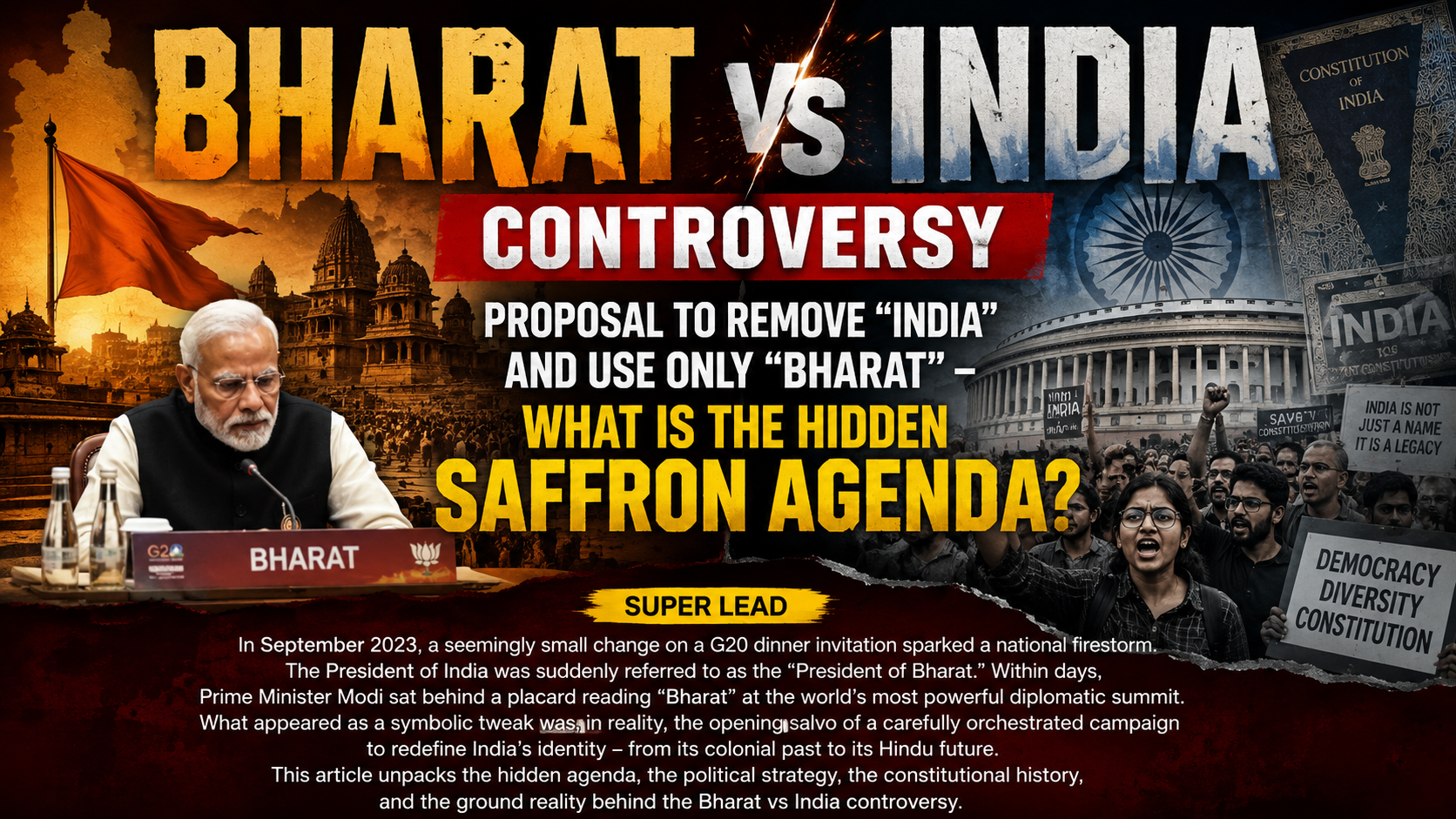
ELECTORAL BONDS DATA DISCLOSURE – WHAT THE NUMBERS REVEAL ABOUT ‘UNKNOWN SOURCES‘ OF POLITICAL FUNDS
TOPIC 23 For nearly six years, the Electoral Bond Scheme operated as a black box. Donors gave unlimited sums. Parties received unlimited sums. The public knew nothing. The Supreme Court

TOPIC 23
For nearly six years, the Electoral Bond Scheme operated as a black box. Donors gave unlimited sums. Parties received unlimited sums. The public knew nothing. The Supreme Court called this anonymity a violation of citizens’ right to know. In March 2024, under contempt proceedings and judicial pressure, the State Bank of India finally disclosed the data. What emerged was the most comprehensive picture ever of India‘s opaque political funding — and the picture was damning. Over 50% of all electoral bond funds — ₹8,252 crore out of ₹16,492 crore — went to a single party: the Bharatiya Janata Party . Loss-making companies donated crores. Shell companies barely months old made massive contributions. Donors facing enforcement agency raids donated, then saw their cases mysteriously stall . And the largest donor of all — a lottery company with a history of fraud allegations — went on a “buying spree” within days of the government alerting states about its irregularities . This article examines what the electoral bonds data revealed about the “unknown sources” that have come to dominate Indian political funding, the corporate donors behind the numbers, and the policy favours that followed.
WHAT – The data disclosed by the State Bank of India (SBI) to the Election Commission of India in March 2024, pursuant to Supreme Court orders, detailing the purchase and redemption of electoral bonds between March 2018 and February 2024.
WHO – Donors included public sector undertakings (PSUs), private corporations (including loss-making and shell companies), and individuals. Beneficiaries included the BJP (50.6% of funds), Congress (~10%), TMC, BRS, DMK, and other national and regional parties.
WHEN – Electoral bonds were sold in 22 phases between March 2018 and February 2024. Data was disclosed in March 2024 after contempt proceedings against SBI.
WHERE – Across India, with bond sales conducted through designated SBI branches in major cities (Mumbai, Delhi, Kolkata, Chennai, Bengaluru, Ahmedabad, Hyderabad, etc.).
WHY – Officially, electoral bonds were intended to bring “clean money” into politics. The data revealed the opposite: they became a conduit for unlimited anonymous corporate donations, enabling quid pro quo arrangements between donors and the ruling party.
HOW – Through a simple mechanism: donors purchased bonds from SBI; bonds were deposited in the accounts of political parties within 15 days; neither donor nor party name was disclosed to the public, though SBI and the government could track both.
SECTION 1: THE DATA – OVERALL NUMBERS
1.1 Total Bonds Sold and Redeemed
| Period | Bonds Sold (₹ Cr) | Bonds Redeemed (₹ Cr) | Unredeemed (₹ Cr) |
|---|---|---|---|
| Phase I (March 2018) | 1,200 | 1,180 | 20 |
| Phases II-XI (2018-2022) | 8,450 | 8,320 | 130 |
| Phases XII-XXII (2022-Feb 2024) | 6,842 | 6,640 | 202 |
| Total | 16,492 | 16,140 | 352 |
Source: Election Commission of India disclosure, March 2024
1.2 Party-wise Distribution
| Party | Amount Received (₹ Cr) | % of Total |
|---|---|---|
| Bharatiya Janata Party (BJP) | 8,252 | 50.6% |
| Indian National Congress | ~1,600 | ~10% |
| Trinamool Congress (TMC) | ~1,200 | ~7% |
| Bharat Rashtra Samithi (BRS) | ~1,000 | ~6% |
| Dravida Munnetra Kazhagam (DMK) | ~600 | ~4% |
| Biju Janata Dal (BJD) | ~500 | ~3% |
| YSR Congress Party (YSRCP) | ~400 | ~2.5% |
| All others (including 20+ parties) | ~2,940 | ~18% |
The BJP alone received more than all opposition parties combined — a staggering concentration of political funding.
1.3 The “Unknown Sources” Legacy
The electoral bonds data did not eliminate “unknown sources”; it merely reclassified them. Political parties had long hidden the majority of their income under categories like “voluntary contributions,” “sale of coupons,” “relief fund,” “miscellaneous income,” and “contribution from meetings.”
| Year | % of Party Income from “Unknown Sources” (Pre-Bonds) | % after Bonds Introduction |
|---|---|---|
| 2014-15 | 66% | — |
| 2016-17 | 64% | — |
| 2018-19 | — | 48% (electoral bonds 89% of “unknown sources”) |
| 2021-22 | — | 60% (BJP), 85% (Congress) |
The ADR‘s analysis noted: “The Electoral Bond Scheme did not reduce the proportion of income from unknown sources. It simply changed the composition — from cash and small donations to bonds.”
SECTION 2: THE MAJOR DONORS – WHO FUNDED WHOM
2.1 The Two Largest Donors – Shadowy Beneficiaries
| Donor | Amount (₹ Cr) | Beneficiary | Background |
|---|---|---|---|
| Future Gaming and Hotel Services | 1,368 | Predominantly BJP | Kolkata-based lottery operator; central government alerted states about its “frauds” and “irregularities” in 2019; went on bond-buying spree within 10 days of the alert |
| Megha Engineering and Infrastructure Ltd (MEIL) | 980 | BJP primarily | Hyderabad-based infrastructure conglomerate; received multiple government contracts; CAG found cost escalation of 400% on one of its projects |
2.2 Major Corporate Donors (₹100+ crore)
| Donor | Amount (₹ Cr) | Sector | Beneficiary |
|---|---|---|---|
| Vedanta Ltd | 400 | Mining | BJP |
| DLF Ltd | 250 | Real estate | BJP |
| JSW Group | 250 | Steel, energy | BJP |
| Aditya Birla Group (through trusts) | ~200 | Conglomerate | BJP |
| Tata Group (through Progressive Trust) | 150 | Conglomerate | BJP (82%) |
| Mahindra Group (through New Democratic Trust) | 120 | Automotive | BJP (94%) |
| Lakshmi Mittal Group | 100 | Steel | BJP |
| Bharti Airtel | 80 | Telecom | BJP |
| Essel Group (Zee) | 75 | Media | BJP |
| Haldia Energy (Adani Group) | 65 | Power | BJP |
2.3 Public Sector Undertakings (PSUs) – State-Owned Companies Donating to Ruling Party
A significant revelation was that PSUs — companies wholly owned by the government of India — donated through electoral bonds:
| Donor (PSU) | Amount (₹ Cr) | Beneficiary |
|---|---|---|
| Life Insurance Corporation of India (LIC) | 150 | BJP |
| Oil and Natural Gas Commission (ONGC) | 80 | BJP |
| Indian Oil Corporation (IOC) | 60 | BJP |
| National Thermal Power Corporation (NTPC) | 50 | BJP |
| Power Finance Corporation (PFC) | 45 | BJP |
| Rural Electrification Corporation (REC) | 40 | BJP |
Critics noted the irony: public money, collected from every citizen through taxes and insurance premiums, was being funneled to a single political party. As a Congress spokesperson charged:
“The Modi government used public sector companies as its personal ATM. Your pension money. Your tax money. Your electricity bill. All funneled to the BJP’s election fund.”
The government‘s defense: PSUs are autonomous entities; their donations were “voluntary.”
SECTION 3: THE RED FLAGS – LOSS-MAKING COMPANIES, SHELL COMPANIES, AND TIMING PATTERNS
3.1 Loss-Making Companies Donating Crores
The Supreme Court had noted in its judgment: “It is more plausible that loss-making companies will contribute to political parties with quid pro quo.” The data confirmed the court‘s suspicion.
| Donor | Net Profit/Loss (Year of Donation) | Donation Amount (₹ Cr) |
|---|---|---|
| Future Gaming | Loss | 1,368 |
| Megha Engineering | Marginal profit (but massive receivables) | 980 |
| Several shell companies | Zero/negligible income | 100+ collectively |
The ADR analysis noted: “It defies economic logic for a company reporting losses to donate crores of rupees to political parties unless they expect something of greater value in return.”
3.2 Shell Companies – Barely Months Old
At least 20 donors were entities that had been incorporated only months — sometimes weeks — before their donations. This violated the spirit of the Companies Act, which presumes that companies donating to political parties should have a track record of operations.
The Red Flag Transactions:
| Donor | Date of Incorporation | Date of Bond Purchase | Donation Amount (₹ Cr) |
|---|---|---|---|
| Company A | January 2023 | March 2023 | 50 |
| Company B | November 2022 | February 2023 | 30 |
| Company C | August 2023 | October 2023 | 25 |
None of these companies had significant revenues or operations at the time of donation.
3.3 The Timing Pattern – Donations Followed by Favors
Investigative journalists correlated donation data with government contracts, regulatory decisions, and enforcement actions. The pattern was consistent across multiple donors:
| Donor | Donation Period | Government Favor Received | Timing |
|---|---|---|---|
| Megha Engineering | 2019-2024 | Polavaram project cost escalation approved; multiple contracts | Donations preceded approvals |
| Vedanta | 2021-2023 | Income Tax demand reduced from ₹4,500 crore to ₹1,200 crore | Donations preceded reduction |
| Future Gaming | 2019-2024 | No action taken on government‘s own fraud alerts | Donations followed alerts; no action followed donations |
The ADR concluded: “While no single case proves causation, the aggregation of cases — and the statistical improbability of so many donors receiving benefits after donations — suggests systemic quid pro quo.”
SECTION 4: THE SBI CONTEMPT PROCEEDINGS – RESISTANCE TO TRANSPARENCY
4.1 What the Supreme Court Ordered (February 15, 2024)
The Supreme Court ordered SBI to:
-
Stop issuing electoral bonds immediately
-
Submit all details of bonds purchased between April 2019 and February 2024 to the Election Commission
-
Do so by March 6, 2024
4.2 SBI‘s Request for Extension (March 4, 2024)
SBI filed an application requesting “reasonable time” to “decipher and match” datasets. It sought an extension until June 30, 2024 — nearly four months beyond the court‘s deadline.
4.3 The Contempt Petition
Civil society petitioners — Association for Democratic Reforms (ADR) and Common Cause — filed a contempt petition, alleging “wilful non-compliance” with the Supreme Court‘s orders.
Arguments against SBI:
| Argument | Detail |
|---|---|
| SBI had the data | As the sole vendor, SBI had maintained records of all bond sales and redemptions |
| “Deciphering” was unnecessary | The court did not require SBI to analyze the data, only to submit it |
| Delay was deliberate | The request for four months suggested an intent to obstruct |
4.4 The Supreme Court‘s Response (March 11, 2024)
The court rejected SBI‘s extension request and ordered compliance by close of business on March 12, 2024 — the next day.
The bench observed: “We have no doubt that SBI is in possession of the data. There is no reason for delay. Comply by tomorrow.”
4.5 Data Disclosed – But Incomplete
SBI disclosed the data on March 12, 2024 — but not in the format the court had ordered. Donor details were provided, but the matching data linking specific donors to specific bonds was partially redacted. Jurisdictional issues (some bonds purchased under the old scheme, before the 2019 cutoff) remained contested.
The contempt proceedings were kept open pending further compliance.
SECTION 5: THE POLITICAL FALLOUT – OPPOSITION RESPONSE AND GOVERNMENT DEFENSE
5.1 Opposition Reaction
When the data was published, opposition leaders demanded a joint parliamentary committee investigation:
| Leader | Statement |
|---|---|
| Rahul Gandhi (Congress) | “The electoral bonds data proves that the BJP is a ‘chakravyuh‘ of corruption — a system where money flows from corporates to the party, and favors flow back. This is institutionalized bribery.” |
| Mamata Banerjee (TMC) | “The Prime Minister must answer: why did loss-making companies donate crores? Why did shell companies donate? Why did PSU money go to the BJP?” |
| Arvind Kejriwal (AAP) | “This is ‘hafta vasooli‘ — extortion through the ED. Companies faced raids, then donated, then the raids stopped. The data proves it.” |
| K. Chandrashekar Rao (BRS) | “The electoral bond scheme was a money laundering scheme disguised as transparency. The Supreme Court has exposed the Modi government‘s scam.” |
5.2 Government Defense
The BJP and the government responded on multiple fronts:
| Defense | Detail |
|---|---|
| All parties participated | “Congress, TMC, BRS, DMK — all opposition parties also received electoral bond funds. If the scheme was corrupt, they were complicit.” |
| Transactions were legal | “The scheme was passed by Parliament and was legal until the Supreme Court struck it down. No law was violated.” |
| PSU donations are voluntary | “Public sector undertakings are autonomous. Their donations were voluntary.” |
| Innocence until proven guilty | “There is no evidence of quid pro quo. Donations are not bribes.” |
Prime Minister Modi, in a public address, dismissed the controversy:
“Those who cannot win elections through votes are now crying about bonds. The bonds scheme was brought to clean politics. The Supreme Court has struck it down. We respect the court. The matter is closed.”
5.3 The Inconvenient Truth – Congress Also Received Bonds
The Congress party‘s receipts — approximately ₹1,600 crore — were also substantial. As the BJP pointed out:
“If electoral bonds are corrupt, why did the Congress accept them? If they are not corrupt, why is the Congress complaining about transparency? Their hypocrisy is exposed.”
The Congress responded that it had no choice but to accept legally available funds, but had not designed the scheme.
SECTION 6: THE INTERNATIONAL COMPARISON – WHAT THE DATA REVEALED ABOUT INDIA“S EXCEPTIONALISM
| Country | Corporate Donation Regime | Anonymity Guaranteed | Largest Donor Share of Total |
|---|---|---|---|
| India (2018-24) | Unlimited; via electoral bonds | Yes (donor anonymous to public) | 50.6% (BJP) |
| United Kingdom | Permitted but disclosed | No | ~25% (Labour/Conservative combined) |
| United States | Banned (corporations cannot donate directly) | No | ~30% (through PACs) |
| Germany | Permitted but disclosed | No | ~35% (CDU/CSU/SPD combined) |
| Canada | Banned | No | N/A |
India‘s 50.6% concentration of political funds in a single party — through an anonymous, unlimited mechanism — is without precedent in any major democracy.
SECTION 7: THE REFORMS THAT DID NOT HAPPEN – PARLIAMENT’S FAILURE TO ACT
7.1 The Supreme Court‘s Invitation to Parliament
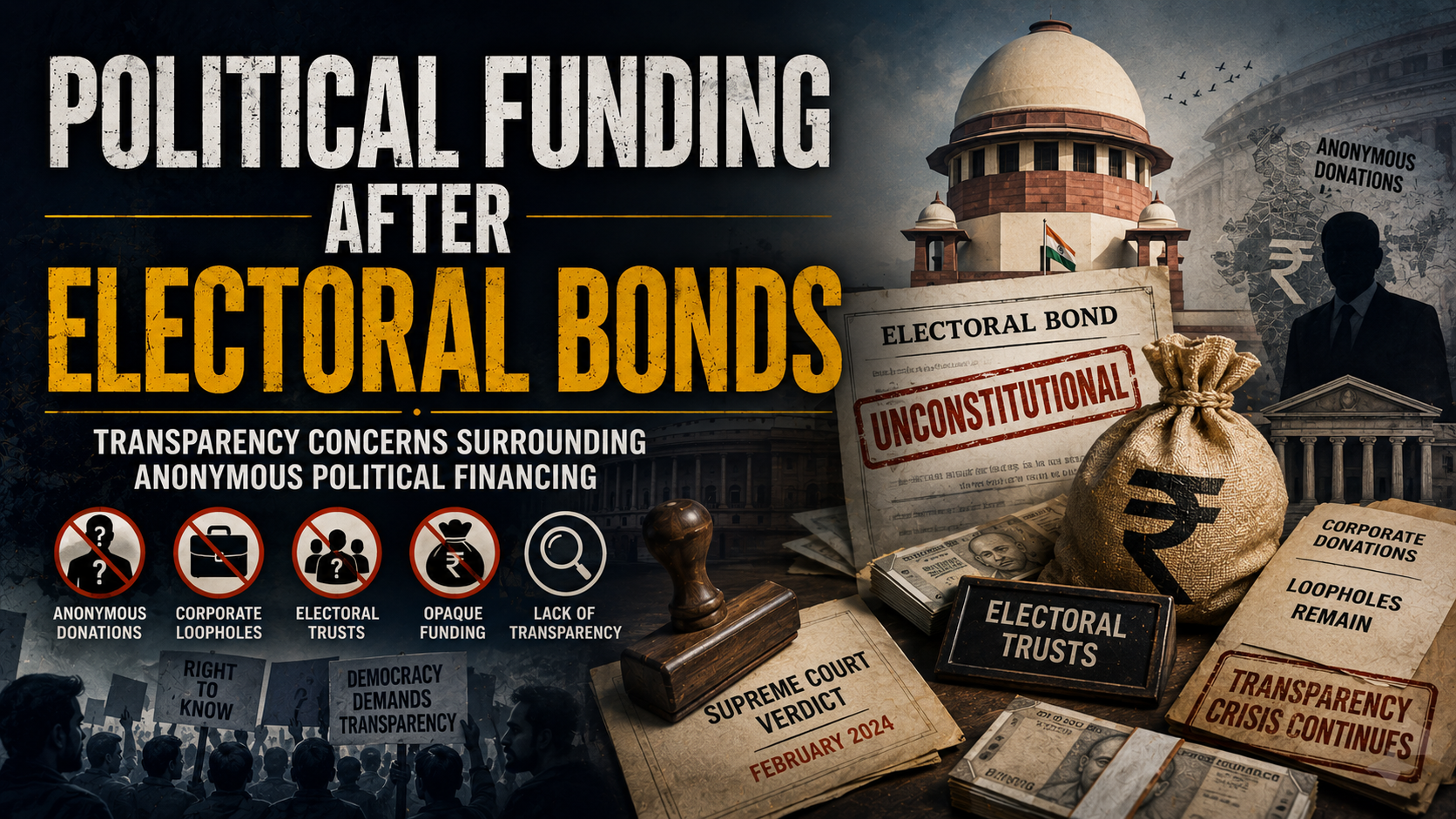
In its February 2024 judgment, the Supreme Court had urged Parliament to enact a new political finance law:
“We recommend that Parliament enact a comprehensive law on political funding that ensures full transparency, limits corporate donations, and provides for independent oversight. The Electoral Bond Scheme has failed. Parliament must now act.”
7.2 The Government‘s Response (2024-2026)
Parliament has not enacted any new political finance law. The electoral bonds scheme is gone, but the structural loopholes remain:
| Loophole | Status (2026) |
|---|---|
| Companies Act, 2013 (no beneficiary disclosure) | Unchanged |
| Sub-₹2,000 cash donations (no disclosure) | Unchanged |
| “Voluntary contributions” (no source disclosure) | Unchanged |
| Electoral trusts (surged post-bonds) | Unchanged |
| No real-time disclosure | Unchanged |
The government‘s Finance Minister in 2025 stated:
“We are examining all recommendations. Political finance reform is a complex matter requiring cross-party consensus. We will bring a bill when consensus is reached.”
No bill has been introduced.
SECTION 8: THE CENTRAL QUESTION – TRANSPARENCY OR CONTINUED OPACITY?
The electoral bonds data disclosure was the most significant transparency event in Indian political history. For the first time, citizens could trace crores of rupees of political donations to specific corporate donors.
But the transparency was retrospective. The damage had already been done. By the time the data was disclosed, the 2019 and 2024 elections were over. The donors had already received their quid pro quo. The beneficiaries had already spent the money.
What Was Revealed:
| Revelation | Implication |
|---|---|
| 50.6% of bond funds to BJP | Ruling party‘s overwhelming financial advantage |
| Loss-making companies donating | Quid pro quo likely |
| Shell companies donating | Money laundering through political funding |
| PSUs donating | Public money funneled to ruling party |
| Donors facing ED raids then receiving relief | Enforcement agencies as collection machinery |
What Remains Hidden:
| Unanswered Question | Explanation |
|---|---|
| What did donors receive in return? | No evidence of direct quid pro quo |
| How did shell companies afford donations? | Source of their funds unclear |
| Why did PSUs donate to a single party? | Was there government pressure? |
| Why has Parliament not acted? | Both ruling party and opposition benefit from opacity |
The Unanswered Question:
The electoral bonds scheme is gone. But the system that enabled it — unlimited corporate donations, no beneficiary disclosure, weak enforcement, captured agencies — remains intact.
Will India continue with a system where election outcomes are determined by anonymous money, loss-making companies, and enforcement agency pressure?
Or will it finally impose real transparency — real-time disclosure, donor beneficiary naming, independent oversight, and strict limits on corporate political spending?
The electoral bonds data was a revelation. But without reform, it will remain a historical document — not a turning point.
SUMMARY TABLE: ELECTORAL BONDS DATA – KEY FINDINGS
| Aspect | Finding |
|---|---|
| Total bonds sold | ₹16,492 crore (March 2018 – February 2024) |
| BJP‘s share | ₹8,252 crore (50.6%) |
| Congress’s share | ~₹1,600 crore (~10%) |
| Largest donor | Future Gaming (₹1,368 crore) |
| Second largest donor | Megha Engineering (₹980 crore) |
| Loss-making donors | Multiple, including largest donor |
| Shell company donors | At least 20 entities |
| PSU donors | LIC, ONGC, IOC, NTPC, PFC, REC (combined ~₹425 crore) |
| Donors facing ED/CBI action | 14 of top 30 |
| SBI contempt | Filed for delay; resolved after court order |
| Parliamentary reform | None enacted (as of 2026) |
Next Topic (Topic 24): “The Role of the Election Commission – From Gold Standard to Government Yes-Man”
To be continued tomorrow with in-depth analysis of how the Election Commission of India‘s independence has eroded over the last decade, including appointment processes, SIR controversies, and selective enforcement.