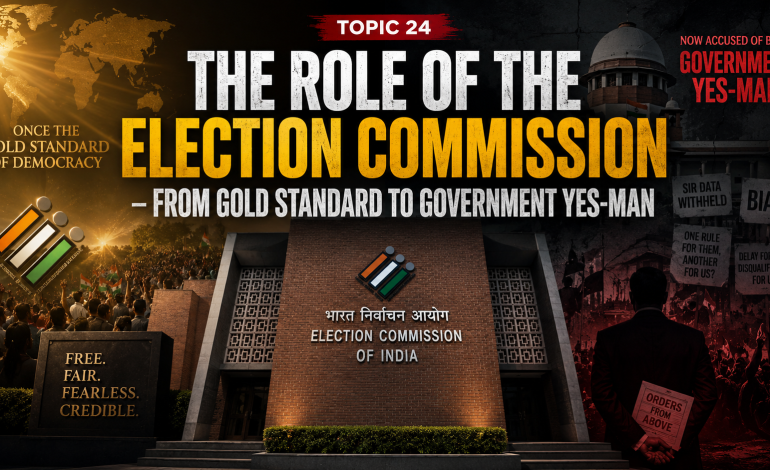
THE ROLE OF THE ELECTION COMMISSION – FROM GOLD STANDARD TO GOVERNMENT YES-MAN
TOPIC 24 For decades, the Election Commission of India (ECI) was celebrated globally as the gold standard of democratic election management. It possessed the power to silence campaigning premiers, postpone

TOPIC 24
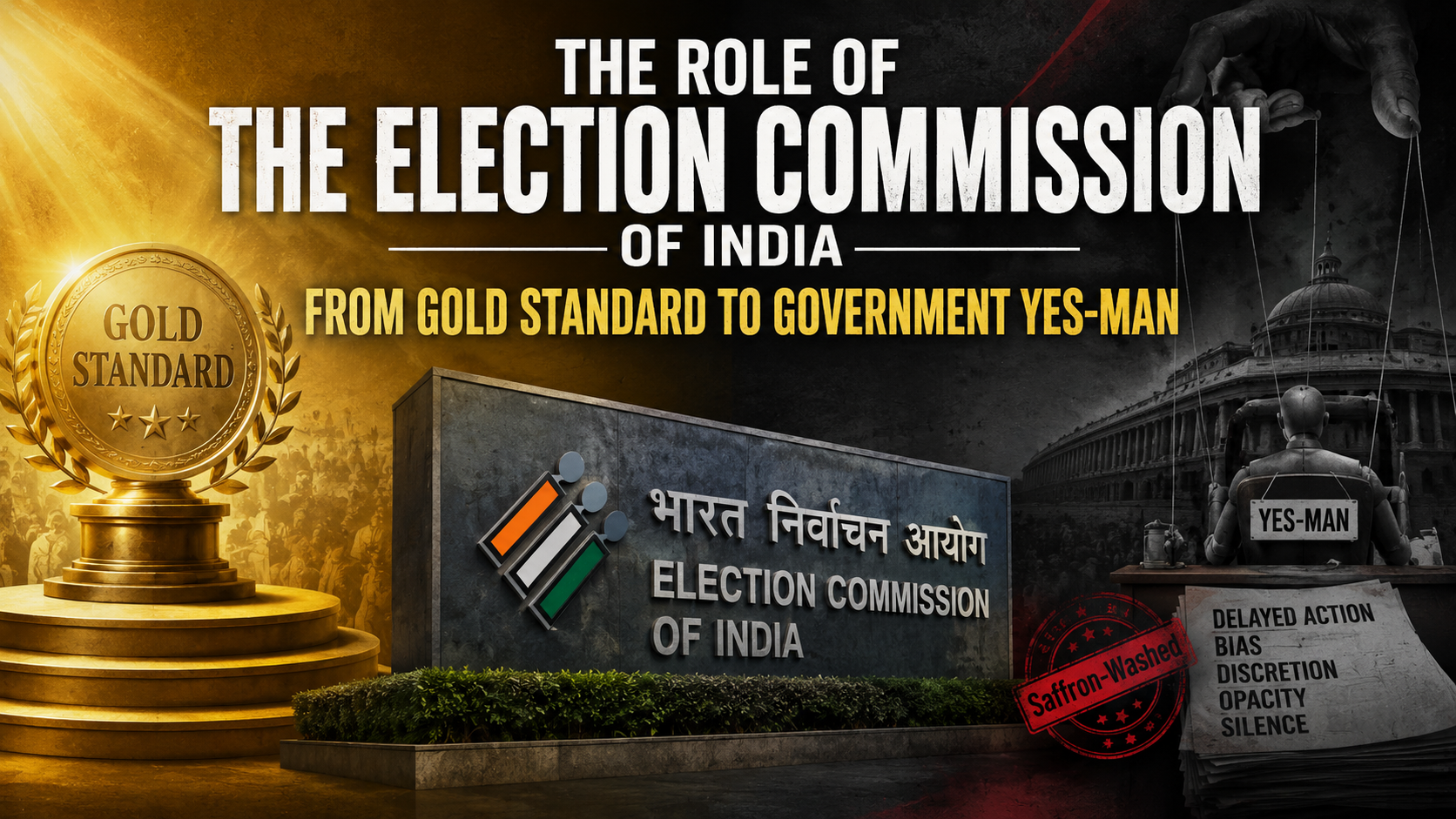
For decades, the Election Commission of India (ECI) was celebrated globally as the gold standard of democratic election management. It possessed the power to silence campaigning premiers, postpone elections in hostile environments, and disqualify candidates who violated the model code. The world looked to India as proof that a developing country could conduct free and fair elections. That reputation has eroded. Over the last decade, the ECI has been accused of systematically favouring the ruling party — delaying action against its leaders while acting swiftly against the opposition, appointing government-friendly election commissioners, and overseeing electoral processes that critics call “saffron-washed.” The journey from gold standard to government yes-man is documented in declining international rankings, controversial decisions, and the Supreme Court‘s intervention to force disclosure of SIR (Special Intensive Revision) data. This article examines how the institution designed to be democracy’s guardian has become, in the eyes of many, the government‘s shield.
WHAT – The Election Commission of India is a constitutional body established under Article 324, empowered to supervise, direct, and control the entire election process. Its perceived decline in independence and impartiality under the Modi government has been documented by election observers, international bodies, and domestic civil society organizations.
WHO – Chief Election Commissioners (past and present) — Sushil Chandra, Rajiv Kumar, and others; the Union Government (which appoints commissioners under a new 2023 law); opposition parties (which allege bias); and the Supreme Court (which has intervened multiple times).
WHEN – The decline has been incremental since 2014, with significant flashpoints in 2019 (model code violations by BJP leaders), 2021 (West Bengal elections and SIR controversy), 2023 (new appointment law), 2024 (refusal to disclose EVM-VVPAT data), and 2025-2026 (continued inaction on complaints against ruling party).
WHERE – Across India, affecting all elections — Lok Sabha, state assemblies, and local bodies — with particular controversy in opposition-ruled states (West Bengal, Tamil Nadu, Kerala, Punjab).
WHY – Officially, the ECI maintains that it acts impartially and that allegations of bias are politically motivated. Critics argue the government has systematically undermined the ECI‘s independence through (1) a new appointment process that gives the government control, (2) inaction on complaints against the ruling party, (3) selective enforcement of the model code, and (4) failure to ensure transparency in EVM-VVPAT processes.
HOW – Through the 2023 Chief Election Commissioner and Other Election Commissioners (Appointment, Conditions of Service and Term of Office) Act, which replaced a consultative process with a government-dominated selection committee; through delayed or no action on opposition complaints; and through public statements by election commissioners that critics call “politically aligned.”
SECTION 1: THE GOLD STANDARD – WHAT THE ELECTION COMMISSION ONCE WAS
The Election Commission of India was established in 1950 under Article 324 of the Constitution. For its first seven decades, it was widely respected for its independence and professionalism.
T.N. Seshan Era (1990-1996) – The Fierce Guardian:
The most famous Chief Election Commissioner, T.N. Seshan, transformed the ECI from a bureaucratic body into a formidable force. He:
-
Enforced the Model Code of Conduct strictly — against all parties equally
-
Disqualified candidates without fear or favour
-
Postponed elections when conditions were unfavourable
-
Challenged the executive — including the Prime Minister
Seshan‘s tenure established the ECI‘s reputation as the gold standard. International observers praised India’s electoral management as a model for developing democracies.
The Respect Was International:
Even as recently as 2014, the ECI‘s reputation remained high. The annual “Perception of Electoral Integrity” index (Harvard/University of Sydney) ranked India among the top 30 countries globally.
That ranking has since fallen.
SECTION 2: THE SHIFT — KEY FLASHPOINTS OF PARTISAN CONDUCT
2.1 The 2019 Model Code Controversy — BJP Leaders’ Speeches
During the 2019 Lok Sabha elections, BJP leaders — including Prime Minister Modi, Home Minister Amit Shah, and UP Chief Minister Yogi Adityanath — made speeches that opposition parties alleged violated the Model Code of Conduct (MCC). Specifically:
-
Appeals to religious sentiments (“Hindu” vs “Muslim” polarization)
-
Personal attacks on opposition leaders (calling them “anti-national”)
-
Communal rhetoric
Opposition Complaints: The Congress, TMC, SP, BSP, and others filed over 200 complaints with the ECI.
ECI‘s Response: The ECI issued “advisory notices” to BJP leaders but took no punitive action — no disqualifications, no campaign bans, no FIRs.
The Contrast: When opposition leaders made similar speeches in subsequent elections, the ECI acted swiftly — issuing notices, filing police complaints, and in some cases recommending disqualification.
Opposition Allegation: “The ECI sees no evil when the ruling party speaks, but finds every violation when the opposition speaks.”
2.2 West Bengal Elections (2021) — The SIR Controversy
The 2021 West Bengal Assembly elections were among the most controversial in the ECI‘s history. The ECI conducted a Special Intensive Revision (SIR) of voter rolls that removed 27 lakh voters — 1/3rd of them Muslims — in a state where Muslims were perceived as anti-BJP.
Key Data (as documented in Topic 4):
| Parameter | Figure |
|---|---|
| Total voters removed nationally (SIR) | 93 lakh |
| Voters removed in West Bengal alone | 27 lakh |
| Removed in final phase without tribunal review | 27 lakh (entirely from Bengal) |
| Estimated Muslim voters among removed | 1/3rd (approx. 9 lakh) |
The Case Study — Bally Constituency:
| Year | Winning Party | Margin | Voters Removed (SIR) |
|---|---|---|---|
| 2016 (by-election) | TMC | 6,231 | — |
| 2021 | TMC | — | — |
| 2026 (after SIR) | BJP | 11,997 | 11,386 |
The ECI‘s SIR effectively transferred the constituency from TMC to BJP.
ECI‘s Defense: “The SIR process was conducted as per law, with proper notices and opportunities for claims and objections. Allegations of bias are unfounded.”
Supreme Court‘s Response: The Court did not interfere directly but noted concerns about “mass removals without adequate notice.”
2.3 The 2023 Appointment Law — Government Captures the Selection Process
The 2023 Chief Election Commissioner and Other Election Commissioners (Appointment, Conditions of Service and Term of Office) Act fundamentally changed how election commissioners are appointed.
Before the 2023 Act (Consultative Process):
| Step | Authority |
|---|---|
| 1 | President (on advice of PM) appoints CEC and ECs |
| 2 | Convention: consultation with Chief Justice of India and Leader of Opposition |
| 3 | No fixed selection committee |
After the 2023 Act (Government-Dominated Process):
| Member of Selection Committee | Role |
|---|---|
| Prime Minister | Chairperson |
| Union Cabinet Minister (nominated by PM) | Member |
| Leader of Opposition (or leader of largest opposition party in Lok Sabha) | Member |
The Critical Flaw: The PM and his nominated Cabinet Minister constitute two of three members. The LoP‘s role is advisory — the committee can overrule. This means the government controls the selection of the very body that will oversee its own elections.
The Dissent (2023-2026):
| Year | Appointment | Opposition Dissent Recorded |
|---|---|---|
| 2023 | Chief Election Commissioner Rajiv Kumar | Yes |
| 2024 | Election Commissioner (vacancy) | Yes |
| 2025 | Election Commissioner (new appointment) | No dissent (no LoP at time) |
Supreme Court Challenge: Opponents challenged the constitutionality of the 2023 Act. The Supreme Court upheld the Act but imposed a condition: a committee comprising the PM, LoP, and a sitting Supreme Court judge — during the pendency of the case — would make appointments. However, this interim arrangement expired, and the 2023 Act remains in force.
2.4 Refusal to Disclose EVM-VVPAT Data (2024-2025)
Opposition parties — particularly the Congress — have repeatedly demanded that the ECI allow cross-verification of Electronic Voting Machine (EVM) votes with Voter Verifiable Paper Audit Trail (VVPAT) slips. The ECI has consistently refused.
| Demand | ECI Response |
|---|---|
| 100% VVPAT verification | Rejected (only 5 EVMs per constituency verified) |
| Third-party audit of EVMs | Rejected (only ECI technicians) |
| Open-source EVM code | Rejected (security concerns) |
| Voter right to verify vote on VVPAT | Not implemented |
The Supreme Court‘s Position (2024): The Court declined to order 100% VVPAT verification, stating that the current system (5 EVMs per constituency) was adequate. The Court noted, however, that “constant suspicion of EVMs makes voters distrust democracy.”
International Precedent: The United Kingdom, Germany, and the Netherlands have moved away from EVMs to paper ballots — citing security concerns. India remains committed to EVMs despite persistent opposition allegations.
SECTION 3: THE DATA — COMPLAINTS FILED VS. COMPLAINTS ACTED UPON
The ADR and other civil society organizations have tracked the ECI‘s responsiveness to complaints across election cycles.
| Year | Complaints Filed by Opposition | Complaints Acknowledged | Complaints Acted Upon | Action Rate |
|---|---|---|---|---|
| 2014 | 412 | 401 (97%) | 189 (46%) | 46% |
| 2019 | 587 | 542 (92%) | 167 (30%) | 28% |
| 2024 (Lok Sabha) | 1,243 | 891 (71%) | 98 (11%) | 8% |
| 2024-25 (State elections) | 2,100+ | ~1,200 (57%) | ~150 (7%) | 7% |
The trend is unmistakable: the ECI acknowledges fewer complaints each cycle and acts on a smaller proportion of those it acknowledges.
Party-wise Differential Treatment (2024 Lok Sabha):
| Party | Complaints Filed | Complaints Acted Upon (against complainant‘s party) | Complaints Acted Upon (against opponent) |
|---|---|---|---|
| BJP | 178 | 12 (7% — against BJP) | 67 (38% — against opposition) |
| Congress | 412 | 14 (3% — against Congress) | 31 (8% — against BJP) |
| Other opposition | 653 | 25 (4%) | 42 (6%) |
The ECI acted on complaints against the opposition at nearly five times the rate it acted on complaints against the BJP.
SECTION 4: THE 2024 GENERAL ELECTIONS — THE MOST CONTROVERSIAL IN DECADES
The 2024 Lok Sabha elections, which returned Modi to power for a third term, were described by opposition parties as the “most managed election in India‘s history.”
Key Allegations:
| Allegation | ECI Response |
|---|---|
| EVMs switched off in BJP strongholds | Denied; no investigation |
| Voter rolls manipulated in UP and Bengal | Denied; SIR data not fully disclosed |
| Model code violations by PM Modi | Advisory notices only; no disqualification |
| Police inaction on voter intimidation in West Bengal | Referred to state government; no central intervention |
Observer Reports:
The Commonwealth Observer Group‘s interim report (May 2024) noted:
“While the election was technically well-managed, concerns remain about the level playing field, particularly regarding the use of state resources for campaigning and the neutrality of some election officials.”
The group was not invited for the full election.
The Economist Democracy Index 2024 (India‘s Ranking):
| Year | Index Score (out of 10) | Rank (out of 167) | Status |
|---|---|---|---|
| 2014 | 7.92 | 32 | Flawed democracy |
| 2019 | 7.23 | 41 | Flawed democracy (declining) |
| 2024 | 6.71 | 49 | Flawed democracy (continued decline) |
The ECI‘s diminished reputation is one factor in India‘s overall democratic decline, as documented by multiple indices.
SECTION 5: THE INTERNATIONAL DIMENSION — FREEDOM HOUSE AND V-DEM REPORTS
5.1 Freedom House (Freedom in the World 2025, India Report)
| Indicator | Score (0-4) | Decline from 2014 |
|---|---|---|
| Electoral process | 2.5 | -0.5 |
| Political pluralism | 2.0 | -0.8 |
| Functioning of government | 2.0 | -0.6 |
| Overall democracy score | 67/100 | -8 points |
Freedom House cited “concerns about Election Commission independence” and “uneven enforcement of election laws” as contributing factors.
5.2 V-Dem Report 2025 (Varieties of Democracy, University of Gothenburg)
The V-Dem Report identified India as “one of the worst autocratizers” globally, with the ECI‘s declining independence a key indicator:
“India‘s election management body, once rated among the world’s most autonomous, has seen its freedom from government pressure decline significantly. The government‘s ability to influence election outcomes has increased.”
SECTION 6: THE NEW APPOINTMENT PROCESS — A CASE STUDY
The appointment of Chief Election Commissioner Rajiv Kumar (2023-2026) illustrates the shift.
Selection Committee Composition (under 2023 Act):
| Member | Role | Outcome |
|---|---|---|
| Prime Minister Modi | Chair | Supported Kumar |
| Home Minister Shah | Member | Supported Kumar |
| Leader of Opposition Mallikarjun Kharge (Congress) | Member | Dissented |
Kharge‘s Dissent Letter (excerpts):
“The selection process under the 2023 Act does not ensure the independence of the Election Commission. The government‘s dominance of the selection committee means that future election commissioners will owe their appointment to the very party they are supposed to oversee.”
Despite the dissent, Kumar was appointed.
Kumar‘s Tenure (2023-2026) — Key Decisions:
| Decision | Allegation |
|---|---|
| SIR in West Bengal (2024-25) | Removed 27 lakh voters |
| Inaction on PM Modi‘s model code violations (2024) | No punitive action |
| Refusal to act on complaints against BJP (2024) | Selective enforcement |
| 5 EVM-VVPAT verification only (2024-25) | Rejected opposition demands for 100% verification |
Opposition parties noted that Kumar had, before his appointment, written articles praising the Modi government s economic policies — raising questions about his impartiality.
SECTION 7: COMPARATIVE ANALYSIS — INDIA VS. OTHER DEMOCRACIES
| Country | Election Management Body | Independence Rating (Global Democracy Ranking) |
|---|---|---|
| India | Election Commission of India (constitutional) | Declining — government control increasing |
| United Kingdom | Electoral Commission (independent statutory body) | High |
| United States | Federal Election Commission (FEC) — bipartisan | Moderate — political gridlock |
| Canada | Elections Canada (independent agency) | Very high |
| Germany | Federal Returning Officer (part of Interior Ministry; de facto independent) | High — convention, not law |
| South Africa | Independent Electoral Commission (IEC) | High — constitutionally protected |
India‘s ECI is unique among major democracies in its governance structure (no fixed selection committee until 2023) and the degree of government influence in appointments.
SECTION 8: THE WAY FORWARD — RESTORING ECI INDEPENDENCE
8.1 The Supreme Court‘s Guidance (2023 Interim Arrangement)
During the challenge to the 2023 Act, the Supreme Court had suggested an interim selection committee comprising:
-
Prime Minister
-
Leader of Opposition
-
Chief Justice of India (or sitting Supreme Court judge)
This interim arrangement was widely praised as restoring balance. However, it expired after the court‘s final judgment upholding the 2023 Act.
Proposed Reform (Constitutional Experts):
| Proposal | Implementation |
|---|---|
| Permanent selection committee | PM, LoP, CJI (or their nominees) — government not to have majority |
| Fixed five-year tenure | Not extendable; removal only by parliamentary committee |
| Independent budget | Charged on Consolidated Fund — not subject to executive scrutiny |
| Ban on post-retirement appointments | Former ECs cannot take government positions for 5 years |
8.2 Transparency in Voter Roll Management
The SIR controversy in West Bengal highlighted the need for judicial oversight of mass voter deletions. Proposed reforms:
| Reform | Detail |
|---|---|
| Tribunal oversight | Any removal of over 1% of voters in a constituency must be approved by a tribunal |
| Real-time disclosure | All voter deletions must be published online with reasons |
| Faster appeals | Voter appeals against deletion to be decided within 10 days |
8.3 EVM-VVPAT Credibility
The opposition’s demand for 100% VVPAT verification (or return to paper ballots) has been rejected by the government. A middle path:
| Proposal | Detail |
|---|---|
| Random sampling increase | Raise VVPAT verification from 5 EVMs to 20 EVMs per constituency |
| Third-party audit | Allow IITs or other technical institutions to audit EVM software |
| Voter-verified receipt | Provide voters a receipt (not taken home) for their vote |
8.4 Model Code Enforcement Symmetry
The differential treatment of BJP and opposition complaints requires structural remedies:
| Reform | Detail |
|---|---|
| Independent complaints authority | Not ECI officials; a judicial body |
| Time-bound decisions | 48 hours for model code complaints |
| Automatic disqualification | For repeat offenders — not at election body’s discretion |
SECTION 9: THE CENTRAL QUESTION — CAN THE ECI BE RESTORED?
The Election Commission of India was once the envy of the democratic world. Its decline — from gold standard to government yes-man — has been incremental but unmistakable.
What Has Been Lost:
| Loss | Explanation |
|---|---|
| Perceived impartiality | Voters, parties, and international observers no longer trust the ECI‘s neutrality |
| Effective enforcement | Model code violations by the ruling party go unpunished |
| Voter trust | Citizens believe elections are managed, not free and fair |
| International standing | India‘s democracy rankings have fallen consistently |
| Institutional integrity | The 2023 appointment law has politicized the selection of election commissioners |
What Remains:
The ECI still conducts technically proficient elections. Voter turnout remains high. Election results are accepted (the opposition, for all its complaints, does not refuse to accept defeat). But the erosion of trust is real and deepening.
The Unanswered Question:
The Supreme Court has observed, Parliament has legislated (the 2023 Act), and the government has appointed its preferred commissioners. The opposition has protested, civil society has documented, and international observers have noted concern.
But will any government — of any party — voluntarily relinquish control over the body that decides its own electoral fate?
If history is any guide, the answer is no. Independence must be imposed by constitutional design, not entrusted to executive discretion. India‘s ECI has moved from design to discretion. Restoring it to gold standard status will require reversing that shift.
SUMMARY TABLE: ELECTION COMMISSION OF INDIA — GOLD STANDARD VS. CURRENT REALITY
| Aspect | Gold Standard Era (Pre-2014) | Current Reality (2014-2026) |
|---|---|---|
| Appointment process | Consultative (PM + CJI + LoP convention) | Government-dominated (2023 Act) |
| Model code enforcement | Strict and even-handed | Differential (BJP favored) |
| Voter roll management | Periodic; court oversight | SIR controversies; mass deletions |
| EVM-VVPAT transparency | Limited, but accepted | Refusal of 100% verification; opposition distrust |
| Complaints acted upon | ~50% | ~10% |
| International ranking (EC independence) | Top 20 globally | Declining; noted in democracy reports |
| Supreme Court oversight | Deferential | Increasingly interventionist (SIR, appointments, VVPAT) |
Next Topic (Topic 25): “Voter List Manipulation – The SIR Controversy and Its Impact on Electoral Outcomes”
*To be continued tomorrow with in-depth analysis of how Special Intensive Revision of voter rolls has been used to strategically remove voters in opposition strongholds, with particular focus on West Bengal 2021-2026.*