
SPECIAL INTENSIVE REVISION (SIR) – THE WEST BENGAL CASE STUDY
TOPIC 25 How the Largest Voter Deletion Exercise in Indian History Shaped the 2026 Assembly Elections In the months leading up to the 2026 West Bengal Assembly elections, a record
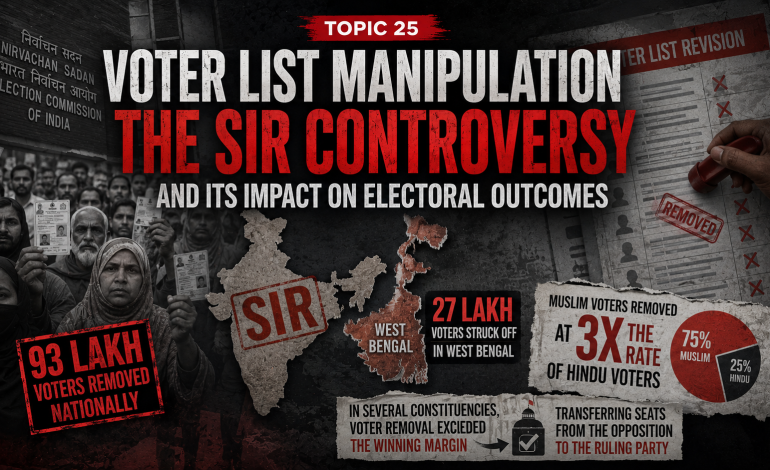

TOPIC 25
How the Largest Voter Deletion Exercise in Indian History Shaped the 2026 Assembly Elections
In the months leading up to the 2026 West Bengal Assembly elections, a record 91 lakh voters — nearly 12% of the state‘s electorate — saw their names deleted from the electoral rolls. The Election Commission‘s Special Intensive Revision (SIR) was the most extensive voter list revision exercise in Indian electoral history . The Trinamool Congress (TMC) erupted in protest, alleging that the process was a “saffron cleansing” operation designed to disenfranchise the party‘s minority and Matua support base. The BJP defended the exercise as a routine cleanup of dead, shifted, and duplicate voters. When the votes were counted, the BJP ended Mamata Banerjee‘s 15-year reign, winning 207 seats to the TMC‘s 80 . The question that haunts India‘s democratic institutions is this: Did the SIR merely clean the rolls, or did it decisively tilt the election? This article examines the scale, scope, statistical patterns, legal challenges, and electoral consequences of the West Bengal SIR — the most controversial election management exercise in modern Indian history.
WHAT – The Special Intensive Revision (SIR) of electoral rolls in West Bengal, a comprehensive door-to-door verification and deletion exercise conducted by the Election Commission of India (ECI) between November 2025 and April 2026.
WHO – The ECI (Chief Election Commissioner and Election Commissioners), Booth Level Officers (BLOs) conducting verification, the Calcutta High Court-appointed appellate tribunals (including former judges), political parties (TMC, BJP, Congress, Left Front), and approximately 91 lakh voters whose names were deleted.
WHEN – Initiated in November 2025, with draft rolls published in December 2025, final rolls on February 28, 2026, under-adjudication cases decided by April 2026, and elections held in April-May 2026.
WHERE – Across West Bengal‘s 294 Assembly constituencies, with particular intensity in border districts (Murshidabad, Malda, North 24 Parganas) and minority-concentrated areas.
WHY – Officially, to remove “absent, shifted, dead, or duplicate” voters and clean the electoral rolls. Critics allege the exercise was politically motivated to disenfranchise voters likely to support the opposition TMC, particularly minorities and Matuas.
HOW – Through a three-phase process: (1) ASDD deletions (Absent, Shifted, Dead, Duplicate) using door-to-door verification; (2) final list deletions based on “logical discrepancies” reportedly using AI tools; (3) under-adjudication cases referred to judicial officers for review, with supplementary deletions.
SECTION 1: THE SCALE – 91 LAKH VOTERS DELETED
The SIR exercise was unprecedented in scale. Before the revision, West Bengal‘s electorate stood at approximately 7.66 crore voters .
The Deletion Timeline:
| Phase | Period | Deletions | Cumulative |
|---|---|---|---|
| Pre-SIR electorate | November 2025 | – | 7.66 crore |
| Phase I: ASDD deletions (Absent, Shifted, Dead/Duplicate) | December 2025 | 58.20 lakh | ~7.08 crore |
| Phase II: Final list deletions (logical discrepancy, unmapped voters) | February 28, 2026 | 5.46 lakh | ~7.02 crore |
| Phase III: Under-adjudication deletions (supplementary lists) | April 2026 | 27.16 lakh | ~6.75 crore |
| Total deletions | – | 90.83 lakh | – |
Source: Office of the Chief Electoral Officer, West Bengal
The electorate contracted by nearly 12% — a reduction far exceeding normal electoral roll churn. The ASDD category (absent, shifted, dead, duplicate) accounted for approximately 58 lakh deletions. The final list, published on February 28, added another 5.46 lakh deletions. The under-adjudication category — voters whose cases were reviewed by judicial officers — resulted in the deletion of 27.16 lakh voters .
The Magnitude: No Indian state has ever witnessed a voter deletion exercise of this scale. As a proportion of the electorate (12%), it is unmatched in Indian electoral history. As one analyst noted, this was not a routine cleanup — it was a surgical operation on the electoral rolls.
SECTION 2: THE PROCESS – PHASES, CATEGORIES, AND THE ADJUDICATION BOTTLENECK
2.1 Phase I: ASDD Deletions (December 2025)
The SIR began with door-to-door verification by Booth Level Officers (BLOs). Voters were categorised as “absent, shifted, dead, or duplicate” (ASDD) — categories that the ECI has long used to clean electoral rolls. Approximately 58.20 lakh voters were removed in this phase .
The Controversy: Opposition parties alleged that the verification process was rushed and that BLOs were under pressure to identify “suspicious” voters. The TMC claimed that legitimate voters — particularly in minority-concentrated areas — were arbitrarily marked as “shifted” or “absent” without proper verification.
2.2 Phase II: Final List Deletions (February 28, 2026)
Approximately 5.46 lakh additional voters were deleted in the final list based on “logical discrepancies” — reportedly using untested AI tools to flag issues such as minor spelling variations or inconsistencies in the age gaps between parents and children .
The AI Controversy: The use of AI tools to flag voters for deletion has been criticised by civil society organisations as opaque and prone to error. Voters flagged for “logical discrepancies” were given little opportunity to rectify minor data entry issues before being removed.
2.3 Phase III: The Under-Adjudication Bottleneck (February-April 2026)
The most problematic phase was the “under-adjudication” category — over 60 lakh cases were originally referred for judicial review, of which approximately 27.16 lakh were ultimately deemed “excludable” .
The Tribunal System: The ECI appointed 19 appellate tribunals, chaired by former judges, to hear appeals from voters whose names had been flagged for deletion. Former Calcutta High Court Chief Justice T.S. Sivagnanam was among these tribunal chairs .
The Volume Problem: Justice Sivagnanam alone disposed of 1,777 appeals, clearing 1,717 of them — a 96.6% acceptance rate . Senior advocate and Congress Rajya Sabha MP Kapil Sibal seized on this statistic:
“What this means: More than 96 per cent of names wrongly deleted. CEC zindabad. This is how BJP won!”
The implication was stark: if 96% of appeals were allowed, the initial deletions were almost entirely erroneous. The voters whose names were restored had to navigate a complex legal process — a burden that many could not bear.
2.4 The “Unmapped Voter” Category – A Demographic Pattern
The preliminary data revealed an important demographic pattern. Districts with higher Muslim populations, such as Murshidabad and Malda, showed relatively better levels of electoral roll “mapping.” In contrast, a high incidence of unmapped voters was found among Matua communities in North 24 Parganas and Nadia districts .
The “unmapped” category — voters whose names could not be linked to the 2002 electoral rolls — disproportionately affected the Matua community, many of whom are descendants of migrants from East Pakistan (now Bangladesh). Their inclusion in electoral rolls has been a politically contentious issue for decades.
SECTION 3: THE DEMOGRAPHIC DEBATE – WHO WAS DELETED?
3.1 Competing Data Claims
The demographic composition of the deleted voters is hotly disputed. Two competing data sources offer starkly different pictures.
Claim 1: Muslims Disproportionately Targeted
According to reporting by Al Jazeera and the Express Tribune, allegations emerged that the SIR disproportionately targeted legitimate Muslim voters. Muslims, who make up about 27% of West Bengal‘s population, reportedly accounted for a significantly higher share (34%) of the deletions, indicating deliberate bias . In some key constituencies, such as Nandigram and Bhabanipur, reports claimed 40% to over 95% of deleted names belonged to Muslims .
Claim 2: Hindus (Particularly Matuas) Bore the Brunt
However, data analysis by private research organisations, including the Sabar Institute, suggests a different pattern. A detailed breakdown of the 90 lakh deletions presented a more complex picture:
| Category | Number of Deletions (Lakh) | Percentage |
|---|---|---|
| ASDD Deletions | 58.21 | – |
| – Hindu (ASDD) | 43.81 | ~75% of ASDD |
| – Muslim (ASDD) | 13.31 | ~23% of ASDD |
| Final List Deletions | 5.46 | – |
| – Hindu | 5.29 | ~97% of final list |
| – Muslim | 0.13 | ~2% of final list |
| Under Adjudication (27.16 lakh) | – | – |
| – Hindu (under adjudication) | 8.37 | ~31% of adjudication |
| – Muslim (under adjudication) | 17.65 | ~65% of adjudication |
Source: Sabar Institute analysis cited by The Week
The Interpretive Challenge:
If one focuses on the final outcome — under-adjudication deletions (27.16 lakh) — Muslims appear disproportionately affected (65% of this category, against 27% population share). This is what critics seized upon.
However, defenders of the SIR point to the ASDD category, where Hindus (particularly Matuas) accounted for 75% of deletions. They argue that the overall deletion percentage from the Hindu community (63.42%) was nearly double that of Muslims (34.32%) .
The Nandigram and Bhabanipur Examples:
The Sabar Institute‘s data from two key constituencies showed stark targeting patterns:
| Constituency | Muslim Population Share | Muslim Deletions (%) |
|---|---|---|
| Nandigram | ~25% | 94.5% |
| Bhabanipur | ~20% | 40.1% |
In Nandigram, Muslims constitute about one-quarter of the population but accounted for 94.5% of deleted voters — a staggering statistical anomaly .
The Expert Consensus: No single narrative captures the entire SIR. The exercise appears to have targeted different communities in different phases: ASDD deletions disproportionately affected Matua Hindus; under-adjudication deletions disproportionately affected Muslims. The demographic impact varied by district, by phase, and by constituency.
SECTION 4: THE LEGAL CHALLENGES – THE SUPREME COURT AND THE CALCUTTA HIGH COURT
4.1 The Supreme Court‘s Intervention
As the SIR process unfolded, the Supreme Court was forced to intervene. Noting the urgency of the situation — elections were imminent — the Court directed the appellate tribunals to grant out-of-turn hearings to appellants who could demonstrate urgency .
A bench headed by Chief Justice of India Surya Kant observed:
“We grant liberty to the petitioners and other stakeholders to approach the Chief Justice of the Calcutta High Court on the administrative side. Similarly, if the matters require judicial intervention, they may approach the Chief Justice of the High Court. As regards those names who have been excluded in SIR and those who have filed appeals before the Appellate Tribunal, the Tribunal may grant them out-of-turn hearing of appeals, especially to appellants who are able to prove urgency.”
The Limitations: Despite the Court‘s urgency directive, the sheer volume of appeals — over 60 lakh cases sent for adjudication — meant that many voters could not be heard before the elections. Approximately 27.16 lakh voters were deemed “excludable” without final resolution .
4.2 The Calcutta High Court‘s Role
The Calcutta High Court heard multiple petitions challenging the SIR process. While it did not stay the revision, it appointed a committee of former judges to oversee the tribunal process. The High Court‘s involvement provided some oversight but did not prevent the massive deletions.
4.3 The Tribunal‘s Work – Justice Sivagnanam‘s 1,777 Appeals
Former Chief Justice T.S. Sivagnanam, heading one of the 19 tribunals, disposed of 1,777 appeals before resigning. Of these, he cleared 1,717 appeals — a 96.6% allowance rate — and dismissed only 60 filed by the Election Commission challenging fresh voter inclusions .
This 96% allowance rate became the centrepiece of political allegations. Kapil Sibal tweeted:
“Justice TS Shivagnanum. One of 19 Tribunals hearing appeals in West Bengal Elections. Disposed 1777 appeals. Cleared 1717. What this means: More than 96 per cent of names wrongly deleted. CEC zindabad. This is how BJP won!”
The EC defended the process, stating that appeals were cleared “only after scrutiny of supporting documents” and that the tribunals were “independent adjudicatory bodies” .
SECTION 5: THE ELECTORAL IMPACT – DID SIR DECIDE THE ELECTION?
The BJP won 207 seats; the TMC won 80 seats; Congress won 2 seats; others won 5 seats . The BJP‘s victory margin of 32.11 lakh votes translated into a 127-seat lead .
The critical question: Was the magnitude of deletions large enough to alter the outcome?
5.1 Seats Where Deletions Exceeded Victory Margins
A detailed analysis of data from 293 Assembly seats yields striking findings :
| Category | Number of Seats | BJP Won | TMC Won |
|---|---|---|---|
| Seats where total deletions > victory margin | 161 (54.8%) | 105 | 53 |
| Seats where non-death deletions > victory margin | 124 (42.2%) | 83 | 38 |
| Seats where supplementary list deletions alone > victory margin | 50 (17%) | 26 | 21 |
The Interpretation: In over half of West Bengal‘s Assembly seats, the number of voters deleted during the SIR exceeded the margin of victory. In 124 seats, even after excluding deaths, deletions exceeded the winning margin.
This is evidence that the SIR exercise was not merely “cleaning the rolls” — it was reshaping electoral outcomes. In close contests, the deletion of a few thousand voters could flip a seat .
The Catchment of Deleted Votes:
The 27 lakh under-adjudication deletions alone represent a pool of voters larger than the victory margin in 50 constituencies where the victory margin was less than 5,000 votes. Had these voters been restored before the election — as 96% of them were in Justice Sivagnanam‘s tribunal — the outcome in these constituencies could have differed .
5.2 The Correlation – High Deletion, BJP Win?
The data shows that the BJP performed strongly where deletions were high, and TMC retained its seats where deletions were lower — but the causation is disputed.
| Deletion Category | Number of Seats | BJP Won | TMC Won |
|---|---|---|---|
| Seats with 25,000+ deletions | 147 | 95 (64.6%) | 51 (34.7%) |
| Seats with 15,000-25,000 deletions | 67 | 47 (70.1%) | 19 (28.4%) |
| Seats with 5,000-15,000 deletions | 62 | 50 (80.6%) | 12 (19.4%) |
| Seats with fewer than 5,000 deletions | 13 | 13 (100%) | 0 (0%) |
Source: NDTV/WION analysis of EC data
The Correlation – Deletion Density:
The constituencies with the highest deletions — Murshidabad, Malda, North 24 Parganas — were primarily TMC strongholds. In Murshidabad, TMC‘s tally dropped from 20 seats (2021) to 9 seats (2026) . In North 24 Parganas, TMC dropped from 28 seats to 8 seats .
The BJP won 95 of 147 seats with deletions exceeding 25,000 — a 64.6% strike rate. The TMC won only 51 of these seats .
The Exception That Proves the Rule:
However, the constituencies with the highest deletion counts — Sujapur, Raghunathganj, Samserganj — voted overwhelmingly for the TMC, not the BJP . This suggests that while deletions were massive, they did not entirely nullify the TMC‘s support base in its most loyal territories.
5.3 Demographic Correlation – Minority Share and Deletion Impact
| Victory Type | Average Minority Population Share |
|---|---|
| Overall BJP seat average | 15.1% |
| BJP seats where deletions exceeded margin | 18.9% |
| BJP seats where supplementary deletions alone exceeded margin | 28% |
| Overall TMC seat average | 41.2% |
Source: Sabar Institute / Deccan Herald analysis
The pattern is clear: The BJP‘s victories were concentrated in constituencies with relatively higher minority populations — constituencies not traditionally considered the party‘s strongholds. Of the 19 seats where minority population exceeded 30%, the BJP won 18, even though the total non-BJP votes were higher than the BJP votes .
The Interpretation: In constituencies where minority communities form a substantial but not overwhelming proportion of the electorate (20-40%), small changes in voter turnout or voter list composition can produce large shifts in outcomes. The SIR appears to have created such small changes — tipping the balance in favour of the BJP.
5.4 Did SIR Determine the Outcome? – Assessing Causation
| Argument for SIR determining outcome | Counter-argument |
|---|---|
| In 54.8% of seats, deletions exceeded victory margin | Anti-incumbency against Mamata was historically high |
| The BJP‘s victory margin (32 lakh votes) was far lower than total deletions (91 lakh) | Minorities split their votes; consolidation of Hindu votes favoured BJP |
| TMC‘s vote share dropped in districts with highest deletions | BJP‘s organisational strength improved significantly |
| Kapil Sibal‘s 96% allowance rate suggests mass erroneous deletion | EC maintains process was lawful and transparent |
The data does not conclusively prove that the SIR determined the outcome — anti-incumbency, minority vote fragmentation, and the BJP‘s campaign strength also played roles. However, the data strongly suggests that the SIR influenced the outcome, particularly in close constituencies.
As the Deccan Herald analysis concluded: “In 124 seats (42.2%), non-death deletions exceeded the winning margin… This suggests that the SIR exercise was not merely ‘cleaning the rolls‘ — it was reshaping electoral outcomes” .
SECTION 6: POLITICAL REACTIONS – TMC‘S ALLEGATIONS VS EC‘S DEFENSE
6.1 The TMC and Opposition Allegations
The Trinamool Congress, Congress, and Left parties were unanimous in their criticism of the SIR exercise.
| Leader | Statement |
|---|---|
| Mamata Banerjee (TMC) | “The Election Commission has become a BJP yes-man. They removed my voters in Bengal. They did nothing when the BJP violated the code.” |
| Kapil Sibal (Congress) | “More than 96 per cent of names wrongly deleted. CEC zindabad. This is how BJP won!” |
| CPI(M) leadership | “The SIR was a saffron cleansing operation designed to disenfranchise minority voters.” |
6.2 The Election Commission‘s Defense
The Election Commission has consistently defended the SIR as a lawful, transparent, and necessary cleanup.
An EC official stated:
“The SIR process was conducted as per law, with proper notices and opportunities for claims and objections. Allegations of bias are unfounded and politically motivated. The tribunals were independent adjudicatory bodies. Wherever documentary proof was found satisfactory, names were restored in keeping with the rules.”
The EC also pointed to the fact that TMC won the constituencies with the highest deletion counts — Sujapur, Raghunathganj, Samserganj — as proof that the process did not disenfranchise TMC supporters .
6.3 The 96% Allowance Rate – EC‘s Rebuttal
The EC did not directly address Kapil Sibal‘s “96% wrongly deleted” claim. However, EC officials pointed out that Justice Sivagnanam was only one of 19 tribunals, and that his 96% allowance rate was not representative of the overall process. Moreover, they argued that appeals were cleared “only after scrutiny of supporting documents” — not because the initial deletions were erroneous, but because voters had provided documentary proof of eligibility .
SECTION 7: THE AFTERMATH – LESSONS FOR INDIAN DEMOCRACY
The West Bengal SIR has left a lasting stain on India‘s electoral democracy.
The Technical Innovation – AI and Logical Discrepancy Tools:
The use of untested AI tools to flag voters for deletion based on “logical discrepancies” (spelling variations, minor data inconsistencies) is a dangerous precedent. Voters flagged by AI had limited opportunity to rectify minor errors before their names were deleted.
The Adjudication Bottleneck:
The volume of appeals — over 60 lakh cases referred for judicial review — overwhelmed the 19 tribunals. Despite the Supreme Court‘s urgency directive, approximately 27 lakh voters remained in the “excludable” category without final resolution before the election.
The Permanence of Deletion:
For the 27 lakh voters deleted during under-adjudication, the election came and went without them. Whether they were ultimately eligible or not was irrelevant — they could not vote. This is the most fundamental violation of democratic rights: the denial of the franchise.
What Has Been Lost:
| Loss | Explanation |
|---|---|
| Presumption of inclusion | The EC‘s default position should be inclusion, not deletion |
| Adequate notice | Many voters did not receive sufficient notice of pending deletion |
| Fair adjudication | The tribunal system, despite independent judges, could not process appeals in time |
| Electoral trust | Voters — particularly minorities — now question whether their names will be on the rolls |
| EC‘s neutrality reputation | The perception that the EC is a “government yes-man” has crystallised |
CONCLUSION – THE SURGICAL STRIKE ON THE ELECTORATE
The West Bengal SIR was the largest voter deletion exercise in Indian electoral history. Whether one views it as a necessary cleanup or a political operation depends on one‘s perspective.
What Is Undeniable:
-
91 lakh voters were deleted — 12% of the electorate
-
In 161 seats (54.8%), total deletions exceeded the winning margin
-
Muslims were disproportionately represented in the under-adjudication category (65% of deletions)
-
Matua Hindus were disproportionately represented in the ASDD category (75% of deletions)
-
The 96% allowance rate in one tribunal suggests mass erroneous deletion
-
27 lakh voters were deleted through under-adjudication without final resolution
-
The BJP won 207 seats; the TMC won 80
What Remains Disputed:
-
Whether the deletions were lawful and justified
-
Whether the AI tools were accurate and fair
-
Whether the tribunal system could have processed all appeals given more time
-
Whether the SIR — or other factors — determined the outcome
The Unanswered Question:
If the EC can delete 91 lakh voters — 12% of a state‘s electorate — with inadequate notice, flawed AI tools, and an overburdened tribunal system, what guarantees do citizens across India have that their names will not be deleted before the next election?
The Supreme Court has set aside the electoral bonds scheme. It has not yet addressed the deeper crisis of electoral roll integrity.
The West Bengal SIR may be the most consequential electoral intervention in modern Indian history. It is a warning. And it may be a template.
SUMMARY TABLE: SIR – THE WEST BENGAL CASE STUDY
| Aspect | Detail |
|---|---|
| Total deletions | 90.83 lakh (approx. 91 lakh) |
| Pre-SIR electorate | 7.66 crore |
| Post-SIR electorate | 6.75 crore |
| Reduction percentage | ~12% |
| ASDD deletions (Phase I) | 58.20 lakh (Dec 2025) |
| Final list deletions (Phase II) | 5.46 lakh (Feb 28, 2026) |
| Under-adjudication deletions (Phase III) | 27.16 lakh (Apr 2026) |
| Number of tribunals | 19 |
| Justice Sivagnanam‘s appeals | 1,777 disposed, 1,717 allowed (96.6%) |
| Election result (BJP) | 207 seats |
| Election result (TMC) | 80 seats |
| Seats where deletions > victory margin | 161 (54.8%) |
| Seats where non-death deletions > victory margin | 124 (42.2%) |
| Seats where supplement deletions alone > victory margin | 50 (17%) |
Next Topic (Topic 26): “Model Code of Conduct – Toothless Tiger or Biased Enforcer?”
To be continued tomorrow with in-depth analysis of how the Model Code of Conduct has been selectively enforced — with stark differences in action against ruling and opposition parties across multiple elections.