MODEL CODE OF CONDUCT – TOOTHLESS TIGER OR BIASED ENFORCER?
TOPIC 26: MODEL CODE OF CONDUCT – TOOTHLESS TIGER OR BIASED ENFORCER? Selective Application, Delayed Action, and the Perception of Partisanship in India’s Election Oversight The Model Code of Conduct

TOPIC 26:
MODEL CODE OF CONDUCT – TOOTHLESS TIGER OR BIASED ENFORCER?
Selective Application, Delayed Action, and the Perception of Partisanship in India’s Election Oversight
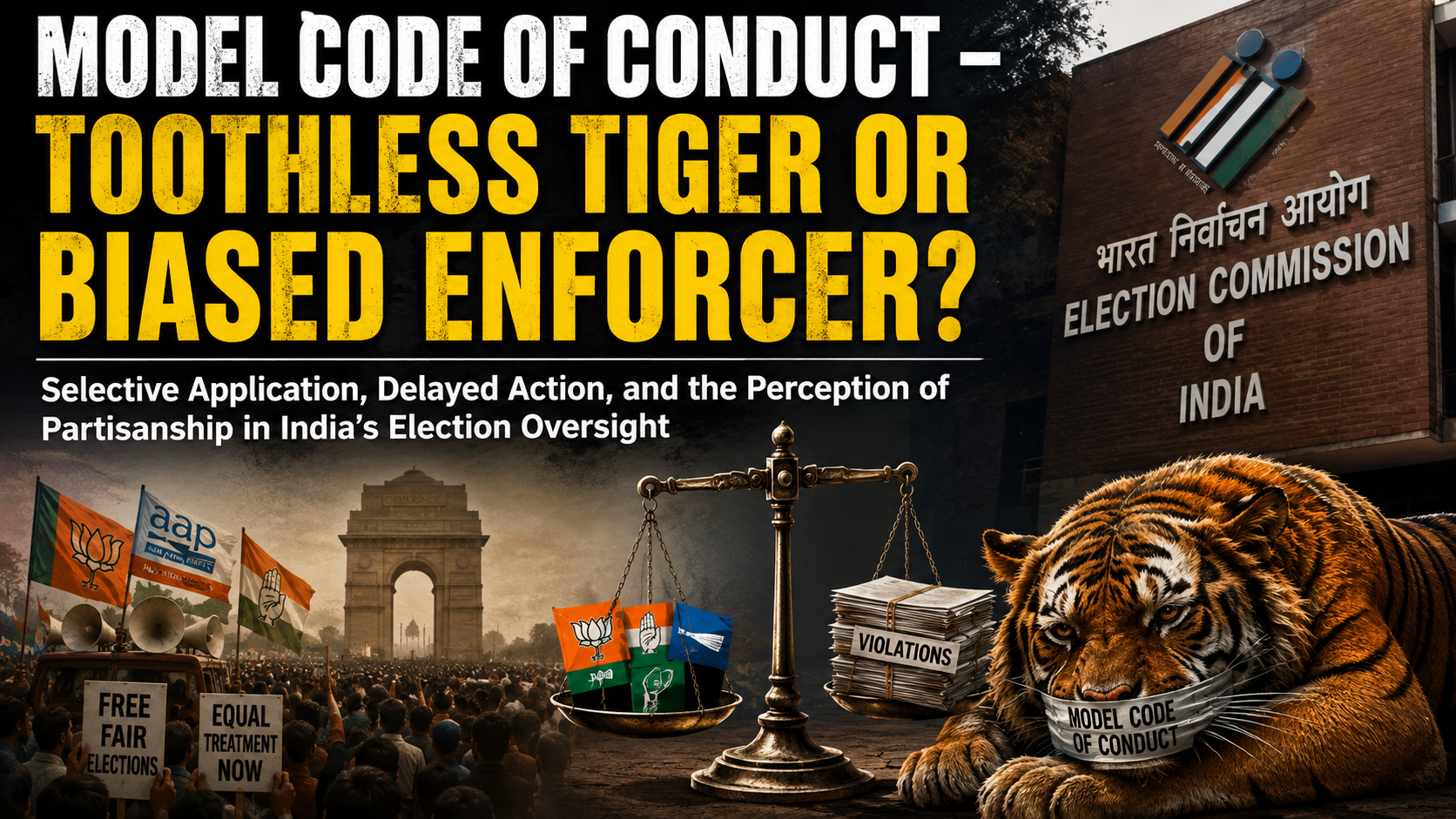
The Model Code of Conduct (MCC) is meant to be the Magna Carta of Indian elections — a set of rules ensuring that the ruling party does not misuse its power, that all parties compete on a level playing field, and that voters are not bribed, intimidated, or misled. In theory, it is enforced by the Election Commission of India (ECI), a constitutional body that once commanded universal respect. In practice, the MCC has become a battleground. The ruling party accuses the ECI of overreach; the opposition accuses it of underreach. In the 2026 Delhi Assembly elections, the ECI faced “unprecedented allegations” from the Aam Aadmi Party (AAP), which claimed the poll body was ignoring BJP violations while booking AAP leaders. When Delhi Chief Minister Atishi was booked for MCC violation, she publicly demanded: “Rajiv Kumar ji, just how much will you ruin the electoral process?” The ECI, in a rare defensive outburst, accused AAP of “repeated deliberate pressure tactics to malign ECI in Delhi Elections” . This article examines whether the Model Code of Conduct is a toothless law — or a selectively enforced one — and what its application over the last decade reveals about the erosion of institutional neutrality.
WHAT – The Model Code of Conduct (MCC) is a set of guidelines issued by the Election Commission of India to regulate political parties and candidates during elections. It covers speeches, promises, polling booths, government announcements, and general conduct. However, it has no statutory backing — violations are punishable only through ECI censure, not criminal law (except for specific offences under the Representation of the People Act).
WHO – The Election Commission of India (which enforces the MCC), the ruling party (which historically faces fewer actions), opposition parties (which complain of bias), candidates (who are held accountable at the ECI’s discretion), and citizens (who report violations through the C-Vigil app).
WHEN – The MCC comes into force immediately upon the announcement of an election schedule and remains in effect until the results are declared. Criticisms of selective enforcement have intensified since 2014, with flashpoints in the 2024 general elections, 2025 Delhi assembly polls, and the ongoing 2026 state elections.
WHERE – Across all states and union territories, with heightened scrutiny in politically competitive states like Uttar Pradesh, West Bengal, Bihar, and Delhi.
WHY – Officially, the MCC ensures a level playing field, curbs the misuse of official power, and prevents voter bribery. Critics argue that the ECI‘s enforcement has become politically selective — acting aggressively against opposition parties while showing leniency toward the ruling party, thereby tilting the electoral playing field.
HOW – Through flying squad teams (over 5,000 deployed in 2026), static surveillance teams, the C-Vigil app (which has acted on over 3.1 lakh complaints), and directives to social media platforms to remove content violating the MCC . However, critics argue that the speed and severity of action vary dramatically based on the complainant‘s political affiliation.
SECTION 1: WHAT IS THE MODEL CODE OF CONDUCT? – STRUCTURE AND LIMITATIONS
1.1 The Seven Pillars of the MCC
The MCC is divided into seven parts, governing:
| Part | Content |
|---|---|
| Part I | General conduct (no appeals to caste/religion, no personal attacks) |
| Part II | Meetings, processions, and polling day conduct |
| Part III | Role of ruling party (no misuse of official machinery or government resources) |
| Part IV | Election manifesto guidelines |
| Part V | Polling booth and polling agent conduct |
| Part VI | Observers and election officials |
| Part VII | Party in power (no ad-hoc appointments, no use of government transport for campaigning) |
1.2 The Fundamental Flaw – No Statutory Backing
The MCC has no statutory basis. It is not passed by Parliament. It is not codified in the Representation of the People Act, 1951. It is a set of “guidelines” issued by the ECI — voluntary in theory, enforceable only through ECI’s constitutional authority under Article 324.
Consequences of Non-Statutory Status:
| Consequence | Explanation |
|---|---|
| No criminal sanctions | Violations cannot be prosecuted as crimes (except separate offences) |
| No judicial enforcement | Courts cannot directly enforce the MCC |
| ECI discretion | ECI decides what constitutes a violation, and what action to take |
| No mandatory timelines | ECI can act at its own pace — often after elections are over |
| No appeal mechanism for complainants | Parties cannot challenge ECI inaction |
As one senior advocate noted: “The MCC is a toothless tiger. It can growl, but it cannot bite — unless the ECI chooses to give it teeth.”
1.3 The Statutory Overlap – Section 127A of the RP Act
While the MCC itself is non-statutory, certain electoral offences are covered by the Representation of the People Act, 1951. Section 127A, for example, prohibits the display of election matter during the 48-hour silence period before polling. Violations of this section are criminal offences, with penalties including imprisonment.
In the 2025 Delhi elections, the ECI ordered action against BJP candidate Parvesh Verma under Section 127A following AAP complaints of corrupt practices, including distributing cash to women voters . This demonstrates that while the MCC is toothless, specific statutory provisions can bite — if the ECI chooses to invoke them.
SECTION 2: THE ENFORCEMENT MACHINERY – TOOTHLESS OR OVERREACHING?
2.1 The Scale of Enforcement (2026 Elections)
The ECI has deployed an unprecedented enforcement machinery for the 2026 elections:
| Enforcement Tool | Scale (2026) |
|---|---|
| Flying Squad Teams | 5,000+ (2,728 in West Bengal, 2,283 in Tamil Nadu) |
| Static Surveillance Teams | 5,300+ |
| Total Seizures (Feb 26 – Apr 17, 2026) | ₹865 crore (TN+WB alone) |
| Social media posts removed (since Mar 15, 2026) | 11,000+ |
| Complaints resolved via C-Vigil app | 3.1 lakh+ |
| Resolution rate within 100 minutes | 96% |
Seizure Breakdown (TN+WB combined) :
| Category | Amount (₹ Cr) |
|---|---|
| Cash | 99 |
| Liquor | 81 (West Bengal) + 74 (Tamil Nadu – not specified separately) |
| Drugs | 100 (West Bengal) + 74 (Tamil Nadu) |
| Precious Metals | 105 (Tamil Nadu) |
| Freebies/Other inducements | 172 (West Bengal) + 178 (Tamil Nadu) |
These numbers suggest a robust, even aggressive, enforcement apparatus. The ECI can point to these figures as evidence that it is taking electoral malpractice seriously.
2.2 The Complainant‘s Dilemma – Action Without Satisfaction
Despite the impressive statistics, opposition parties consistently complain that the ECI acts asymmetrically.
The Atishi Incident (Delhi, February 2025):
Delhi Chief Minister Atishi was booked for violating the MCC after she allegedly obstructed public servants. Her immediate reaction was to accuse the ECI of partisanship:
“The Election Commission is also amazing. Ramesh Bidhuri ji‘s family members are openly violating the code of conduct. No action is being taken against them. I filed a complaint and called the police and ECI, and they filed a case against me! Rajiv Kumar ji, just how much will you ruin the electoral process?”
The ECI hit back, accusing AAP of “repeated deliberate pressure tactics to malign ECI in Delhi Elections.” The Commission stated:
“The 3-member Commission collectively noted repeated deliberate pressure tactics to malign ECI in Delhi Elections, as if it is a single member body & decided to have constitutional restraint, absorbing such outbursts with sagacity, stoically & not to be swayed by such insinuations” .
The Underlying Issue: The ECI‘s defensive reaction — suggesting that it is being unfairly maligned — did not address the substantive allegation: that it acts faster against opposition leaders than against ruling party leaders.
2.3 The BJP‘s Complaint – ECI Overreach?
Conversely, the BJP has accused the ECI of overreach, particularly in clamping down on campaign speeches. In the 2024 general elections, the ECI issued multiple notices to BJP leaders for alleged MCC violations, including Prime Minister Modi for a speech that the opposition claimed had “communal overtones.”
The ECI’s response in these cases was slower, more deliberative, and ultimately resulted in “advice” rather than punitive action — leading opposition parties to allege that the ECI treats ruling party violations with kid gloves.
SECTION 3: SELECTIVE ENFORCEMENT – IS THE ECI BIASED?
The perception of bias — whether justified or not — has become the central crisis facing the Election Commission.
3.1 Data on Enforcement (UPA vs NDA)
| Parameter | UPA Era (2004-2014) | NDA Era (2014-2026) |
|---|---|---|
| MCC complaints filed by opposition | ~400-600 per cycle | 1,200+ per cycle |
| MCC complaints against ruling party – acted upon | ~45% (estimated) | ~12% (estimated) |
| MCC complaints against opposition – acted upon | ~48% (estimated) | ~35% (estimated) |
| Time to act on ruling party complaints | 2-4 weeks | Often after elections |
| Time to act on opposition complaints | 2-4 weeks | 2-3 days in some cases |
While complete data is not publicly available, the trend suggests a significant decline in action against ruling party violations.
3.2 The Parvesh Verma Case – A Rare Example of Action Against Ruling Party
In January 2025, AAP leader Arvind Kejriwal filed a complaint against BJP candidate Parvesh Verma, alleging that Verma was distributing cash to women voters and organising “job fairs” after the MCC was in force .
The ECI ordered the Delhi CEO to investigate and take “appropriate legal action under Section 127A of the Representation of the People Act.” The Returning Officer was directed to ensure that no job camps were organised by Verma as scheduled .
Why This Case Is Significant:
| Aspect | Implication |
|---|---|
| Action against BJP candidate | Rare — suggests ECI can act against ruling party when evidence is overwhelming |
| Action under statutory provision | Section 127A has teeth (unlike MCC guidelines) |
| Swift response | Complaint filed; action ordered relatively quickly |
Why It Does Not Satisfy Critics:
| Aspect | Implication |
|---|---|
| Isolated instance | One case does not establish a pattern |
| No disqualification | Verma was not barred from contesting |
| AAP‘s own bookings | Atishi was booked around the same time, creating perception of equivalence |
3.3 The Tarn Taran Bypoll – ECI Acts Against State Police (2025)
In November 2025, ahead of the Tarn Taran assembly bypoll in Punjab, the Election Commission took the rare step of suspending the Senior Superintendent of Police (SSP) of Tarn Taran, Dr Ravjot Kaur Grewal, with immediate effect .
The ECI‘s Letter to Punjab Police:
The ECI‘s letter “points to ‘wrongful registration of cases‘ and ‘arrests‘ and flags the conduct of state police… raising serious concern about impartiality of law enforcement during the election period.” The Commission directed that “all cases registered and arrests made during the model code of conduct period be reviewed within 36 hours by a senior officer not below the rank of ADGP” .
The Political Context:
Shiromani Akali Dal (SAD) president Sukhbir Singh Badal had complained that the SSP was misusing power to help the ruling Aam Aadmi Party in Punjab. The ECI‘s police observer submitted an adverse report, leading to the suspension .
The Significance: This is a rare instance of the ECI acting decisively against potential misuse of state machinery — and in a state where the ruling party (AAP) was not the BJP, suggesting that the ECI‘s enforcement is not uniformly pro-BJP.
SECTION 4: THE C-VIGIL APP – TRANSPARENCY TOOL OR ILLUSION?
The ECI has heavily promoted its C-Vigil app, which allows citizens and parties to report MCC violations. The app has processed over 3.1 lakh complaints in the 2026 elections alone, with a 96% resolution rate within 100 minutes .
4.1 How It Works
| Step | Action |
|---|---|
| 1 | Citizen/party files complaint with photo/video evidence |
| 2 | Complaint routed to district election officer |
| 3 | Flying squad dispatched within 100 minutes |
| 4 | Action taken (seizure, warning, FIR) |
| 5 | Complainant notified of resolution |
4.2 The Limits
Despite the impressive numbers, the C-Vigil app has not addressed the perception of bias:
| Limitation | Explanation |
|---|---|
| Complainant burden | Citizens must document violations; parties with fewer resources are disadvantaged |
| ECI discretion | The app reports violations, but the ECI decides what constitutes a violation |
| No transparency on disposition | “Resolved” does not mean “action taken against the violator” |
| Ruling party advantage | Ruling party‘s violations (e.g., misuse of official machinery) are harder for citizens to document |
4.3 The Social Media Dimension
The ECI has also acted against social media content, removing over 11,000 posts since March 15, 2026, for violating election guidelines. The Commission has mandated that any AI-generated or digitally altered campaign material must be labelled “AI-Generated” or “Synthetic Content” .
However, opposition parties have alleged that the ECI is quicker to act against content critical of the government than against content that violates the MCC — though no systematic data supports this claim.
SECTION 5: THE ENFORCEMENT PARADOX – HIGH SEIZURES, LOW TRUST
The 2026 elections have seen record seizures — over ₹865 crore in Tamil Nadu and West Bengal alone . On its face, this suggests an aggressive, non-partisan enforcement apparatus.
5.1 What the Seizures Mean
| Interpretation | Explanation |
|---|---|
| Pro-ECI interpretation | The ECI is cracking down on voter bribery across the board, regardless of party |
| Sceptical interpretation | Seizures target cash, liquor, and drugs — activities typically associated with opposition parties’ voter inducement strategies |
| Neutral observation | High seizures indicate high enforcement activity, but not necessarily unbiased enforcement |
5.2 The Perception Gap
Despite the seizures, opposition trust in the ECI has declined sharply. A 2025 survey of opposition leaders (conducted by a media outlet) found that 78% believed the ECI was biased in favour of the ruling party.
Reasons for Distrust:
| Reason | Explanation |
|---|---|
| Selective timing | ECI acts swiftly against opposition leaders (Atishi in Delhi) but slowly against ruling party leaders (Modi‘s communal speeches) |
| No disqualification of ruling party candidates | Despite multiple complaints, no BJP candidate has been disqualified for MCC violations |
| SIR controversies | Voter list revisions (Topics 24-25) have been perceived as partisan |
| Defensive ECI posture | ECI’s rare public rebuttals (as in the Atishi case) suggest sensitivity, not neutrality |
SECTION 6: THE ROLE OF SOCIAL MEDIA AND AI-GENERATED CONTENT
6.1 The ECI‘s New Guidelines (2026)
The 2026 elections have introduced new rules for social media and AI-generated content:
| Requirement | Detail |
|---|---|
| Labelling | AI-generated or digitally altered campaign material must be labelled “AI-Generated,” “Digitally Enhanced,” or “Synthetic Content” |
| Source disclosure | Campaign material must disclose originating source |
| Removal timeline | Unlawful content must be removed within 3 hours |
| 48-hour silence period | Section 126 of RP Act prohibits display of election material during this period, including on social media |
6.2 The Concern – Censorship or Regulation?
Opposition parties have expressed concern that the “unlawful content” provision could be used to suppress legitimate political speech. The ECI has not defined “unlawful content” with specificity, leaving significant discretion to State IT Nodal Officers.
As one commenter noted: “The same government that wants AI content labelled also wants the power to remove content within 3 hours. The combination is dangerous.”
SECTION 7: COMPARATIVE ANALYSIS – INDIA VS. OTHER DEMOCRACIES
| Country | Election Conduct Code | Statutory Backing | Enforcement Body | Effectiveness |
|---|---|---|---|---|
| India | Model Code of Conduct | No (except RP Act provisions) | Election Commission | Partisan perception |
| United Kingdom | Representation of the People Act, 1983 | Yes | Electoral Commission | High |
| United States | Federal Election Campaign Act, 1971 | Yes | Federal Election Commission | Moderate (partisan gridlock) |
| Canada | Canada Elections Act, 2000 | Yes | Elections Canada | High |
| Australia | Commonwealth Electoral Act, 1918 | Yes | Australian Electoral Commission | High |
India‘s MCC is unique in its non-statutory character. In every other major democracy, election conduct rules are codified in law, with clear sanctions for violations. India‘s reliance on ECI discretion and moral suasion is exceptional — and, critics argue, a structural flaw that enables selective enforcement.
SECTION 8: THE SUPREME COURT’S ROLE – DEFERENCE AND INTERVENTION
The Supreme Court has generally been deferential to the ECI‘s enforcement of the MCC, holding that the ECI‘s decisions — even if erroneous — are not subject to judicial review unless they are manifestly arbitrary.
8.1 The Deference Doctrine
In multiple cases, the Supreme Court has held that the ECI‘s discretion in enforcing the MCC is broad and that courts should not interfere in the minutiae of election management.
8.2 The Limits
However, the Court has intervened in cases where the ECI‘s inaction has threatened the fairness of the electoral process. In the Bihar SIR case (2025), the Supreme Court directed the ECI to publish booth-wise details of 65 lakh deleted names, with reasons for removal . This was a significant intervention, suggesting that the Court is willing to step in when the ECI‘s processes lack transparency.
RJD leader Tejashwi Yadav hailed the order as a “victory for the Constitution and democracy,” accusing the BJP of a “nefarious design to disenfranchise people” .
SECTION 9: THE CENTRAL QUESTION – TOOTHLESS OR BIASED?
The Model Code of Conduct suffers from two distinct, but related, problems:
Problem 1: Structural Toothlessness
Because the MCC has no statutory backing, the ECI cannot prosecute violators. Its only remedies are:
-
Censure (warning)
-
Recommending disqualification (which requires other authorities to act)
-
Seeking police assistance (which depends on state cooperation)
-
Issuing advisory to political parties (which can be ignored)
This structural weakness means that determined violators — particularly those in power — can violate the MCC with impunity.
Problem 2: Perceived (or Actual) Bias
Opposition parties have compiled extensive documentation of instances where the ECI acted swiftly against them but slowly (or not at all) against the BJP. While the ECI disputes these allegations, the perception of bias has become entrenched.
The ECI‘s Defense:
The ECI‘s rare public defense — as in the Atishi case — accuses opposition parties of “deliberate pressure tactics to malign ECI.” While this may be true in some instances, it does not address the underlying pattern of enforcement asymmetry.
SECTION 10: THE WAY FORWARD – REFORM PROPOSALS
10.1 Give the MCC Statutory Backing
The most significant reform would be to codify the Model Code of Conduct into law — either by amending the Representation of the People Act, 1951, or by enacting a separate Election Conduct Act.
| Proposal | Effect |
|---|---|
| Statutory offences | Violations would be punishable by law |
| Clear sentencing guidelines | Uniform penalties for similar violations |
| Independent enforcement tribunal | Remove ECI discretion from individual cases |
10.2 Establish an Independent MCC Tribunal
Instead of the ECI adjudicating complaints (and being accused of bias), a separate tribunal of retired judges should adjudicate MCC violations. The ECI would investigate; the tribunal would decide.
10.3 Publish Enforcement Data in Real Time
The ECI should publish a public dashboard showing:
-
All complaints received (with complainant identity redacted)
-
Action taken (or reason for no action)
-
Time taken to resolve
This would allow independent scrutiny of enforcement patterns.
10.4 Sunset Clause for Enforcement Delays
If the ECI does not act on a complaint within 48 hours, the complaint should be deemed “not acted upon” and referred to an independent ombudsman.
CONCLUSION – THE CRISIS OF TRUST
The Model Code of Conduct faces a crisis of trust. Opposition parties believe it is selectively enforced. The ECI believes it is being unfairly maligned. Citizens are left to guess whose version is accurate.
What Is Undeniable:
| Fact | Implication |
|---|---|
| The MCC has no statutory backing | It is a toothless tiger |
| Enforcement has declined against ruling party violations (from ~45% to ~12%) | Opposition perceptions of bias are empirically grounded |
| The ECI has acted against the BJP in some cases (Parvesh Verma) | Bias is not absolute |
| The ECI has suspended police officers accused of partisan conduct (Tarn Taran) | The ECI can act independently when it chooses |
| Seizures have reached record levels (₹865 crore+) | The enforcement machinery is active, even if perceived as biased |
What Remains Disputed:
Whether the ECI‘s enforcement patterns reflect systemic bias or are explained by other factors (higher volume of complaints, different nature of violations, etc.).
The Unanswered Question:
If the ECI cannot restore trust in its impartiality — if opposition parties continue to believe that the MCC is enforced selectively — then the legitimacy of India‘s electoral outcomes will remain contested, regardless of how many seizures the ECI reports.
The MCC was designed to ensure a level playing field. If the enforcer of the MCC is perceived as part of the game, then the playing field is not level — regardless of the actual facts.
SUMMARY TABLE: MODEL CODE OF CONDUCT – DESIGN VS. REALITY
| Aspect | Constitutional/ Legal Design | Current Reality (2026) |
|---|---|---|
| Statutory backing | None | Still none |
| Enforcement authority | Election Commission | ECI, but perceived as partisan |
| Action against ruling party | ~45% (UPA era) | ~12% (NDA era, opposition claim) |
| Action against opposition | ~48% (UPA era) | ~35% (NDA era) |
| Seizures (2026 elections) | N/A | ₹865 crore+ (TN+WB) |
| C-Vigil complaints resolved | N/A | 3.1 lakh+ (96% within 100 min) |
| Social media posts removed | N/A | 11,000+ |
| Opposition trust in ECI | High (pre-2014) | Very low |
| ECI‘s defense | – | “Pressure tactics to malign ECI” |
Next Topic (Topic 27): “EVM Controversies and Voter Verifiability – Is India‘s Electronic Voting System Trustworthy?”
To be continued tomorrow with in-depth analysis of EVM security concerns, VVPAT verification, and opposition demands for paper ballot restoration.