
EVM CONTROVERSIES AND VOTER VERIFIABILITY
TOPIC 27 EVM CONTROVERSIES AND VOTER VERIFIABILITY Is India’s Electronic Voting System Trustworthy? The Debate Over EVM Security, VVPAT Verification, and Paper Trail Transparency Since their phased introduction in the
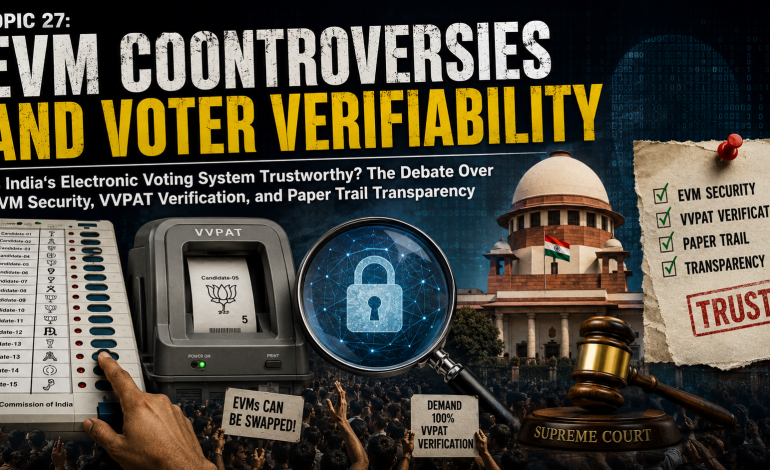

TOPIC 27
EVM CONTROVERSIES AND VOTER VERIFIABILITY
Is India’s Electronic Voting System Trustworthy? The Debate Over EVM Security, VVPAT Verification, and Paper Trail Transparency
Since their phased introduction in the 1990s, Electronic Voting Machines (EVMs) have transformed Indian elections — making them faster, cheaper, and more efficient. But efficiency has come at the cost of trust. Opposition parties across the political spectrum — from the Congress and TMC to the CPI(M) and AAP — have repeatedly raised questions about EVM security, manipulation, and the lack of a verifiable paper trail. The Supreme Court has dismissed multiple petitions seeking 100% VVPAT slip counting, most recently in April 2026, deeming the allegations “vague” and an “abuse of the process of law” . The Election Commission asserts that EVMs are “tamper-proof” and that “vote theft doesn‘t even arise” . Yet the allegations persist. In the aftermath of the 2026 West Bengal elections, TMC leader Abhishek Banerjee alleged that EVMs “can be swapped” even if not manipulated, citing mismatched serial numbers and anomalous battery charge levels . The Bombay High Court, in a landmark order, directed an EVM audit in the presence of a losing candidate — the first time such a transparent diagnostic check has been ordered . This article examines the technical, legal, and political dimensions of the EVM controversy, assesses the credibility of opposing claims, and evaluates whether India‘s electronic voting system can ever command the trust of all stakeholders.
WHAT – The controversy over the security, transparency, and verifiability of Electronic Voting Machines (EVMs) used in Indian elections, including allegations of manipulation, swapping, and tampering; the role of Voter Verifiable Paper Audit Trail (VVPAT) slips as a paper backup; and the legal and technical debates over the adequacy of current verification mechanisms.
WHO – The Election Commission of India (which defends EVM integrity), the Supreme Court (which has adjudicated multiple challenges), opposition parties (Congress, TMC, CPI(M), AAP, and others who raise doubts), civil society organizations (like the Association for Democratic Reforms), and technology experts (who debate the security of EVM hardware and software).
WHEN – The controversy has intensified since the 2014 general elections, with major flashpoints in 2019 (pre-election protests), 2024 (Supreme Court judgment on VVPAT verification), and the 2026 West Bengal elections (where TMC alleged widespread irregularities).
WHERE – Across India, with particular intensity in politically competitive states like West Bengal, Uttar Pradesh, and Maharashtra.
WHY – Officially, the ECI argues that EVMs are tamper-proof, that manual counting would introduce errors, and that VVPAT verification of a sample of EVMs (mandated by the Supreme Court in 2024) provides sufficient safeguard. Critics argue that without 100% VVPAT counting, electronic manipulation cannot be ruled out, and that voter trust requires a fully verifiable paper trail.
HOW – Through the alleged swapping of EVM units after voting; through manipulation of the microcontroller “burnt memory”; through discrepancies in EVM serial numbers reported in statutory Form 17C; through anomalous battery charge levels contradictory to standard usage; and through the opaque handling of EVMs between polling and counting.
SECTION 1: THE TECHNICAL ARCHITECTURE – HOW EVMS AND VVPAT WORK
1.1 Components of the EVM System
The Indian EVM system consists of three independent units:
| Component | Function | Security Features |
|---|---|---|
| Ballot Unit (BU) | Voter presses button next to candidate‘s name/symbol | Tamper-evident seals; unique serial number |
| Control Unit (CU) | Records votes; controls voting process; stored in strongroom after polling | Real-time clock; memory with write-once feature; battery backup |
| Voter Verifiable Paper Audit Trail (VVPAT) | Prints paper slip visible to voter for 7 seconds; slip drops into sealed box | Paper trail for physical verification |
1.2 How Votes Are Recorded
When a voter presses a button on the Ballot Unit:
-
The Control Unit registers the vote in its memory
-
The VVPAT unit prints a paper slip (showing candidate serial number, name, and symbol)
-
The voter views the slip through a transparent window for 7 seconds
-
The slip drops into a sealed compartment
-
The vote is recorded electronically
The paper slips are never given to the voter — they remain in the VVPAT machine‘s sealed box.
1.3 The Post-Polling Sealing Process
After polling concludes:
-
The Control Unit is sealed and placed in a strongroom
-
The VVPAT paper slip box is sealed separately
-
Strongrooms are guarded by central paramilitary forces
-
CCTV surveillance covers strongrooms 24/7
-
Candidates and their agents can monitor the seals
The ECI maintains that this process makes EVM tampering “virtually impossible.”
SECTION 2: THE ELECTION COMMISSION‘S DEFENSE – “VOTE THEFT DOESN‘T EVEN ARISE”
Following allegations of discarded VVPAT slips in West Bengal‘s Noapara constituency ahead of vote counting in the 2026 assembly elections, West Bengal Chief Electoral Officer Manoj Kumar Agarwal strongly defended the EVM system .
Agarwal‘s Statement:
“The issue of vote theft doesn‘t even arise; votes are locked in the EVM. The security is so tight that the question of vote theft doesn‘t come up at all.”
Key Elements of the ECI‘s Defense:
| Argument | Explanation |
|---|---|
| Tamper-proof hardware | EVMs are standalone devices with no wireless connectivity; cannot be hacked remotely |
| Write-once memory | Once a vote is recorded, memory cannot be altered |
| Physical security | Strongrooms guarded by central forces; candidates monitor seals |
| Randomization | EVMs are randomly allocated to polling stations; no one knows which machine will go where |
| VVPAT verification | VVPAT slips of one randomly selected polling station per assembly segment are counted to verify EVM totals |
| Judicial validation | Supreme Court has repeatedly upheld EVM integrity |
The ECI also points to the unprecedented scale of enforcement in 2026:
| Enforcement Metric | Scale |
|---|---|
| Flying Squad Teams | 5,000+ (2,728 in WB, 2,283 in TN) |
| Static Surveillance Teams | 5,300+ |
| Total Seizures (cash, liquor, drugs, freebies) | ₹865 crore+ (WB + TN) |
| C-Vigil complaints resolved | 3.1 lakh+ (96% within 100 minutes) |
The ECI‘s position, as articulated by Agarwal, is that the EVM system is not merely secure but “so tight” that questioning it is baseless.
SECTION 3: THE ALLEGATIONS – EVM SWAPPING, DISCREPANCIES, AND MANIPULATION
Despite the ECI‘s assurances, opposition parties — most vocally the Trinamool Congress after the 2026 West Bengal elections — have raised a series of specific allegations.
3.1 The “Swapping” Allegation – Abhishek Banerjee‘s Charge
TMC general secretary Abhishek Banerjee made a nuanced but serious allegation: EVMs may not be manipulated electronically, but they can be physically swapped .
“While the votes cast within the EVMs themselves may not have been manipulated, the EVM units can be swapped.”
The Specifics of the Allegation:
| Allegation | Detail |
|---|---|
| Serial number mismatch | When EVMs used for voting were cross-checked at counting tables, their serial numbers did not match records listed in Form 17C (the statutory record of EVM serial numbers assigned to each polling station) |
| Scope | Reports from “numerous locations” across West Bengal |
| Specific examples | 10 mismatched EVMs from Kalyani; similar reports from Memari |
| Formal complaints | All documented and submitted to Returning Officers |
The Implication: If EVM units were swapped after polling but before counting, votes recorded on one machine could be attributed to a different constituency — or votes could be added or removed without electronic tampering.
3.2 The Battery Charge Anomaly
Banerjee also pointed to an unusual pattern in EVM battery charge levels :
“The machines were used for 12 hours, but 90 per cent of the machines had 92-95 per cent charge. How is this possible?”
The Technical Context:
| Normal Expectation | Anomaly Alleged |
|---|---|
| EVM batteries are designed to last for 2-3 days of continuous operation | Charging an EVM before use typically brings it to ~100% |
| Normal usage over 12 hours would reduce charge modestly | The reported 92-95% charge after 12 hours is not technically impossible but statistically anomalous if widespread |
| Variability expected across machines | TMC claims 90% of machines showed this pattern |
The ECI has not responded publicly to the battery charge allegation.
3.3 Counting Irregularities – Agents Removed, Delays Manufactured
Beyond EVM hardware, Banerjee alleged serious procedural irregularities at counting centres :
| Allegation | Detail |
|---|---|
| Forced removal of counting agents | After 2:00 PM, counting agents were “forcibly removed or driven away through violence” at approximately 100 counting centres |
| Manufactured leads | By holding back vote counts while projecting leads, the BJP “manufactured an atmosphere that the BJP had already won” |
| Delayed counting | In centres where 80-90% of counting should have been completed by 2:00 PM, only 3-4 rounds had been completed |
| Pending rounds | In some places, 20-24 rounds of counting remained pending |
The CCTV Footage Demand:
“I give you 100 such CCTV footage from counting centres and let EC release 10 such footage. The footage of the entire day from counting centres, especially from 12 noon to 6 pm, be released.”
The ECI has not released comprehensive CCTV footage from counting centres.
3.4 The “Randomisation Rule” Violation
Banerjee cited the Supreme Court‘s directive that “randomisation rule should be implemented in both letter and spirit,” which requires the presence of employees from both State and Central governments at counting centres .
His Allegation:
| Requirement (SC order) | Reality (per TMC) |
|---|---|
| Both State and Central government employees present | Only Central government employees present |
| Counting Observers from mixed backgrounds | Counting Observers and Micro-Observers were central government appointees |
| Returning Officers from neutral pool | ECI installed its own Returning Officers, “replacing state government officials with their own hand-picked loyalists” |
| Mixed security personnel | Security consisted “entirely of paramilitary forces” |
The Discarded VVPAT Slips Incident (Noapara, April 2026):
Days before the vote counting, VVPAT slips allegedly from booth number 29 of Noapara Assembly constituency were found discarded in Subhashnagar of Ichapur Nilganj Panchayat under Madhyamgram Assembly . CPI(M) candidate Gargi Chatterjee, along with police personnel, reached the spot following the discovery.
The ECI did not offer a public explanation for how VVPAT slips — which are supposed to remain sealed in VVPAT machines until counting — ended up discarded in a panchayat area.
SECTION 4: THE JUDICIAL RESPONSE – SUPREME COURT‘S LIMITED PATIENCE
4.1 The 2024 Supreme Court Judgment
In April 2024, a bench of Justices Sanjiv Khanna (now CJI) and Dipankar Datta dismissed a clutch of petitions seeking mandatory cross-verification of EVM votes with VVPAT slips .
Key Holdings:
| Holding | Detail |
|---|---|
| Right to verify ≠ Right to 100% counting | The Court acknowledged voters‘ right to ensure their vote is accurately recorded, but held that this does not equate to a right to 100% VVPAT slip counting |
| No right to physical access | Voters have no right to physically access the VVPAT slips or to put them in the drop box themselves |
| VVPAT verification mechanism sufficient | The existing procedure (counting VVPAT slips from one randomly selected polling station per assembly segment) provides adequate verification |
4.2 The April 2026 Dismissal – “Vague Allegations, Gross Abuse of Process”
In April 2026, the Supreme Court dismissed another PIL seeking 100% manual counting of VVPAT slips .
The Court‘s Observations:
| Observation | Implication |
|---|---|
| Allegations are “vague” | The petitioner provided no specific evidence of manipulation |
| “Gross abuse of process of law” | The Court viewed the petition as an attempt to harass the ECI without factual basis |
| Election petitions are the proper remedy | Candidates challenging election results should file election petitions with the High Court, not PILs |
The Bench‘s Remark:
“It would not be examining the same issues over and over again.”
The Court‘s frustration is evident: multiple petitions raising similar EVM concerns have been filed, and the Court has consistently ruled that the existing safeguards are sufficient.
4.3 The Bombay High Court‘s Landmark Order (April 2026)
In a significant development, the Bombay High Court ordered an EVM audit in the presence of a losing candidate — the first time such a transparent diagnostic check has been ordered in Indian electoral history .
The Case:
| Aspect | Detail |
|---|---|
| Petitioner | Arif Naseem Khan (Congress), former minister |
| Constituency | Chandivali Assembly seat, Mumbai |
| Winning candidate | Dilip Lande (Shiv Sena) |
| Legal basis | Supreme Court‘s April 2024 judgment, which allows candidates to request technical examination of up to 5% of EVMs per assembly segment after results are declared |
The Court‘s Direction:
| Direction | Significance |
|---|---|
| “Diagnostic check” to be performed by BEL engineers | Not an internal ECI check — independent engineers |
| In the direct presence of the candidate | Transparency — candidate can observe the entire process |
| Up to 20 EVM machines from the constituency to be audited | ~5% of machines (consistent with SC’s 2024 direction) |
| VVPAT units also to be examined | Paper trail included in audit |
Scheduled dates: April 16-17, 2026.
Why This Matters:
This is the first time that EVMs will be “technically opened and verified in front of a candidate” rather than just being handled by Election Commission officials . The Congress party hailed the decision as one that “will significantly enhance transparency in the electoral process.”
If the audit reveals discrepancies, it could open the door to broader challenges to EVM integrity. If it confirms the machines‘ integrity, it could bolster the ECI‘s credibility.
SECTION 5: THE DEMANDS – WHAT OPPOSITION PARTIES WANT
5.1 The CPI(M) Demand in Tripura (March 2026)
In Tripura‘s Tribal Areas Autonomous District Council (TTAADC) elections, CPI(M) state secretary Jitendra Chaudhury demanded that the State Election Commission ensure the use of EVMs equipped with VVPAT .
The Background:
| Issue | Detail |
|---|---|
| Concern | State Election Commission reportedly planned to deploy older EVM units without VVPAT attachments |
| CPI(M) argument | “While questions have been raised nationally about the functioning of EVMs, voters tend to place greater trust in the system when VVPAT is used, as it provides a verifiable paper trail” |
| Appeal | Ensure that “all polling stations are equipped with updated EVMs along with VVPAT systems to maintain transparency and credibility” |
VVPAT is not merely a technical add-on — it is, for many voters and parties, a necessary condition for electoral trust.
5.2 The TMC‘s Post-Bengal Demands (May 2026)
Following the BJP‘s decisive victory in West Bengal, TMC leader Abhishek Banerjee articulated a series of demands :
| Demand | Justification |
|---|---|
| Release of CCTV footage from counting centres | To verify allegations of agent removal and delayed counting |
| Transparent counting of VVPAT slips | To verify that electronic totals match paper trails |
| Independent investigation of EVM mismatches | To address serial number discrepancies |
| Restoration of trust in electoral institutions | As Banerjee stated, “Democracy can only survive when electoral institutions inspire trust and confidence among citizens” |
Banerjee‘s broader critique: “Democratic institutions that are meant to function impartially appeared compromised, raising serious concerns about the fairness, credibility and transparency of the electoral process in West Bengal” .
5.3 The Long-Standing Opposition Demand – 100% VVPAT Counting
The consistent opposition demand — across parties and elections — has been for 100% mandatory counting of VVPAT slips, not just the one randomly selected polling station per assembly segment currently required.
Arguments for 100% VVPAT Counting:
| Argument | Detail |
|---|---|
| Complete verifiability | Every vote can be verified against paper trail |
| Deterrent effect | Would make tampering pointless |
| Voter confidence | Would restore trust in electronic system |
| Precedent | Many countries use paper ballots or paper trails exclusively |
Arguments Against (ECI/Government Position):
| Argument | Detail |
|---|---|
| Logistical burden | Counting VVPAT slips manually would take weeks, not hours |
| Human error | Manual counting introduces its own errors |
| Cost | Would require massive additional staff and infrastructure |
| Existing safeguards sufficient | Random verification provides statistically adequate checks |
The Supreme Court has consistently rejected 100% VVPAT counting demands, most recently in April 2026.
SECTION 6: THE TRUST DEFICIT – WHY DOUBTS PERSIST
Despite the ECI‘s robust defense and the Supreme Court‘s repeated validation, doubts about EVM integrity persist. This is not merely a technical problem — it is a crisis of trust.
6.1 The Asymmetry of Information
| ECI Has Access To | Voters/Parties Have Access To |
|---|---|
| Full chain of custody | Limited observation |
| EVM source code (contested) | No access to source code |
| Internal security audits | No independent audits |
| Strongroom access | External monitoring only |
| VVPAT slips (post-counting) | No access to slips |
This asymmetry fuels suspicion. When only one side has full information, the other side cannot independently verify claims of integrity.
6.2 The Pattern of Allegations – Not Limited to One Party
| Party | Election | Allegation |
|---|---|---|
| Congress | Multiple | EVM manipulation |
| TMC | 2026 West Bengal | Swapping, serial number mismatch, battery anomalies |
| AAP | 2025 Delhi | EVM tampering |
| CPI(M) | 2026 Tripura | Lack of VVPAT in older machines |
| BRS | 2024 Telangana | EVM manipulation |
The breadth of allegations — across party lines and across states — suggests that distrust of EVMs is not confined to a single political formation. It is a systemic concern.
6.3 The Form 17C Controversy
Form 17C is the statutory record of EVM serial numbers assigned to each polling station. It is prepared before polling and signed by candidates‘ agents.
Abhishek Banerjee‘s allegation — that EVM serial numbers on the machines at counting did not match those recorded in Form 17C — goes to the heart of the swapping charge . If true, it would mean that the EVM unit that recorded votes at a polling station was not the unit presented for counting.
The ECI‘s Silence: The ECI has not publicly addressed the serial number mismatch allegation.
SECTION 7: COMPARATIVE ANALYSIS – INDIA VS. OTHER COUNTRIES
| Country | Voting System | Voter Verifiability | Controversy Level |
|---|---|---|---|
| India | EVM + VVPAT (sample verification) | Low (no individual voter verification) | High |
| United States | Mixed (paper ballots, optical scanners, some EVMs) | Varies by state; paper trail common | Moderate |
| Germany | Paper ballots (EVMs declared unconstitutional in 2009) | High (paper trail) | Low (since EVM ban) |
| Netherlands | Paper ballots (EVMs banned after 2008 security concerns) | High | Low |
| Brazil | EVM (no VVPAT) | Low | Moderate |
Key Observation: Germany‘s Federal Constitutional Court banned EVMs in 2009, holding that “only a voting system that allows all essential steps of the election to be reliably verified by the citizen is constitutional.” The Court found that electronic systems without a verifiable paper trail violated the principle of public elections. The Netherlands followed a similar path in 2008.
Relevance to India: While India‘s Supreme Court has repeatedly upheld EVMs, the constitutional principle cited by Germany‘s Court — that public verifiability is essential to democratic legitimacy — is not fundamentally different in Indian constitutional law. The divergence is in judicial assessment of risk.
SECTION 8: THE WAY FORWARD – RESTORING TRUST
8.1 The April 2026 Mumbai Audit – A Template?
The Bombay High Court‘s order for an EVM audit in the presence of a losing candidate could serve as a template for restoring trust.
| Feature | Significance |
|---|---|
| Independent engineers (BEL) | Not ECI‘s internal team |
| Candidate presence | Transparency |
| VVPAT included | Paper trail verified |
| Court oversight | Judicial accountability |
If the April 2026 audit — scheduled for April 16-17 — confirms EVM integrity, it could bolster the ECI‘s credibility. If discrepancies are found, it would validate opposition concerns.
8.2 Expanding VVPAT Verification
| Proposal | Likelihood | Impact on Trust |
|---|---|---|
| Increase VVPAT counting from 1 to 5 polling stations per segment | Medium (ECI could implement without legislation) | Moderate |
| Mandate 100% VVPAT counting | Low (rejected by SC repeatedly) | High (if implemented) |
| Allow voter to deposit VVPAT slip in box | Low (SC has rejected) | High |
8.3 Independent EVM Security Audits
The ECI should allow independent cybersecurity experts (nominated by opposition parties and civil society) to audit EVM hardware and software. The source code — currently treated as classified — should be made available to trusted third parties under non-disclosure agreements.
8.4 Real-Time Voter Verification
If voters could see a printed slip and deposit it themselves into a ballot box — while still casting an electronic vote — the paper trail would be complete. This system is used in some democracies. The Supreme Court has rejected this proposal in India, but it could be revisited.
SECTION 9: THE CENTRAL QUESTION – EFFICIENCY OR VERIFIABILITY?
The EVM debate pits two democratic values against each other: efficiency and verifiability.
| Value | ECI‘s Position | Critics’ Position |
|---|---|---|
| Efficiency | EVMs produce results in hours, not weeks | Speed should not come at the cost of trust |
| Verifiability | Random VVPAT checks are statistically sufficient | Only 100% manual verification can guarantee integrity |
| Security | Physical safeguards prevent tampering | Physical safeguards can be circumvented; without software transparency, trust is blind |
| Cost | Paper ballots would be more expensive | Democracy‘s cost is not a valid trade-off for integrity |
The Unanswered Question:
Is it more important to have election results quickly — or to be certain that those results are accurate?
The ECI and the Supreme Court have chosen efficiency, with limited verifiability. Opposition parties and civil society organizations continue to demand verifiability, even at the cost of speed.
The 2026 West Bengal elections — with their massive SIR deletions, EVM allegations, and counting irregularities — have intensified this debate. The TMC‘s demand for CCTV footage and VVPAT counting reflects a deeper crisis: when a significant segment of political society believes the electoral system is rigged, the legitimacy of the outcome is compromised regardless of the actual facts.
What Has Been Lost:
| Loss | Explanation |
|---|---|
| Cross-party trust | Opposition parties no longer accept electoral outcomes as legitimate |
| Voter confidence | Many voters believe EVMs can be manipulated |
| ECI‘s reputation | Once seen as neutral, now perceived as partisan |
| Judicial credibility | Repeated dismissals of EVM petitions fuel perception of bias |
| Democratic legitimacy | When elections are not trusted, democracy suffers |
What Remains:
The EVM system remains in place. The Supreme Court has validated it. The ECI defends it. But trust — once broken — is not easily restored.
CONCLUSION – A SYSTEM THAT WORKS BUT IS NOT TRUSTED
The Indian EVM system is technically robust. The ECI‘s security protocols are strict. The Supreme Court has repeatedly upheld the system‘s integrity. Yet millions of Indians — including entire political parties — do not trust it.
What Is Undeniable:
| Fact | Implication |
|---|---|
| EVMs have never been successfully hacked in a controlled test | Technical security is strong |
| Multiple courts have upheld EVM integrity | Judicial validation exists |
| Opposition parties across states have alleged manipulation | Distrust is widespread |
| ECI‘s enforcement of MCC and SIR has been controversial | ECI‘s perceived partisanship fuels EVM distrust |
| VVPAT provides a paper trail, but only sample is counted | Verification is incomplete |
The Path Forward:
The Bombay High Court‘s audit order offers a possible path: transparent, candidate-observable, court-supervised diagnostic checks on a statistically significant sample of EVMs after every election. If such audits consistently confirm EVM integrity, trust may gradually return. If discrepancies are found, the system must be reformed.
The Unanswered Question:
Can India‘s EVM system — technically secure but politically distrusted — survive the accumulating evidence of perceived partisanship in other areas of election management? Or will the crisis of trust in India‘s electoral machinery reach a point where even technically robust systems are rejected by those who lose?
Democracy requires not just fair elections, but the perception of fairness. On that metric, India‘s EVM system is failing — not because it is insecure, but because it is not trusted.
SUMMARY TABLE: EVM CONTROVERSY – CLAIMS VS. COUNTER-CLAIMS
| Aspect | ECI Position | Opposition Allegations |
|---|---|---|
| EVM security | “Vote theft doesn‘t even arise” | Units can be swapped |
| VVPAT verification | Random sample is sufficient | 100% counting required |
| Serial numbers | Properly recorded in Form 17C | Mismatch between Form 17C and counted machines |
| Battery charge | Within technical norms | Anomalous 92-95% after 12 hours |
| Counting process | Transparent and orderly | Agents removed; delays manufactured |
| Randomisation rule | Implemented in letter and spirit | Only central government employees present |
| Supreme Court | Has repeatedly upheld EVMs | Has permitted diagnostic checks in candidate presence |
Next Topic (Topic 28): “Post-Election Violence and Accountability – Who Protects the Losers?”
To be continued tomorrow with in-depth analysis of violence against opposition workers after elections, the role of state police, and the effectiveness of ECI‘s post-poll violence monitoring mechanisms.