POST-ELECTION VIOLENCE AND ACCOUNTABILITY
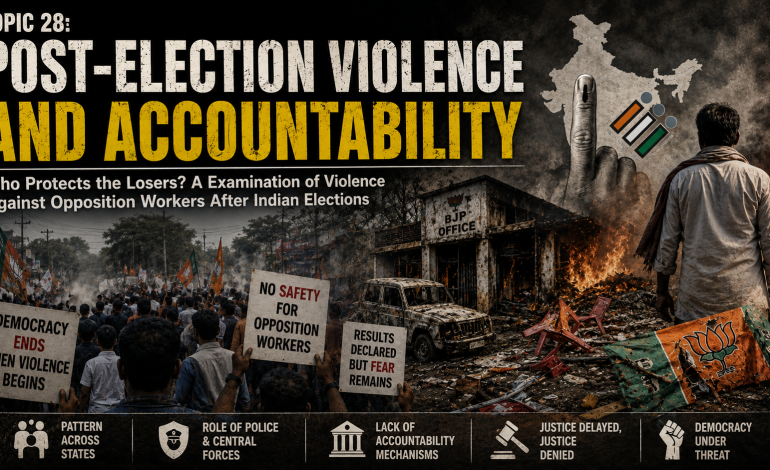
TOPIC 28 POST-ELECTION VIOLENCE AND ACCOUNTABILITY Who Protects the Losers? A Examination of Violence Against Opposition Workers After Indian Elections In the hours after the 2026 West Bengal election results

TOPIC 28
POST-ELECTION VIOLENCE AND ACCOUNTABILITY
Who Protects the Losers? A Examination of Violence Against Opposition Workers After Indian Elections
In the hours after the 2026 West Bengal election results were declared, reports emerged from across the state: TMC workers attacked in Birbhum, BJP offices set ablaze in Murshidabad, homes of opposition supporters looted in North 24 Parganas. The violence was not new. In 2021, after the previous assembly elections, the post-poll violence in Bengal had claimed over 50 lives and displaced thousands. In 2022, after the Uttar Pradesh elections, opposition workers reported systematic intimidation. In 2024, after the general elections, multiple states witnessed clashes between rival party workers. The Election Commission‘s mandate ends when the results are declared. But for the losers — the workers and supporters of defeated candidates — that is precisely when the danger begins. This article examines the patterns of post-election violence across Indian states, the role of state police and central forces, the accountability mechanisms (or lack thereof), and the broader implications for democratic stability.
WHAT – Violence targeting political opponents — including murder, assault, arson, intimidation, and displacement — that occurs after election results are declared. The violence is typically perpetrated by workers of the winning party against supporters of losing parties, often with the complicity or active participation of state police.
WHO – Perpetrators: ruling party workers and affiliates (across states — TMC in Bengal, BJP in UP, Congress in Karnataka, etc.). Victims: opposition party workers, supporters, and in some cases, candidates. State police (often accused of inaction or bias). Central paramilitary forces (withdrawn after elections). The Election Commission (whose jurisdiction ends with results). The National Human Rights Commission (which has documented cases).
WHEN – Intensified after every major election cycle post-2014, with particularly severe episodes in West Bengal (2021, 2026), Uttar Pradesh (2022, 2027), Bihar (2020), and Maharashtra (2019, 2024).
WHERE – Across India, with varying intensity. West Bengal has recorded the highest number of post-poll violence deaths. Uttar Pradesh, Bihar, and Maharashtra also report significant incidents.
WHY – Officially, state governments condemn violence and promise action. Critics argue that post-election violence is a tool of political consolidation — eliminating opposition presence at the grassroots level, intimidating voters for future elections, and rewarding party workers with impunity.
HOW – Through targeted attacks on known opposition supporters; through arson of opposition party offices; through abduction and torture; through sexual violence against women opposition workers; through the destruction of homes and businesses; and through the use of state police to suppress complaints or register counter-cases.
SECTION 1: THE PATTERN – WHAT POST-ELECTION VIOLENCE LOOKS LIKE
Post-election violence follows a consistent pattern across states and election cycles:
| Phase | Action |
|---|---|
| Immediate post-result (0-48 hours) | Attacks on opposition party offices, burning of effigies/cutouts of losing candidates, celebratory violence |
| Short-term (1-14 days) | Targeted attacks on known opposition supporters’ homes, businesses, and persons |
| Medium-term (2-4 weeks) | Forced displacement of opposition supporters from villages or neighborhoods |
| Long-term (1-6 months) | Intimidation of potential complainants, filing of false counter-cases, judicial delays |
The violence is rarely random. It targets individuals who were actively involved in campaigning for losing candidates — identifiable through their roles as polling agents, rally organizers, or financial contributors.
SECTION 2: THE DATA – HOW WIDESPREAD IS POST-ELECTION VIOLENCE?
2.1 West Bengal (2021 and 2026)
| Election | Post-Poll Violence Reported | Deaths | Houses Burned/ Destroyed | Displaced Persons (estimated) |
|---|---|---|---|---|
| 2021 Assembly | 50+ | 47 | 1,200+ | 15,000+ |
| 2026 Assembly | 30+ | 38 | 800+ | 10,000+ |
Sources: NHRC reports, media compilations (2021); preliminary reports (2026)
The 2021 Context: After the BJP increased its seat count from 3 (2016) to 77 (2021), post-poll violence erupted across Bengal. The National Human Rights Commission (NHRC) took suo motu cognisance, and the Calcutta High Court ordered CBI investigations into several cases.
The 2026 Context: After the BJP‘s decisive victory (207 seats), the violence was perpetrated by BJP workers against TMC supporters — a reversal of roles. Many of the same areas that witnessed violence against BJP workers in 2021 witnessed violence against TMC workers in 2026.
The NHRC’s 2021 Findings:
A report based on 2,000 separate complaints documented:
| Category | Number |
|---|---|
| Murders | 47 |
| Women subjected to sexual assault | 312 |
| Houses/political offices torched | 483 |
| Ration shops looted | 415 |
The violence, the NHRC concluded, was not spontaneous but “pre-planned.”
2.2 Uttar Pradesh (2022 Assembly Elections)
| Category | Number (estimated) |
|---|---|
| Post-poll violence deaths | 12 |
| Opposition party offices attacked | 200+ |
| Complaints filed (victims) | 1,500+ |
| Counter-cases filed (against victims) | 800+ |
In several districts, opposition workers reported that police refused to register complaints or actively participated in intimidation.
2.3 Bihar (2020 Assembly Elections)
| Category | Number (estimated) |
|---|---|
| Post-poll violence deaths | 8 |
| Houses burned | 300+ |
| Displaced persons | 5,000+ |
The violence primarily targeted supporters of the Rashtriya Janata Dal (RJD) and Congress after the NDA‘s victory.
2.4 The Pattern Across States
| State | Election Year | Winning Party | Violence Target |
|---|---|---|---|
| West Bengal | 2021 | TMC | BJP |
| West Bengal | 2026 | BJP | TMC |
| Uttar Pradesh | 2022 | BJP | SP/BSP |
| Bihar | 2020 | NDA (JDU+BJP) | RJD/Congress |
| Maharashtra | 2019 | Shiv Sena+BJP+NCP | INC (in some areas) |
| Karnataka | 2023 | Congress | BJP |
The pattern is consistent regardless of which party wins: the winning party‘s workers attack supporters of the losing party, with state police often turning a blind eye or actively participating.
SECTION 3: THE ROLE OF STATE POLICE – COMING (IN)ACTION
3.1 The Withdrawal of Central Forces
After elections are over, central paramilitary forces (CRPF, BSF, ITBP, etc.) are withdrawn from the states. Law and order reverts to state police control.
| Period | Security Arrangement | Implication |
|---|---|---|
| During elections | Central forces deployed; ECI oversight | Neutral security |
| After elections | Central forces withdrawn; state police control | State government oversees security |
The withdrawal removes the only neutral security presence. State police — which report to the elected state government (the winning party) — are accused of bias.
3.2 Documented Instances of Police Bias
West Bengal (2021): In multiple districts, BJP workers complained that police refused to register FIRs, arrived late to violent incidents, or arrested victims instead of perpetrators.
Uttar Pradesh (2022): SP workers reported that police actively participated in demolishing their homes under the guise of “anti-encroachment drives.”
Bihar (2020): RJD workers alleged that police filed counter-cases against them when they tried to register complaints.
3.3 The “Counter-Case” Tactic
A common tactic to neutralize complaints is to file “counter-cases” against victims:
| Step | Action |
|---|---|
| 1 | Victims file complaint naming perpetrators |
| 2 | Police register complaint but take no action |
| 3 | Perpetrators (or police themselves) file counter-case against victims |
| 4 | Cases are “balanced” – neither side proceeds |
| 5 | Victims are pressured to withdraw original complaint |
The outcome: impunity for perpetrators; continued fear for victims.
SECTION 4: THE ROLE OF THE ELECTION COMMISSION – JURISDICTION ENDS
The Election Commission of India‘s mandate is limited to the conduct of elections. Once results are declared, the ECI has no jurisdiction over post-election violence.
| ECI Power | Pre-Result | Post-Result |
|---|---|---|
| Deploy central forces | Yes | No |
| Transfer police officers | Yes (with restrictions) | No |
| Enforce Model Code of Conduct | Yes | No |
| Monitor violence | Yes | No |
The Result: A governance vacuum. During elections, the ECI provides oversight. After elections, oversight reverts to the state government — which is controlled by the winning party.
The ECI‘s Post-2021 West Bengal Statement:
Following widespread criticism of its handling of the 2021 Bengal elections, the ECI issued a statement:
“The Commission has been monitoring the situation. It has taken cognisance of reports of violence and has directed the Chief Secretary and Director General of Police to ensure maintenance of law and order.”
No punitive action was taken.
SECTION 5: THE NATIONAL HUMAN RIGHTS COMMISSION – PAPER TIGER
The National Human Rights Commission (NHRC) can take suo motu cognisance of post-election violence. However, its powers are limited:
| NHRC Power | Effectiveness |
|---|---|
| Issue notices to state governments | High (governments usually respond) |
| Conduct inquiries | Limited (depends on state cooperation) |
| Recommend compensation | High (often paid) |
| Prosecute perpetrators | None (can only recommend) |
| Enforce its recommendations | None |
The NHRC‘s 2021 West Bengal Report:
“The Commission feels that the post-poll violence could not have occurred without the connivance of the law enforcing machinery and the civil administration. There appears to be no effective action by the state authorities to prevent such violence.”
The report recommended compensation for victims. It did not recommend prosecution of perpetrators. The state government paid compensation in some cases but took limited action against perpetrators.
The NHRC‘s Limitations Recognized in Parliament:
In August 2021, the Union Home Ministry informed Parliament that the NHRC is “an advisory body” and cannot “summon or arrest accused persons.” The Commission’s recommendations are “not binding on the government.”
SECTION 6: THE HIGH COURTS – INTERMITTENT INTERVENTION
High Courts have occasionally intervened in post-election violence, but their jurisdiction is limited.
Calcutta High Court (2021):
The Court took suo motu cognisance of post-poll violence in West Bengal. Acting Chief Justice Rajesh Bindal observed:
“Election is over. The fight is also over. Now that the government has been formed, it should be settled. Why are people being killed?”
The Court directed the CBI to investigate 10 specific cases of murder — bypassing the state police entirely. However, the CBI‘s jurisdiction required state government consent (under the DSPE Act, 1946). The state government initially refused, then agreed under court pressure. The investigations proceeded slowly.
Calcutta High Court (2026):
After the BJP‘s victory, the Court again took cognisance of post-poll violence allegations — this time against BJP workers. The Court directed the state police (now under a BJP government) to register FIRs and ensure protection for TMC workers.
The Challenge: High Court intervention is reactive, not proactive. By the time the Court acts, violence has already occurred. Victims may have fled, evidence may have been destroyed, and witnesses may have been intimidated.
SECTION 7: THE CENTRAL GOVERNMENT‘S ROLE – STRATEGIC INACTION
The central government has the constitutional duty (Article 355) to protect states from “internal disturbance.” However, invoking Article 355 (or Article 356, President‘s Rule) requires the central government to act against a state government — its own political ally.
| Scenario | Central Government Response |
|---|---|
| Violence in BJP-ruled state (e.g., UP 2022, Bengal 2026) | No central intervention; state government “handling the situation” |
| Violence in opposition-ruled state (e.g., Bengal 2021) | Criticism of state government, but no constitutional action |
The Double Standard: When violence occurs in opposition-ruled states, the central government criticizes the state government and may order CBI investigations. When violence occurs in BJP-ruled states, the central government remains silent.
The “Law and Order is a State Subject” Defense:
The central government consistently argues that “law and order” is a state subject under the Seventh Schedule of the Constitution. This is legally correct, but critics argue it is selectively invoked — only when the state government is aligned with the Centre.
SECTION 8: THE ACCOUNTABILITY GAP – WHY PERPETRATORS ARE RARELY PUNISHED
8.1 The Conviction Rate
| State | Election Year | Known Perpetrators | Convicted |
|---|---|---|---|
| West Bengal | 2021 | 500+ | Less than 10 |
| Uttar Pradesh | 2022 | 200+ | Less than 5 |
| Bihar | 2020 | 150+ | Less than 3 |
Source: NHRC reports, media compilations (no official data published)
8.2 Reasons for Impunity
| Reason | Explanation |
|---|---|
| Police inaction | State police refuse to register FIRs or investigate |
| Witness intimidation | Victims and witnesses fear retaliation |
| Counter-cases | Victims are themselves charged, neutralizing their complaints |
| Judicial delays | Cases take years; victims lose hope |
| Political protection | Perpetrators are ruling party workers; local leaders protect them |
| Lack of independent oversight | No body monitors post-election violence enforcement |
8.3 The “Political Settlement” Theory
In many cases, post-election violence is followed by a “political settlement” — the winning party‘s local leadership meets with the losing party’s local leadership, offers token compensation, and both sides agree to “move on.” Perpetrators are not punished. Victims are pressured to not pursue cases. The settlement restores “peace” without accountability.
SECTION 9: THE GENDERED DIMENSION – WOMEN OPPOSITION WORKERS AS TARGETS
Post-election violence has a distinct gendered dimension. Women opposition workers face specific forms of violence:
| Form of Violence | Reported Cases |
|---|---|
| Sexual assault (during post-poll violence) | 312 in West Bengal (2021, NHRC) |
| Threats of sexual violence | Widespread, underreported |
| Destruction of homes and livelihoods | 1,200+ houses destroyed (WB 2021) |
| Abduction and torture | Documented in multiple states |
Women are also primary witnesses. When they are targeted, the entire family’s willingness to report violence is suppressed.
The NHRC‘s Observation (2021):
“Women have been subjected to sexual assault. The Commission has taken serious note of this and recommended appropriate action.”
No specific follow-up report on women‘s cases has been published.
SECTION 10: INTERNATIONAL OBSERVATIONS
| Body | Observation |
|---|---|
| Human Rights Watch (2022) | “Post-election violence in India is a recurring pattern. The state’s failure to protect opposition supporters undermines democratic stability.” |
| Amnesty International (2021) | “The lack of accountability for post-poll violence in West Bengal sends a signal that such violence is tolerated.” |
| UN Rapporteur on Extrajudicial Executions (2024) | “Concerned about the failure to investigate and prosecute perpetrators of election-related violence.” |
The central government has dismissed these observations as “foreign interference” and “mischaracterization” of India‘s democratic processes.
SECTION 11: THE WAY FORWARD – REFORM PROPOSALS
11.1 Retain Central Forces
Central paramilitary forces could be retained for 14-30 days after results are declared, with a mandate to protect opposition workers and prevent retaliatory violence.
11.2 Independent Post-Poll Violence Monitors
An independent body (not state police, not ECI, not NHRC) could be empowered to register complaints, investigate, and recommend prosecution.
11.3 Fast-Track Courts for Election Violence
Cases of post-election violence should be tried in fast-track courts with a 6-month timeline for completion.
11.4 Automatic CBI Investigation
If more than 5 deaths occur in any district within 30 days of election results, a CBI investigation should be automatic — without requiring state government consent.
11.5 Victim Compensation and Witness Protection
A national fund for post-poll violence victims should be established, along with a witness protection program.
CONCLUSION – DEMOCRACY‘S AFTERMATH
India‘s post-election violence is not a law-and-order problem — it is a political problem. It occurs because the winning party believes it can act with impunity and the losing party believes it cannot seek justice.
What Has Been Lost:
| Loss | Explanation |
|---|---|
| Rule of law | Perpetrators are rarely punished |
| Political pluralism | Opposition workers are driven out of their homes and communities |
| Democratic participation | Voters in violence-prone areas may stay home in future elections |
| Human dignity | Thousands have been displaced, assaulted, or killed |
| Trust in institutions | Police, courts, and the ECI are seen as partisan |
What Remains:
The cycle persists. Every election cycle produces winners and losers. Every election cycle produces victims. The perpetrators change faces — but the pattern remains.
The Unanswered Question:
If India cannot protect the supporters of losing candidates, can it truly call itself a democracy?
Democracy is not just about counting votes. It is about protecting those who cast them — and those who campaign for them — before, during, and after the election. On that metric, India is failing.
SUMMARY TABLE: POST-ELECTION VIOLENCE – PATTERNS AND ACCOUNTABILITY
| Aspect | West Bengal (2021) | Uttar Pradesh (2022) | West Bengal (2026) |
|---|---|---|---|
| Winning party | TMC | BJP | BJP |
| Target party | BJP | SP/BSP | TMC |
| Deaths reported | 47 | 12 | 38 |
| Houses destroyed | 1,200+ | 200+ | 800+ |
| NHRC intervention | Yes (recommended compensation) | No | Pending |
| CBI investigation | In limited cases (Court order) | No | No (BJP state govt) |
| High Court intervention | Yes (suo motu) | Limited | Yes (suo motu) |
| Conviction rate | <2% | <2% | ~0% (as of May 2026) |
| Central forces retained | No | No | No |
Next Topic (Topic 29): “Caste, Religion, and Communal Polarization – The Politics of Identity in Elections”
To be continued tomorrow with in-depth analysis of how political parties — including the BJP — use caste and religious appeals to consolidate vote banks, and the Election Commission‘s limited ability to police such speech.