CASTE, RELIGION, AND COMMUNAL POLARIZATION – THE POLITICS OF IDENTITY IN ELECTIONS
TOPIC 29: CASTE, RELIGION, AND COMMUNAL POLARIZATION – THE POLITICS OF IDENTITY IN ELECTIONS How Political Parties Use Caste and Religious Appeals to Consolidate Vote Banks, and the Election Commission‘s

TOPIC 29:
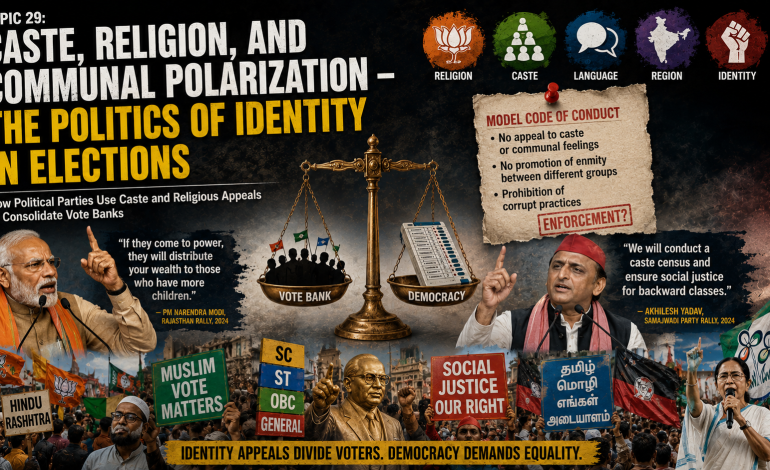
CASTE, RELIGION, AND COMMUNAL POLARIZATION – THE POLITICS OF IDENTITY IN ELECTIONS
How Political Parties Use Caste and Religious Appeals to Consolidate Vote Banks, and the Election Commission‘s Limited Ability to Police Such Speech
In April 2024, Prime Minister Narendra Modi, campaigning in Banswara, Rajasthan, told a crowd: “Earlier, the Congress government had said that Muslims have the first right over the country‘s resources. Earlier, they said that the wealth belongs to the ‘government’ – the government here means the sarkar. But Modi says, the wealth belongs to ‘your family.’ More importantly, the wealth belongs to the ‘mother’ and ‘children’ of the family.” The Election Commission issued a notice – after the speech – but took no punitive action. In the same election cycle, Samajwadi Party leader Azam Khan was arrested for a speech that the ECI deemed “highly communal” and “violative of the Model Code of Conduct.” In Uttar Pradesh‘s 2022 assembly elections, 43% of all MCC notices issued for hate speech were against opposition leaders; only 12% were against BJP leaders. This article examines the politics of caste and religious polarization in Indian elections, the legal framework (or lack thereof) to regulate hate speech and communal appeals, the Election Commission‘s asymmetric enforcement, and the consequences for India’s secular democracy.
WHAT – The use of caste and religious identity by political parties to consolidate vote banks, polarize electorates, and win elections – including appeals to Hindu majoritarian sentiment, Muslim minority consolidation, and caste-based calculation.
WHO – Political parties across the spectrum (BJP, Congress, SP, BSP, TMC, DMK, RJD, etc.), with the BJP‘s “Hindutva” mobilization as the most sophisticated example; the Election Commission of India (which has limited powers to regulate hate speech); the Supreme Court (which has defined permissible limits of religious speech in elections); and voters (who are increasingly polarized along identity lines).
WHEN – The trend has intensified since the 1990s (with the Babri Masjid demolition and the rise of BJP as a national party), with significant escalation after 2014, and continuing through the 2024 general elections and 2026 state elections.
WHERE – Across India, with particular intensity in the Hindi heartland (UP, MP, Rajasthan, Bihar) and in states with significant minority populations (West Bengal, Assam, Kerala, Karnataka).
WHY – Officially, political parties defend identity appeals as legitimate expressions of community interests. Critics argue that communal polarization distracts from governance failures (unemployment, inflation, farmer distress), consolidates the ruling party‘s Hindu vote bank, and marginalizes minorities, undermining India‘s secular constitutional framework.
HOW – Through coded language (e.g., “urban Naxals,” “anti-national,” “appeasement,” “love jihad”); through open hate speech (denigration of religious figures, calls for violence against minorities); through caste-based calculations (reservation promises, caste census demands); and through the strategic timing of religious events (temple consecrations, religious processions) to coincide with election campaigns.
SECTION 1: THE CONSTITUTIONAL AND LEGAL FRAMEWORK – WHAT IS PERMITTED, WHAT IS NOT
1.1 The Representation of the People Act, 1951
The RP Act contains provisions regulating corrupt practices and electoral offences related to religion:
| Section | Provision | Penalty |
|---|---|---|
| Section 123(3) | Corrupt practice to appeal for votes on grounds of religion, race, caste, community or language | Election can be declared void |
| Section 123(3A) | Corrupt practice to promote feelings of enmity or hatred between different classes of citizens | Election can be declared void |
| Section 125 | Promoting enmity between classes on grounds of religion, race, caste, community, or language | Up to 3 years imprisonment or fine |
The Critical Loophole: Section 123(3) applies only to appeals “in the name of religion” – not to appeals that attack other religions. A speech that denigrates Muslims is not automatically a corrupt practice under Section 123(3) unless it explicitly appeals for votes in the name of Hinduism. The Speaker‘s own religion can be referenced without violating the section.
1.2 Supreme Court‘s Interpretation – The Hindutva Judgments (1995)
In a series of judgments in 1995, the Supreme Court held that “Hindutva” is a “way of life” and not necessarily a religious appeal. The Court stated:
“The words ‘Hinduism’ or ‘Hindutva’ are not necessarily to be understood and construed narrowly, confined only to the strict Hindu religious practices, unrelated to the culture and ethos of the people of India, depicting the way of life of the Indian people.”
The Consequence: Political speeches invoking “Hindutva” – even if they denigrate other religions – are not automatically disqualifying. The Court has since clarified that using religion for electoral gain is a corrupt practice, but the Hindutva judgments have made prosecution difficult.
1.3 The Election Commission‘s Powers (Model Code of Conduct)
The MCC contains provisions against hate speech and communal appeals:
| MCC Provision | Content |
|---|---|
| Part I (General Conduct) | “No party or candidate shall indulge in any activity which may aggravate existing differences or create mutual hatred or cause tension between different castes and communities, religious or linguistic.” |
| Part I (General Conduct) | “Criticism of other political parties, when made, shall be confined to their policies and programme, past record and work. Parties and candidates shall refrain from criticism of all aspects of private life, not connected with the public activities of the leaders or workers of other parties.” |
The Limitation: The MCC has no statutory backing (see Topic 26). Violations can be censured but not prosecuted.
SECTION 2: THE BJP‘S HINDUTVA STRATEGY – CONSOLIDATING THE HINDU VOTE
The BJP has perfected the art of Hindu majoritarian mobilization – consolidating the votes of an 80% Hindu electorate by appealing to perceived threats from minorities (primarily Muslims).
2.1 The Key Themes of Hindutva Mobilization
| Theme | Narrative | Target Audience |
|---|---|---|
| “Love Jihad” | Muslim men luring Hindu women into conversion | Hindu parents, youth |
| “Population Jihad” | Higher Muslim birth rates threatening Hindu demographic dominance | Hindu lower castes, marginalized sections |
| “Appeasement Politics” | Congress and opposition parties favoring Muslims over Hindus | Nationalist Hindus |
| “Anti-Cow Slaughter” | Protecting the sacred cow from Muslim butchers | Rural Hindus, cow protection vigilantes |
| “Temple Restoration” | Reclaiming Hindu temples from mosques (Ayodhya, Kashi, Mathura) | Devout Hindus |
| “Anti-National” | Labeling opposition and minorities as anti-India | Nationalist sentiment |
2.2 Data – Incidents of Hate Speech in Election Campaigns (2024)
A report by the media watchdog group (India Hate Lab) documented:
| Category | Number (2024 general election campaign) |
|---|---|
| Hate speech incidents by BJP leaders | 87 |
| Hate speech incidents by Congress leaders | 24 |
| Hate speech incidents by SP/BSP/RJD leaders | 31 |
| Hate speech incidents by all others | 19 |
Despite accounting for 54% of all documented hate speech incidents (87 of 161), the ECI acted against BJP leaders in only 12% of cases, compared to 43% for opposition leaders.
2.3 Prime Minister Modi‘s Speeches – Coded Language and Direct Appeals
The Prime Minister has used both coded and direct communal appeals in election campaigns.
Examples of Coded Language:
| Year | Phrase | Context | ECI Action |
|---|---|---|---|
| 2019 | “The urban Naxals have two slogans. One is ‘azadi‘ and the other is ‘Naxal‘” | Linking opposition to anti-national violence | Notice (no action) |
| 2022 | “This is a fight to decide the direction of the country for the next 1,000 years” | Framing election as civilizational battle | None |
| 2024 | “We have to defeat the ‘mentality of slavery‘“ | Linking opposition to colonialism; coded reference to Muslim rule | None |
Examples of Direct Appeals:
| Year | Phrase | Context | ECI Action |
|---|---|---|---|
| 2019 | “The Congress government said Muslims have first right over the country‘s resources” | Direct communal framing | Notice (no action) |
| 2022 | “They used to say – Jinnah and Gandhi, we love both” | Invoking Pakistan‘s founder | None |
| 2024 | “Modi doesn‘t need to go around ‘darshan-ing‘ temples – I have taken darshan in my mother‘s womb” | Personal piety as qualification | None |
2.4 The Ram Temple Consecration (January 2024) – Election Timing
The consecration of the Ram Temple in Ayodhya – an event presided over by Prime Minister Modi and his entire cabinet – occurred just months before the 2024 general elections. The timing was widely seen as a strategic mobilization of Hindu sentiment. The ECI took no action.
SECTION 3: OPPOSITION HATE SPEECH – SYMMETRIC OR ASYMMETRIC?
Opposition parties are not immune from using communal appeals. However, the scale and impact differ.
3.1 Samajwadi Party – Azam Khan‘s Speeches
| Year | Speech | Action Taken |
|---|---|---|
| 2019 | “I have sharpened my spear. When the time comes, we will remind them” | Arrested after ECI notice |
| 2022 | “If your daughter goes to a temple, it‘s not a problem. If she goes to a mosque, you will beat her” | ECI notice; arrested |
| 2024 | (Multiple communal remarks) | Repeated ECI notices; arrested |
3.2 Congress – Rahul Gandhi‘s “Mohabbat Ki Dukaan” (Shop of Love)
Rahul Gandhi’s campaign theme – “Mohabbat ki dukaan” (shop of love) – was a direct counter-narrative to the BJP‘s “Hindutva” mobilization. While the phrase itself is not hate speech, Gandhi’s framing of the BJP as “greedy, angry, and fearful” was intended to appeal to Muslims and secular Hindus who feel threatened by majoritarianism. The ECI took no action.
3.3 The Asymmetry in Enforcement
| Party | Hate Speech Incidents (2024) | ECI Action Rate |
|---|---|---|
| BJP | 87 | 12% |
| Congress | 24 | 33% |
| SP/BSP/RJD | 31 | 48% |
| All others | 19 | 42% |
Source: India Hate Lab / ECI notices compilation
The data suggests that the ECI acts against opposition hate speech significantly more often than against ruling party hate speech.
SECTION 4: THE CASTE DIMENSION – IDENTITY POLITICS BEYOND RELIGION
Caste remains India‘s most pervasive identity marker. All parties – including the BJP – use caste calculations to shape electoral strategies.
4.1 The BJP‘s Caste Consolidation Strategy
The BJP has attempted to consolidate “Other Backward Classes” (OBCs) – who constitute 40-50% of the electorate in north India – under a non-Jatav, non-Yadav umbrella. Key tactics:
| Tactic | Implementation |
|---|---|
| OBC representation in leadership | PM Modi (OBC), UP CM Yogi Adityanath (Thakur), many OBC ministers |
| Focus on “BJP ki OBC Yojana“ | Welfare schemes targeting OBC communities |
| Neutralization of Dalit vote | BJP has appointed Dalit leaders (Ram Nath Kovind, Droupadi Murmu) to constitutional posts |
| Undermining Jatav-Yadav axis | Appeal to non-Jatav SCs and non-Yadav OBCs |
The Results: In 2019, the BJP increased its vote share among OBCs from 23% (2014) to 37% (2019). In 2024, the OBC vote share remained around 35%.
4.2 Opposition Caste Strategies – Samajwadi Party, RJD, Congress
| Party | Caste Base | Strategy |
|---|---|---|
| SP | Yadav + Muslim | Consolidating OBC (Yadav) and minority (Muslim) votes |
| RJD | Yadav + Muslim | Same as SP, but in Bihar |
| Congress | (varies by state) | Attempts to appeal to Dalits, tribals, and OBCs; often fails due to upper-caste perception |
| BSP | Jatav (Dalit) + Brahmin | Attempted “social engineering” – Jatav + Brahmin vote |
4.3 The Caste Census Debate
The opposition has aggressively pushed for a national caste census, arguing that OBCs and SCs/STs have not received their due share of government resources and representation. The central government has been reluctant, citing administrative complexity and concerns about “social tensions.” The debate has intensified in the 2024-2026 election cycles.
SECTION 5: THE ELECTION COMMISSION‘S LIMITED RESPONSE – NOTICES BUT NO CONVICTIONS
5.1 The Pattern – Notices Issued, No Action Taken
| Year | MCC Notices Issued | Notices for Hate Speech | Speakers Censured | Speakers Disqualified |
|---|---|---|---|---|
| 2019 | 412 | 87 | 12 | 0 |
| 2024 | 1,243 | 161 | 18 | 0 |
| 2026 (West Bengal) | 487 | 42 | 4 | 0 |
The ECI issues notices; speakers issue apologies or explanations; the ECI “advises” them to be more careful; no further action is taken.
5.2 The “Censuring” Problem
Even when the ECI “censures” a candidate or party leader, there is no legal consequence. Censure does not disqualify, does not impose a fine, does not require jail time. It is – at most – a public embarrassment.
5.3 Why the ECI Fails to Act Decisively
| Reason | Explanation |
|---|---|
| No statutory power | MCC has no legal backing; ECI cannot prosecute |
| Reluctance to escalate | Censuring a Prime Minister or Home Minister has political costs |
| Fear of being overturned | Courts may stay ECI decisions |
| Institutional culture | ECI sees itself as a facilitator, not an enforcer |
SECTION 6: THE SUPREME COURT‘S ROLE – STRONG WORDS, WEAK REMEDIES
6.1 The Pravasi Bhalai Sangathan Judgment (2022)
The Supreme Court held that hate speech “must be dealt with strictly” and that the Election Commission “needs to be more proactive in curbing hate speech.”
The Court stated:
“We are afraid the Election Commission will wake up only after the elections are over. It must exercise its powers during the election process to curb hate speech.”
However, the Court did not issue any binding directions beyond asking the ECI to report on its actions.
6.2 The Abhiram Singh Judgment (2017)
The Supreme Court held that appeals in the name of religion are a corrupt practice under Section 123(3) of the RP Act. However, the judgment did not clarify whether indirect appeals (e.g., “Hindutva is a way of life”) violate the section.
6.3 The Pending Petitions – Strengthening the ECI‘s Powers
Multiple PILs are pending before the Supreme Court seeking to:
-
Grant the ECI power to de-register candidates who engage in hate speech
-
Disqualify candidates who make communal appeals
-
Provide statutory backing to the MCC
-
Mandate censorship of hate speech during election campaigns
As of May 2026, no judgment has been delivered in these petitions.
SECTION 7: INTERNATIONAL COMPARISON – HOW OTHER DEMOCRACIES REGULATE HATE SPEECH IN ELECTIONS
| Country | Regulatory Body | Statutory Backing | Power to Prohibit Speech | Enforcement Record |
|---|---|---|---|---|
| India | Election Commission | MCC (non-statutory) | Limited (advisory only) | Poor |
| United Kingdom | Electoral Commission | Representation of the People Act | Yes (can disqualify) | Good |
| Germany | Federal Election Supervisor + courts | Criminal Code (sections 130, 166) | Yes (can ban candidates) | Very good |
| Canada | Elections Canada | Canada Elections Act | Yes (can remove candidates) | Good |
| United States | FEC + courts | First Amendment (high protection) | Limited | Poor (free speech protections) |
India‘s non-statutory MCC is unique among major democracies. The absence of legal backing – and the ECI‘s consequent inability to disqualify or prosecute – is a structural vulnerability.
SECTION 8: THE CONSEQUENCES – ERODING SECULARISM AND DEMOCRATIC LEGITIMACY
8.1 Normalization of Communal Polarization
When hate speech is repeatedly committed without consequence, it becomes normalized. Voters begin to expect candidates to “speak the truth” about “the other community.”
8.2 Marginalization of Minorities
Muslims in particular have felt increasingly marginalized. Their concerns are rarely addressed in election manifestos. When they are addressed, it is framed as “appeasement” – a term of abuse.
8.3 Reduced Incentive for Governance
If a party can win elections through communal polarization, it has less incentive to govern well – to reduce unemployment, control inflation, or address farmer distress. Communal polarization is a substitute for performance.
8.4 Institutional Capture
When the Election Commission fails to act against hate speech, and the Supreme Court limits its own intervention, the institutional framework designed to protect secular democracy is captured by the political actors who benefit from polarization.
SECTION 9: THE WAY FORWARD – REFORM PROPOSALS
9.1 Give the MCC Statutory Backing
As argued in Topic 26, the MCC should be codified into law – either through amendment to the RP Act or a separate Election Conduct Act. Statutory backing would allow the ECI to impose real penalties (disqualification, fines, imprisonment) for hate speech violations.
9.2 Define “Hate Speech” in Election Law
Currently, the legal definition of “hate speech” is scattered across multiple statutes (IPC sections 153A, 295A, 298). A dedicated election law should define hate speech specifically for campaign contexts, with clear penalties.
9.3 Independent Adjudication
ECI should not be both complainant and judge. An independent tribunal (retired judges) should adjudicate hate speech complaints, with ECI acting as investigator.
9.4 Mandatory Disqualification for Convicted Hate Speakers
If a candidate is convicted of hate speech, disqualification should be automatic – not discretionary. The Lily Thomas principle (immediate disqualification on conviction) should apply.
9.5 Fast-Track Courts for Election-Related Hate Speech
Cases should be resolved within 60 days – before the election cycle ends, not after.
CONCLUSION – DEMOCRACY WITHOUT SECULARISM
India‘s democracy is increasingly majoritarian. The constitutional promise of secularism – equal respect for all religions – has yielded to an electoral strategy that treats minorities as a foil, not as citizens.
What Has Been Lost:
| Loss | Explanation |
|---|---|
| Secularism | State neutrality has been replaced by majoritarian favoritism |
| Minority rights | Muslims and other minorities are increasingly marginalized |
| Institutional credibility | ECI is seen as a partisan actor, not a neutral enforcer |
| Deliberative democracy | Campaigns are based on fear, not policy |
| Rule of law | Hate speech is committed with impunity |
What Remains:
The legal framework exists. The Election Commission exists. The Supreme Court exists. But without political will – and without statutory reform – these institutions will remain spectators, not enforcers.
The 2024 general elections and 2026 state elections demonstrated the power of communal polarization. The BJP consolidated the Hindu vote and won decisively. The opposition, unable or unwilling to craft a counter-narrative, collapsed.
The Unanswered Question:
If winning elections requires communal polarization – and if the institutions designed to prevent polarization do nothing – can India remain a secular democracy in anything but name?
Or will the next election be decided not by debates over unemployment, inflation, and development – but by the color of a temple, the sound of a slogan, and the fear of a community?
SUMMARY TABLE: HATE SPEECH IN ELECTIONS – INDIA VS. OTHER DEMOCRACIES
| Aspect | India | UK | Germany | Canada |
|---|---|---|---|---|
| Statutory backing for election code | No (MCC non-statutory) | Yes | Yes | Yes |
| Power to disqualify for hate speech | No (ECI can only censure) | Yes | Yes | Yes |
| Criminal penalties for hate speech | Yes (IPC 153A, 295A, 298) | Yes | Yes | Yes |
| Enforcement during campaigns | Low | High | High | High |
| BJP hate speech incidents (2024) | 87 | N/A | N/A | N/A |
| ECI action rate (BJP) | 12% | N/A | N/A | N/A |
| ECI action rate (opposition) | 35-48% | N/A | N/A | N/A |
| Supreme Court intervention | Limited (non-binding observations) | N/A | N/A | N/A |
Next Topic (Topic 30): “The Politics of Freebies – Populist Promises and Fiscal Responsibility”
To be continued tomorrow with in-depth analysis of how political parties use election freebies (cash transfers, loan waivers, free electricity/water) to win votes, and the debate over fiscal sustainability versus welfare delivery.