THE POLITICS OF FREEBIES – POPULIST PROMISES AND FISCAL RESPONSIBILITY
TOPIC 30 THE POLITICS OF FREEBIES – POPULIST PROMISES AND FISCAL RESPONSIBILITY Are Election-Time Guarantees Genuine Welfare or Unsustainable Vote Buying? In April 2026, Tamil Nadu Chief Minister M.K. Stalin

TOPIC 30
THE POLITICS OF FREEBIES – POPULIST PROMISES AND FISCAL RESPONSIBILITY
Are Election-Time Guarantees Genuine Welfare or Unsustainable Vote Buying?
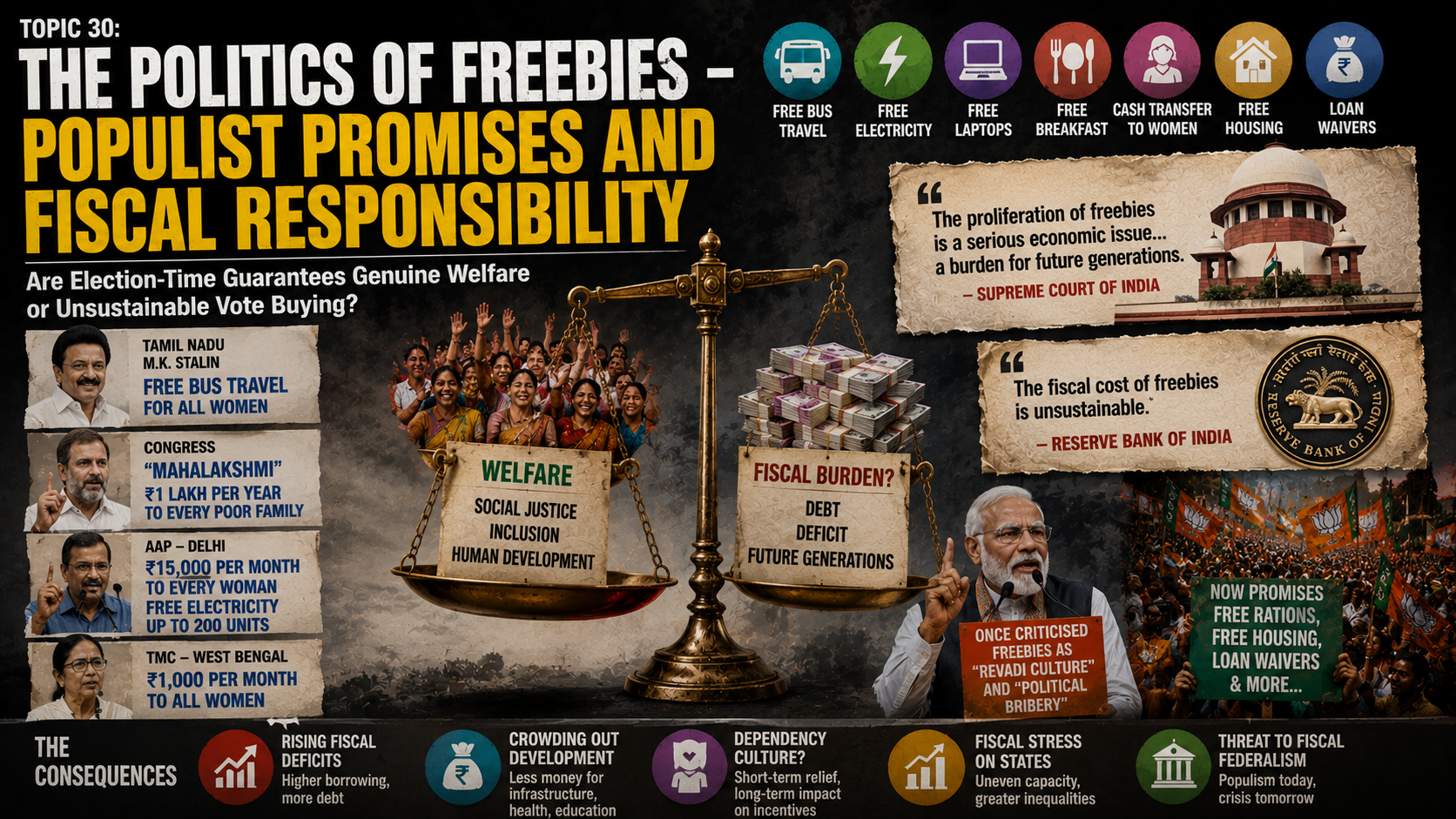
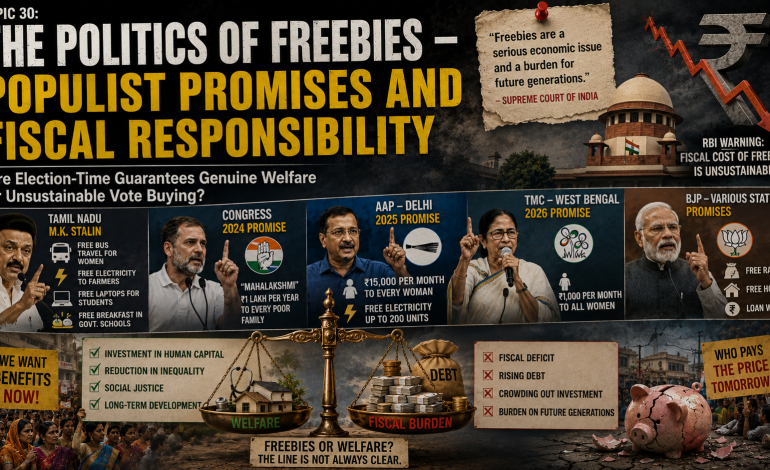
In April 2026, Tamil Nadu Chief Minister M.K. Stalin announced a new scheme: free bus travel for all women in government transport corporations. Already, Tamil Nadu offers free electricity to farmers, free laptops for students, and free breakfast in government schools. Before the 2024 general elections, Congress promised “Mahalakshmi” – ₹1 lakh per year to every poor family. Before the 2025 Delhi elections, AAP promised ₹15,000 per month to every woman and free electricity up to 200 units. Before the 2026 West Bengal elections, TMC promised ₹1,000 per month to all women. The BJP – which once criticized freebies as “revadi culture” (freebies) and “political bribery” – has itself promised free rations, free housing, and loan waivers in various states. The Supreme Court has called the proliferation of freebies “a serious economic issue” and “a burden for future generations.” The Reserve Bank of India has warned that the fiscal cost of freebies is “unsustainable.” Yet voters demand them. And politicians supply them. This article examines the economics of election-time freebies, the legal and political debates, the distinction between “freebies” and “welfare,” and the consequences for fiscal federalism.
WHAT – “Freebies” refer to electoral promises of free utilities (electricity, water), transport, cash transfers, loan waivers, gold for weddings, free televisions/laptops, and other goods or services provided or promised by political parties to voters, typically at government expense.
WHO – All major political parties (BJP, Congress, AAP, TMC, DMK, SP, BSP, RJD, etc.) make freebie promises. State governments (which bear the primary fiscal burden) implement them. The Supreme Court (which has both condemned freebies and declined to ban them) arbitrates. Economists and the Reserve Bank of India (which warn of unsustainability) provide critique.
WHEN – Freebie promises have intensified since the late 2000s, particularly after the Delhi “zero electricity bill” promise by AAP (2013), and have become a nationwide phenomenon across all states in the 2024-2026 election cycles.
WHERE – Across India, with particular intensity in Tamil Nadu, Delhi, Punjab, West Bengal, Telangana, Andhra Pradesh, and Karnataka.
WHY – Officially, political parties defend freebies as “welfare” and “social justice” – redistributing resources to the poor, reducing inequality, and fulfilling constitutional Directive Principles. Critics argue freebies are short-term vote-buying strategies that crowd out investment in infrastructure, health, and education, leading to fiscal crises.
HOW – Through budget allocations (often unbudgeted), through subsidies to public utilities, through loan waivers (which shift liability to banks), and through direct benefit transfers (cash into bank accounts).
SECTION 1: WHAT ARE FREEBIES? – WELFARE VS. VOTE-BUYING
The distinction between “welfare” and “freebies” is contested. Not every government scheme that provides benefits to citizens is a “freebie.”
1.1 Common Categories
| Category | Example | Parties Known For |
|---|---|---|
| Free utilities | Free electricity (up to 200 units), free water | AAP (Delhi), DMK (Tamil Nadu), TMC (West Bengal) |
| Cash transfers | ₹1 lakh/year per family (Congress), ₹1,000/month per woman (TMC, AAP), ₹2,500/ month for unemployed (Tamil Nadu) | Congress, TMC, AAP, DMK |
| Loan waivers | Farm loan waiver up to ₹2 lakh (Congress in Karnataka, Himachal), Shahi Samridh Yojana (Jharkhand | Congress, BJP (in some states), RJD |
| Free transport | Free bus travel for women (Tamil Nadu, Karnataka, Delhi) | DMK, Congress, AAP |
| Consumer durables | Free laptops (Tamil Nadu), free televisions (Tamil Nadu), free cycles for students (Bihar, West Bengal) | DMK, TMC, RJD |
| Gold for weddings | Puducherry’s gold for weddings scheme | Congress-affiliated government |
| Free education/health | Free schooling, free breakfast, free health insurance (Ayushman Bharat) | All parties (differing on scope) |
1.2 The Distinction – When Does Welfare Become a Freebie?
The Supreme Court has called freebies a “serious economic issue” and a “burden for future generations.” But the Court has also acknowledged that not all electoral promises are freebies – some are legitimate welfare.
| Aspect | Welfare (Legitimate) | Freebie (Potentially Illegitimate) |
|---|---|---|
| Intent | Long-term capacity building (education, health) | Short-term electoral gain |
| Targeting | Universal or means-tested | Often universal without fiscal assessment |
| Financing | Budgeted, sustainable revenue stream | Unbudgeted, borrowed funds |
| Implementation | Institutionalized scheme | Ad-hoc, election-driven |
Economists use the test of “fiscal space” – does the state have the revenue to sustain the scheme without compromising essential services or borrowing unsustainably?
SECTION 2: THE DATA – HOW MUCH DO FREEBIES COST?
2.1 Fiscal Cost of Selected Schemes (Annual, estimated)
| Scheme | State | Estimated Annual Cost (₹ Cr) |
|---|---|---|
| Free electricity up to 200 units | Delhi | 3,200 |
| Free bus travel for women | Tamil Nadu | 2,500 |
| Free bus travel for women | Karnataka | 4,000 (projected) |
| Farm loan waiver (Karnataka, 2023) | Karnataka | 37,000 (one-time) |
| Mahalakshmi (₹1 lakh/year/family – if implemented) | National (Congress promise) | 17,00,000 (17 lakh crore) – unsustainable |
| Free ration (PMGKAY – national) | Central | 3,50,000 |
| Free electricity for farmers | Punjab | 8,100 |
| Free electricity for farmers | Tamil Nadu | 7,600 |
Sources: State budget documents, Reserve Bank of India reports, PRS Legislative Research
2.2 State Subsidy Burden as % of GSDP (2025-26 Estimates)
| State | Total Subsidies (₹ Cr) | Subsidies as % of GSDP | Primary Freebie Categories |
|---|---|---|---|
| Punjab | 32,500 | 8.2% | Free power, loan waivers |
| Tamil Nadu | 85,000 | 6.1% | Free power, bus travel, electronics |
| Delhi | 14,000 | 4.3% | Free power, water |
| Karnataka | 62,000 | 4.0% | Free bus, loan waivers (2023) |
| West Bengal | 45,000 | 3.8% | Free power, cash transfers |
| Andhra Pradesh | 48,000 | 3.5% | Free power, cash transfers |
| All-state average | – | 2.5-3.0% | – |
Source: Reserve Bank of India – State Finances: A Study of Budgets (2025-26)
2.3 The Fiscal Unsustainability Warning
Chief Economic Adviser V. Anantha Nageswaran has repeatedly warned that the proliferation of freebies is pushing state finances to the brink.
“Freebies that are not backed by productivity enhancements are fiscally unsustainable. States are spending more on subsidies than on capital investment. This is a recipe for fiscal crisis.”
The RBI’s 2025 report on state finances noted that state subsidies grew at 15% annually between 2018-2025 – twice the rate of revenue growth.
SECTION 3: THE POLITICAL ORIGINS – FREE SAMOSA VS. FREE ELECTRICITY
3.1 PM Modi‘s “Revadi Culture” Critique (July 2022)
Prime Minister Modi’s critique of freebies brought the term “revadi” (a cheap sweet) into political discourse. He argued that freebies “destroy the tendency to work” and “weaken the economy.” He specifically criticized the AAP’s promise of free electricity and the Congress’s promise of cash transfers.
Key Quote:
“The ‘revadi culture’ is very dangerous for the development of the nation. – Those who have this revadi mindset will not build new expressways, new airports, or new defense corridors. They will only distribute free revadi.”
3.2 The Opposition‘s Response – “Free Samosa vs. Job Loss”
Opposition leaders responded by contrasting the cost of freebies with the economic hardship caused by demonetization, GST implementation, and COVID-19 lockdowns.
| Leader | Response |
|---|---|
| Arvind Kejriwal (AAP) | “Modi gave free samosa to 800 crore people during his foreign visits. Is that not a freebie? ” |
| Rahul Gandhi (Congress) | “The Prime Minister speaks of revadi culture while his government waived Rs 16 lakh crore of corporate loans. Whose revadi is that?” |
| Mamata Banerjee (TMC) | “Free rations are not a freebie – they are the right of the poor. The PM distributes free ration – that is his biggest freebie.” |
3.3 The BJP‘s Own Freebie Record
Despite criticizing freebies, the BJP has implemented or promised:
| BJP Freebie/Subsidy | Context |
|---|---|
| Free ration under PMGKAY | Extended several times; cost ₹3.5 lakh crore annually |
| Free COVID-19 vaccines | Universal vaccination program |
| Farm loan waivers | Implemented in UP (2022), MP (2023), Gujarat (2024) before elections |
| Free housing under PM Awas Yojana | Subsidized housing for poor |
| Free electricity for farmers | Promised in multiple BJP-ruled states |
The BJP’s critique is thus of freebies promised by opposition parties – not freebies themselves.
SECTION 4: THE LEGAL DEBATE – CAN FREEBIES BE BANNED?
4.1 The Supreme Court’s Ashwini Upadhyay Petition (2022-2026)
BJP lawyer Ashwini Upadhyay filed a PIL seeking to ban political parties from promising “irrational freebies” – defined as “any distribution of any free commodity, cash, or service which is not authorized by the Constitution and is prone to violate the Doctrine of Level Playing Field.”
Key Arguments:
| Argument | Explanation |
|---|---|
| Freebies violate the “level playing field” doctrine | Unequal promises distort electoral competition |
| Freebies are “corrupt practice” under Section 123 of RP Act | Promising cash or goods in exchange for votes |
| Freebies lead to fiscal bankruptcy | Unsustainable subsidies crowd out capital investment |
The Government‘s Response:
The central government – despite its critique of freebies – opposed the PIL, arguing that:
| Counter-Argument | Explanation |
|---|---|
| Banning freebies is undemocratic | Voters have the right to choose policies that benefit them |
| Distinction between “freebie” and “welfare” is subjective | What is a freebie to one person is welfare to another |
| Courts cannot micromanage election manifestos | This is a parliamentary, not judicial, function |
4.2 The Supreme Court’s Pending Hearing
The Supreme Court has heard the petition multiple times but has not issued a final judgment. In its last hearing (March 2026), the Court observed:
“We are concerned about the fiscal impact of freebies. But we cannot ban political parties from making promises that are within the constitutional framework. The remedy lies with voters, not with the court.”
The Court has asked the Election Commission to consider framing guidelines for freebies in election manifestos – but has not mandated them.
4.3 The Election Commission‘s “Guidelines on Manifestos” (2014)
The ECI has existing guidelines requiring parties to:
| Requirement | Detail |
|---|---|
| Disclose financial implications | Manifesto must state how promises will be funded |
| Not promise irrational freebies | Vague – not defined |
| Maintain “level playing field” | Not enforced |
The ECI has not disqualified any party or candidate for violating these guidelines.
SECTION 5: THE ECONOMIC DEBATE – FREEBIES AS INVESTMENT OR CONSUMPTION?
5.1 The Case Against Freebies
| Argument | Evidence |
|---|---|
| Crowds out capital investment | States spend more on subsidies than on infrastructure, health, education |
| Fiscal unsustainability | Subsidy growth (15%) exceeds revenue growth (7.5%) |
| Distorts incentives | Free electricity reduces incentive for conservation; loan waivers encourage default |
| Creates dependency | Voters become dependent on government handouts |
| Redistributes from productive to unproductive | Subsidies are consumption, not investment |
5.2 The Case For Freebies (As Welfare)
| Argument | Evidence |
|---|---|
| Reduces poverty | Cash transfers directly reduce deprivation |
| Redistributes wealth | Freebies transfer resources from rich (taxpayers) to poor (beneficiaries) |
| Constitutional mandate | Directive Principles require state to ensure adequate means of livelihood |
| Stimulates demand | Cash in hands of poor increases consumption, drives growth |
| Women‘s empowerment | Cash transfers to women increase household welfare |
5.3 The Middle Path – Conditional vs. Unconditional Freebies
| Type | Example | Economic Impact |
|---|---|---|
| Universal, unconditional | Free electricity for all | High fiscal cost; benefits rich more than poor |
| Targeted, conditional | Cash for school attendance, health checkups | Lower cost; encourages productive behavior |
| Capital investment | Free education, health, infrastructure | High long-term returns; low short-term political gain |
Economists across the political spectrum largely agree that targeted, conditional ‘freebies‘ (e.g., cash conditional on school attendance) are preferable to universal, unconditional ones.
SECTION 6: THE POLITICAL ECONOMY – WHY FREEBIES WIN ELECTIONS
6.1 The Data – Electoral Impact
Studies of state elections (2014-2024) show that freebie promises significantly influence voter choice:
| Study | Finding |
|---|---|
| Centre for the Study of Developing Societies (CSDS) – 2023 analysis | Voters who received direct benefits (free rations, cash transfers) were 12-15% more likely to vote for the incumbent |
| National Council of Applied Economic Research (NCAER) – 2022 study | Freebie promises increase vote share by 3-5% – enough to swing close elections |
| State-specific analysis (Punjab, Delhi) | Free electricity promise was decisive in AAP victory (2017); loan waiver promise decisive in Congress victory (Karnataka 2023) |
6.2 The Incumbent‘s Advantage
Incumbent governments – across parties – discover that implementing freebies before elections is an effective vote-winner. Examples:
| Election | Incumbent | Freebie Implemented | Result |
|---|---|---|---|
| Punjab 2022 | Congress (incumbent) | Free electricity, loan waiver | Lost – freebies not enough |
| Delhi 2025 | AAP (incumbent) | Free electricity, water, bus travel for women | Won |
| Karnataka 2023 | BJP (incumbent) | No major freebie before election | Lost |
| Karnataka 2023 | Congress (challenger) | Promised free bus, loan waiver | Won |
The Pattern: Freebies help incumbents retain power, but challengers can also use freebie promises to defeat incumbents – as the Congress did in Karnataka (2023).
6.3 The Escalation Cycle
Once one party promises a freebie, other parties feel compelled to match or exceed it. This creates an escalation cycle – each election sees higher promises than the last.
| Election | Freebie Baseline | Escalation |
|---|---|---|
| Delhi 2013 | Free water (up to 20 KL) | AAP set low baseline |
| Delhi 2020 | Free water + electricity (up to 200 units) | Increased electricity cap |
| Delhi 2025 | Free water + electricity + bus for women | New addition |
| Tamil Nadu 2021 | Free electricity for farmers + free laptop | Baseline |
| Tamil Nadu 2026 | Free electricity + free bus + free breakfast + free water | Significantly expanded |
The escalation cycle has no natural endpoint. Each victory rewards higher promises, until fiscal limits are reached.
SECTION 7: THE SUPREME COURT‘S DILEMMA – TO INTERVENE OR NOT
7.1 The S. Subramaniam Balaji Judgment (2013)
The Supreme Court held that promises of freebies in election manifestos are not “corrupt practices” under the RP Act unless they constitute “bribery.” The Court distinguished:
| Promise | Legal Status |
|---|---|
| Cash or kind in exchange for vote | Corrupt practice (if proven) |
| Promise of government scheme after election | Not corrupt practice (policy matter) |
The Consequence: Most freebie promises (free electricity, free bus, loan waiver) are future government policies – not direct cash payments to voters. They fall outside the definition of “corrupt practice.”
7.2 The Pending Petition (Ashwini Upadhyay)
The pending PIL seeks to overturn or narrow the Balaji precedent. The Supreme Court has not yet ruled.
7.3 The ECI‘s Role
The ECI has issued guidelines but cannot prosecute freebie promises unless they meet the narrow definition of bribery.
SECTION 8: COMPARATIVE ANALYSIS – FREEBIES IN OTHER DEMOCRACIES
| Country | Prevalence of Freebies | Regulation | Fiscal Impact |
|---|---|---|---|
| India | Very high | Minimal (only if bribes) | High (state fiscal stress) |
| United States | Low (some welfare promises) | None (freedom of speech) | Low |
| United Kingdom | Low | None | Low |
| Brazil | High (Bolsa Família – conditional) | None | Moderate |
| South Africa | Moderate (welfare grants) | None | Moderate |
| Argentina | High (subsidies) | None | High (fiscal crisis) |
India‘s freebie culture is among the most intense in the world, comparable only to Brazil and South Africa.
The Key Difference: In Brazil, freebies (Bolsa Família) are conditional on school attendance and health checkups – incentivizing productive behavior. In India, most freebies are unconditional, leading to fiscal stress without behavioral benefits.
SECTION 9: THE WAY FORWARD – REFORM PROPOSALS
9.1 Fiscal Responsibility Legislation for States
| Proposal | Implementation |
|---|---|
| Cap on subsidies as % of GSDP | RBI-imposed or Parliament-enacted limit |
| Sunset clauses for freebies | Schemes automatically expire unless re-approved with fiscal impact assessment |
| Independent fiscal council | Non-partisan body to assess long-term sustainability of freebies |
9.2 Transparency in Manifestos
| Proposal | Implementation |
|---|---|
| Mandatory fiscal impact statement | Every manifesto promise must state funding source |
| Independent costing | Costing to be verified by Comptroller and Auditor General |
| “Red Flag” for unsustainable promises | ECI could flag promises that lack credible funding |
9.3 Reform, Not Ban
Economists broadly agree that banning freebies is impractical and undemocratic. Instead, the goal should be to reform freebies away from universal, unconditional transfers toward targeted, conditional welfare.
| Reform | Example |
|---|---|
| Target benefits to poor | Free electricity only up to a consumption threshold, only for Below Poverty Line (BPL) households |
| Conditionality | Cash transfers conditional on school attendance, health checkups |
| Sunset reviews | Freebies automatically expire unless reauthorized with fiscal assessment |
9.4 Incentivize Capital Investment
The RBI could provide fiscal incentives to states that reduce subsidy-to-GSDP ratios and increase capital investment-to-GSDP ratios.
SECTION 10: THE CENTRAL QUESTION – DEVELOPMENT OR VOTE-BUYING?
The politics of freebies reflects a deeper tension in democratic theory: what is the legitimate role of the state in redistributing resources?
| Position | Argument |
|---|---|
| Freebies are welfare | The state has a constitutional duty to ensure the welfare of its citizens. Cash transfers, free utilities, and loan waivers are legitimate means of fulfilling that duty. |
| Freebies are vote-buying | Promises timed to elections, with no credible fiscal plan, are not welfare – they are bribes paid with public money. |
What Is Undeniable:
| Fact | Implication |
|---|---|
| Freebies have become pervasive | Virtually all parties promise them |
| Freebies influence voter choice | Electoral studies show significant impact |
| Freebies are fiscally unsustainable | Subsidy growth outpaces revenue growth |
| The legal framework is silent | No ban, no effective regulation |
| The Supreme Court is divided | Will not ban; will not regulate |
What Remains Disputed:
| Dispute | Explanation |
|---|---|
| Where to draw the line | Universal vs. targeted; conditional vs. unconditional |
| Who should regulate | ECI, courts, or Parliament? |
| What is the remedy | Ban, regulate, or let voters decide? |
The Unanswered Question:
If every election produces higher freebie promises – and if every freebie promise is fiscally unsustainable – how long before India‘s states face a debt crisis?
The RBI has warned. The Chief Economic Adviser has warned. The Supreme Court has observed. But election after election, the freebie cycle continues.
Because the party that promises the most, wins. And the party that wins, does not pay the cost – it passes the bill to future generations.
Democracy may be the government of the people, by the people, for the people. But if that government is bought with promises it cannot fulfill – is it democracy, or is it auction?
SUMMARY TABLE: THE FREEBIES DEBATE – INDIA VS. OTHER DEMOCRACIES
| Aspect | India | US | UK | Brazil |
|---|---|---|---|---|
| Prevalence of freebies | Very high | Low | Low | High |
| Freebie regulation | Minimal (bribery only) | None (free speech) | None | None |
| Conditionality | Mostly unconditional | N/A | N/A | Mostly conditional |
| Fiscal impact | High (state fiscal stress) | Low | Low | Moderate |
| Supreme Court intervention | Limited (no ban) | None | None | N/A |
| ECI guidelines | Exist (not enforced) | N/A | N/A | N/A |
| Reform proposals | Multiple (none enacted) | None | None | None |