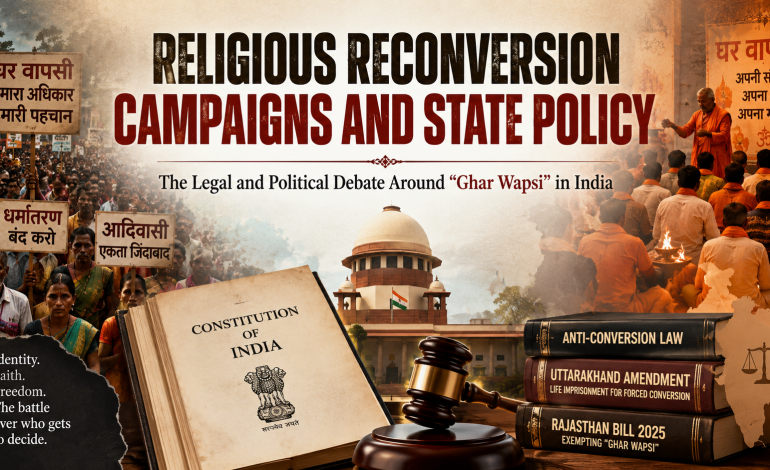
RELIGIOUS RECONVERSION CAMPAIGNS AND STATE POLICY
TOPIC 31 RELIGIOUS RECONVERSION CAMPAIGNS AND STATE POLICY Legal and Political Debates Surrounding “Ghar Wapsi” Initiatives In April 2026, tribal Christians in Chhattisgarh received an ultimatum: attend a “Ghar Wapsi”

TOPIC 31
RELIGIOUS RECONVERSION CAMPAIGNS AND STATE POLICY
Legal and Political Debates Surrounding “Ghar Wapsi” Initiatives
In April 2026, tribal Christians in Chhattisgarh received an ultimatum: attend a “Ghar Wapsi” (homecoming) ceremony to return to their ancestral faith, or face mass protests and legal consequences under the state’s proposed anti-conversion law . The Sarva Adivasi Samaj, a prominent tribal organization, assembled 800 people demanding the reconversion of Christian converts, viewing conversion to Christianity as a threat to cultural and ethnic identity rather than merely a religious issue . Meanwhile, RSS General Secretary Dattatreya Hosabale defended such campaigns as “an act of correction rather than conversion,” while simultaneously acknowledging that reconverts face social rejection—temples refusing entry, communities refusing acceptance . The Rajasthan government passed an anti-conversion Bill in September 2025 that explicitly exempts “ghar wapsi” from its provisions, defining it as merely “returning to one’s original religion” rather than conversion . Uttarakhand amended its anti-conversion law to impose life imprisonment for forced conversions, while launching “Operation Kaalnemi” to verify suspicious persons and demolish “illegal” madrasas and mazaars . The Supreme Court, hearing challenges to these laws across ten states, posed a fundamental question: “Who will decide that a religious conversion is deceitful or not?” . This article examines the legal and political landscape surrounding religious reconversion campaigns, the constitutional tensions they raise, and the deepening debate over the meaning of religious freedom in contemporary India.
WHAT – “Ghar Wapsi” (literally “homecoming”) refers to campaigns and ceremonies aimed at reconverting individuals—particularly Christians and Muslims—back to Hinduism, which proponents describe as “returning to one’s ancestral religion” rather than conversion. Critics characterize these as forced or coerced reconversion drives, often accompanied by threats, social boycotts, or inducements.
WHO – RSS-affiliated organizations (Vishva Hindu Parishad, Dharam Jagran Manch) conduct reconversion campaigns. State governments led by BJP have passed anti-conversion laws that explicitly exempt ghar wapsi from restrictions. Tribal organizations like Sarva Adivasi Samaj pressure converts to return to ancestral faiths. The Supreme Court adjudicates constitutional challenges. Christian and Muslim communities face pressure as targets of these campaigns.
WHEN – Reconversion campaigns intensified after 2014, with a significant escalation between 2022-2026. Major legislative developments occurred in 2025-2026, including Rajasthan’s new Bill (September 2025), Uttarakhand’s amendments (August 2025), and Chhattisgarh’s proposed law (October 2025).
WHERE – Across India, with particular intensity in Uttar Pradesh, Madhya Pradesh, Rajasthan, Uttarakhand, Gujarat, Chhattisgarh, Haryana, Karnataka, Himachal Pradesh, and Jharkhand—all states that have enacted anti-conversion laws. Punjab has emerged as a new frontline, with Union Home Minister Amit Shah promising an anti-conversion law ahead of the 2027 Assembly elections .
WHY – Proponents argue reconversion campaigns “correct” past forced or deceitful conversions, protect Hindu culture and demographic balance, and prevent “love jihad” and missionary inducements. Critics argue these campaigns violate constitutional guarantees of religious freedom, target religious minorities for political mobilization, and use state machinery to enforce majoritarian religious norms.
HOW – Through mass reconversion ceremonies, social pressure from community organizations, legal provisions exempting ghar wapsi from anti-conversion restrictions, police actions under “Operation Kaalnemi” style initiatives, demolition of religious structures, and legislative amendments increasing penalties for conversion while legitimizing reconversion.
SECTION 1: DEFINING GHAR WAPSI – CORRECTION OR CONVERSION?
The central semantic and legal debate surrounding reconversion campaigns hinges on whether ghar wapsi constitutes “conversion” at all.
1.1 The RSS Position: “Act of Correction”
In November 2025, RSS General Secretary Dattatreya Hosabale articulated the organized Hindutva position on ghar wapsi during a visit to Odisha :
| Claim | Explanation |
|---|---|
| “Act of correction, not conversion” | Reconversion merely restores an original religious identity rather than changing it |
| Voluntary return required | “Ghar wapsi of converted Hindus should be voluntary” |
| Non-Hindu foreigners welcome | Acceptance of non-Hindus into Hinduism is permissible |
| Opposition to forced conversion | RSS opposes “forced conversion by any religion” |
However, Hosabale also acknowledged critical social barriers faced by reconverts: “They are not readily accepted by their communities. It is often seen that many Hindu communities show reservation to accept them (after their reconversion) and temples do not allow them to enter” .
1.2 The Legal Definition: Exempting Ghar Wapsi from Anti-Conversion Laws
Multiple state anti-conversion laws explicitly exempt reconversion from their purview. The Rajasthan Prohibition of Unlawful Conversion of Religion Bill, 2025 (tabled September 2025) states: “The return of any person already converted to his original religion i.e. ancestral religion shall not be deemed conversion” .
| State | Legal Treatment of Ghar Wapsi |
|---|---|
| Rajasthan | Explicitly exempted from anti-conversion provisions |
| Uttarakhand | Not defined as conversion under amended Act |
| Madhya Pradesh | Recognized as legitimate return |
| Uttar Pradesh | De facto exemption through non-enforcement against reconversion |
Rajasthan Law Minister Jogaram Patel confirmed this interpretation: “If someone returns to their mool (original) religion, which we call ghar wapsi, then these provisions will not be applicable to them” .
1.3 The Critique: Redefining Conversion for Majoritarian Convenience
Critics argue that exempting ghar wapsi while criminalizing other conversions represents constitutional hypocrisy. An editorial in Nagaland Post noted: “The same politicians who rail against conversion celebrate ‘reconversion’ or Ghar Wapsi campaigns that are drenched in threats, inducements, and outright coercion. The hypocrisy could not be starker” .
The constitutional contradiction is evident:
| Conversion Type | Legal Status | Burden of Proof |
|---|---|---|
| Conversion to Christianity/Islam | Restricted; requires 60-90 day notice, subject to police inquiry | On convert to prove no coercion/allurement |
| Reconversion to Hinduism | Exempt from restrictions; no notice required | No burden |
SECTION 2: STATE ANTI-CONVERSION LAWS – THE LEGAL ARCHITECTURE
As of 2026, ten states have enacted “Freedom of Religion” Acts that regulate religious conversion. The Supreme Court has described these laws as growing “more and more strident” .
2.1 Comparative Analysis of State Laws
| State | Year (Latest) | Max Punishment | Key Provisions |
|---|---|---|---|
| Uttarakhand | 2025 (amended) | Life imprisonment | “Love jihad” provisions; third-party complaints; burden on convert |
| Rajasthan | 2025 (new Bill) | Life imprisonment + ₹1 crore fine | 90-day notice; ghar wapsi exempt; digital propaganda covered |
| Uttar Pradesh | 2021 | 10 years | Prohibition of conversion by marriage |
| Madhya Pradesh | 2021 | 5 years | Prior declaration required |
| Himachal Pradesh | 2019 | 7 years | Allurement includes education, employment |
| Gujarat | 2021 | 10 years | Burden of proof on accused |
| Haryana | 2022 | 10 years | Mass conversion provisions |
| Karnataka | 2022 | 5 years | Prior notice to District Magistrate |
| Jharkhand | 2017 | 4 years | Tribal protections |
| Chhattisgarh | Proposed 2026 | To be determined | Targeting “changai sabhas” (faith healing) |
Sources: The Hindu, Indian Express, Frontline
2.2 Uttarakhand: The Most Aggressive Model
The Pushkar Singh Dhami government in Uttarakhand has emerged as the most aggressive exponent of Hindutva legal architecture. In August 2025, the Assembly passed three contentious Bills in a chaotic session lasting mere minutes :
Uttarakhand Freedom of Religion (Amendment) Bill, 2025:
| Provision | Detail |
|---|---|
| Punishment for forced conversion | Up to life imprisonment (increased from 10 years) |
| “Allurement” defined as | Gift, gratification, easy money, employment, invoking divine displeasure |
| Marriage-related provision | Hiding religion to marry: 3-10 years + ₹3 lakh fine |
| Mass conversion | Up to 14 years |
| Foreign funding for conversion | 7-14 years + ₹10 lakh minimum fine |
| Threat-based conversion | 20 years to life imprisonment |
| Property confiscation | DM empowered to confiscate property acquired through conversion |
Operation Kaalnemi: Alongside legislative changes, Uttarakhand Police launched this operation targeting “suspicious persons.” Over 4,000 persons were verified, with more than 300 arrested, including one Bangladeshi national caught “disguising himself in religious attire” in Dehradun .
Madrasa Regulation: The government abolished the Uttarakhand Madrasa Education Board Act, 2016, effective July 1, 2026, replacing it with a State Minority Education Authority that will grant recognition to minority institutions across all communities—effectively ending Muslim monopoly over madrasa recognition .
Mazaar Demolitions: Over 500 “illegal” mazaars (mausoleums) have been demolished, with the government claiming 9,000 acres of government land was “freed from encroachment” .
2.3 Rajasthan: The Template Law
The Rajasthan Bill, tabled in September 2025, represents the most detailed and stringent anti-conversion legislation to date, serving as a template for other states .
Evolution from February to September 2025:
| Provision | February 2025 Bill | September 2025 Bill |
|---|---|---|
| Notice period for voluntary conversion | 60 days | 90 days |
| Punishment for unlawful conversion | 1-5 years | 7-14 years |
| Fine for conversion | ₹15,000 minimum | ₹5 lakh minimum |
| SC/ST/woman/minor conversion | 2-10 years | 10-20 years + ₹10 lakh fine |
| Mass conversion | 3-10 years | 20 years to life + ₹25 lakh fine |
| Repeat offenders | Not specified | 20 years to life + ₹50 lakh fine |
| Foreign funding provision | None | 10-20 years + ₹20 lakh fine |
| Property seizure | Not specified | Confiscation + demolition |
| Institution penalty | None | License cancellation + ₹1 crore fine |
Expanded Definitions: The September Bill significantly broadened the scope of prohibited activities:
-
“Allurement” now includes “portraying practice, rituals and ceremonies or any integral part of a religion in a detrimental way vis-à-vis another religion; or glorifying one religion against another religion”
-
“Propaganda” defined as “systematic dissemination of information, ideas, or beliefs, including misinformation, through any medium (printed material, print media, social media, messaging applications, or any other digital mode), with the intent to cause or facilitate unlawful conversion”
-
Third-party complaints: Previously only aggrieved persons or relatives could file complaints; now “any person” can
2.4 Chhattisgarh: Targeting “Changai Sabhas”
In October 2025, Chhattisgarh Deputy Chief Minister Vijay Sharma announced a proposed anti-conversion law that would be “one step ahead” of existing state laws, specifically targeting “changai sabhas” (faith healing meetings) .
CM Vishnu Deo Sai confirmed the new law would be tabled in the next Assembly session. Sharma elaborated: “An Act will be introduced… which I believe will be a step ahead of the existing Acts in other states, as it incorporates everyone’s experiences. Additionally, there are things like ‘changai sabha’, which everybody understands are misleading. Therefore, these things must be stopped. This requires legal provisions” .
This provision directly responds to evangelical Christian practices in tribal areas, where faith healing gatherings have been sites of conversion.
SECTION 3: THE SUPREME COURT DILEMMA – CONSTITUTIONAL CHALLENGES
The Supreme Court is currently seized of petitions challenging the constitutional validity of anti-conversion laws across ten states. The lead petition was filed by Citizens for Justice and Peace (CJP) in 2020 .
3.1 The Core Question: “Who Decides?”
In September 2025, a bench comprising Chief Justice B.R. Gavai and Justice Vinod Chandran posed a fundamental question to petitioner Ashwini Upadhyay (who sought a ban on “deceitful” conversion): “Who will find out as to whether it is deceitful or not?”
This question exposes the practical impossibility of administering subjective religious classifications. Senior advocate P. Wilson added that what Upadhyay sought was “in the legislative domain and out of the scope of the court’s powers.” The bench subsequently detagged Upadhyay’s petition .
3.2 Petitioners’ Arguments
Senior advocate C.U. Singh, appearing for CJP, presented the case against the laws :
| Argument | Detail |
|---|---|
| “Freedom of Religion Acts contain everything but freedom” | Laws are “virtually anti-conversion laws” |
| Bail conditions are draconian | Comparable to Unlawful Activities (Prevention) Act |
| Burden of proof reversed | Convert must prove absence of force/allurement |
| Chilling effect on Article 25 | Right to profess and propagate religion undermined |
| Third-party complaints enable harassment | “Any person” can file complaint against inter-faith couples |
Singh noted that recent amendments empower third parties to file criminal complaints against couples in inter-faith marriages, making “bail impossible” .
3.3 States’ Response and Current Status
Additional Solicitor General K.M. Nataraj questioned the timing of the stay request, noting the case had been pending for three years before petitioners sought a stay. The Court directed states to file replies within four weeks and scheduled the case for further hearing .
The Court has not yet issued a stay on the implementation of these Acts, allowing them to remain in force during the pendency of the litigation.
3.4 The 2023 Precedent
In 2023, while hearing the same case, the Supreme Court had refused to refer to the Law Commission the question of whether “forcible conversion” should be made a separate offence under the Indian Penal Code. The government had also opposed the locus standi of CJP to move the court .
SECTION 4: PUNJAB – THE NEW FRONTIER
While anti-conversion laws have been concentrated in BJP-ruled states, Punjab has emerged as a new battleground ahead of the 2027 Assembly elections.
4.1 Amit Shah’s Promise
On March 14, 2026, Union Home Minister Amit Shah addressed a “Badlav Rally” in Moga, Punjab, wearing a saffron turban. His key announcement: if the BJP forms the next government in Punjab, its “first legislative move would be a law to ban religious conversions” .
Shah framed conversion alongside drugs, debt, corruption, and gangster violence as markers of Punjab’s decline: “Punjab was ‘shrouded with loans, drugs, conversion, corruption, and the terror of gangsters'” .
4.2 The Sikh Dimension
Punjab’s case is distinct because it is India’s only Sikh-majority state. The conversion debate carries specific historical and social weight:
| Factor | Relevance |
|---|---|
| Partition trauma | Demographic fears rooted in 1947 |
| 1984 anti-Sikh violence | Historical minority vulnerability |
| Sikh theological opposition to conversion | Formal rejection of proselytization |
| Dalit Sikh conversions to Christianity | Escape from caste hierarchy within Sikhism |
| “Crypto-Christianity” phenomenon | SC families attend gurdwara publicly, practice Christianity privately |
Political scientist Ashutosh Kumar observed: “Conversions have emerged as a big issue in the State and have been a source of constant social anxiety over fears of demographic change, especially among the Sikhs. From the point of view of electoral politics, it is a smart move by the BJP” .
4.3 The Caste Question Underlying Conversion
Sociologists and historians argue that the conversion debate in Punjab obscures deeper structural issues. Political commentator Jagtar Singh noted: “There are no large-scale forcible conversions in Punjab; the more relevant question is why people are leaving their existing faiths. Sikh society is caste-based, just like Hindu society—casteless in philosophy, but not always in reality” .
The 1950 Presidential Order restricts Scheduled Caste status—and associated reservation benefits—to those professing Hinduism, Sikhism, or Buddhism. Dalit Christians and Muslims are excluded from SC reservations even though caste discrimination persists within their communities .
This creates the “crypto-Christian” phenomenon documented by researcher Niyati Sharma: “Scheduled Caste families who convert often conceal it to avoid losing constitutional protections. Many converts thus continue to have two identities: on official documents, they identify as Sikhs or Hindus; in private, they live as Christians” .
4.4 Historical Precedent: Bhagat Singh on Conversion
In a remarkable historical irony, the conversion debate echoes arguments made nearly a century ago. In a June 1928 article titled “The Question of the Untouchables” published under the pseudonym “Vidrohi” in Kirti magazine, Bhagat Singh argued that the real issue was not why people changed faiths but why they were denied dignity within them .
India’s religious communities, he wrote, were less concerned with ending caste oppression than with drawing the oppressed into their own folds—a critique that resonates with contemporary debates over both Christian conversion and Hindu reconversion.
SECTION 5: GROUND REALITIES – PRESSURE AND RESISTANCE
5.1 Chhattisgarh: Ultimatum to Tribal Christians
In April 2026, Sarva Adivasi Samaj—an umbrella organization of tribal groups in Chhattisgarh—assembled 800 people demanding the reconversion of Christian converts. Village representatives alleged that “attempts to convert people away from traditional customs and faith in tribal deities are increasing in the area” and stated that “such conversions will not be tolerated within the community” .
The organization explicitly framed conversion as “a threat to cultural and ethnic identity, rather than ‘only’ religious conversion.” Representatives appealed to the administration “to intervene immediately to maintain peace and preserve traditions” .
The ultimatum: Converts must attend a Ghar Wapsi ceremony on April 30, 2026, threatening “mass protests and legal action against those who do not comply, citing the new Chhattisgarh Freedom of Religion Bill 2026” .
Response: Some families expressed willingness to undergo reconversion “due to increasing social pressure,” while several Christians “are reportedly living in fear of large-scale protests and forced reconversions.” None of the converted families attended the planning meetings .
5.2 Social Barriers to Reconversion
Even as state policies facilitate ghar wapsi, reconverts face social rejection. RSS leader Hosabale himself acknowledged: “It is often seen that many Hindu communities show reservation to accept them (after their reconversion) and temples do not allow them to enter” .
This reveals the gap between political Hindutva’s project of numerical consolidation and the persistence of caste-based exclusion within Hindu society. Hosabale conceded that “the RSS has no role to play here as this is a religious matter”—a striking admission of the limits of political intervention in social hierarchy .
5.3 The “Crypto-Christian” Phenomenon
Documented extensively in Punjab, this phenomenon extends to other states. Niyati Sharma’s research reveals that Scheduled Caste converts to Christianity—who lose SC status upon conversion—often “lead a life of deceit,” maintaining dual religious identities across official and private domains .
The Supreme Court reaffirmed this legal reality on March 24, 2026, in Chinthada Anand v. State of Andhra Pradesh, holding that SC status is restricted to adherents of Hinduism, Sikhism, or Buddhism. This leaves Dalit Christians and Muslims outside reservation frameworks despite the persistence of caste-based disadvantage .
SECTION 6: POLITICAL DISCOURSE – LOVE JIHAD, LAND JIHAD, THOOK JIHAD
The legislative architecture of anti-conversion laws is accompanied by a distinctive political vocabulary deployed by BJP leaders, particularly in Uttarakhand.
6.1 The Three “Jihads”
Chief Minister Pushkar Singh Dhami has repeatedly invoked three terms :
| Term | Meaning | Government Action |
|---|---|---|
| Love jihad | Alleged conspiracy of Muslim men to convert Hindu women through marriage | Enhanced punishment for marriage-based conversion; life imprisonment provisions |
| Land jihad | Alleged encroachment of government land by Muslims | Demolition of over 500 “illegal” mazaars; claim of 9,000 acres recovered |
| Thook jihad | Allegation that Muslim vendors spit in food served to non-Muslims | ₹1 lakh fine for spitting in food announced October 2024 |
Dhami has stated: “The original existence of Dev Bhoomi should be saved. This is my resolution, the resolution of Dev Bhoomi. I will not allow love jihad, land jihad, or thook jihad to alter the State’s original form” .
6.2 Communal Violence in Uttarakhand
This political discourse has accompanied multiple instances of communal violence :
| Location | Date | Incident |
|---|---|---|
| Purola, Uttarkashi | May 2023 | Hindu-Muslim violence after alleged abduction attempt; economic boycott of Muslims; 20+ Muslim families fled |
| Haldwani | February 2024 | Six killed in violence over mosque and madrasa demolition (day after UCC Bill passed) |
| Nandprayag, Chamoli | September 2024 | Shops vandalized after barber accused of misbehaving with minor girl |
| Uttarkashi | October 2024 | “Jan Aakrosh” rally against “illegal” mosque; 20+ injured in police clash |
Political analyst S.M.A. Kazmi observed: “Every two to three months, we see that the ruling dispensation comes up with an issue that has communal overtones. Sometimes, Dhami talks about love jihad, and on other occasions he rakes up the issue of land jihad or even thook jihad” .
SECTION 7: THE CONSTITUTIONAL CRISIS – FUNDAMENTAL RIGHTS UNDER ASSAULT?
7.1 Rights at Stake
| Article | Right | How Anti-Conversion Laws Impact |
|---|---|---|
| Article 25 | Freedom of conscience and free profession, practice, propagation of religion | Prior notice requirements; criminalization of “propaganda”; burden of proof on convert |
| Article 21 | Liberty and privacy | State inquiry into personal religious choice; third-party complaints |
| Article 14 | Equality before law | Exemption of ghar wapsi from restrictions; differential treatment of conversions to/from Hinduism |
7.2 The Nagaland Post Editorial
An editorial in Nagaland Post (September 2025) captured the stakes for religious freedom :
“India’s Constitution promises every citizen the right to choose, profess, practice, and propagate faith. Yet that promise is being systematically dismantled by a patchwork of anti-conversion laws that have turned freedom of conscience into a crime scene… The danger begins with vague, elastic terms like ‘coercion’ and ‘allurement’ that are deliberately drafted to be abused… The result is that compassion is criminalized, kindness is suspect, and love itself becomes a punishable offence.”
The editorial called on northeastern states with Christian majorities—Nagaland, Mizoram, Meghalaya—to “lead the fight, not whisper from the sidelines” and concluded: “This is a battle for India’s democratic soul” .
7.3 The International Dimension
Open Doors, a Christian persecution monitoring organization, issued an urgent prayer appeal in April 2026 for tribal Christians in Chhattisgarh facing reconversion pressure. The organization reports that India has “the most restrictive anti-conversion laws” that make “it very difficult to leave your previous faith if you follow Jesus” .
SECTION 8: COMPARATIVE PERSPECTIVE
| Country | Anti-Conversion Laws | Reconversion Framework | Constitutional Context |
|---|---|---|---|
| India | 10 states with “Freedom of Religion” Acts | Explicitly exempted; termed “ghar wapsi” | Secular with qualified religious freedom (Article 25) |
| Pakistan | Blasphemy laws; conversion from Islam prohibited | Not applicable; apostasy from Islam criminalized | Islamic Republic |
| Bangladesh | No national anti-conversion law | Not codified | Secular principle |
| Nepal | No anti-conversion law (2017 Constitution) | Not codified | Secular state |
| Sri Lanka | No anti-conversion law but Buddhist primacy | Not codified | Buddhism given foremost place |
India’s approach is unique in explicitly exempting reconversion to Hinduism from legal restrictions while criminalizing conversion away from Hinduism—a legal architecture that critics argue effectively establishes Hinduism as a preferred religion, contradicting the constitutional commitment to secularism.
SECTION 9: THE WAY FORWARD – LEGAL AND POLITICAL QUESTIONS
9.1 Pending Before Supreme Court
| Question | Status |
|---|---|
| Constitutional validity of anti-conversion laws | Under consideration; stay not granted |
| Definition of “deceitful” conversion | CJI asked “who decides?”; no answer provided |
| Third-party complaint provisions | Challenged as enabling harassment |
| Burden of proof reversal | Challenged as violative of fundamental rights |
| Ghar wapsi exemption | Challenged as unequal treatment under Article 14 |
9.2 Reform Proposals from Civil Society
| Proposal | Source |
|---|---|
| Uniform definition of “forced conversion” across states | Law Commission recommendation |
| Removal of third-party complaint provisions | CJP petition |
| Elimination of reverse burden of proof | Multiple intervenors |
| Equal treatment of all conversions (including reconversion) | Constitutional challenge |
| Restoration of madrasa boards and minority rights | Muslim organizations |
9.3 Political Trajectory
The pattern since 2020 suggests escalation rather than moderation:
-
More states are adopting anti-conversion laws (Chhattisgarh proposed)
-
Penalties are increasing (life imprisonment replacing 10-year caps)
-
Definitions are expanding (digital propaganda, faith healing, “glorifying” one religion over another)
-
Enforcement is intensifying (Operation Kaalnemi, mazaar demolitions, madrasa closures)
-
Ghar wapsi exemptions remain while other conversions face unprecedented restrictions
SECTION 10: THE CENTRAL QUESTION – RELIGIOUS FREEDOM OR MAJORITARIANISM?
The politics of ghar wapsi and anti-conversion laws reflects a fundamental tension in India’s constitutional identity.
| Position | Argument |
|---|---|
| Pro-ghar wapsi | Reconversion corrects historical injustices of forced or deceitful conversion. The state has a duty to protect vulnerable communities from inducements. Exempting ghar wapsi recognizes the unique history of conversion in India. |
| Anti-ghar wapsi (pro-religious freedom) | Exempting reconversion while criminalizing other conversions violates Article 14. The state cannot be the arbiter of which religious transitions are legitimate. These laws enable harassment of inter-faith couples and religious minorities. |
What Is Undeniable:
| Fact | Implication |
|---|---|
| Ten states have anti-conversion laws | Pattern established across BJP-ruled states |
| Penalties have increased dramatically | Life imprisonment for conversion in some states |
| Ghar wapsi is explicitly exempted | Unequal treatment under law is codified |
| Supreme Court has not stayed these laws | Laws remain operational during litigation |
| Communal violence has accompanied implementation | Purola, Haldwani, Uttarkashi incidents |
What Remains Disputed:
| Dispute | Explanation |
|---|---|
| Are conversions “forced” at scale? | Government claims yes; civil society cites lack of evidence |
| Does ghar wapsi involve coercion? | RSS says voluntary; ground reports suggest social pressure |
| Are these laws constitutional? | Supreme Court yet to decide |
| What constitutes “allurement”? | Definition expanded to include education, employment, social media |
The Unanswered Question:
If the state prohibits conversion from Hinduism to Christianity or Islam while facilitating reconversion to Hinduism—and if the Supreme Court has asked “who decides” whether a conversion is deceitful—is India moving toward a legal framework that effectively establishes Hinduism as the state-preferred religion?
The Constitution declares India to be secular. The courts have affirmed that secularism is a basic feature of the Constitution. But the legislative architecture emerging across ten states—explicitly exempting reconversion to Hinduism while criminalizing conversion away from it—suggests a different constitutional vision.
The Supreme Court’s answer to its own question—”who decides”—will determine whether that vision prevails.
SUMMARY TABLE: GHAR WAPSI AND ANTI-CONVERSION LAWS – STATE COMPARISON
| State | Law Status | Ghar Wapsi Exemption | Max Punishment | Special Provisions |
|---|---|---|---|---|
| Uttarakhand | Amended 2025 | Implicit | Life imprisonment | Operation Kaalnemi; madrasa board abolished |
| Rajasthan | Passed Sept 2025 | Explicit | Life imprisonment + ₹1 crore | Third-party complaints; digital propaganda |
| Madhya Pradesh | 2021 | Implicit | 5 years | Prior declaration |
| Uttar Pradesh | 2021 | Implicit | 10 years | Marriage provisions |
| Gujarat | 2021 | Implicit | 10 years | Burden on accused |
| Haryana | 2022 | Implicit | 10 years | Mass conversion provisions |
| Karnataka | 2022 | Implicit | 5 years | DM notice required |
| Himachal Pradesh | 2019 | Implicit | 7 years | Broad “allurement” definition |
| Jharkhand | 2017 | Implicit | 4 years | Tribal focus |
| Chhattisgarh | Proposed 2026 | To be determined | To be determined | Targeting “changai sabhas” |
Contiued….