
COW PROTECTION AND VIGILANTISM
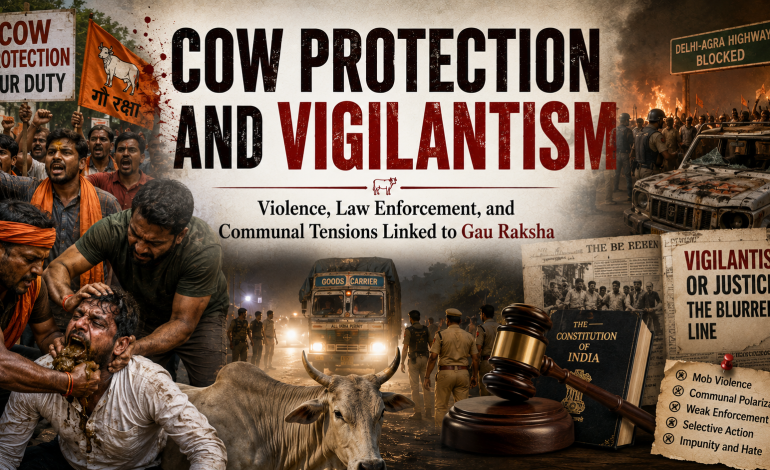
TOPIC 33 COW PROTECTION AND VIGILANTISM Violence, Law Enforcement, and Communal Tensions Linked to Gau Raksha In March 2026, a video went viral across India showing a Muslim truck driver

TOPIC 33
COW PROTECTION AND VIGILANTISM
Violence, Law Enforcement, and Communal Tensions Linked to Gau Raksha
In March 2026, a video went viral across India showing a Muslim truck driver being forced to eat cow dung by self-proclaimed “gau rakshaks” who had intercepted his vehicle on the Mumbai-Bengaluru Highway near Pune. The victim was too scared to report the assault to police, and the vigilantes were only arrested after the video emerged on social media platforms. Just days later, in Mathura, the death of a cow protection activist named Chandrashekhar — known as “Farsa Wale Baba” — triggered massive protests, with supporters blocking the Delhi-Agra Highway, vandalizing police vehicles, and clashing with law enforcement. The activist had allegedly been run over while intercepting a vehicle he suspected of cattle smuggling, but police later confirmed the vehicle was carrying groceries, not cattle, and classified the death as a tragic road accident. In Bhopal, right-wing groups staged weeks of protests after forensic tests confirmed that a 25-tonne meat consignment seized in December 2025 was cow meat — despite a municipal doctor initially certifying it as buffalo. The doctor was suspended, the slaughterhouse was sealed, and opposition Congress corporators joined the protests, accusing the BJP-run municipal corporation of being “hand in gloves” with those involved in illegal cow slaughter. The Uttar Pradesh police chief ordered a statewide crackdown on cattle smuggling networks, deploying over 60,000 new constables while simultaneously directing units to monitor social media for “anti-national” content spreading communal hatred. This article examines the phenomenon of cow vigilantism in India — its patterns of violence, the response of law enforcement, the legislative frameworks that enable or constrain it, and the deepening communal tensions that surround the politics of gau raksha.
WHAT – Cow vigilantism refers to extra-judicial actions taken by individuals or groups who claim to be protecting cows from slaughter or illegal transportation. These actions range from intercepting vehicles suspected of carrying cattle, to physical assault, forced consumption of cow dung or urine, public humiliation, and in extreme cases, murder. The phenomenon exists within a broader ecosystem of legal bans on cow slaughter, political mobilization around gau raksha, and communal polarization.
WHO – Self-styled “gau rakshaks” (cow protectors) from various right-wing organizations including Bajrang Dal, Vishva Hindu Parishad, Karni Sena, and smaller local groups form the vigilante networks. Their targets are predominantly Muslims involved in the cattle trade or beef industry, though Dalits and other communities are also targeted. State governments in BJP-ruled states have enacted stringent anti-cow slaughter laws. The Supreme Court and High Courts have issued rulings on both cow protection and vigilante excesses. Police forces are caught between enforcing anti-slaughter laws and protecting citizens from vigilante violence.
WHEN – Cow vigilantism intensified significantly after 2014, with a sharp escalation between 2015-2017 when several high-profile lynchings occurred. The period 2024-2026 has seen continued violence, including the Pune cow dung incident (March 2026), the Mathura gau rakshak death and subsequent riots (March 2026), and the Bhopal meat controversy (December 2025-January 2026).
WHERE – Across India, with particular intensity in Uttar Pradesh, Madhya Pradesh, Rajasthan, Gujarat, Maharashtra, Karnataka, and Odisha. The phenomenon is most prevalent in states with stringent anti-cow slaughter laws and strong Hindutva political mobilization.
WHY – The cow holds sacred status in Hinduism, and cow slaughter has been a politically charged issue since before Independence. Proponents of vigilantism argue that state enforcement of anti-slaughter laws is inadequate and that citizens have a right to prevent what they see as a religious offense. Critics argue that vigilantism is a form of extra-legal violence targeting religious minorities, enabled by state inaction or complicity, and that it serves to consolidate Hindu votes while persecuting Muslims.
HOW – Through vehicle interceptions on highways, physical assault and humiliation, forced consumption of cow products, destruction of property, social boycotts, and targeted attacks on individuals suspected of cattle trade. Vigilante groups often operate with impunity, leveraging the political sensitivity of cow protection to deter police intervention.
1 THE LEGISLATIVE ARCHITECTURE OF COW PROTECTION
The Constitutional Framework
The cow occupies a unique position in India’s constitutional scheme. Article 48 of the Directive Principles of State Policy directs the State to “organise agriculture and animal husbandry on modern and scientific lines” and specifically to “take steps for preserving and improving the breeds, and prohibiting the slaughter, of cows and calves and other milch and draught cattle.” This is not a justiciable right but a directive to the State.
Article 48 falls under Part IV of the Constitution, which is explicitly non-enforceable in courts. However, it has provided the moral and political foundation for cow slaughter bans across India. The Seventh Schedule places “preservation, protection and improvement of stock and prevention of animal diseases” under the State List, meaning state legislatures have primary jurisdiction over cattle protection laws.
State-Level Anti-Cow Slaughter Laws
As of 2026, twenty states and union territories have enacted laws banning or restricting cow slaughter. These laws vary considerably in their stringency. Gujarat, Madhya Pradesh, and Uttar Pradesh have some of the strictest laws, with provisions for life imprisonment in certain cases. Karnataka, under the previous BJP government, enacted the Karnataka Prevention of Slaughter and Preservation of Cattle Act, 2020, imposing a blanket ban on cow slaughter. However, the current Congress government in Karnataka has moved to amend this law, responding to a High Court order. The amendment, expected to be tabled in the Budget session starting March 6, 2026, would allow vehicles used for illegal transport of cattle to be released on an indemnity bond rather than requiring a bank guarantee.
The 2020 Karnataka Act replaced a 1964 law that had permitted the slaughter of bulls, bullocks, and buffaloes aged over twelve years or if they were unfit for breeding or did not yield milk. The BJP government imposed a blanket ban, though with a narrow exception allowing slaughter of terminally-ill cattle and buffaloes above thirteen years with permission.
In March 2025, the central government announced new regulations under the Prevention of Cruelty to Animals Act that effectively banned the sale of cattle for slaughter nationwide. The regulations extended beyond cows to include bulls, bullocks, calves, buffaloes, camels, steers, and heifers. An Indian court suspended the regulations four weeks after their announcement, and the heads of two state governments, along with various business associations, vowed to challenge the law. Kerala’s finance minister described the move as “a big blow to the agrarian economy,” noting that India is one of the world’s largest exporters of buffalo meat.
The Enforcement Gap
Despite stringent laws, enforcement remains inconsistent. In Madhya Pradesh, a major scandal erupted in December 2025 when activists from Sanskriti Bachao Manch and Hindu Utsav Samiti intercepted a truck carrying over 25 tonnes of meat near the state police headquarters in Bhopal’s Jahangirabad area, alleging the consignment was cow meat. A Bhopal Municipal Corporation doctor, Beni Prasad Gaur, initially certified the seized meat as buffalo. However, subsequent forensic examination at the Veterinary College laboratory in Mathura confirmed it was cow or cow progeny meat — the slaughter and sale of which are banned and attract stringent punishment in Madhya Pradesh.
The investigation revealed the seized meat was linked to a BMC-operated slaughterhouse in the Jinsi area, a facility permitted only to slaughter buffalo. The slaughterhouse was sealed on January 9, 2026, and Dr. Gaur was suspended by order of Urban Development Minister Kailash Vijayvargiya. The protestors demanded the slaughterhouse be demolished entirely. Aslam “Chamda” Qureshi was identified as the alleged prime accused, though sources suggested he might only be the “face” of an illegal trade involving “big players wielding major clout in the state”.
The Bhopal case reveals a recurring pattern: stringent laws on paper, compromised enforcement in practice, periodic scandals that trigger public outrage, and vigilante mobilization in response to perceived state failure.
2 PATTERNS OF VIGILANTE VIOLENCE
Cow vigilantism in India takes multiple forms, ranging from vehicle interceptions and document verification to severe physical assault, public humiliation, and targeted killings.
Forced Consumption of Cow Dung and Urine
One of the most degrading forms of vigilante violence involves forcing individuals, almost always Muslims, to consume cow dung or urine. The March 2026 Pune incident is illustrative. In the early hours of March 6, three self-proclaimed gau rakshaks — identified as Bipasha alias Akash Manikam, Hemant Gaikwad, and Viraj Sole — intercepted a truck carrying buffaloes on the Mumbai-Bengaluru Highway near Ambegaon in Pune district.
The vigilantes accused the driver and his helper of transporting buffaloes on forged documents. They proceeded to assault both men. The specific targeting of the helper’s religious identity is significant: the accused allegedly “made insulting comments about the truck driver’s religion, thrashing him and forcing him to eat cow dung”. They recorded the act on video, which later circulated on social media platforms.
Critically, when the victims were first brought to the Ambegaon police station, the helper was too frightened to report the forced consumption of cow dung. Police initially registered only non-cognizable offenses related to the assault and separately booked the truck driver under the Prevention of Cruelty to Animals Act for allegedly transporting buffaloes wrongfully. It was only when Police Constable Ganesh Shende came across the Instagram video of the incident that a formal criminal case was registered under sections of the Bharatiya Nyaya Sanhita including 196 (promoting enmity between different groups), 299 (outraging religious feelings), 352 (intentional insult to provoke breach of peace), and 115(2) (voluntarily causing hurt).
Two of the accused were arrested and remanded to police custody until March 10. Former AIMIM MLA Waris Pathan and others shared the video on social media demanding police action.
Physical Assault and Humiliation
In September 2025, a similar incident occurred in Bhubaneswar, Odisha. A farmer from Sithala in Cuttack district had availed a loan under the Chief Minister’s Kamdhenu Yojana to purchase cattle for his livelihood. He was bringing four cows and three calves in two vehicles from Andhra Pradesh when a group of youth claiming to be from a “gau rakshak” group intercepted him near Palasuni Square.
The vigilantes demanded to see his documents. Despite the farmer producing valid papers, the accused dismissed them as fake and demanded money. When the farmer refused, they allegedly assaulted him. During the commotion, one of the calves died. The assailants forced the farmer to kneel on the road and, according to sources, made him strip. In protest, farmers later staged a demonstration with the carcass of the calf, demanding stringent action.
A similar incident had taken place in Bhubaneswar’s Khandagiri area on August 28, 2025, when a farmer’s vehicle was vandalized while he was returning home with his cattle. The recurring pattern suggests an organized network of vigilante groups operating across states, with farmers and transporters living in constant fear.
Deaths and Extra-Judicial Killings
The most extreme form of vigilantism involves loss of life. In March 2026, Mathura witnessed intense violence following the death of cow protection activist Chandrashekhar, known as “Farsa Wale Baba.” The incident occurred between 3:00 AM and 4:00 AM in the Kosi Kalan station area. According to his supporters, Chandrashekhar had stopped a vehicle on suspicion of cattle smuggling when a truck approached from behind and collided with him.
However, the Mathura Police investigation produced a different narrative. Police confirmed that the vehicle Chandrashekhar had intercepted was carrying grocery items, not cattle. The collision occurred when a truck loaded with industrial wires struck the activist due to extremely dense fog. Police officially classified the event as a road accident, stating explicitly: “This is a road accident, it has no connection to cattle smuggling”.
Despite this clarification, Chandrashekhar’s supporters refused to accept the police version. The death triggered “massive mobilisation of local villagers and cow vigilantes who blocked the Delhi-Agra Highway (NH-19), leading to significant traffic congestion and reports of vandalism against police vehicles.” Police intensified their crackdown, detaining five individuals identified as stone-pelters and conducting door-to-door patrols to locate supporters who had gone into hiding after clashing with law enforcement.
The conflicting narratives around the Mathura incident — supporters alleging murder by cattle smugglers, police concluding road accident — illustrate the deeply polarized environment in which cow protection debates occur. Vigilante groups have strong incentives to frame any harm to their members as evidence of a broader conspiracy, fueling cycles of retaliation.
Protest and Collective Action
Cow-related controversies frequently trigger mass protests that disrupt public order. Following the Bhopal meat scandal, right-wing groups and opposition Congress activists both took to the streets. Bajrang Dal, Karni Sena, and other saffron outfits protested, with Bhanu Hindu of the Jai Maa Bhavani Hindu Organisation stating: “Our sentiments have been hurt. We will not tolerate this. A memorandum is being submitted to the CM, demanding action”.
The anger permeated the Bhopal Municipal Corporation as well. Opposition Congress corporators created a commotion and accused the BJP-ruled corporation and mayor Malti Rai of overlooking the issue despite repeated complaints since December. S. Zaki, the Leader of Opposition in the BMC, warned: “We’ve been continuously trying to bring the matter to notice since December, but it has fallen on deaf ears. Still if no action is initiated, we will be forced to take strong action”.
Notably, even a BJP corporator, Devendra Bhargava, raised the issue and threatened to resign “if sternest possible action isn’t initiated.” This internal pressure from within the ruling party suggests that cow protection remains an emotive issue that transcends party lines and can turn against incumbent governments perceived as soft on enforcement.
3 LAW ENFORCEMENT RESPONSE
The response of state police forces to cow vigilantism has been a subject of intense debate. Critics argue that police are often complicit in vigilante violence or at best indifferent; supporters argue that police are caught between enforcing anti-slaughter laws and protecting citizens’ rights.
The Uttar Pradesh Approach
In May 2026, Uttar Pradesh DGP Rajeev Krishna issued a directive that encapsulates the dual pressures on law enforcement. On one hand, he ordered “special statewide drives against cow slaughter and cattle smuggling,” directing police units to “identify financial and logistical networks linked to such rackets and take stringent action.” On the other hand, he simultaneously instructed officials to “keep a strict vigil on anti-national and terror-linked networks allegedly using social media platforms to mislead and radicalise youth” and to take “immediate action against individuals spreading caste hatred and communal tension through digital platforms”.
The DGP described the induction of 60,244 newly recruited constables as a “once in a generation opportunity” for UP Police, ordering their maximum deployment in beat policing, foot patrolling, and public outreach programmes. He also emphasized “proper behavioural training” for recruits — an acknowledgment, perhaps, of past complaints about police conduct in communally sensitive situations.
The Pune Case: Police Responsiveness
The Pune cow dung incident of March 2026 offers a mixed picture of police responsiveness. Initially, when the victims were brought to the Ambegaon police station, officers registered only non-cognizable offenses. The truck driver was himself booked under the Prevention of Cruelty to Animals Act. The helper — the primary victim of the forced cow dung consumption — was too scared to report what had happened.
This initial response could be interpreted as police prioritizing enforcement of animal protection laws over protection of human victims. However, once the video emerged on social media, police acted decisively. Police Constable Ganesh Shende independently came across the Instagram footage and initiated a formal criminal case. The accused were identified as Bipasha alias Akash Raju Manickam, Hemant Gaikwad, and Viraj Sole, and arrests followed.
The case was registered under multiple BNS sections including 196 (promoting enmity between different groups) and 299 (outraging religious feelings) — charges that recognize the communal dimension of the offense. The case suggests that while initial police response may be inadequate, sustained media attention and social media pressure can compel action.
The Mathura Incident: Police Containment
In Mathura, police faced a more volatile situation. Following the death of Chandrashekhar, supporters blocked the Delhi-Agra Highway and vandalized police vehicles. Police responded by intensifying their crackdown: five detainees were arrested, door-to-door patrolling was conducted, and a large police contingent was deployed to maintain order. However, police also took care to clarify their version of events — that the death was a road accident unrelated to cattle smuggling — in an apparent effort to de-escalate tensions by countering the narrative of murder by smugglers.
The Bhubaneswar Incident: Investigation Promised
Following the September 2025 assault on a farmer and the death of his calf in Bhubaneswar, police began an investigation and stated they were “verifying the authenticity of the documents produced by the farmer” — again, focusing on the legality of cattle transport rather than the vigilante assault. The incident raised “serious questions about law and order,” with many demanding “strict action against those taking the law into their own hands under the pretext of cow protection”.
4 THE BHOPAL MEAT CONTROVERSY – A CASE STUDY IN COMPLEXITY
The Bhopal scandal of December 2025-January 2026 illustrates the complex ecosystem in which cow protection controversies unfold — involving municipal officials, slaughterhouse operators, political parties, vigilante groups, export networks, and communal mobilization.
The Seizure
On December 17, 2025, activists of Sanskriti Bachao Manch and Hindu Utsav Samiti intercepted a truck carrying over 25 tonnes of meat near the state police headquarters in Bhopal’s Jahangirabad area. The activists alleged the consignment was cow meat — a serious charge in Madhya Pradesh, where cow slaughter is banned and punishable with stringent penalties.
The initial certification by Bhopal Municipal Corporation doctor Beni Prasad Gaur declared the meat to be buffalo — legally permissible for slaughter and sale. However, activists and opposition parties refused to accept this certification, demanding forensic testing.
The Forensic Confirmation
The Veterinary College laboratory in Mathura — a city deeply associated with the politics of cow protection — conducted the forensic examination. The lab confirmed what the vigilante groups had alleged: the meat was from a cow or its progeny. This finding transformed the scandal. What had been a routine seizure became evidence of large-scale organized criminal activity involving municipal infrastructure.
Police investigation traced the meat to a BMC-operated slaughterhouse in the Jinsi area. This facility operated on a public-private partnership model and was licensed only for buffalo slaughter. The revelation that cow meat was being processed in a municipal facility triggered immediate political fallout.
Government Response
The state government moved quickly. Urban Development Minister Kailash Vijayvargiya ordered Dr. Gaur’s immediate suspension. The slaughterhouse was sealed on January 9, 2026. The minister also ordered an “in-depth probe” into possible collusion by insiders or staff of the civic body.
Two persons were reportedly arrested in connection with the case. Sources indicated that action might be taken against the properties of Aslam “Chamda” Qureshi, identified as the alleged prime accused. However, sources also suggested Qureshi might only be “the face of the illegal trade” and that “some big players wielding major clout in the state could actually be behind him”.
Political Fallout
The scandal produced an unusual political alignment. Right-wing Hindu groups demanded the demolition of the modern slaughterhouse that had opened only in October 2025. Opposition Congress activists accused the BJP-ruled BMC and mayor Malti Rai of “overlooking the issue” and being “hand in gloves with those involved in cow slaughter and illegal transport of cow meat.” Congress corporators had been raising concerns since December, they claimed.
Most remarkably, a BJP corporator, Devendra Bhargava, threatened to resign if “sternest possible action isn’t initiated.” This threatened resignation from within the ruling party underscores the political sensitivity of cow protection: even for ruling party members, perceived inaction on cow slaughter is politically dangerous.
The controversy revealed additional dimensions. Unconfirmed reports suggested that meat from the Jinsi slaughterhouse was being exported to Gulf countries, including the UAE, via Maharashtra and Chennai. If true, this would indicate an international dimension to the illegal trade.
5 THE COMMUNAL DIMENSION
Cow vigilantism in India is not a religiously neutral phenomenon. The overwhelming majority of victims are Muslims, and vigilante violence is accompanied by anti-Muslim rhetoric.
Targeting Muslims
The Pune cow dung incident involved explicitly religious targeting. The accused vigilantes were “purportedly seen making insulting comments about the truck driver’s religion”. The victim, a Muslim truck helper, was forced to eat cow dung — an act that carries specific religious humiliation for Muslims, for whom cows are not sacred but whose religious identity is being weaponized against them.
Sociologists have noted that cow vigilantism serves to reinforce the second-class citizenship of Muslims in contemporary India. By enforcing Hindu religious strictures on the entire population — including non-Hindus — vigilantes communicate that Muslim dietary practices are illegitimate and that Muslims themselves are suspect citizens.
The Minority Experience
The fear that vigilante violence generates within Muslim communities is substantial. In the Pune case, the truck helper was “too scared” to report the forced consumption of cow dung to police. Only when a police constable independently discovered the video did formal charges follow. This fear — that reporting vigilante violence might lead to further harassment or even prosecution under anti-slaughter laws — is a recurring theme.
In Chhattisgarh, within the context of “ghar wapsi” pressures on Christians, similar dynamics of fear and silence exist. Minority communities face the dilemma of either complying with majoritarian demands or risking violence without assurance of state protection.
The Beef Economy
The beef industry in India is disproportionately dependent on Muslim labor. From slaughterhouse workers to transporters to leather tanners, Muslims form a significant portion of the cattle trade workforce. Cow vigilantism thus serves a dual economic function: it disrupts an industry where Muslims are prominent and it creates a climate of fear that forces Muslims out of these occupations.
India remains one of the world’s largest exporters of buffalo meat, with buyers including Vietnam, Malaysia, and Egypt. The country produces millions of tons of beef annually, with almost half exported. This creates a fundamental tension between economic reality — the demand for beef, both domestically and internationally — and the political imperative of cow protection.
6 THE ROLE OF SOCIAL MEDIA
Social media platforms have emerged as critical actors in the ecosystem of cow vigilantism. The Pune case was only brought to justice because a video of the assault circulated on Instagram and was viewed by a police constable. The viral nature of such content can compel official action that might otherwise not occur.
However, social media also enables vigilantism. Videos of alleged cattle smuggling are circulated to mobilize vigilante groups. Videos of vigilante “successes” — intercepting trucks, humiliating “smugglers” — are shared to recruit new members and to demonstrate the effectiveness of extra-legal action. The same platforms that enable accountability also enable mobilization.
Police forces have recognized this dual role. The Uttar Pradesh DGP ordered “stronger monitoring of online activities” and directed social media monitoring units to “upgrade technical surveillance capabilities to track inflammatory content in real time.” The directive covered both “anti-national and terror-linked networks” and “individuals spreading caste hatred and communal tension through digital platforms”.
7 JUDICIAL RESPONSES
Indian courts have addressed cow protection and vigilantism through multiple rulings, though the jurisprudence remains unsettled.
Supreme Court
The Supreme Court has, on multiple occasions, expressed concern about extra-judicial violence in the name of cow protection. In 2018, following a spate of lynchings, the Court directed states to formulate schemes to prevent mob violence and to appoint nodal officers in every district. However, implementation has been uneven.
The Court has also upheld the constitutionality of state cow slaughter laws, recognizing them as falling within the legislative competence of states under Article 48. The tension in the Court’s approach — affirming the right of states to ban slaughter while condemning vigilante enforcement — remains unresolved.
High Courts
State High Courts have played varying roles. The Karnataka High Court’s October 2022 order requiring seized vehicles to be released on indemnity bonds rather than bank guarantees led directly to the current Congress government’s proposed amendment to the 2020 Act.
The Allahabad High Court has addressed cases of interfaith couples facing harassment under anti-conversion laws, drawing boundaries around state power over personal relationships.
8 COMPARATIVE PERSPECTIVE
Cow vigilantism is largely unique to India, arising from the specific religious significance of cows in Hinduism and the political mobilization around this symbolism.
| Country | Cow Slaughter Legal Status | Vigilantism | Notes |
|---|---|---|---|
| India | Banned in 20 states | Significant | Religious and political dimensions |
| Nepal | Banned (Hindu kingdom) | Limited | State enforcement adequate |
| Sri Lanka | No ban | None | Cattle not religiously significant |
| Bangladesh | Permitted for certain cattle | None | Muslim-majority country |
| Pakistan | Permitted | None | Muslim-majority country |
India’s combination of constitutional secularism, majoritarian religious sentiment, weak state enforcement, and political mobilization around cow protection produces a unique environment conducive to vigilantism.
9 THE CENTRAL QUESTION – PROTECTION OR PERSECUTION?
The politics of cow vigilantism reflects a fundamental tension between competing interpretations of cow protection.
One interpretation sees vigilantism as a necessary response to state failure. From this perspective, anti-slaughter laws exist on paper but are poorly enforced. Corrupt officials collude with smugglers. The judiciary is slow. In such circumstances, concerned citizens have a right — even a duty — to enforce the law themselves. The Bhopal scandal, where a municipal doctor falsely certified cow meat as buffalo, exemplifies the kind of official complicity that fuels vigilante mobilization.
The alternative interpretation sees vigilantism as a form of communal persecution enabled by state inaction. From this perspective, the selective enforcement of anti-slaughter laws — with Muslims disproportionately targeted — reveals the true motivation: not cow protection but Muslim subordination. The explicit religious insults, the forced consumption of cow dung, the communal nature of the violence — all point to a campaign of intimidation against a religious minority.
What is undeniable is that cow vigilantism has become a recurring feature of India’s political landscape. The incidents documented here — Pune (March 2026), Mathura (March 2026), Bhopal (December 2025-January 2026), Bhubaneswar (September 2025) — represent only a fraction of the total. Vigilante groups operate across the country. State responses vary from crackdowns to complicity. Victims live in fear.
What remains disputed is the way forward. Should anti-slaughter laws be more strictly enforced, removing the rationale for vigilantism? Should they be relaxed, reducing the economic incentive for illegal trade? Should police be empowered to arrest vigilantes who take the law into their own hands? Should community vigilance committees be formalized and regulated?
The Supreme Court has not provided clear answers. Parliament has not acted. State governments pursue divergent approaches. And on the highways of India, trucks continue to be intercepted, drivers continue to be assaulted, and the cycle of violence continues.
KEY INCIDENTS (2025-2026)
Pune (March 2026): Three self-proclaimed gau rakshaks intercepted a buffalo transport truck, assaulted the driver and helper, forced the Muslim helper to eat cow dung, and recorded the act. Police acted only after the video went viral on Instagram. Two arrests made under BNS sections 196, 299, 352, and 115(2).
Mathura (March 2026): Death of cow protection activist Chandrashekhar (“Farsa Wale Baba”) triggered protests, highway blockades, and vandalism of police vehicles. Police clarified the death was a road accident, not cattle-smuggling related. Five detained for stone-pelting.
Bhopal (December 2025-January 2026): 25-tonne meat consignment seized; initially certified as buffalo, forensic testing confirmed cow meat. Municipal doctor suspended, slaughterhouse sealed, opposition and right-wing groups protested. BJP corporator threatened resignation.
Bhubaneswar (September 2025): Farmer transporting cattle from Andhra Pradesh was intercepted by gau rakshaks, assaulted despite valid documents, and forced to strip. One calf died during the commotion. Police investigation focused on document verification.