CINEMA, STREAMING PLATFORMS AND IDEOLOGICAL NARRATIVES
TOPIC 34 CINEMA, STREAMING PLATFORMS AND IDEOLOGICAL NARRATIVES How Films and Web Series Shape Political and Cultural Perceptions In April 2026, Prime Minister Narendra Modi stood at a rally in

TOPIC 34
CINEMA, STREAMING PLATFORMS AND IDEOLOGICAL NARRATIVES
How Films and Web Series Shape Political and Cultural Perceptions
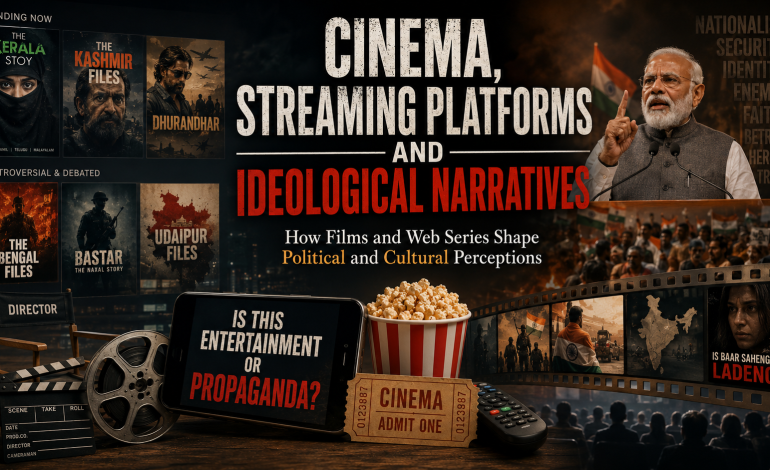
In April 2026, Prime Minister Narendra Modi stood at a rally in Tiruvalla, Kerala, and did something unusual: he defended a set of films as if they were government policy. “They said Kerala Story is a lie, they said Kashmir Files is a lie, they said Dhurandhar is a lie,” he declared, calling the Opposition a “factory of lies” for questioning these cinematic works. The remarks did two things at once: they gave fictional films a sense of veracity, and they dismissed any criticism of them as politically motivated. Just weeks earlier, the trailer for The Kerala Story 2 had dropped with an even more audacious claim—that “in the next 25 years, India could be transformed into an Islamic state governed by Sharia law”. The sequel promised to “go beyond,” focusing on Hindu girls allegedly coerced into conversion, with the tagline: “Is baar sahenge nahi… ladenge” (This time we will not endure… we will fight).
Meanwhile, the commercial landscape of Indian cinema had transformed. Dhurandhar, a spy thriller depicting Indian agents confronting Pakistan-linked foes, had collected a staggering Rs 1,300 crore at the box office. Its sequel, Dhurandhar 2, set for release in March 2026, appeared poised to surpass even that feat. Industry insiders predicted a 45–50 percent rise in net Hindi box-office collections and a 25 percent increase in young theatre-goers. The strategy of “event cinema”—big-budget spectacles where patriotism, spectacle, and ideological clarity trump nuance and narrative risk—appeared to be working.
But not everyone was celebrating. Film critic Arnab Banerjee argued that “propaganda films” were succeeding not because of their quality but because “the mood of the nation is such that people are lapping up these subjects. Pakistan-bashing and references to enemy countries are being accepted without questioning”. Others pointed to a string of failures—The Bengal Files, Bastar: The Naxal Story, Udaipur Files—all nationalist films that had bombed at the box office, suggesting that audiences were more discerning than politicians assumed.
This article examines the evolving relationship between cinema, streaming platforms, and ideological narratives in India. It explores how films and web series shape political and cultural perceptions, the commercial incentives driving ideological storytelling, the contested space of OTT platforms, and the fundamental question of whether Indian cinema is reflecting public sentiment or actively manufacturing it.
WHAT – The intersection of cinema, streaming platforms, and ideological narratives refers to the use of films and web series to shape political and cultural perceptions. This includes nationalist films that dramatize historical or current events from a particular ideological perspective, biographical films on political figures, mythological epics, and streaming content that addresses caste, religion, and social justice issues.
WHO – Filmmakers like Vivek Agnihotri (The Kashmir Files), Aditya Dhar (Dhurandhar), and Vipul Amrutlal Shah (The Kerala Story franchise) produce ideologically charged content. Political leaders including Prime Minister Narendra Modi have endorsed such films, lending them official credibility. OTT platforms including Netflix, Amazon Prime Video, Disney+ Hotstar, Zee5, and SonyLIV distribute content. Audiences consume and react to this content, with social media amplifying debates. Critics, film reviewers, and civil society organizations challenge factual inaccuracies and propagandistic elements.
WHEN – The intensification of ideological storytelling in Indian cinema began around 2014 and accelerated after the pandemic, with 2022-2026 witnessing the most pronounced shift. Key releases include The Kashmir Files (2022), The Kerala Story (2023), Dhurandhar (2025), its sequel (2026), The Kerala Story 2 (February 2026), Ikkis (January 2026), and Border 2 (January 2026).
WHERE – Across India, with Bollywood (Hindi cinema) at the center of ideological filmmaking. Regional industries, including Telugu cinema (Mayasabha on Sony LIV), also produce politically charged content. OTT platforms operate nationwide and globally, with Indian content reaching diaspora audiences.
WHY – Proponents argue that these films correct historical omissions, give voice to suffering communities, and reflect authentic public sentiment. Critics argue that they are propaganda tools that selectively retell history, manufacture consent for political agendas, and deepen social polarization. The commercial reality is that such films have proven highly profitable, creating economic incentives for their proliferation.
HOW – Through theatrical releases amplified by social media marketing, political endorsements that confer legitimacy, OTT distribution that extends reach, and the blending of fact and fiction to create emotionally resonant narratives that shape public memory.
1 THE RISE OF IDEOLOGICAL CINEMA
The Shift in Bollywood’s Creative Priorities
Over the past decade, Bollywood has undergone a noticeable shift. Traditionally regarded as a largely secular space—one where religion and caste seldom dictated professional or creative alignments—the industry now appears more ideologically divided. This shift reflects not just a commercial recalibration but a broader change in creative priorities.
The pandemic accelerated this transformation. With theatrical revenues decimated by lockdowns and the rise of streaming platforms, studios began betting on “event cinema”—big-budget spectacles guaranteed to lure audiences—especially smartphone-loving Gen Z viewers—back into theatres. These films leaned heavily on patriotism, war dramas, spy thrillers, mythological epics, and nationalist narratives.
The strategy appears to be working. Akshaye Rathi, a prominent film exhibitor, predicted a 45–50 percent rise in net Hindi box-office collections and a 25 percent increase in young theatre-goers in 2026. “The year looks poised for historic numbers,” he told AFP.
The Term “Propaganda” Enters the Mainstream
The word “propaganda”—once reviled and feared, associated with Joseph Goebbels—has found surprising acceptance in the vocabulary of Bollywood. Film trade analyst Atul Mohan acknowledged this openly: “These days film themes also depend upon who is ruling at the centre—Hindu wave, propaganda… all these are big factors that filmmakers cash in on”.
However, Mohan added a crucial caveat: “But only one or two films work, not all 10 or 15”. He cited the success of The Kashmir Files (2022) and contrasted it with The Bengal Files (2025), which he described as a commercial “disaster”. This distinction—between propaganda that works and propaganda that fails—is central to understanding the phenomenon.
2 CASE STUDIES IN IDEOLOGICAL FILMMAKING
The Kashmir Files (2022)
Vivek Agnihotri’s The Kashmir Files tells the story of the exodus of Kashmiri Pandits from the Kashmir Valley in 1989-90. The event itself is not contested. What has been questioned is how the film presents it.
Critics have pointed to several issues. The Hindu noted that the film offers a selective retelling, focusing on one strand of suffering while leaving out the broader political context—including militancy, state response, and violence faced by multiple communities. The Wire pointed out that the film leans on heightened claims and dramatization without engaging with documented complexity.
There has also been criticism of how the film portrays university spaces. Scenes resembling campuses like Jawaharlal Nehru University are shown as breeding grounds of “anti-national” thought—echoing a political trope rather than a verifiable reality.
The issue, as one analysis put it, “is not invention, but careful and motivated omission”. Yet the film became a massive commercial success, tapping into what audiences perceived as a suppressed truth finally being told.
The Kerala Story (2023) and Its Sequel (2026)
The Kerala Story hinged on one number: 32,000. That was the figure the film initially pushed of women from Kerala who were allegedly converted and recruited by the Islamic State. It was this number that gave the film its shock value.
But that number did not stand for long. BBC News reported there was no evidence backing it. Available data and official records pointed to far smaller figures—in some cases, just a handful of confirmed instances. Under scrutiny, the filmmakers quietly dropped the 32,000 claim from the film’s description.
The concern, as critics noted, “isn’t about whether radicalisation exists. But the scale the film builds its story on doesn’t match what’s been documented. Once that scale falls apart, the entire narrative starts to feel shaky”.
The trailer for The Kerala Story 2, released in February 2026, escalated the claims dramatically. It opened with a stark warning that “in the next 25 years, India could be transformed into an Islamic state governed by Sharia law”. The sequel presents three parallel narratives centred on Hindu girls who allegedly face coercion and religious conversion after entering relationships with Muslim men.
One storyline unfolds in Madhya Pradesh, where a young Hindu woman is allegedly deceived into marriage under false pretences and later compelled to convert. Another takes viewers to Kerala, where a Muslim man suggests a live-in relationship to his Hindu girlfriend. When she refuses to convert, the trailer depicts her allegedly being forced to eat beef and held captive by him and his family.
The makers’ social media post accompanying the trailer declared: “They targeted our daughters. They broke their trust. They stole their futures. This time, we do not stay silent. The story goes beyond. Is baar sahenge nahi… ladenge”.
The Dhurandhar Phenomenon (2025-2026)
Perhaps the most striking example of ideological cinema’s commercial potential is the Dhurandhar duology. Directed by Aditya Dhar, known for Uri: The Surgical Strike (2019), Dhurandhar tells the story of a covert Indian agent who infiltrates Pakistan to thwart alleged anti-India conspiracies.
On the surface, such a premise is hardly novel; Bollywood has long been fascinated with stories of undercover agents operating in hostile territory. What distinguishes Dhurandhar and its sequel is their apparent attempt to weave real events and characters into the storyline, blending fact and fiction in a way that has contributed significantly to the controversy surrounding the film.
The first installment collected a staggering Rs 1,300 crore at the box office. Its sequel, Dhurandhar 2, set for release on March 19, 2026 (coinciding with Eid), appears poised to surpass even that feat.
Critics have accused Dhar of using his films to promote the perceived agenda of the current regime. According to detractors, his films “employ the language of nationalism to present scenes and situations that bear little resemblance to reality”.
Yet the film’s commercial performance has remained unaffected by criticism. If anything, the controversy appears to have amplified public interest. This raises an important question: can propaganda alone ensure a film’s success? The evidence suggests otherwise. The film appears to be backed by considerable research, lending it a degree of authenticity that resonates with viewers. More importantly, its audience seems largely indifferent to whether the film qualifies as propaganda—for them, the primary concern is whether it entertains on a larger-than-life canvas.
The 2026 Slate: Patriotism as a Genre
The year 2026 opened with a wave of patriotic cinema. Ikkis, released on January 1, marked the acting debut of Akshay Kumar’s niece Simar Bhatia and Amitabh Bachchan’s grandson Agastya Nanda. The film is based on the life of Second Lieutenant Arun Khetarpal, a Param Vir Chakra recipient from the 1971 India-Pakistan war.
Border 2, a multi-starrer featuring Sunny Deol, Varun Dhawan, Diljit Dosanjh, and others, released on January 23, 2026. Battle of Galwan, based on the India-China clash in the Galwan Valley, is scheduled for April 17, 2026, with Salman Khan in the lead role.
As a Hindi news report put it, “Hindustan Zindabad… patriotism will echo through 2026”.
3 THE POLITICAL ENDORSEMENT OF CINEMA
The most significant development in the relationship between cinema and ideology has been the direct endorsement of specific films by political leaders. When Prime Minister Modi addressed a rally in Kerala in April 2026 and defended The Kerala Story, The Kashmir Files, and Dhurandhar by name, he crossed a threshold.
“The key shift is not in the films,” one analysis noted. “It is in how they have been used by political leaders in public discourse. They draw from real events, but at the same time, they reshape those events through selective retelling, emphasis and omission. When such films are authenticated by politicians, they move from the domain of being works of fiction into transforming public memory of the events they depict”.
This authentication has several effects. First, it gives fictional films a sense of veracity—the Prime Minister would not defend a lie, the reasoning goes. Second, it dismisses any criticism as politically motivated. Third, it mobilizes the government’s vast communication machinery to amplify the film’s messaging.
The criticism around these films, as the analysis points out, “has not been abstract. It has focused on specific claims, numbers and portrayals that do not align with available evidence or wider reporting”. Yet political endorsement renders such fact-based criticism irrelevant to large sections of the audience.
4 THE MIXED FORTUNES OF NATIONALIST CINEMA
For all the attention paid to successful nationalist films, the majority have failed. A Times of India analysis noted that “of the many that hit the theaters only The Kashmir Files and The Kerala Story have been successful. The rest despite aggressive marketing and being topical have failed to sustain interest from the audience”.
The list of failures is long: The Bengal Files, Bastar: The Naxal Story, Udaipur Files: Kanhaiya Lal Tailor Murder, Veer Savarkar, Jahangir National University, The Sabarmati Report. Vivek Agnihotri’s The Bengal Files, made after the stupendous success of The Kashmir Files, failed to cross the Rs 10 crore mark even after four days in cinemas. Udaipur Files, released after considerable struggle with the Censor Board, managed a lifetime collection of just over Rs 2 crore.
Why do some nationalist films succeed while others fail? The analysis suggests several factors:
Emotional resonance: The Kashmir Files and The Kerala Story “tapped into the raw emotional response” and “leveraged word-of-mouth publicity” by engaging with narratives that connected with a large section of the public.
Simplicity: Both films “were told in a simple manner by focusing on victims’ perspectives”.
Media amplification: Both films “got a lot of attention with news channels and social media debates and conversations”—attention that their failures did not receive.
Fatigue: “Over-saturation of similar narratives” has led to “audience fatigue and changing sensibilities”.
Skepticism: Many nationalist films “have been accused of manipulating facts for political gains or oversimplifying complex issues,” leading to a loss of trust among “discerning viewers”.
Veterans warn that such cinema risks “diminishing credibility and reducing art’s ability to inspire civic spirit or genuine reflection.” Some of these films have led to “violence and polarization,” further underlining “the dangers of opportunistic or sensational storytelling”.
5 REGIONAL CINEMA AND POLITICAL NARRATIVES
Ideological storytelling is not confined to Bollywood. Regional industries have also produced politically charged content, often with more nuanced approaches.
Mayasabha, a Sony LIV web series based on Andhra Pradesh politics, dramatizes the rivalry between legendary politicians Y.S. Rajasekhar Reddy and Nara Chandrababu Naidu. Though the makers have labeled the show as fictional, audiences are well aware that it is inspired by real-life political figures. Season 2, premiering in January 2026, promises to address “several important historical events that changed the face of Andhra politics”.
Director Deva Katta has stated that he “will not take sides and will focus on showcasing facts”—an approach quite different from the ideological clarity of Bollywood’s nationalist films. Lead actor Chaitanya Rao Madadi revealed that Season 2 will feature “some of the most controversial scenes of the series,” suggesting that regional content faces similar tensions between dramatization and accuracy.
6 OTT PLATFORMS AS CONTESTED SPACES
Streaming platforms have emerged as crucial sites for ideological contestation, offering both opportunities for diverse narratives and new forms of exclusion.
The Promise of OTT
Over-the-top platforms have increased access to a variety of narratives that might not find theatrical release. Documentaries, independent films, and web series addressing caste, religious, and social justice issues have found audiences on Netflix, Amazon Prime Video, Disney+ Hotstar, Zee5, and SonyLIV.
The Problem of Caste Representation
However, an academic study examining Dalit representation in OTT productions between 2014-2025 identified two opposite patterns. The first is the “hegemonic savarna narrative,” which marginalizes Dalit characters through victimhood motives, stereotyping, and upper-caste saviour narratives. The second is “counter-hegemonic Dalit cinema,” which places Dalit characters at the centre in terms of centrality, historical awareness, and anti-caste aesthetics.
The study argues that “on the one hand, with OTT, there is increased access to a variety of narratives, on the other hand, these platforms are also contested spaces which code caste hierarchies through algorithmic forms of curation and commissioning”.
The Ghooskhor Pandat Controversy
In February 2026, Netflix faced massive backlash over the title of its upcoming film Ghooskhor Pandat, starring Manoj Bajpayee. The title and a dialogue in the film drew accusations of “anti-Hindu sentiment” and “vilification of the Brahmin community”.
The film features Bajpayee as Ajay Dikshit, popularly known as “Pandat” among peers, a rogue police official with a reputation for being corrupt and morally bankrupt. Critics pointed out the irony—Neeraj Pandey (writer) and Manoj Bajpayee (actor) are themselves Brahmins—but this did not stop the backlash.
Social media users demanded that the makers change the title before release, with some threatening to cancel Netflix subscriptions or take legal action. Within a short period, there were 16,500 posts about the movie promoting Brahmin stereotypes.
The controversy illustrates how OTT platforms have become battlegrounds for identity-based politics, with different communities mobilizing to challenge what they perceive as negative representations.
7 THE ROLE OF SOCIAL MEDIA IN SHAPING NARRATIVES
Social media has fundamentally altered the relationship between films and their audiences. A film’s fate is increasingly “decided by social media hype”. This has several consequences.
First, controversy itself becomes a marketing tool. A film that attracts condemnation from one political camp gains free publicity and may be embraced by the opposing camp. The debates themselves drive interest.
Second, clips and scenes from films circulate independently of their context. A powerful emotional moment can go viral, drawing audiences to the theatre even if the film as a whole is poorly reviewed.
Third, social media enables direct communication between filmmakers and audiences, bypassing traditional critics. When The Kashmir Files was criticized by established reviewers, its supporters mobilized on social media to declare that the critics were “out of touch” with “real India.”
Fourth, social media algorithms tend to amplify polarizing content. A film that provokes strong reactions—whether positive or negative—is more likely to be promoted by algorithmic systems than a film that inspires quiet appreciation.
8 THE ECONOMICS OF IDEOLOGICAL CINEMA
The Commercial Logic
The shift toward ideological cinema is not primarily ideological—it is commercial. Bollywood’s defining instinct “has never been ideological commitment to the craft of filmmaking; it has been commercial instinct”. If the success of Dhurandhar encourages a proliferation of similar films, “the industry will undoubtedly follow that path blindly”.
The economics are straightforward. Dhurandhar collected Rs 1,300 crore. Its budget is estimated at a fraction of that. For a studio executive, the lesson is not “nationalism sells” but “this specific film sold.” Replicating its formula becomes the goal.
The Role of Government Support
Several nationalist films have received support from government institutions, including tax exemptions, promotional assistance, and screening in government-owned theatres. The central government has also used its influence to encourage the production of films depicting the ruling party and its leaders in favorable light.
Biographical films on former Prime Minister Atal Bihari Vajpayee and current Prime Minister Narendra Modi have been produced, while projects on Indira Gandhi and the Emergency have attracted accusations of political bias. Notably, most of these films failed to achieve sustained commercial success. “After initial waves of attention and criticism, many quietly faded into obscurity”.
The Risk of Over-Saturation
The string of failures among nationalist films suggests that the genre has limits. “Poor storytelling, generic characterizations, and lack of star power coupled with increasing skepticism led to diminishing revenues for new releases”.
The trajectory reveals “a growing disconnect between screen and society. Only films that tap into buried trauma or provide compelling evidence however controversial continue to draw crowds, while a majority now flounder amid audience fatigue and changing sensibilities”.
9 THE EFFECT ON PUBLIC PERCEPTION
Shaping Political Consciousness
Films have an unparalleled ability to shape public perception because they operate through emotion, not argument. A viewer watching a dramatized event experiences it viscerally, absorbing its implicit claims without the critical distance that reading a news article might afford.
When The Kerala Story claims (without evidence) that 32,000 women were converted, the number lodges in the viewer’s mind. When the sequel claims that India could become an Islamic state in 25 years, the fear is visceral. When Dhurandhar shows Indian agents heroically defeating Pakistani adversaries, the emotional response is pride.
These emotional responses translate into political attitudes. A viewer who has internalized the narrative of The Kashmir Files is more likely to support hardline policies toward Pakistan. A viewer who believes The Kerala Story’s claims is more likely to view Muslim men with suspicion.
The Blurring of Fact and Fiction
The most significant concern is the blurring between fact and fiction. When Prime Minister Modi defends The Kerala Story and The Kashmir Files as truthful, he is not offering a film review—he is conferring governmental legitimacy on dramatized accounts.
“The issue here is not invention, but careful and motivated omission”. Films can be factually accurate in every specific claim while still being fundamentally misleading through what they leave out. A film that shows only the suffering of Kashmiri Pandits without showing the context of militancy and state violence is not lying—but it is not telling the whole truth either.
The Polarization Effect
These films also deepen social polarization. They create ingroups (the victims, the heroes, the nation) and outgroups (the enemy, the traitor, the converter). They simplify complex realities into moral fables where good battles evil.
This has real-world consequences. The Times of India analysis noted that nationalist films “often lead to violence and polarization,” underlining “the dangers of opportunistic or sensational storytelling”. When a film portrays an entire community as threatening, it licenses discrimination against members of that community in daily life.
10 THE CENTRAL QUESTION – REFLECTION OR MANUFACTURE?
The politics of cinema and ideology reflects a fundamental tension: is Indian cinema reflecting public sentiment or actively manufacturing it?
One interpretation sees these films as authentic expressions of popular feeling. From this perspective, audiences were hungry for narratives that validated their existing beliefs—that the Kashmir exodus was a tragedy, that conversion is a threat, that Pakistan is an enemy. Filmmakers simply supplied what the market demanded.
The alternative interpretation sees these films as tools of manufactured consent. From this perspective, the state and its allies have actively cultivated the conditions for these films’ success—through political endorsements, tax exemptions, and the amplification of certain narratives over others. The films do not reflect pre-existing public sentiment; they create it.
What is undeniable is that Indian cinema has undergone a profound transformation. The slate of 2026 films—Ikkis, Border 2, Battle of Galwan, Dhurandhar 2, The Kerala Story 2—represents a concentration of ideological messaging unprecedented in recent memory.
What remains disputed is whether this transformation is sustainable. The string of failures among nationalist films suggests that audiences are not simply passive consumers of propaganda. They reject films that feel inauthentic, poorly made, or manipulative. Only those that combine emotional resonance with compelling execution succeed.
The unanswered question is what happens when the formula stops working. When audience fatigue sets in. When a new political mood emerges. When a different genre captures the cultural imagination. Cinema, after all, is a fickle industry. Today’s blockbuster is tomorrow’s forgotten relic.
But for now, in 2026, “Hindustan Zindabad” echoes through the theatres. And the lines between entertainment, ideology, and politics have never been blurrier.
KEY FILMS AND THEIR IDEOLOGICAL CLAIMS
| Film | Year | Ideological Positioning | Contested Claim | Box Office Outcome |
|---|---|---|---|---|
| The Kashmir Files | 2022 | Hindu victimhood in Kashmir | Selective retelling of Pandit exodus | Major success |
| The Kerala Story | 2023 | Conversion conspiracy | 32,000 women converted (later dropped) | Major success |
| Dhurandhar | 2025 | India vs. Pakistan espionage | Blending of real events with fiction | Rs 1,300 crore |
| The Bengal Files | 2025 | Political violence in West Bengal | Historical claims disputed | Below Rs 10 crore |
| Ikkis | 2026 | 1971 war heroism | Based on real Param Vir Chakra recipient | TBD |
| Border 2 | 2026 | India-Pakistan war drama | Fictionalized account | TBD |
| Battle of Galwan | 2026 | India-China conflict | Based on 2020 clash | TBD |
| Dhurandhar 2 | 2026 | Continuation of spy narrative | Further blending of fact/fiction | TBD |
| The Kerala Story 2 | 2026 | Conversion conspiracy | “25 years to Islamic state” claim | TBD |