TEMPLE–MOSQUE HISTORICAL DISPUTES IN MODERN INDIA
TOPIC 34 TEMPLE–MOSQUE HISTORICAL DISPUTES IN MODERN INDIA Religious Claims, Archaeology, and Legal Battles Over Sacred Spaces In August 2019, a five-judge bench of the Supreme Court of India delivered

TOPIC 34
TEMPLE–MOSQUE HISTORICAL DISPUTES IN MODERN INDIA
Religious Claims, Archaeology, and Legal Battles Over Sacred Spaces
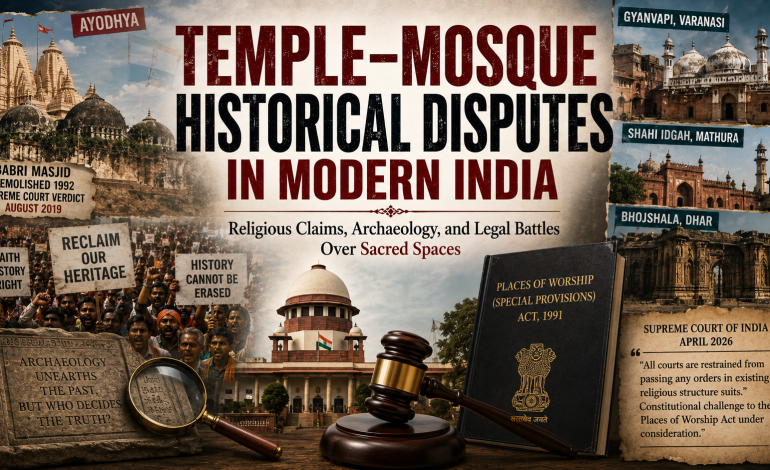
In August 2019, a five-judge bench of the Supreme Court of India delivered a unanimous verdict that would reshape the legal landscape of religious disputes for generations: the site of the 16th-century Babri Masjid in Ayodhya belonged to Hindus, who believed it was the birthplace of Lord Ram. A mosque that had stood for over four centuries, the Court ruled, was “not built on vacant land” . The Muslim community was offered a separate five-acre plot to build a new mosque. The demolition of the Babri Masjid in 1992 — carried out by mobs in the presence of political leaders — was acknowledged as “in violation of status quo orders of this court,” but no punitive action followed . Six years later, the ripples from that judgment have become a tidal wave. Across northern India, courts are now seized of disputes over the Gyanvapi mosque in Varanasi, the Shahi Idgah in Mathura, the Bhojshala complex in Dhar, and at least a dozen other sites where Hindu groups claim that mosques were built atop demolished temples during the medieval period. In April 2026, the Supreme Court intervened to halt the cascade of litigation, restraining all courts from passing orders in existing religious structure suits while it considered a constitutional challenge to the very law that was designed to prevent such disputes: the Places of Worship (Special Provisions) Act, 1991 . This article examines the legal battles, archaeological investigations, and religious claims that define modern India’s temple-mosque disputes, and the fundamental constitutional questions they raise about history, faith, and the secular state.
WHAT – Temple-mosque disputes involve legal battles over religious sites where Hindu groups claim that mosques were built after demolishing pre-existing Hindu temples during medieval Muslim rule. These disputes typically seek court orders for archaeological surveys to investigate the existence of temple remains, and ultimately for the mosque to be removed or replaced with a temple.
WHO – Hindu petitioners include religious trusts (Shri Krishna Janmabhoomi Mukti Nirman Trust), right-wing organizations (Vishva Hindu Parishad, Hindu Front for Justice), and individuals (including BJP leader Subramanian Swamy and members of the Kashi Royal Family). Muslim respondents include mosque management committees (Anjuman Intezamia Masjid Committee, Shahi Idgah management), the Sunni Waqf Board, and organizations like Jamiat Ulama-i-Hind and the All India Muslim Personal Law Board. The Archaeological Survey of India (ASI) conducts court-ordered excavations. The Supreme Court and various High Courts adjudicate, with the central government also involved as a respondent.
WHEN – The Ayodhya judgment was delivered in November 2019. Post-2022, disputes escalated significantly, with ASI surveys at Gyanvapi (2022-2024), High Court rulings on the maintainability of Mathura suits (August 2024), the Allahabad High Court ruling that Mathura suits are not barred by the Places of Worship Act (February 2026), and the Supreme Court’s order staying further orders in all such cases (April 2026).
WHERE – Across northern India, with major active disputes in: Ayodhya (Ram Janmabhoomi-Babri Masjid, resolved by Supreme Court), Varanasi (Gyanvapi mosque), Mathura (Shahi Idgah mosque-Krishna Janmabhoomi), Dhar (Bhojshala-Kamal Maula mosque complex), and other sites including the Shahi Masjid in Sambhal and the Quwwat-ul-Islam mosque in Delhi.
WHY – Hindu petitioners argue that reclaiming these sites is a matter of historical justice, correcting past wrongs of temple destruction during Muslim rule, and restoring access to sacred birthplaces (Ram in Ayodhya, Krishna in Mathura) and revered temples (Saraswati temple in Dhar). Muslim respondents argue that these mosques have been active places of worship for centuries, that the Places of Worship Act bars altering their religious character, and that reopening settled historical claims threatens communal harmony.
HOW – Through public interest litigations and title suits filed in district and high courts; court-ordered ASI scientific surveys using ground-penetrating radar, excavations, and carbon-dating; legal arguments over the applicability of the Places of Worship Act, 1991; and ultimately through judicial verdicts that can transfer possession of disputed sites.
1 THE AYODHYA PRECEDENT – THE VERDICT THAT CHANGED EVERYTHING
The Supreme Court’s November 9, 2019 judgment in the Ayodhya title dispute is the indispensable starting point for understanding the current wave of temple-mosque litigation. It established legal principles and a political precedent that have been invoked — and contested — in every subsequent dispute.
The Key Holdings
A five-judge bench led by then-Chief Justice Ranjan Gogoi delivered a unanimous 1,024-page verdict . The Court held that the 2.77-acre disputed site belonged to Hindus, and directed the central government to form a trust to oversee the construction of a Ram temple. The Court also directed that a separate “prominent” five-acre plot of land be allocated to the Sunni Waqf Board for the construction of a mosque .
Crucially, the Court observed that the Babri Masjid was “not built on vacant land” — implying that some Hindu religious structure had previously occupied the site. The Court stated that the Hindu belief that the site was Lord Ram’s birthplace “could not be disputed” by a court of law .
At the same time, the Court acknowledged that the December 6, 1992 demolition of the mosque was “in violation of the status quo orders of this court” . However, the Court did not order any punitive action against those responsible for the demolition — which occurred in the presence of several leaders of what is now the ruling Bharatiya Janata Party.
The Controversy Within the Verdict
Legal scholars remain divided on the Ayodhya judgment. Faizan Mustafa, vice-chancellor of NALSAR University of Law, termed the verdict “controversial,” explaining: “The judges tried their best to have a kind of a balance but ultimately it’s the mystery of the faith over rule of law, because they said that we can’t be doing anything about the Hindu belief and if they believe that Ram was born here … we have to accept it. Belief is good for the purposes of religion, but can it become a basis to resolve property disputes?”
The Exemption from the Places of Worship Act
The Ayodhya dispute was explicitly exempted from the Places of Worship (Special Provisions) Act, 1991 — a law enacted specifically to freeze the religious character of all places of worship as they existed on August 15, 1947, and to prevent the kind of dispute that Ayodhya represented. Section 5 of the Act excluded the Ayodhya site from its purview, allowing the litigation to proceed.
This exemption has become a central point of contention in subsequent cases. Hindu petitioners argue that if Ayodhya could be exempted, other sites should also be amenable to judicial scrutiny. Muslim respondents argue that Ayodhya was a unique exception, and that the Places of Worship Act was precisely designed to prevent endless litigation over medieval history.
The Aftermath: A “Floodgate” of Litigation
In the immediate aftermath of the Ayodhya verdict, Vishva Hindu Parishad international vice president Acharya Giriraj Kishore declared: “This ruling could pave the way for Hindus to retrieve more Hindu holy places from Muslim occupation. Muslims would now also have to be ready to return to us the land beneath the two mosques where we used to have our temples in Mathura and Varanasi” .
That prediction has proved accurate. From 2020 onwards, courts have been flooded with suits seeking similar relief at mosques across Uttar Pradesh, Madhya Pradesh, and beyond.
2 THE PLACES OF WORSHIP ACT – THE STATUTORY BACKDROP
No discussion of temple-mosque disputes is complete without understanding the Places of Worship (Special Provisions) Act, 1991 — the law that stands as the primary legal barrier to such litigation.
The Purpose of the Act
The Act was passed in 1991, at the height of the Ram Janmabhoomi agitation. Its stated purpose was to prevent the conversion of any place of worship and to maintain the religious character of all places of worship as it existed on August 15, 1947 — the date of India’s independence. Section 3 of the Act bars the conversion of a place of worship from one religious denomination to another. Section 4 prohibits any legal proceeding to alter the religious character of a place of worship as it existed on that date .
Section 2 defines the Act’s scope, while the key provisions under challenge — Sections 2, 3, and 4 — are currently being scrutinized by the Supreme Court for allegedly breaching the principles of secularism and the rule of law .
The Ayodhya Exception
Section 5 of the Act explicitly exempted the Ayodhya site — described as the place where the Ram Janmabhoomi-Babri Masjid dispute was pending — from its purview. This exemption allowed the title suit to proceed and culminated in the 2019 judgment.
The Constitutional Challenge
The constitutional validity of the Places of Worship Act is currently pending before the Supreme Court. Petitioners — including BJP leader Subramanian Swamy, members of the Kashi Royal Family, and religious leaders — have argued that the Act violates fundamental rights under Articles 25, 26, and 29 of the Constitution, which guarantee religious freedom, the right to manage religious institutions, and the protection of cultural heritage .
Critics of the Act argue that the retrospective cutoff date of August 15, 1947 is “arbitrary and irrational,” effectively abating proceedings regarding encroachments by historical invaders . They also claim that the Act is discriminatory because it preserved an exemption for Lord Ram’s birthplace but denies any such exemption for Lord Krishna’s birthplace in Mathura.
In response, organizations such as Jamiat Ulama-i-Hind, the All India Muslim Personal Law Board, and mosque management committees have filed applications supporting the Act. They argue that overturning the law would lead to a “flood of litigation targeting mosques nationwide, disrupting communal harmony” .
The Supreme Court’s April 2026 Intervention
On April 17, 2026, the Supreme Court issued a directive that temporarily halted the escalating cycle of litigation. A bench comprising Chief Justice Sanjiv Khanna and Justices P.V. Sanjay Kumar and K.V. Viswanathan restrained all courts across India from passing any interim or final orders — including survey orders — in pending cases concerning existing religious structures .
The Court also barred the registration of new suits on related claims during the pendency of the constitutional challenge. “While suits may be filed, no suits would be registered, and proceedings undertaken till further orders of this court,” the bench stated. “In the pending suits, courts would not pass any effective interim or final orders, including orders of survey” .
Currently, 18 cases involving 10 mosques or shrines are under litigation across the country . The Supreme Court’s order effectively freezes all of them while it considers the larger constitutional questions.
3 THE GYANVAPI DISPUTE – SCIENCE, FAITH, AND THE SHIVLING
The Gyanvapi mosque dispute in Varanasi represents the most advanced of the post-Ayodhya disputes in terms of judicial proceedings and archaeological investigation.
The Dispute
The Gyanvapi mosque was built in 1669 by Mughal emperor Aurangzeb. Hindu petitioners claim it was constructed after demolishing a portion of the Kashi Vishwanath temple — one of the holiest shrines in Shaivism. The temple had been destroyed and rebuilt multiple times over centuries, with the present Kashi Vishwanath temple standing adjacent to the mosque.
In 2022, five women petitioners filed a suit seeking the right to worship Hindu deities whose idols, they claimed, were located on the outer walls of the mosque complex. The suit led to a court-ordered videography survey of the premises.
The Shivling Claim
During the 2022 videography survey, the petitioners’ lawyers claimed that a structure found within the mosque complex — specifically in the wuzukhana (ablution pond area) — was a “shivling” (a representation of Lord Shiva). Muslim respondents rejected this claim, stating that the structure was a fountain.
The Varanasi district court ordered the Archaeological Survey of India to conduct a scientific survey of the complex to determine whether the mosque was built on the remains of a pre-existing temple . The survey was initially stayed by the Supreme Court but later permitted with the specific exclusion of the wuzukhana area, which was to be sealed .
The ASI Survey and Report
In 2023-2024, the ASI conducted a comprehensive survey using ground-penetrating radar, excavations, and architectural analysis. In August 2024, the Varanasi district court ordered that the ASI survey report be made public, directing that hard copies be provided to both sides . The mosque management committee’s plea to stop the survey was rejected, with the court noting that the survey had already received approval from the Allahabad High Court and the Supreme Court .
While the full report remains confidential, its findings are believed to have identified structural remains suggesting pre-existing construction beneath the mosque — findings that have been cited in subsequent legal arguments.
Current Status
The Gyanvapi case is currently covered by the Supreme Court’s April 2026 stay on all effective orders in pending suits involving religious structures . However, the ASI survey has been completed, and its evidentiary value will be considered once the constitutional challenge to the Places of Worship Act is resolved.
4 THE MATHURA DISPUTE – KRISHNA JANMABHOOMI AND SHAHI IDGAH
The Mathura dispute centers on the Shahi Idgah mosque, also built during Aurangzeb’s reign, which Hindu petitioners claim stands on the site of a temple marking the birthplace of Lord Krishna.
The Core Claim
For devout Hindus, Mathura is not merely another holy city — it is the birthplace of Lord Krishna, one of the most revered deities in the Hindu pantheon. The claim is that a temple existed at the site of Krishna’s birth, which was demolished to construct the Shahi Idgah mosque during Aurangzeb’s rule. The present Shahi Idgah stands adjacent to the Krishna Janmasthal temple complex.
The Legal Battles
Eighteen suits have been filed by the Hindu side seeking possession of the land after the removal of the Shahi Idgah mosque, as well as the restoration of the temple . The Shri Krishna Janmabhoomi Mukti Nirman Trust is among the key petitioners.
In August 2024, the Allahabad High Court delivered a significant ruling that dramatically altered the trajectory of the case. The Court rejected the Muslim side’s applications challenging the maintainability of the Hindu suits. More importantly, the Court held that the suits were not barred by the Limitation Act, the Waqf Act, or the Places of Worship Act, 1991 .
This ruling was a major blow to the Muslim side’s primary legal defense. The Places of Worship Act, which bars litigation to alter the religious character of places of worship as they existed in 1947, was held not to be an impediment to the Mathura suits.
The Dhirendra Shastri Application
In December 2025, the Krishna Janmabhoomi Mukti Nirman Trust moved the Allahabad High Court seeking to include Dhirendra Krishna Shastri — the Peethadheshwar of Bageshwar Dham and a prominent religious figure known for his widely attended “spiritual discourses” — as a “spiritual witness” in the case. The trust claimed that Shastri had “good knowledge of religious traditions as well as historical evidences of this case” .
The application also claimed that there is “no reference to Eidgah in the records of Mathura Municipal Corporation,” suggesting that the mosque structure lacked legal recognition in municipal records .
Current Status
The Allahabad High Court fixed March 12, 2026 as the next hearing date for the amendment application moved by the Muslim side . However, the Supreme Court’s April 2026 stay on all effective orders in religious structure suits now applies to the Mathura litigation as well. The case will remain in abeyance until the constitutional challenge to the Places of Worship Act is resolved.
5 THE BHOJSHALA DISPUTE – SARASWATI TEMPLE OR KAMAL MAULA MOSQUE?
The Bhojshala complex in Dhar, Madhya Pradesh, represents a unique variant of the temple-mosque dispute. Unlike Ayodhya, Varanasi, or Mathura — where active mosques have been in continuous use — the Bhojshala is an ASI-protected monument with a shared usage arrangement.
The Historical Background
The Bhojshala complex is an 11th-century monument built by Raja Bhoj of the Parmar dynasty, a legendary king who ruled Dhar from 1010 to 1055 CE. Hindu petitioners claim it was originally a temple dedicated to Goddess Saraswati (the goddess of knowledge and learning). Muslim respondents identify it as the Kamal Maula Mosque, associated with Sufi saint Maulana Kamaluddin Chishti .
The Present Arrangement
Currently, the complex is under the control of the Archaeological Survey of India. Hindus offer prayers at the site on Tuesdays, while Muslims offer namaz on Fridays — a shared arrangement that has been in place for decades.
The Legal Dispute
The dispute escalated when Hindu Front for Justice and other petitioners filed PILs seeking exclusive worship rights for Hindus at the site. The Muslim side, represented by Qazi Moinuddin (a descendant of the Sufi saint) and the Maulana Kamaluddin Welfare Society, has challenged these petitions .
In April 2026, the Muslim side made several key arguments before the Madhya Pradesh High Court’s Indore bench. Counsel Noor Ahmed Sheikh argued that the site has historically been registered as a “mosque” in government revenue records, and that his client’s ancestors have held the title of Sajjadanashin (spiritual head) of the complex for generations. He contended that those associated with the management of the Kamal Maula Mosque have been in “continuous and peaceful occupation” of the site for a long time .
Counsel Touseef Warsi argued that the Hindu petitioners had made “misleading representations” regarding historical facts. He claimed that available historical sources “do not clearly mention the existence of a Saraswati temple established by Raja Bhoj” . He also raised objections to the ASI’s scientific survey process conducted in 2024, including the methodology of videography, and noted that the ASI had taken “three different positions” in various proceedings regarding the complex, raising “serious questions about judicial scrutiny” .
Current Status
The hearing in the Bhojshala case was scheduled to continue day-to-day. However, like the other disputes, it is now covered by the Supreme Court’s April 2026 stay .
6 THE SUPREME COURT’S BALANCING ACT – STAYING THE FLOOD
On April 17, 2026, the Supreme Court took decisive action to pause the accelerating cycle of temple-mosque litigation across India.
The Order
A bench of Chief Justice Sanjiv Khanna and Justices P.V. Sanjay Kumar and K.V. Viswanathan ordered that while the constitutional challenge to the Places of Worship Act is pending, no court in India shall pass any effective interim or final orders in suits concerning existing religious structures. This includes orders for surveys, which have become a critical tool for Hindu petitioners seeking evidence of pre-existing temple remains .
The Court also barred the registration of new suits on related claims, stating: “While suits may be filed, no suits would be registered, and proceedings undertaken till further orders of this court” .
The Rationale
The Court’s order was clearly intended to prevent a cascading series of lower court orders — each ordering surveys or directing parties to maintain status quo — from creating a fait accompli before the constitutional validity of the Places of Worship Act could be determined. The existing number of contested sites — 18 cases involving 10 mosques or shrines — had already created a climate of uncertainty and communal tension. The Court sought to freeze that situation while it resolved the fundamental legal questions.
The Earlier Warning: February 2026
The April 2026 stay was foreshadowed by the Court’s stance in February 2026. In Ashwini Kumar Upadhyay v. Union of India, an intervenor sought pre-emptive directions against a trial court in Ajmer that was allegedly misapplying the Supreme Court’s earlier orders. The Court refused to pass what it termed “speculative, anticipatory, or pre-emptive directions,” observing: “If somebody passes an order in defiance of that, we will examine… is there any distinguishing circumstance or is it directly in the teeth of the order we have passed. Then consequences will follow” .
The Court’s message was clear: lower courts must abide by the Places of Worship Act as currently in force, and the Supreme Court would not issue blanket stays based on hypothetical violations. However, by April 2026, the volume of litigation and the number of lower court orders had evidently crossed a threshold, prompting the more sweeping intervention.
7 THE ROLE OF THE ARCHAEOLOGICAL SURVEY OF INDIA
The ASI has emerged as a central actor in temple-mosque disputes, its scientific surveys treated by Hindu petitioners as the key to unlocking evidence of pre-existing temples beneath mosques.
The ASI’s Dual Role
The ASI is a government agency with statutory responsibilities for protecting India’s archaeological heritage. In temple-mosque disputes, it is typically ordered by courts to conduct surveys to determine whether a mosque was built on the remains of a pre-existing structure. This places the ASI in a legally and politically sensitive position: its findings become critical evidence in title disputes, yet it is simultaneously an agency of a government that has publicly supported Hindu claims in some cases.
The Gyanvapi Survey
The ASI’s survey at Gyanvapi was conducted under intensive scrutiny and security. The survey used multiple methodologies: ground-penetrating radar to identify subsurface anomalies, excavations to expose structural remains, and architectural analysis of visible features. The survey excluded the wuzukhana area, which the Supreme Court had ordered sealed .
The survey’s findings — which have not been fully released to the public — are believed to have identified structural remains consistent with a pre-existing temple. The Muslim side has objected to the ASI’s methodology, including the process of videography and the handling of evidentiary chain of custody.
The Bhojshala Survey Controversy
In the Bhojshala case, the Muslim side has raised more fundamental objections to the ASI’s role. Counsel Touseef Warsi pointed out that the ASI has taken “three different positions” in various proceedings regarding the same complex. This shifting stance, he argued, raises “serious questions about judicial scrutiny” and suggests that the agency’s findings may be influenced by the political climate rather than purely archaeological considerations .
8 THE SHARED LEGAL ARGUMENTS ACROSS DISPUTES
Despite the unique historical and theological features of each disputed site, the legal arguments across all temple-mosque cases share common structures.
Hindu Petitioners’ Arguments
The Historical Wrong Argument: Hindu petitioners argue that the mosques at Ayodhya, Varanasi, Mathura, and elsewhere were built after the demolition of pre-existing Hindu temples during Muslim rule. This, they contend, was a historical wrong that the courts must remedy by restoring the sites to their original religious character. The destruction of temples, they argue, was an act of religious persecution, and reclaiming these sites is a matter of historical justice.
The Continuous Worship Argument: In many cases, petitioners claim that worship never entirely ceased at these sites, even after the construction of mosques. In Gyanvapi, for instance, the presence of Hindu deity idols on the mosque’s outer walls is cited as evidence that the site retained its Hindu religious character despite the mosque’s presence. In Mathura, the claim is that the site is the birthplace of Krishna, a fact that cannot be erased by subsequent construction.
The Faith Argument: Drawing on the Ayodhya judgment’s holding that Hindu belief about Ram’s birthplace “could not be disputed” by a court, petitioners argue that courts must similarly accept Hindu beliefs about Krishna’s birthplace in Mathura and the sacredness of the Kashi Vishwanath site in Varanasi. Since these beliefs are matters of faith, they argue, they are not subject to evidentiary proof.
The Places of Worship Act Challenge: Petitioners argue that the Places of Worship Act is unconstitutional because it arbitrarily freezes the religious character of sites based on a cutoff date (August 15, 1947) that has no relevance to their historical status. They also argue that the Act violates the right to religious freedom under Article 25 by preventing Hindus from reclaiming sites they consider sacred.
Muslim Respondents’ Arguments
The Places of Worship Act as Shield: Respondents argue that the Act is a valid piece of legislation designed to preserve communal harmony by preventing endless litigation over medieval history. The Act, they argue, represents a legislative bargain: to move on from the past, India would freeze the religious character of all places as they stood at independence. Undermining or repealing the Act, they argue, would open a Pandora’s box of disputes that would destabilize inter-communal relations.
The Limitation Act: Respondents argue that claims to sites based on events that occurred centuries ago are barred by the Limitation Act, which sets time limits for filing property disputes. Even if a temple was demolished to build a mosque in the 17th century, they argue, the descendants of those who worshipped at the temple cannot file a suit in the 21st century seeking possession.
Continuous Use as Mosques: Respondents argue that the mosques in question have been active places of worship for centuries — in some cases for over 400 years. During this period, they have been managed by waqf boards, and Muslims have offered namaz without interruption. This continuous use, they argue, establishes legal rights that cannot be overridden by historical claims that were allowed to lie dormant for centuries.
The Waqf Act: Respondents argue that the disputed sites, having been registered as waqf properties (in many cases in the 1960s or earlier), are protected under the Waqf Act. The Waqf tribunals have exclusive jurisdiction over such properties, and civil courts cannot entertain suits that would interfere with their management.
9 BEYOND THE MAJOR DISPUTES – OTHER CONTESTED SITES
While Ayodhya, Varanasi, Mathura, and Dhar attract the most attention, they are not the only temple-mosque disputes active in Indian courts.
The Jami Masjid, Sambhal
In Sambhal, Uttar Pradesh, a dispute has arisen over the Shahi Jami Masjid, with Hindu petitioners claiming it was built on the site of a Hari Har temple. In November 2024, a local court ordered a survey of the mosque, leading to violence during the survey process.
The Quwwat-ul-Islam Mosque, Delhi
The Quwwat-ul-Islam mosque within the Qutb Minar complex in Delhi — built in the 1190s using material from 27 demolished Hindu and Jain temples — is among the most historically documented cases of temple destruction. While currently an ASI monument rather than an active mosque, the site represents a template for arguments about temple destruction that activists cite in other disputes. A listing of 299 mosques in various districts of Uttar Pradesh that Hindu groups claim were built after demolishing temples has been compiled by some organizations .
The Fate of Other Mosques
One observer noted: “Legal sanctity is not enough to protect religious structures in India, as the Babri Masjid’s demolition showed” . The concern among Muslim communities is that even if the Places of Worship Act remains on the books, widespread litigation and the discovery of ASI survey evidence of temple remains could create political pressure that leads to the de facto conversion of additional mosques — or outright demolition, as happened in Ayodhya in 1992.
10 THE CENTRAL QUESTION – HISTORY, FAITH, AND THE SECULAR STATE
The temple-mosque disputes of modern India raise fundamental questions about the relationship between history, faith, law, and communal harmony.
The Irreconcilable Frameworks
Hindu petitioners frame the disputes in terms of historical justice. They argue that the destruction of Hindu temples by Muslim rulers was a historical wrong, and that reclaiming these sites is an act of restorative justice — undoing the violence of the past. This framework treats the medieval period as a living grievance, and sees the courts as the appropriate forum for addressing it.
Muslim respondents frame the disputes in terms of stability and finality. They argue that centuries of continuous use create legal rights that cannot be extinguished by archaeological evidence of pre-existing structures. The Places of Worship Act, they argue, enshrines the principle of finality: whatever happened before August 15, 1947 is irrelevant to the legal status of a place of worship today. This framework treats the medieval period as settled history and prioritizes present harmony over past grievances.
The Faith Principle
The Ayodhya judgment’s holding that a court cannot dispute a Hindu belief about a sacred site’s significance has proved to be the most significant — and controversial — legal principle from the verdict. Critics argue that it elevates faith over evidence and allows religious belief to displace objective historical inquiry in judicial proceedings.
Supporters argue that questions of religious faith are inherently outside the competence of courts. If a community genuinely believes that a site is the birthplace of a deity, they argue, that belief is a social fact that the court must accept, regardless of whether archaeologists can verify it. The court’s role is to adjudicate property disputes, not to sit in judgment over the validity of religious beliefs.
The Unanswered Question
The ultimate question before the Supreme Court in the Places of Worship Act challenge is whether the Act’s freeze on religious character is constitutional. If the Court upholds the Act, the current wave of temple-mosque litigation will largely end — at least for sites whose religious character was settled in 1947. If the Court strikes down the Act, every mosque built on a site with evidence of a pre-existing temple could become the subject of litigation.
The April 2026 stay on all effective orders in these cases suggests that the Court is acutely aware of the stakes. As one observer noted: “The verdict will open a floodgate of law suits against any mosque claiming that it was built on a temple site. Lower courts are likely to follow the Supreme Court verdict allowing building a temple on the site of a mosque” .
The Court’s ultimate resolution of the constitutional challenge will determine whether India’s temple-mosque disputes remain a manageable set of exceptional cases or become a permanent feature of the country’s legal and political landscape — with consequences for the 200 million Muslims who call India home.
MAJOR ACTIVE DISPUTES (2026)
| Site | Location | Claimant | Current Status | Key Developments |
|---|---|---|---|---|
| Ram Janmabhoomi-Babri Masjid | Ayodhya, UP | Hindus (resolved) | Temple constructed; mosque to be built on 5-acre plot | SC verdict Nov 2019 |
| Gyanvapi Mosque | Varanasi, UP | Hindus | Survey completed, frozen by SC April 2026 | ASI survey 2023-24; “shivling” claim |
| Shahi Idgah Mosque | Mathura, UP | Hindus | Frozen by SC April 2026 | HC Aug 2024 held suits maintainable; not barred by Place of Worship Act |
| Bhojshala-Kamal Maula | Dhar, MP | Both sides | Frozen by SC April 2026 | ASI survey 2024; revenue records dispute |
| Shahi Jami Masjid | Sambhal, UP | Hindus | Survey ordered; violence during survey | Survey completed 2024 |