SANATAN DHARMA IN PUBLIC INSTITUTIONS AND EVENTS
TOPIC 35 SANATAN DHARMA IN PUBLIC INSTITUTIONS AND EVENTS Debates on Cultural Representation versus State Neutrality In December 2025, a three-day event titled “Sanatan Rashtra Shankhnaad Mahotsav” took place in

TOPIC 35
SANATAN DHARMA IN PUBLIC INSTITUTIONS AND EVENTS
Debates on Cultural Representation versus State Neutrality
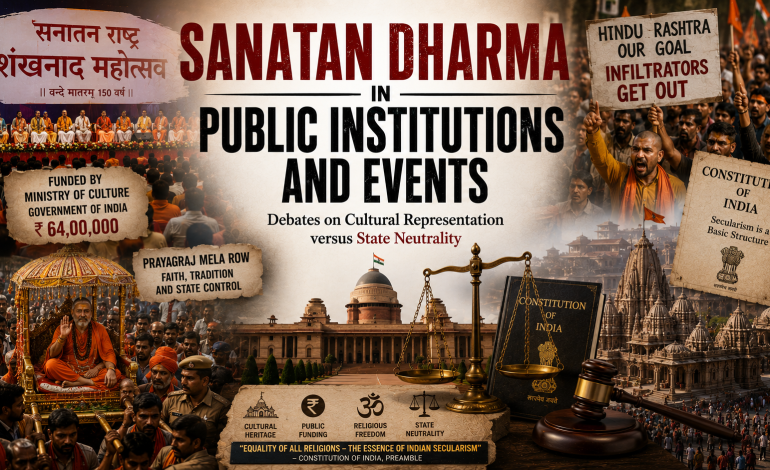
In December 2025, a three-day event titled “Sanatan Rashtra Shankhnaad Mahotsav” took place in New Delhi’s Talkatora Stadium, featuring speeches that described Muslims as “infiltrators” and called for the establishment of a “Hindu Rashtra” . What transformed this gathering from a fringe religious assembly into a national controversy was not the content of the speeches alone, but the source of its funding: approximately 6.4 million rupees from the Union Ministry of Culture, allocated under programs marking the 150th anniversary of Vande Mataram . Union ministers were in attendance. Public money had been deployed to support an event promoting the expulsion of religious minorities.
Just weeks earlier, the Prayagraj Mela Authority had issued notices to Shankaracharya Avimukteshwaranand Saraswati, questioning his right to use the “Shankaracharya” title and criticizing his insistence on traveling by palanquin during the Magh Mela’s crowded Mauni Amavasya bathing ritual . The resulting confrontation—police pulling the hair of young disciples, a hunger strike by the Shankaracharya, and political parties lining up on either side—exposed the fragility of the relationship between religious authority and state administration .
These two incidents, occurring within weeks of each other, frame the central tension of this topic. On one hand, critics accuse the state of using public funds to promote a majoritarian religious agenda while claiming secular neutrality . On the other hand, religious leaders accuse the state of interfering in Hindu affairs—controlling temple funds, regulating religious gatherings, and imposing rules that they argue disrespect Sanatan traditions . The question is no longer whether Sanatan Dharma should be represented in public institutions and events, but on whose terms and under whose control.
This article examines the legal framework governing religion-state relations, the controversies surrounding public representation of Sanatan Dharma, the management of religious institutions by state authorities, and the fundamental debate over India’s secular character.
WHAT – The debate over Sanatan Dharma in public institutions and events concerns the extent to which the state can or should represent Hindu religious traditions through its funding, infrastructure, ceremonial practices, and administrative control. It encompasses state funding of religious events, government management of temples and shrines, regulation of religious gatherings, display of religious symbols in public spaces, and the presence of religious practices in state-run institutions like schools and universities.
WHO – The Union and state governments (particularly BJP-led administrations) allocate funds for religious events and manage temple affairs. Religious leaders, including Shankaracharyas and mahamandaleshwars, claim authority over Hindu religious matters and resist state interference. Opposition political parties (Congress, SP, AAP) accuse the ruling party of using Sanatan Dharma for political mobilization while being selectively “anti-Hindu” in administrative matters . The judiciary, including the Supreme Court and High Courts, adjudicates disputes over religious rights and state authority. Civil society organizations debate the meaning of secularism and the legitimate scope of state engagement with religion.
WHEN – The debate has intensified between 2024 and 2026, with key events including the Mahakumbh 2025, the Sanatan Rashtra Shankhnaad Mahotsav in December 2025, the Magh Mela controversy in January 2026, and the UGC regulations controversy in January 2026. The Delhi High Court’s refusal to entertain a PIL for a “Sanatan Dharm Raksha Board” occurred in November 2024.
WHERE – Across India, with particular intensity in Uttar Pradesh (Prayagraj’s Mahakumbh and Magh Mela, Varanasi’s Kashi Vishwanath corridor), New Delhi (the Sanatan Rashtra Shankhnaad Mahotsav at Talkatora Stadium), and in the Supreme Court and High Courts where constitutional challenges are pending.
WHY – Proponents argue that Sanatan Dharma is the civilizational bedrock of India and that state support for Hindu traditions is legitimate cultural preservation, not religious favoritism. They point to similar state support for other religions, such as the Haj subsidy and Waqf Board management of Muslim properties. Critics argue that state funding of Hindu religious events, particularly those promoting anti-minority rhetoric, violates constitutional secularism and that state control over Hindu temples while other religions manage their own affairs constitutes discriminatory treatment.
HOW – Through budget allocations for religious events (Kumbh Mela preparations, cultural festivals), administrative regulations governing religious gatherings (Mela authorities issuing permits and rules), statutory control over temple management (state-appointed boards for major shrines), judicial rulings on religious rights, and political discourse that frames Sanatan Dharma as either India’s civilizational heritage requiring state support or as a private religious matter from which the state must remain neutral.
1 DEFINING THE TERMS – SANATAN DHARMA, HINDUISM, AND SECULARISM
The debate over Sanatan Dharma in public institutions is complicated by the contested meanings of the term itself.
The Meaning of Sanatan Dharma
“Sanatan” translates as eternal, and “Dharma” as duty or cosmic order. For believers, Sanatan Dharma literally means the eternal religion . However, the relationship between Sanatan Dharma, Hinduism, and Hindutva remains ambiguous. The BJP has described it as synonymous with Hinduism and Hindutva, a connection that critics argue is politically motivated .
Indian mythologist Devdutt Pattanaik and Indo-Czech Indologist Julius Lipner have noted that “Hinduism” itself is a nomenclature not mentioned in the Vedas. The two words together—Sanatan and Dharma—have been used primarily in the Shrimad Bhagwat Gita . This ambiguity allows political actors to deploy the term strategically: as a marker of civilizational identity, as a synonym for Hindu religious practice, or as a broader philosophical framework.
Those who oppose the political use of Sanatan Dharma argue that the term has been co-opted to singularly uphold the varnashrama (caste system), working to the detriment of those who want to break the shackles of the old order . Udhayanidhi Stalin’s controversial comments on Sanatan Dharma—which triggered a national political firestorm in 2023—drew attention to what he termed the problems within the Sanatan framework, particularly its association with caste hierarchy.
The Constitutional Framework of Secularism
The word “secularism” was not originally in the Constitution’s Preamble. B.R. Ambedkar argued against its separate mention, believing that the Constitution was inherently imbued with the spirit of secularism and did not need explicit labeling . Both terms—”secularism” and “socialism”—were added to the Preamble only in 1976 through the 42nd Amendment, during the Emergency declared by Indira Gandhi .
However, the fact that the term was added later does not mean secularism was absent from the constitutional vision. The framers rejected the idea of a Hindu rashtra. Indian nationalism from the freedom movement onward was never a parochial one for one ethnicity, religion, or language. Independent India held onto a distinct vision of Indian nationalism, sharply diverging from the dangerous idea of nationalism that ruled Europe in the 1930s .
The contemporary debate asks: Does secularism require the state to be strictly neutral toward all religions, or does it permit the state to support religious traditions as long as no single religion is favored? And if the latter, does state support for Sanatan Dharma cross the line from cultural preservation into religious favoritism?
2 STATE FUNDING OF SANATAN EVENTS – THE SANATAN RASHTRA SHANKHNAAD CONTROVERSY
The most direct form of state engagement with Sanatan Dharma is financial: public funds allocated to religious events and festivals.
The Mahotsav and Its Funding
In December 2025, the Sanatan Sanstha organized the “Sanatan Rashtra Shankhnaad Mahotsav” at Talkatora Stadium in New Delhi. The event was funded through a grant of approximately 6.4 million rupees from the Union Ministry of Culture, allocated under programs commemorating the 150th anniversary of the national song Vande Mataram .
The grant’s stated purpose—cultural commemoration—is facially neutral. However, according to Congress spokesperson Dr. Ragini Nayak Basoya, the content of the event was anything but neutral. Several speakers described Muslims as “infiltrators,” discussed methods of religious conversion, and called for the large-scale expulsion of Muslims and the establishment of a “Hindu Rashtra” .
The Presence of Union Ministers
The controversy extended beyond funding to attendance. Union ministers Gajendra Singh Shekhawat, Shripad Yesso Naik, and Sanjay Seth, along with Delhi minister Kapil Mishra, were present at the gathering . Their presence, critics argue, conferred legitimacy on the event and its messaging.
Basoya stated: “Presenting such divisive positions at a gathering funded by public money indicates that hate speech has shifted from the fringes to the political mainstream” . She called on Prime Minister Modi to clarify the rationale behind the allocation of funds and to state whether the government supports the polarization of society.
The Defense
Defenders of the funding argue that the government supports cultural and religious events across all communities—the Haj subsidy for Muslims, the management of Waqf properties, grants to Christian missionary schools. The Ministry of Culture funds events that fall within its mandate of preserving India’s diverse cultural heritage. The content of speeches at a funded event, they argue, cannot be attributed to the government, which cannot be expected to police every word spoken at every gathering it supports.
However, critics counter that the government exercised due diligence in other contexts, and the absence of such diligence in this case was itself a policy choice.
3 THE MAHAGATHBANDHAN – STATE MANAGEMENT OF RELIGIOUS GATHERINGS
The Kumbh Mela—the largest religious gathering in the world—represents both the state’s most extensive engagement with Sanatan Dharma and the most frequent site of conflict between religious sentiments and administrative rationality.
The Mahakumbh 2025 as State-Sanatan Collaboration
The Mahakumbh 2025 in Prayagraj was presented as a showcase of both Sanatan Dharma and the Uttar Pradesh government’s administrative capabilities. City walls were transformed into vibrant canvases depicting scenes from the Ramayana, the 108 dancing postures of Nataraja, and elements of Hindu mythology . Artists described their work as “promoting Sanatan culture,” and the project received state support .
The scale of the transformation was immense: over 10 lakh square feet of wall space covered with murals, featuring contributions from local and national artists, including hearing-impaired youths working alongside Fine Arts students . The artworks, artistes noted, could last up to five years with proper maintenance, leaving a lasting imprint of Sanatan iconography on the city’s public spaces .
This represented state support for Sanatan cultural expression—not theocratic governance, but a government choosing to invest public resources in the beautification and promotion of a religious event. The question is whether this constitutes legitimate cultural promotion or unconstitutional religious favoritism.
The Avimukteshwaranand Controversy
The Magh Mela in January 2026—held annually at the Sangam in Prayagraj, the confluence of the Ganga, Yamuna, and the mythical Saraswati—became the site of a major confrontation between religious authority and state administration.
Shankaracharya Avimukteshwaranand Saraswati, the head of the Jyotish Peeth (one of the four cardinal mathas established by Adi Shankaracharya), insisted on traveling to the Triveni (triple confluence) for the Mauni Amavasya bath in a palanquin, carried by his disciples. The Mela administration—responsible for managing crowds that numbered in the lakhs (hundreds of thousands)—refused permission, citing safety concerns .
On January 18, during Mauni Amavasya, the conflict turned physical. A video emerged showing a policeman pulling the hair of a young sadhu (disciple) . The administration claimed that the Shankaracharya’s insistence on proceeding by palanquin in an already dense crowd risked disorder. The Shankaracharya and his supporters claimed that the administration had insulted them, physically assaulted young disciples, and prevented them from bathing.
The Aftermath
Avimukteshwaranand began a hunger strike at the site, which continued for seven days . The Mela administration issued two notices to him, questioning his right to use the “Shankaracharya” title—a position whose legal status, they noted, was under consideration in the Supreme Court .
The response of the Uttar Pradesh government was split. Chief Minister Yogi Adityanath, speaking at an event in Haryana, took a jibe at Avimukteshwaranand, comparing him to “Kalnemi” (a demon from Hindu mythology known for deceit) without naming him . Deputy Chief Minister Keshav Prasad Maurya offered a more conciliatory response: “There is no provision for disrespecting any revered saint or Shankaracharya. If anyone has done so, we will investigate and take action” .
Political observers noted that the government’s primary concern was its image. For the first time, the opposition had been given an opportunity to accuse the BJP of being “anti-Hindu” . The Congress and Samajwadi Party actively supported Avimukteshwaranand, with SP leader Akhilesh Yadav speaking to him personally and Congress state president Ajay Rai (along with Prayagraj MP Ujjwal Raman Singh) meeting him .
The Vishva Hindu Parishad expressed a nuanced view. VHP believed that such a dispute should not have occurred at the Magh Mela. Rules and laws are equal for everyone, and if there is a ban on traveling to the Sangam by palanquin, the Shankaracharya should have followed it. However, the incident of pulling Batuks’ (young disciples) hair and physical assault was condemnable and weakens Hindu unity .
4 JUDICIAL RESPONSES – THE COURTS AND SANATAN REPRESENTATION
The Delhi High Court’s Refusal
In November 2024, the Delhi High Court declined to entertain a Public Interest Litigation (PIL) seeking directions to the central government to constitute a religious body like a “Sanatan Dharm Raksha Board” for the protection of Sanatan Dharma and its culture .
The bench, led by Chief Justice Manmohan and comprising Justice Tushar Rao Gedela, stated that the court cannot intervene in matters of policy .
The petitioner, Sanatan Hindu Sewa Sangh Trust, had argued that while the government has constituted various bodies or boards for the followers of different religions (such as the Waqf Board for Muslims and the Minority Commissions for Christians, Sikhs, and others), followers of Sanatan Dharma have no dedicated board to protect their rights and customs .
The petition also pointed out that many temples in the country are controlled and managed by the government, with funds collected from these temples, yet no dedicated national body exists for their protection. The plea argued that the government is legally bound to protect the rights and customs of the Sanatan/Hindu religion .
The High Court’s refusal to entertain the petition was not a ruling on the merits—it did not say such a board should not exist. It merely held that the creation of such a body is a policy matter for the executive and legislature, not for judicial intervention.
The Shankaracharya Title Question
The question of who can legitimately claim the “Shankaracharya” title—and whether the state has any role in determining this—is currently pending before the Supreme Court. A case has been ongoing since 2022 regarding the use of the title .
When the Prayagraj Mela Authority issued notices questioning Avimukteshwaranand’s right to the title, he responded that the Supreme Court had not issued any order prohibiting him from continuing in the position of Shankaracharya . Reliance on court proceedings — a strategic invocation of legal ambiguity — has allowed the current situation to protract without resolution.
This case raises a fundamental question: Does the secular state have any business determining who is and who is not a legitimate religious authority within Hinduism? Or should such matters be left entirely to religious communities themselves?
The UGC Regulations Controversy
In January 2026, Shankaracharya Avimukteshwaranand alleged that new University Grants Commission (UGC) regulations were “completely anti-Sanatan Dharma” . He claimed that the government wants to divide Sanatan Dharma and incite conflict between different castes.
He argued: “In the system of Sanatan Dharma, castes were not created for conflict, but to secure the livelihood and balance of all sections of society. What does the government ultimately want to achieve in the country with this law?”
He alleged that through the UGC, one caste has been pitted against another, which will increase conflict in society. “This will lead to increased internal conflict, and ultimately, the entire Hindu society will suffer. This is a law that divides the Hindu community itself” .
This accusation—that the secular state is actively undermining Sanatan Dharma through its university regulations—represents a significant escalation in religious leaders’ criticism of the government. Ironically, the same religious leaders who accuse the state of interfering in Hindu affairs (through temple management, Mela regulations, and university policies) are also those who demand state protection for Hindu rights and state funding for Hindu events.
5 STATE CONTROL OF TEMPLES AND SHRINES
A long-standing dimension of the Sanatan-state relationship is government management of Hindu temples.
The Temple Control Paradox
As noted in the PIL before the Delhi High Court, many temples in India are controlled and managed by government authorities, with funds collected from these temples . The Shri Mata Vaishno Devi Shrine Board, the Tirumala Tirupati Devasthanams, the Somnath Trust, and countless other temple bodies are either directly managed by state-appointed boards or subject to significant government regulation.
The Vaishno Devi shrine board row, referenced in a Times of India discussion , is emblematic of this tension. The state argues that its management of these temples ensures proper administration, prevents corruption, and protects devotees’ interests. Critics argue that the state’s control over Hindu temples—while Muslim waqf properties are managed by community-controlled Waqf Boards and Christian properties by church authorities—represents unequal treatment of Hinduism compared to other religions.
The Defense of State Control
Defenders of state control argue that Hindu temple administration has historically been decentralized and prone to mismanagement. The state’s intervention, through statutory boards and appointed trustees, ensures transparency and accountability. Moreover, they argue, the state does not “control” the religious practices of these temples—it merely manages their finances and administration.
The Criticism of State Control
Religious leaders counter that state control of temples is a form of majoritarian governance—the state treats Hindu temples as public resources to be managed according to bureaucratic rationality rather than religious tradition, while allowing other religious communities to manage their own affairs. The demand for a “Sanatan Dharm Raksha Board” was partly motivated by the desire to have Hinduism treated on par with other religions—with a dedicated statutory body to manage its affairs.
6 THE CULTURAL REPRESENTATION DEBATE – PUBLIC SPACES AND SANATAN ICONOGRAPHY
Beyond funding and management, the debate extends to the representation of Sanatan Dharma in public spaces.
The Mahakumbh Murals
The transformation of Prayagraj’s walls for Mahakumbh 2025 represented an unprecedented investment in Sanatan iconography in public spaces . Scenes from the Ramayana, depictions of Lord Ram, Mata Sita, Hanuman, Shri Krishna, Bholenath, and the 108 dancing postures of Nataraja were painted across the city .
Supporters argue that this is cultural expression, not religious imposition. India’s civilizational heritage is predominantly shaped by Sanatan traditions, and representing that heritage in public spaces is legitimate cultural preservation. Moreover, they note, the government also supports Islamic and Christian art and architecture.
Critics argue that the scale and intensity of the representation—funded by the state, promoted by the government, and explicitly framed as “promoting Sanatan culture”—crosses the line from cultural preservation to religious favoritism. They ask: Would the government invest similar resources in painting Islamic calligraphy or Christian iconography on public walls? And if not, why not?
The Indo-Japanese Cultural Park
A more nuanced example of cultural diplomacy is the proposed ₹124 crore Indo-Japanese Cultural Park in Prayagraj, to be developed along the banks of the Yamuna in the Arail area . The park will symbolically represent the confluence of Indian Sanatan and Japanese Shinto traditions, featuring a Torii Gate, a Japanese Garden, a Zen Garden, and installations depicting traditional Japanese art forms like the Tea Ceremony and Ikebana, alongside zones inspired by Indian temple architecture, yoga, music, and dance traditions .
Officials stated that the park aims to celebrate harmony, peace, and global brotherhood—values rooted in India’s philosophy of Vasudhaiva Kutumbakam (the world is one family) and Japan’s Wa (harmony) .
This project—state-funded, celebrating Hindu-Japanese religious and cultural parallels—represents a form of cultural representation that is difficult to characterize as “majoritarian imposition.” At the same time, it is undeniably state promotion of a Hindu-associated cultural tradition.
7 THE POLITICAL DIVIDE – SANATAN AS ELECTORAL STRATEGY
The debate over Sanatan Dharma in public institutions cannot be separated from electoral politics.
The BJP’s Sanatan Strategy
Political scientist Mohd. Saqib noted that by whipping up a storm over comments critical of Sanatan Dharma (such as Udhayanidhi Stalin’s remarks in 2023), Prime Minister Modi and the BJP “have clearly signalled their intention to stir the Hindutva pot” . The strategy, he argued, was to try to dub opposition parties as anti-Hindu by linking Hinduism, Sanatan Dharma, and Hindutva deliberately .
Critics argue that the state’s funding of Sanatan events, its promotion of Sanatan iconography, and its political defense of Sanatan traditions are inseparable from this electoral strategy. The government, they argue, is not neutrally supporting cultural heritage—it is mobilizing Hindu votes.
The Opposition’s Counter-Strategy
The opposition’s response has been twofold. First, to accuse the government of being “anti-Hindu” in practice—citing incidents like the Avimukteshwaranand confrontation and the state’s control of temple funds—while claiming to be pro-Hindu in rhetoric. As political experts noted, for the first time, the opposition got an opportunity to accuse the BJP of being anti-Hindu through the Magh Mela controversy .
Second, to argue that the government’s Sanatan politics is a distraction from substantive governance failures. By creating controversies over Sanatan Dharma, the government diverts attention from unemployment, healthcare, education, and economic distress.
8 THE CENTRAL QUESTION – CULTURAL REPRESENTATION OR RELIGIOUS FAVORITISM?
The debate over Sanatan Dharma in public institutions and events ultimately turns on a question that the Constitution does not explicitly answer: What does secularism mean in practice?
Two Competing Visions
Vision One: Strict Neutrality. The state must be strictly neutral toward all religions. It cannot fund religious events, display religious symbols on public property, or manage religious institutions. Religion is a private matter, and the state’s role is to protect the right to practice religion without interfering in or promoting any religious tradition.
Vision Two: Equal Respect. The state may engage with religious traditions as long as it does so equally. Funding a Hindu festival is acceptable if funding a Muslim or Christian festival is equally available. Displaying Hindu iconography is acceptable if similar opportunities exist for other religious traditions. The state should not be hostile to religion; it should be equally accommodating of all religions.
The Problem of Asymmetry
The difficulty is that India’s religious landscape is asymmetric. Hindus constitute approximately 80% of the population. A policy of “equal engagement”—funding religious events in proportion to population—would inevitably result in far more state support for Hindu traditions than for any other religion. Is this neutrality or majoritarianism?
Similarly, the state’s historical management of Hindu temples—inherited from colonial and post-colonial practices—has no parallel for other religions. Whether this is a legacy of unequal treatment (special state control of Hindu institutions that other communities do not face) or a reflection of Hinduism’s decentralized organizational structure is disputed.
The Unresolved Constitutional Question
The Supreme Court has not provided definitive guidance on these questions. The Places of Worship Act challenge and the Shankaracharya title case are currently pending. In the absence of judicial clarity, the executive and legislative branches have moved forward—funding Sanatan events, investing in Sanatan iconography, and managing Sanatan institutions—while critics argue that this constitutes a slow but steady erosion of constitutional secularism.
KEY INCIDENTS AND DEBATED POINTS (2024-2026)
| Incident | Date | State Action | Criticism |
|---|---|---|---|
| Sanatan Rashtra Shankhnaad Mahotsav | Dec 2025 | ₹64 lakh grant to event; ministers attended | Public funds used for anti-Muslim hate speech |
| Mahakumbh Murals | Oct 2024-Feb 2025 | State-funded Sanatan iconography on public walls | Implicit religious favoritism through public space |
| Avimukteshwaranand-Mela Authority conflict | Jan 18, 2026 | Notices issued to Shankaracharya; police pulled disciples’ hair | State disrespect of Hindu religious authority |
| Shankaracharya hunger strike | Jan 18-25, 2026 | Government refused apology | Religious leaders accuse state of “anti-Hindu” conduct |
| UGC Regulations controversy | Jan 2026 | New university regulations enacted | Accused of pitting castes against each other, dividing Hindus |
| Delhi HC refuses Sanatan Board PIL | Nov 2024 | Court declines to intervene | Leaves policy matter to executive |
| Indo-Japanese Cultural Park announcement | Nov 2025 | ₹124 crore state-funded project | Cultural diplomacy or religious promotion? |