RELIGIOUS SLOGANS IN POLITICAL AND PUBLIC SPACES
TOPIC 36 RELIGIOUS SLOGANS IN POLITICAL AND PUBLIC SPACES The Changing Language of Nationalism and Patriotism In April 2026, the streets of Kalyani in West Bengal’s Nadia district erupted with

TOPIC 36
RELIGIOUS SLOGANS IN POLITICAL AND PUBLIC SPACES
The Changing Language of Nationalism and Patriotism
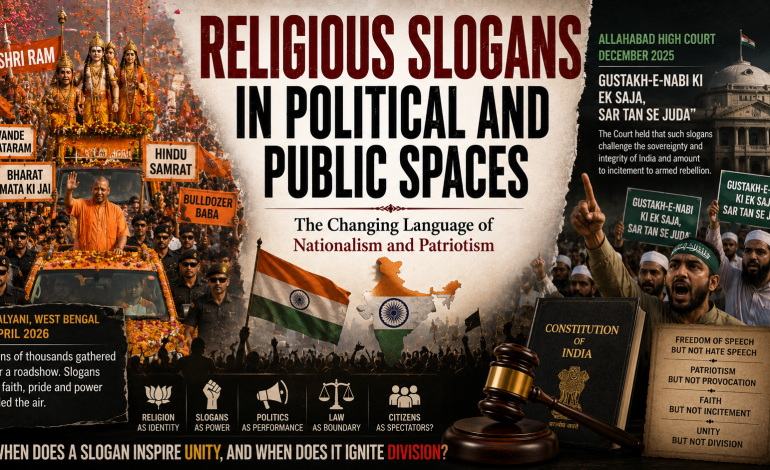
In April 2026, the streets of Kalyani in West Bengal’s Nadia district erupted with a chorus of slogans. Tens of thousands had gathered for a roadshow led by Uttar Pradesh Chief Minister Yogi Adityanath, who had crossed state borders to campaign for the BJP’s candidate in the upcoming Assembly elections. The air vibrated with chants of “Jai Shri Ram,” “Vande Mataram,” “Bharat Mata ki Jai,” “Hindu Samrat,” and even the moniker “Bulldozer Baba” — a reference to the Chief Minister’s extra-judicial demolition campaigns in Uttar Pradesh . Ahead of the chariot, artists dressed as Lord Ram, Sita, Lakshman, and Hanuman walked as living icons, receiving reverence from the crowd. Saffron flags, the colour synonymous with Hindu asceticism and Hindutva politics, fluttered everywhere.
Just four months earlier, in December 2025, the Allahabad High Court had issued a starkly different ruling on a different slogan. Denying bail to an accused in the Bareilly violence case, the Court held that raising the slogan “gustakh-e-nabi ki ek saja, sar tan se juda” — which calls for the beheading of anyone who insults the Prophet — amounted to a direct challenge to “the sovereignty and integrity of India” . The Court observed that such expressions fall beyond protected speech and constitute incitement to armed rebellion, punishable not only under criminal law but also contrary to the basic tenets of Islam, which the Court noted instructs meeting disrespect with kindness .
Between these two events — the jubilant, mass chanting of Hindu devotional slogans at a political rally and the judicial condemnation of a Muslim slogan as seditious — lies the contested terrain of religious slogans in Indian public and political spaces. The contrast raises urgent questions: When does a slogan become an expression of legitimate patriotism, and when does it become a communal provocation? Why are “Jai Shri Ram” and “Vande Mataram” celebrated as nationalist affirmations while other religious slogans are policed as threats to public order? And what does the changing language of Indian nationalism tell us about the relationship between religion, state, and citizenship in contemporary India?
This article examines the legal framework governing religious slogans, the political uses of slogan-shouting in electoral campaigns, the judicial responses to different kinds of sloganeering, and the fundamental debate over whether India’s public spaces are becoming arenas for competing religious assertions rather than shared civic identity.
WHAT – Religious slogans in political and public spaces refer to chants, catchphrases, and rallying cries that invoke religious figures, symbols, or sentiments, deployed during political campaigns, protests, religious processions, and state ceremonies. These include “Jai Shri Ram,” “Vande Mataram,” “Bharat Mata ki Jai,” “Allahu Akbar,” “Sar tan se juda” variants, “Har Har Mahadev,” and others. The question is whether these constitute legitimate expressions of faith and patriotism, permissible political speech, or impermissible incitement to communal hatred.
WHO – Political parties, particularly the BJP and its allies, use religious slogans as campaign tools. Religious leaders and organizations (Vishva Hindu Parishad, Jamiat Ulema-e-Hind) mobilize supporters through sloganeering. Protestors and demonstrators raise slogans to assert collective identity. Law enforcement and courts (Supreme Court, High Courts) adjudicate when slogans cross into hate speech or sedition. Minority community members face the choice of participation or resistance.
WHEN – The intensification of religious sloganeering has occurred over the past decade, with significant spikes during the 2019, 2024, and 2026 election cycles. Key events include the Ayodhya mobilization (pre-1992 and post-2019), the Shaheen Bagh protests (2019-2020), the Rajasthan Vande Mataram directive (November 2025), the Bareilly violence (September 2025) and subsequent High Court ruling (December 2025), and the Bengal roadshow (April 2026).
WHERE – Across India, with particular intensity in Uttar Pradesh, West Bengal, Rajasthan, Delhi, and Karnataka. Sloganeering occurs in election rallies, religious processions, protest sites, educational institutions (following state directives on Vande Mataram), and increasingly on social media platforms where slogans circulate virally.
WHY – Proponents argue that religious slogans, particularly those linked to Hindu devotional traditions, are inseparable from Indian national identity and that chanting them is an assertion of patriotism. They accuse critics of “pseudo-secularism” and minority appeasement. Critics argue that the state’s selective promotion and prohibition of religious slogans violates constitutional secularism, that forced participation in religiously-coded patriotism infringes religious freedom, and that the normalization of majoritarian slogans marginalizes minority communities.
HOW – Through mass mobilization at rallies where slogans are chanted collectively to generate emotional energy and solidarity; through state directives mandating the singing of Vande Mataram in schools and madrasas; through judicial rulings that define the limits of permissible sloganeering; through social media amplification that spreads slogans beyond their original context; and through violent confrontations when competing slogans clash.
THE CONSTITUTIONAL FRAMEWORK – WHERE SLOGANS MEET RIGHTS
The regulation of religious slogans in India operates at the intersection of multiple constitutional provisions. Understanding these is essential before examining specific controversies.
Article 19(1)(a) guarantees freedom of speech and expression. This protects the right to raise slogans, chant religious invocations, and express political opinions. However, Article 19(2) permits the State to impose “reasonable restrictions” on this freedom in the interests of, among other things, “sovereignty and integrity of India,” “public order,” and “incitement to an offence.”
Article 25 guarantees “freedom of conscience and the right freely to profess, practise and propagate religion.” This protects the chanting of religious slogans as an aspect of religious practice. However, Article 25 itself is subject to “public order, morality and health” and to other provisions of the Constitution.
Article 15(1) prohibits discrimination on grounds of religion. However, the State may make special provisions for the advancement of socially and educationally backward classes — a provision that has been controversially invoked in debates over minority rights but has limited direct application to slogan regulation.
On April 28, 2026, a nine-judge Supreme Court Constitution bench hearing petitions related to the Sabarimala temple case reinforced a crucial distinction: while religious denominations enjoy autonomy in matters of worship, such freedom is not absolute and cannot justify disrupting public life . Justice B.V. Nagarathna observed: “Suppose there is a temple, they want to have an annual festival, like you have the annual cart or chariot festival. You cannot block all the roads around the temple. That has nothing to do with religion. You do your religious activity, but not by blocking the roads. The State can always step in to regulate” .
Justice Ahsanuddin Amanullah added: “There cannot be anarchy. Take a dargah or a temple. There will be elements associated with the institution, the manner of worship, the sequence in which things are done. Somebody has to regulate that. It cannot be that everyone says I will do whatever I want, or that the gates remain open at all times without any control” .
This distinction — between protected religious practice and secular activity that affects the public — is central to understanding how courts distinguish legitimate from illegitimate sloganeering. A slogan chanted within a religious institution as part of worship may receive constitutional protection. The same slogan chanted at a political rally, or chanted in a manner that incites violence against another community, falls within the State’s regulatory power.
“VANDE MATARAM” – THE SLOGAN THAT BECAME A NATIONAL SONG
No religious slogan in modern Indian history has generated as much controversy as Vande Mataram. Written by Bankim Chandra Chatterjee in the 1870s and published in his 1882 novel Anandamath, the song was adopted as India’s National Song in 1950 . The phrase “Vande Mataram” — “Mother, I bow to thee” — was a revolutionary cry during the freedom struggle, with the British government issuing circulars against it, yet being unable to stop people from shouting it .
However, the song’s religious content has always been contested. Some verses of Vande Mataram describe the homeland as a goddess — “Durga” and “Lakshmi” — an anthropomorphization of the nation that contradicts the monotheistic beliefs of Muslims and Christians. When the Constituent Assembly debated the national song in 1950, a compromise was reached: only the first two stanzas (which do not contain explicit idolatrous references) would be recognized as the National Song, and singing it would be voluntary, not compulsory .
The Rajasthan Madrasa Directive
In November 2025, the Rajasthan government announced that Vande Mataram would be sung daily in all government schools, colleges, and madrasas, coinciding with the song’s 150th anniversary . Education Minister Madan Dilawar defended the directive as “a patriotic initiative aimed at fostering unity and respect for the nation,” stating: “Vande Mataram is our pride; it should be sung in every educational institution. It is a song that binds everyone together” .
Muslim organizations reacted with immediate opposition. Khanu Khan Budhwali, former Chairman of the Rajasthan Waqf Board, described the order as “an attack on freedom of worship and religious rights,” arguing: “India is a democratic country where every citizen has the freedom to pray and worship according to his religion. The government has no right to decide who should recite which prayer” .
Imran Sheikh, a madrasa teacher in Jaipur, expressed the discomfort felt by many educators: “We teach our students both secular subjects and religious studies. Suddenly mandating a song that is not part of our religious tradition feels like an intrusion. Our priority is to provide quality education, not to participate in political displays” .
The Central Government’s Six-Stanza Mandate
The controversy escalated in February 2026 when the Union Ministry of Home Affairs issued detailed guidelines mandating that all six stanzas of Vande Mataram, not just the first two, be played before the national anthem at official events . This decision was portrayed as “restoring the glory” of the national song, which Union Minister Rajnath Singh claimed had been “marginalized” due to Congress’s “appeasement politics” .
Jamiat Ulema-e-Hind chief Maulana Arshad Madani issued a strongly worded condemnation: “The Central Government’s unilateral and coercive decision to make Vande Mataram the national song and to mandate all its stanzas in all government programmes, schools, colleges, and functions is not only a blatant attack on the freedom of religion guaranteed by the Constitution of India but also a systematic attempt to curtail the constitutional rights of minorities” .
Madani explained the theological objection: “Since a Muslim worships only one Allah, forcing him to sing this song is a clear violation of Article 25 of the Constitution and several judgments of the Supreme Court” .
The Parliamentary Debate
In December 2025, Parliament held a special discussion on the 150th anniversary of Vande Mataram. Prime Minister Narendra Modi used the occasion to attack the Congress, accusing it of “insulting the national song” and “surrendering before the Muslim League” . He criticized Rahul Gandhi’s absence from the discussion, stating: “First Nehru, now Rahul Gandhi, has shown disregard for Vande Mataram” .
AIMIM chief Asaduddin Owaisi offered a constitutional rejoinder: “When the very first page of the Constitution itself grants complete freedom of thought, expression, belief, religion, and worship, then how can any citizen be compelled to worship any god or deity, or to prostrate in reverence?” . He added: “A certificate of loyalty should not be demanded” .
The debate encapsulated the fundamental disagreement: the government framing Vande Mataram as a non-religious expression of patriotism, and minority leaders arguing that its compulsory recitation in religiously-coded language constitutes coerced worship.
“JAI SHRI RAM” – FROM DEVOTIONAL CHANT TO POLITICAL BATTLE CRY
“Jai Shri Ram” — “Victory to Lord Ram” — has undergone perhaps the most dramatic transformation of any Indian slogan. From a traditional Hindu greeting and devotional chant, it has become the signature slogan of Hindutva politics, deployed in electoral campaigns, religious processions, and at sites of communal violence.
The Ayodhya Mobilization and Its Aftermath
The slogan’s political ascent is inseparable from the Ram Janmabhoomi movement. During the late 1980s and early 1990s, “Jai Shri Ram” was chanted by kar sevaks marching to Ayodhya, transforming a religious invocation into a political assertion of Hindu majoritarianism. After the Babri Masjid’s demolition in 1992, the slogan acquired connotations of triumphalism, often shouted at Muslim communities as a provocation.
Bengal 2026: A Case Study in Slogan Politics
The Kalyani roadshow of April 2026 demonstrated how “Jai Shri Ram” functions in contemporary electoral politics. The slogan was not chanted in isolation but woven into a tapestry of other chants — “Vande Mataram,” “Bharat Mata ki Jai,” “Hindu Samrat” — creating a dense auditory field of Hindu nationalist assertion .
Significantly, the roadshow’s atmosphere was deliberately theatricalized as a religious procession. Ahead of Chief Minister Yogi Adityanath’s chariot, artists dressed as Lord Ram, Sita, Lakshman, and Hanuman walked, receiving folded-hand salutations from the crowd . The boundary between political rally and religious festival was deliberately blurred, if not entirely erased.
The slogans directed at Adityanath himself — “Bulldozer Baba” — represented a fusion of governance style with religious veneration. The bulldozer, a construction vehicle, has become a symbol of the Uttar Pradesh government’s demolition of properties belonging to alleged criminals and rioters, often from minority communities. By hailing Adityanath as “Bulldozer Baba,” the crowd was endorsing not just his religious identity but his extra-judicial enforcement methods.
The Communal Load of the Slogan
For many Hindus, “Jai Shri Ram” remains a benign expression of devotion, no more political than saying “Om Namah Shivaya.” However, for many Muslims, the slogan carries a different weight — one shaped by the Ayodhya demolition, by post-riot circumstances in Gujarat (2002) where the slogan was chanted during anti-Muslim violence, and by its regular use in confrontations at religious sites.
Political scientist Mohd. Saqib, writing in a 2025 analysis of Indian political language, notes that the slogan’s power derives from its “religious language transposition” — taking a term rooted in devotional practice and using it as a “algorithm for generating political collectivities” . This “encoding” of political messages in religious vocabulary accomplishes two things: it mobilizes the emotional force of faith for political ends, and it frames opposition to the political project as opposition to religion itself.
“SAR TAN SE JUDA” – THE JUDICIARY REDLINES THE SPEECH
In sharp contrast to the celebration of “Jai Shri Ram” in political rallies, the Allahabad High Court in December 2025 took an uncompromising stance against a slogan raised by Muslim protestors in Bareilly.
The Bareilly Incident
On September 26, 2025, violence erupted in Bareilly during a protest over alleged derogatory remarks against the Prophet Muhammad. According to the prosecution, leaders of the Ittefaq Minnat Council had called for a gathering despite prohibitory orders being in force. A crowd of around 500 people assembled, and the FIR recorded that they raised slogans against the state, repeatedly chanting “gustakh-e-nabi ki ek saja, sar tan se juda” — “the punishment for one who insults the Prophet is to be separated from the body” .
When police attempted to prevent the gathering from proceeding, the situation escalated into violence. The prosecution alleged stone-pelting, firing, and petrol bombs, resulting in injuries to several policemen and damage to public and private vehicles .
The High Court’s Ruling
Justice Arun Kumar Singh Deshwal, denying bail to an accused named Rihan, delivered a detailed judgment that rejected any claim of religious protection for the slogan. The Court held that the slogan amounts to “a direct challenge to the authority of law and the sovereignty and integrity of India” .
The Court observed: “This slogan incites the people to armed rebellion, which is not only punishable under Section 152 BNS but also against the basic tenets of Islam. Prophet Muhammad met disrespect with kindness, not violence. Slogans calling for beheading are contrary to his ideals and instead promote hostility and enmity” .
The judgment further emphasized that Indian criminal law already provides specific punishments for acts that insult religion or promote communal enmity. Advocating beheading as punishment through public slogans, the Court ruled, “cannot be legitimised under the constitutional framework” .
The Selectivity Question
The Allahabad High Court’s ruling, while legally sound in its reasoning about incitement to violence, raises questions about the differential treatment of slogans that call for violence against outgroups. If a slogan advocating beheading of non-believers is seditious, why is a slogan that has been used to justify violence against Muslims not similarly regulated?
The contrast is stark. “Jai Shri Ram” has been chanted during lynchings of Muslims accused of cow slaughter or transporting cattle. It has been shouted while mobs attacked Muslim homes and businesses. Yet no court has declared the slogan itself unconstitutional or seditious. The distinction the law draws is between explicit incitement to violence (“sar tan se juda”) and a slogan that is content-neutral on its face but has acquired violent connotations through its contexts of use.
This distinction — between the literal meaning of words and their social meaning — is central to understanding the politics of religious slogans. “Sar tan se juda” literally calls for a specific violent act. “Jai Shri Ram” does not. Its violence is contextual, not textual. Law, with its emphasis on clear rules and determinate meanings, struggles to regulate contextual violence effectively.
THE POLITICAL SCIENCE – RELIGIOUS LANGUAGE TRANSPOSITION
The pattern of religious slogan use in Indian politics is not random. It reflects a deliberate political technology that a 2025 analysis of Indian political language terms “religious language transposition” .
The Encoding-Decoding Framework
Modern Indian political language, particularly in the Hindi heartland, operates through a process of encoding political messages in religious vocabulary. Terms like “Ram Rajya” (the rule of Lord Ram, used by Gandhi to describe his vision of independent India), “Swadeshi” (self-reliance, derived from Sanskrit roots but given modern economic meaning), and “Hindutva” (Hinduness, a term coined by Savarkar to describe a political identity rather than a purely religious one) exemplify this transposition .
The process works as follows: A term with deep resonance in Hindu devotional or scriptural tradition is extracted from its religious context. It is then combined with modern political concepts — democracy, development, nationalism, security — to create a hybrid vocabulary. This hybrid can be deployed in electoral campaigns, official communications, and mass media. Its religious valence mobilizes emotional commitment; its political valence provides policy content .
The Case of “Jai Shri Ram” as Algorithm
The analysis suggests that “Jai Shri Ram” functions not merely as a slogan but as what might be termed a “political algorithm” — a condensed instruction set that generates a range of political outputs: solidarity among co-religionists, joy and emotional release, demarcation of outgroups (those who do not or will not chant the slogan), and a frame for interpreting policy (development as the restoration of a Hindu golden age) .
The RSS Doctrine: Civilization, Not Religion
Rashtriya Swayamsevak Sangh chief Mohan Bhagwat articulated the ideological underpinning of this transposition in November 2025: “India and Hindus are one. There is no need to declare India a Hindu nation. Our civilization already expresses this. Whoever is proud of India is a Hindu. Hindu is not just a religious word but a civilizational identity, connected to thousands of years of cultural tradition” .
This formulation — that “Hindu” names a civilization, not merely a religion — has profound implications for sloganeering. If “Jai Shri Ram” is not a religious slogan but a civilizational one, then objecting to it is not an assertion of minority religious rights but a rejection of Indian civilization itself. The slogan becomes mandatory for patriotic citizenship, not optional for religious adherence.
THE SUPREME COURT ON RELIGIOUS ASSERTION IN PUBLIC SPACE
The Supreme Court’s April 2026 observations on religious processions and public order, while not directly about slogans, establish the broader legal framework within which slogan regulation operates.
The Public Order Limitation
The nine-judge bench, led by Chief Justice Surya Kant, made clear that religious freedom does not include the right to disrupt public life. Justice Nagarathna’s example — temple chariot festivals cannot block roads — applies equally to slogan-shouting: a religious procession may chant devotional slogans, but if those slogans are directed at another community in a provocative manner, the State can intervene .
Justice Amanullah’s observation that “there cannot be anarchy” and that “somebody has to regulate” religious institutions applies to the regulation of slogans as well . The right to raise religious slogans is not a right to create a situation where “everyone says I will do whatever I want” .
The Distinction Not Yet Made
However, the Court has not yet drawn a clear distinction between different kinds of religious slogans. Are all religious slogans equally protected? Or may the State prohibit slogans that, while not inciting immediate violence, are designed to assert dominance over other communities? The Allahabad High Court’s distinction — between protected religious practice and incitement to violence — provides one framework, but the Supreme Court’s nine-judge bench may need to provide more detailed guidance.
PATRIOTISM AS RELIGIOUS PERFORMANCE
A significant trend in recent years has been the framing of certain religious slogans as mandatory performances of patriotism, with non-participation coded as sedition or anti-nationalism.
The “Tukde-Tukde” Gang Frame
During the December 2025 parliamentary debate on Vande Mataram, Prime Minister Modi accused the Congress of doing “tukde-tukde” of the national song — a reference to a term used to describe those accused of advocating the fragmentation of India . The phrase “tukde-tukde gang” was previously used to label student activists at Jawaharlal Nehru University who raised slogans deemed anti-national.
The effect of this framing is to criminalize dissent about the form that patriotic expression takes. A Muslim madrasa teacher who objects to compulsory Vande Mataram recitation is not expressing a constitutional right to religious freedom; he is aligning himself with forces seeking to “break” the nation.
RSS Chief Bhagwat’s Clarification
Mohan Bhagwat, in a December 2025 speech in Andaman, offered what might be read as a corrective to the most aggressive forms of this rhetoric. Speaking on the 115th anniversary of Veer Savarkar’s song “Sagar Pran Talamala,” Bhagwat stated: “It is time to live for India, not to die. True patriotism should be reflected in the way people live and work for the country. Threatening language has no place in society” .
Bhagwat criticized “frequent disputes over small issues” and called for unity above divisions: “We must believe that we are all India” .
This statement — from the head of the ideological parent organization of the BJP — suggests some awareness within the Sangh Parivar that the aggressive deployment of religious slogans can be counterproductive, alienating minorities and dividing society rather than uniting it. However, the distance between Bhagwat’s measured rhetoric and the triumphalist sloganeering of party campaigns remains vast.
THE MINORITY EXPERIENCE – CHOICE, COERCION, AND RESISTANCE
For members of religious minorities in India, particularly Muslims, the proliferation of religious slogans in public and political spaces creates a set of difficult choices.
The Pressure to Participate
When “Vande Mataram” is mandated in madrasas, Muslim students and teachers face a choice: comply and violate their religious beliefs (by singing a song that, in its complete version, associates the nation with Hindu goddesses), resist and face accusations of anti-nationalism, or find a middle path (such as standing silently while others sing).
The Supreme Court has previously held that compelling the singing of the national anthem violates fundamental rights when it goes against religious beliefs (Bijoe Emmanuel v. State of Kerala, 1986). However, the Vande Mataram directives have not been challenged with the same success, partly because the song has not been given the same legal status as the anthem.
The Experience of Exclusion
Even when not directly compelled to participate, minority citizens experience the chanting of “Jai Shri Ram” in public spaces as an assertion of majoritarian dominance. A slogan that for one community evokes devotion to a beloved deity, for another community recalls mob violence and state-sanctioned discrimination.
This asymmetry of experience is not incidental to the slogan’s function; it is central to it. “Jai Shri Ram” is effective as a political tool precisely because it means different things to different people. To Hindus, it is a call to solidarity and pride. To Muslims, it is a reminder of their subordinate status. The slogan’s political work is accomplished through this differential meaning.
THE CENTRAL QUESTION – RELIGIOUS PLURALISM OR MAJORITARIAN ASSERTION
The debate over religious slogans in political and public spaces ultimately asks: What kind of nation is India?
The Two Visions
Vision One: India as a Hindu Civilization-State. In this vision, India’s identity is inextricably tied to its Hindu majority. Sanskrit and Hindi are the authentic languages of national expression. Hindu devotional symbols — including “Jai Shri Ram” and “Vande Mataram” — are the natural vocabulary of patriotism. Minorities are welcome to participate in this civilizational identity, but they cannot demand that public space be purged of its Hindu character.
Vision Two: India as a Secular Pluralist Democracy. In this vision, India’s identity lies in its diversity. No single religious tradition defines the nation, and public space must be neutral ground where all citizens can participate without renouncing their religious identities. Religious slogans may be raised in private worship or religious processions, but they have no place in state institutions or as mandatory performances of patriotism.
The Unanswered Question
Which vision will prevail? The evidence of the past decade suggests movement toward the first vision: the increasing deployment of religious slogans in state-backed events, the mandatory recitation of Vande Mataram in schools, the use of “Jai Shri Ram” as a political battle cry. The second vision has its defenders — the courts, when they rule on free speech and religious freedom; minority communities, when they resist coercion; secular civil society, when it demands neutral public space — but it is on the defensive.
The Supreme Court’s nine-judge bench, currently deliberating on the scope of religious freedom, may provide some constitutional boundaries. But the deeper question is political, not legal. A democracy cannot coerce its minorities into religious performances and still claim to be secular. A nation that demands “loyalty certificates” from its citizens, as Owaisi warned, has lost something essential.
The changing language of Indian nationalism, from a civic vocabulary of rights and duties to a religious vocabulary of Rama and Bharat Mata, is the most significant transformation in India’s public culture since Independence. Whether this transformation deepens Indian democracy or undermines it remains to be seen.
KEY SLOGANS IN CONTEMPORARY INDIAN POLITICS
| Slogan | Literal Meaning | Contexts of Use | Legal/Judicial Status | Communal Load |
|---|---|---|---|---|
| Jai Shri Ram | Victory to Lord Ram | Political rallies, religious processions, post-violence triumphalism | No legal restriction; celebrated as patriotic | High (associated with anti-Muslim violence) |
| Vande Mataram | Mother, I bow to thee | National song; mandated in schools, madrasas, official events | Recognized as National Song (1950); compulsion challenged under Article 25 | Moderate (idolatrous content contested by Muslims) |
| Bharat Mata ki Jai | Victory to Mother India | Political rallies, nationalist events | No legal restriction | Moderate |
| Sar tan se juda | Separate head from body | Protests against blasphemy; Bareilly violence (2025) | Allahabad HC ruled seditious (Dec 2025) | High (explicit incitement to violence) |
| Har Har Mahadev | Hail to Mahadev (Shiva) | Processions, political rallies (primarily in Maharashtra) | No legal restriction | Low |
| Hindu Samrat | Hindu Emperor | Addressed to Yogi Adityanath in Bengal rally (April 2026) | No legal restriction | Moderate/HIGH |