AYODHYA, KASHI, MATHURA AND FUTURE RELIGIOUS CLAIMS
TOPIC 37 AYODHYA, KASHI, MATHURA AND FUTURE RELIGIOUS CLAIMS Whether Unresolved Disputes Could Sustain Long-Term Polarization In April 2026, the Supreme Court of India issued a directive that temporarily halted

TOPIC 37
AYODHYA, KASHI, MATHURA AND FUTURE RELIGIOUS CLAIMS
Whether Unresolved Disputes Could Sustain Long-Term Polarization
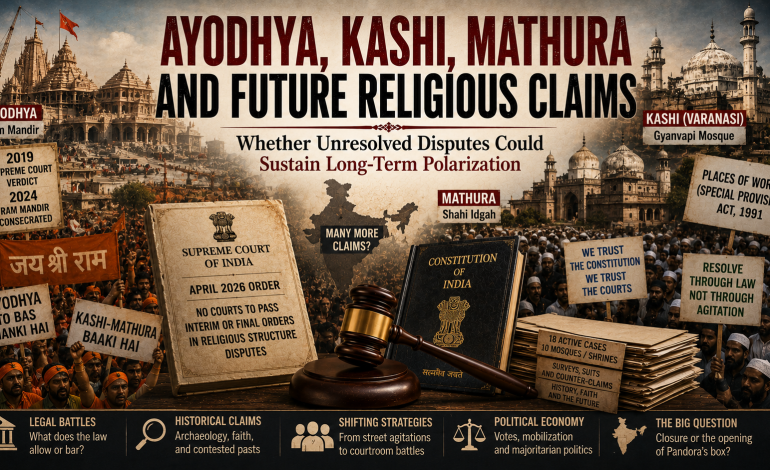
In April 2026, the Supreme Court of India issued a directive that temporarily halted one of the most significant legal trends of the past decade: it restrained all courts across the country from passing any interim or final orders, including survey orders, in pending cases concerning existing religious structures. The bench, comprising Chief Justice Sanjiv Khanna and Justices P.V. Sanjay Kumar and K.V. Viswanathan, also barred the registration of new suits on related claims during the pendency of the constitutional challenge to the Places of Worship Act, 1991 . The order covered 18 active cases involving 10 mosques or shrines across the nation, freezing a wave of litigation that had been building since the Ayodhya verdict .
Six years after the Ram temple was consecrated in Ayodhya—marking what the Supreme Court had hoped would be a “closure” to one of India’s most bitter disputes—the battles had merely shifted ground. The slogan of the 1990s—”Ayodhya to bas jhanki hai, Kashi-Mathura baaki hai” (Ayodhya was just a glimpse, Kashi and Mathura will follow)—once dismissed as mere rhetoric, appeared to be materializing . Civil suits seeking surveys of the Gyanvapi mosque in Varanasi and the Shahi Idgah in Mathura had progressed through lower courts. Archaeological surveys had been conducted, reports submitted, and in some cases, court orders had permitted Hindu rituals within mosque premises .
Yet the Muslim response to these disputes had undergone a profound transformation. Unlike the mass mobilization of the 1980s and 1990s—when the Babri Masjid action committee had led nationwide agitations—Muslim leaders, clergy, and community intellectuals now emphasised keeping the Gyanvapi and Mathura disputes local and relying solely on legal processes . The decades of failed negotiation attempts over Ayodhya, and fears that any compromise would trigger demands for 3,000 other mosques allegedly built on temple sites, had reinforced a preference for court-led resolutions rather than political agitation .
This article examines whether the unresolved disputes over Kashi, Mathura, and potentially other sites could sustain long-term polarization in Indian society. It analyzes the legal framework that currently blocks or enables these claims, the shifting strategies of Muslim respondents, the political economy of temple-mosque disputes, and the fundamental question of whether the Ayodhya verdict brought closure or opened a Pandora’s box.
WHAT – The unresolved temple-mosque disputes refer to ongoing legal battles over religious sites where Hindu petitioners claim that mosques (particularly the Gyanvapi mosque in Varanasi and the Shahi Idgah in Mathura) were built after demolishing pre-existing Hindu temples during medieval Muslim rule. The question is whether these disputes—along with claims over up to 3,000 other mosques allegedly built on temple sites—could sustain long-term religious polarization in India, similar to what the Ayodhya dispute generated for three decades.
WHO – Hindu petitioners include religious trusts (Shri Krishna Janmabhoomi Mukti Nirman Trust, Kashi Royal Family descendants), political figures (BJP leader Subramanian Swamy), and right-wing organizations (Vishva Hindu Parishad). Muslim respondents include mosque management committees (Anjuman Intezamia Masjid Committee, Shahi Idgah management), the Sunni Waqf Board, and national bodies like the All India Muslim Personal Law Board. The Supreme Court and various High Courts adjudicate, with the central government defending the Places of Worship Act. Political parties across the spectrum—BJP, Congress, CPM, and others—have staked positions.
WHEN – The Ayodhya verdict was delivered in November 2019, with the Ram temple consecration in January 2024. Post-2022, disputes over Gyanvapi and Mathura escalated significantly, with ASI surveys, High Court rulings, and the Supreme Court’s April 2026 stay on further orders. The constitutional challenge to the Places of Worship Act is currently pending before the Supreme Court, with final hearings expected in 2026-2027.
WHERE – The primary active disputes are in Varanasi (Gyanvapi mosque) and Mathura (Shahi Idgah mosque-Krishna Janmabhoomi). However, claims extend to at least 10 mosques or shrines currently under litigation, and lists of up to 3,000 mosques allegedly built on temple sites have been circulated by right-wing organizations. Geographically, the disputes are concentrated in Uttar Pradesh but have national political implications.
WHY – The persistence of these disputes matters because they represent a potential continuation of the same dynamics that produced the Babri Masjid demolition in 1992—a cycle of legal claims, political mobilization, archaeological surveys, and escalating demands. If the Places of Worship Act is struck down or exceptions are carved out for Kashi and Mathura, a floodgate of litigation could follow, affecting hundreds of mosques and potentially hundreds of thousands of Muslim citizens. The question is whether Indian society has learned from the Ayodhya experience, or whether the same patterns will repeat.
HOW – Through public interest litigations and title suits filed in district and high courts; court-ordered ASI scientific surveys using ground-penetrating radar and excavations; political rhetoric that invokes these disputes during election campaigns; and ultimately through judicial verdicts that could transfer possession of disputed sites. The Supreme Court’s pending decision on the constitutional validity of the Places of Worship Act will determine the legal framework for all future claims.
AYODHYA AS PRECEDENT — CLOSURE OR CATALYST?
The Ayodhya verdict was intended to draw a line under one of India’s most contentious disputes. Whether it succeeded in doing so—or merely set a template for future claims—remains contested.
The Supreme Court’s Hope for “Closure”
The five-judge bench’s unanimous 1,024-page judgment in November 2019 awarded the disputed 2.77-acre site to Hindus for the construction of a Ram temple, while directing that a separate five-acre plot be allocated to the Sunni Waqf Board for a mosque . The Court acknowledged that the demolition of the Babri Masjid on December 6, 1992 was a “violation of the rule of law,” but did not order punitive action .
Crucially, the Court declined to use its powers under Article 142 of the Constitution—which grants it the authority to deliver “complete justice”—to prohibit further claims against other places of worship. As legal commentator C. Rammanohar Reddy noted, if the Supreme Court “was going to decide to give possession of the disputed land to a trust for constructing a Ram temple, it could have used this particular article of the constitution to draw a line under any other disputes over ancient mosques. That could have spared the country future communal mobilisations in Kashi and Mathura” . The Court’s refusal to go down that path, Reddy argued, meant that “the citizen could be forgiven for feeling that lawlessness can sometimes succeed” .
The Muslim Acceptance of Ayodhya as “Closed Chapter”
Following the Supreme Court’s verdict and the subsequent Pran Prathishtha (consecration) of the Ram temple in January 2024, many Muslims in India view Ayodhya as a closed chapter, preferring calm acceptance over renewed conflict . This represents a significant shift from the mobilisation of the 1980s and 1990s.
The dominant view among Muslim intellectuals, clergy, and community leaders now emphasizes keeping the Gyanvapi and Mathura disputes localized and resorting solely to legal recourse . Unlike the Babri action committee and political agitations led by Syed Shahabuddin and Zafaryab Jeelani in previous decades, contemporary Muslim leadership is dismissive of making Kashi-Mathura disputes political or nationwide .
The Historical Fear: “3,000 Mosques”
The shift in Muslim strategy is rooted in a specific historical fear. As Outlook India reported, some Muslim leaders had privately considered making a unilateral goodwill gesture in the Ayodhya dispute but backed out fearing that the demand may go on for Mathura, Kashi, and “3,000 other places of Muslim worship” . This number—3,000—refers to a list compiled by author-journalist Arun Shourie in his work “What Happened to the Hindu Temples” during Muslim rule in India, which cataloged mosques allegedly built on erstwhile temple sites .
The fear was that any compromise in Ayodhya—even a favorable one—would open floodgates of similar concessions from Muslims for other places of worship. This fear has now materialized, with active litigation across 10 mosques and claims extending to hundreds more .
The Missed Opportunity for Constitutional Closure
The Ayodhya verdict’s refusal to use Article 142 to bar future claims is now seen by some legal observers as a missed opportunity. The mediation panel appointed by the Supreme Court had reportedly secured agreement from most parties on a clause that would have prevented further mobilisation over Kashi and Mathura . The Court’s refusal to incorporate this into its judgment meant that “a few Hindu political groups have already said that there will not be any agitation for those sites, but only ‘for now'” .
THE LEGAL BATTLEGROUND — THE PLACES OF WORSHIP ACT UNDER SIEGE
The Act and Its Purpose
The Places of Worship (Special Provisions) Act, 1991 was enacted at the height of the Ram Janmabhoomi agitation. Its stated purpose was to prevent the conversion of any place of worship and to maintain the religious character of all places of worship as it existed on August 15, 1947—the date of India’s independence . Section 3 bars the conversion of a religious site, while Section 4 prohibits any legal proceeding to alter the religious character of a place of worship .
The only explicit exception carved out in the statute is for the Ayodhya dispute, which was already the subject of litigation at the time . Section 5 of the Act exempted the Ram Janmabhoomi-Babri Masjid site from its purview.
The Constitutional Challenge
The constitutional validity of the Places of Worship Act is currently pending before the Supreme Court. Petitioners—including members of the Kashi Royal Family, BJP leader Subramanian Swamy, and various religious leaders—have argued that the Act violates fundamental rights under Articles 25, 26, and 29 of the Constitution, which guarantee religious freedom, the right to manage religious institutions, and the protection of cultural heritage .
The petitioners contend that the Act “unjustly excludes Lord Krishna’s birthplace while preserving the exemption for Lord Rama’s birthplace, creating discriminatory provisions” . Sections 2, 3, and 4 of the Act are under scrutiny for allegedly “breaching the principles of secularism and the rule of law enshrined in the Constitution” .
The petitioners also claim that the Act “deprives religious communities of their right to reclaim properties misappropriated during historical invasions and unfairly limits legal recourse” . Critics of the Act argue that the retrospective cutoff date of August 15, 1947 is “arbitrary and irrational, effectively abating proceedings regarding encroachments by historical invaders” .
The Defense of the Act
In response, organizations such as Jamiat Ulama-i-Hind, the All India Muslim Personal Law Board, and mosque management committees have filed applications supporting the Act. They argue that overturning the law “would lead to a flood of litigation targeting mosques nationwide, disrupting communal harmony” .
The Union government, in earlier affidavits, has defended the statute as “a legislative measure aimed at preserving public order and maintaining secularism,” submitting that the law “embodies a commitment to non-retrogression in matters of faith and is designed to prevent the reopening of historical grievances that could destabilise communal harmony” .
In its 2019 judgment in the Ayodhya title dispute, the Supreme Court itself described the Places of Worship Act as a legislative intervention that “protects and secures the fundamental values of the Constitution,” observing that the statute “enforces the constitutional commitment to secularism by preventing attempts to alter the status quo of religious sites” .
The Supreme Court’s April 2026 Stay
On April 17, 2026, the Supreme Court issued a directive that temporarily halted the escalating cycle of litigation. A bench comprising Chief Justice Sanjiv Khanna and Justices P.V. Sanjay Kumar and K.V. Viswanathan restrained all courts across India from passing any interim or final orders—including survey orders—in pending cases concerning existing religious structures .
The Court also barred the registration of new suits on related claims during the pendency of the constitutional challenge. “While suits may be filed, no suits would be registered, and proceedings undertaken till further orders of this court. In the pending suits, courts would not pass any effective interim or final orders, including orders of survey,” the bench stated .
Currently, 18 cases involving 10 mosques or shrines are under litigation across the country. The Supreme Court’s order effectively freezes all of them while it considers the larger constitutional questions .
KASHI (GYANVAPI) — THE FOREMOST ACTIVE DISPUTE
The Historical Claim
The Gyanvapi mosque was built in 1669 by Mughal emperor Aurangzeb. Hindu petitioners claim it was constructed after demolishing a portion of the Kashi Vishwanath temple—one of the holiest shrines in Shaivism. The present Kashi Vishwanath temple stands adjacent to the mosque. Unlike Ayodhya, where the historical evidence remains contested, the destruction of a temple to build the Gyanvapi mosque is documented in Mughal records, including Aurangzeb’s own orders.
The ASI Surveys and Court Orders
In 2022, five women petitioners filed a suit seeking the right to worship Hindu deities whose idols, they claimed, were located on the outer walls of the mosque complex. The suit led to a court-ordered videography survey, during which the petitioners’ lawyers claimed that a structure within the mosque complex’s wuzukhana (ablution pond area) was a “shivling.” Muslim respondents rejected this, stating the structure was a fountain.
The Varanasi district court ordered the Archaeological Survey of India to conduct a scientific survey of the complex. The survey was initially stayed by the Supreme Court but later permitted with the exclusion of the wuzukhana area, which was to remain sealed. In 2023-2024, the ASI conducted a comprehensive survey using ground-penetrating radar, excavations, and architectural analysis. In August 2024, the Varanasi district court ordered that the ASI survey report be made public . The mosque management committee’s plea to stop the survey was rejected, with the court noting that the survey had already received approval from the Allahabad High Court and the Supreme Court .
In March 2026, the Varanasi Fast Track Court dismissed the Hindu side’s plea for a new ASI survey of the Gyanvapi complex . However, a Varanasi court also ordered that Hindu rituals be performed in the Gyanvapi Mosque’s southern cellar, mandating “the creation of a conducive environment for these practices within seven days” .
Current Status
The Gyanvapi case is currently covered by the Supreme Court’s April 2026 stay on all effective orders in pending suits involving religious structures. However, the ASI survey has been completed, and its evidentiary value will be considered once the constitutional challenge to the Places of Worship Act is resolved.
MATHURA (SHAHI IDGAH) — THE BIRTHPLACE OF KRISHNA
The Core Claim
The Mathura dispute centers on the Shahi Idgah mosque, also built during Aurangzeb’s reign, which Hindu petitioners claim stands on the site of a temple marking the birthplace of Lord Krishna. For devout Hindus, Mathura is not merely another holy city—it is the birthplace of Lord Krishna, one of the most revered deities in the Hindu pantheon.
The present Shahi Idgah stands adjacent to the Krishna Janmasthal temple complex. Eighteen suits have been filed by the Hindu side seeking possession of the land after the removal of the Shahi Idgah mosque, as well as the restoration of the temple .
The Allahabad High Court’s 2024 Ruling
In August 2024, the Allahabad High Court delivered a significant ruling that dramatically altered the trajectory of the case. The Court rejected the Muslim side’s applications challenging the maintainability of the Hindu suits. More importantly, the Court held that the suits were not barred by the Limitation Act, the Waqf Act, or the Places of Worship Act, 1991.
This ruling was a major blow to the Muslim side’s primary legal defense. The Places of Worship Act, which bars litigation to alter the religious character of places of worship as they existed in 1947, was held not to be an impediment to the Mathura suits.
The RSS Dimension
In August 2025, RSS chief Mohan Bhagwat made remarks that reignited the Kashi and Mathura disputes, suggesting that Muslims “give away” the mosques in these two places as a precondition for “brotherhood” . The CPM condemned Bhagwat’s statement, arguing it “reflected the RSS’s disregard for the Constitution and was in violation of the law of the land” . The party accused the RSS of “inciting communal divisions as a diversionary tactic” to divert public attention from economic issues .
The Telegraph India report noted that Bhagwat had made the remark during his three-day lecture series to mark 100 years of the RSS, aimed at expanding the influence and ideology of the outfit .
THE SHIFTING MUSLIM STRATEGY — FROM AGITATION TO LITIGATION
Lessons from Ayodhya
The most significant development in the Muslim response to the Kashi and Mathura disputes is the strategic shift away from mass mobilization and toward legal recourse. As Outlook India reported, Muslim scholars, clergy, and community leaders now emphasize keeping these disputes local and relying solely on court processes .
This shift is rooted in the lessons learned from Ayodhya. An analysis of nine failed negotiation attempts to resolve the Ayodhya dispute since 1859 revealed that political compromises were repeatedly undermined by hardline factions . In 1990, Prime Minister Chandrashekhar’s negotiations were aborted when VHP volunteers damaged the mosque. In 1992, Prime Minister Narasimha Rao’s talks with “apolitical” sadhus were proceeding well until they abruptly broke off—Rao later concluded that “political forces” controlling the sadhus had scuttled the deal .
In 2003, Prime Minister Atal Bihari Vajpayee and the Shankaracharya of Kanchi came close to a breakthrough. The All India Muslim Personal Law Board had given final touches to a proposal that included: a mosque within 67 acres of undisputed land, a legal mandate to bar Hindutva forces from raking up Mathura and Kashi, and a plaque at the disputed site recording the chronology of the dispute . However, the VHP and RSS criticized Vajpayee’s efforts, and the deal collapsed.
The Fear of Compromise
The reluctance to engage in negotiations today is rooted in the Ayodhya experience. A jurist cited in the Outlook India report argued that no matter how “favourable” the terms and conditions of a compromise would have been, the individuals signing it would have been accused of ‘selling’ the interests of Muslims for cheap. “The recrimination would have grown with time. In contrast, an adverse ruling from the apex court brought a sense of ‘closure'” .
This logic—that a judicial verdict, even an adverse one, provides more durable closure than a negotiated compromise—now guides Muslim strategy in Kashi and Mathura.
The Internal Debate
However, this strategy is not without internal critics. Islamic scholar Maulana Salman Nadwi had long advocated for a compromise in Ayodhya, citing the example of Caliph Umar Bin Khattab who shifted a mosque in Kufa to another place . Nadwi also referred to the Treaty of Hudaibiyah (628 CE), a peace accord signed by Prophet Muhammad that was unfavorable to Muslims at the time but ultimately beneficial.
Nadwi’s call to avoid conflict, however, “has not gone down well with many Muslim community leaders” and led to his summary expulsion from the All India Muslim Personal Law Board . The internal Muslim debate—between pragmatists willing to countenance compromise and hardliners refusing any concession—remains unresolved.
THE BEYOND — 3,000 MOSQUES?
The Shourie List
The long-term polarization potential of temple-mosque disputes extends far beyond Kashi and Mathura. As early as the 1990s, author-journalist Arun Shourie’s work “What Happened to the Hindu Temples” listed some 3,000 mosques which he claimed were built on erstwhile temples .
This list has become a reference point for right-wing organizations. The slogan “Ayodhya to bas jhanki hai, Kashi-Mathura baaki hai” captured the sense that Ayodhya was merely the first step in a larger project of reclaiming Muslim places of worship built on temple sites .
The Scale of Potential Litigation
If the Places of Worship Act is struck down or significantly narrowed, the legal basis for protecting these mosques would disappear. Each could become the subject of title suits, ASI surveys, and court battles.
The scale of potential displacement is staggering. Hundreds of mosques across northern India—many still in active use by Muslim communities—could face legal challenges. The Muslim community’s capacity to litigate hundreds of cases simultaneously is limited, and the economic and psychological costs of such widespread litigation would be immense.
The Waqf Board’s Defensive Strategy
The Muslim side’s current strategy—relying on the Places of Worship Act as a shield—is a defensive one. It does not seek to prove that these mosques were not built on temple sites. It argues instead that the law bars such claims regardless of their historical merit. This strategy’s viability depends entirely on the Supreme Court upholding the Act.
THE POLITICAL ECONOMY OF POLARIZATION
Electoral Incentives
Temple-mosque disputes have been systematically politicized, serving as rallying points for political parties . The strategic importance of these disputes for electoral mobilization cannot be overstated. The Ayodhya movement helped consolidate Hindu votes behind the BJP in the 1990s and 2000s. Kashi and Mathura serve a similar function in the 2020s.
However, there are limits to this strategy. Overuse of religious polarization can lead to diminishing returns, as voters become fatigued or begin to prioritize economic issues. The CPM’s condemnation of RSS chief Mohan Bhagwat’s remarks explicitly accused the Sangh Parivar of “raking up communal issues to take people’s focus off worsening economic conditions, steep US tariffs and alleged manipulation of electoral rolls” .
The “Anti-Hindu” Counter-Narrative
An interesting dynamic in the polarization landscape is the opposition’s attempt to turn the BJP’s own rhetoric against it. During the Magh Mela controversy in January 2026, the Congress and Samajwadi Party supported Shankaracharya Avimukteshwaranand against the Yogi Adityanath government, accusing the state of being “anti-Hindu.” This suggests that Hindu religious sentiment is not a monopoly of any single party, and that the politics of polarization carries risks for the incumbent as well.
The Supreme Court as Political Actor
The Supreme Court’s handling of these disputes inevitably carries political implications. The April 2026 stay on all effective orders in religious structure suits can be read as the Court attempting to de-escalate tensions and prevent lower courts from creating a fait accompli before the constitutional question is resolved.
However, the Court’s refusal to use Article 142 in the Ayodhya verdict to bar future claims is now seen by some as having enabled the current wave of litigation. The Court’s eventual ruling on the Places of Worship Act will be one of the most consequential decisions in India’s constitutional history.
THE CENTRAL QUESTION — CAN SUSTAINABLE POLARIZATION BE MAINTAINED?
The question of whether unresolved disputes over Kashi, Mathura, and other sites can sustain long-term polarization requires examining the conditions that made Ayodhya sustainable as a political issue for three decades.
The Conditions for Sustained Polarization
Ayodhya sustained polarization because it had several features: a single, identifiable disputed structure; a clear religious significance for Hindus (birthplace of Ram); a Muslim community that was politically mobilized in opposition; a political party (the BJP) with a strategic interest in keeping the issue alive; and a legal framework (the Places of Worship Act’s exemption) that kept the dispute in court.
Kashi and Mathura share most of these features. However, there are differences. The Muslim community’s strategy has shifted away from mass mobilization, reducing the visible conflict that sustains media attention. The Supreme Court’s April 2026 stay has frozen the litigation, reducing the pace of legal developments. And the Places of Worship Act—if upheld—could bar these claims entirely.
The Role of the Places of Worship Act
The single most important variable in determining whether Kashi, Mathura, and other disputes can sustain long-term polarization is the fate of the 1991 Act.
If the Supreme Court upholds the Act, the religious character of these sites as of August 15, 1947 would be frozen. The Gyanvapi mosque would remain a mosque; the Shahi Idgah would remain a mosque. The current wave of litigation would effectively end. While political rhetoric could continue, the legal basis for reclaiming these sites would be removed.
If the Supreme Court strikes down the Act—or carves out exceptions for Kashi and Mathura similar to the Ayodhya exemption—the floodgates would open. Each site would be subject to litigation, ASI surveys, and potentially transfer of possession. The legal battles would continue for years, perhaps decades, providing sustained material for political polarization.
The Middle Path: Narrowing the Act
A third possibility is that the Supreme Court narrows the Act rather than striking it down entirely. The Court could, for example, uphold the Act’s prohibition on altering religious character but strike down the bar on legal proceedings seeking to establish historical facts. Or the Court could hold that the Act does not bar suits where there is documented evidence of temple destruction—a category that would include Gyanvapi (with Aurangzeb’s own records) but exclude sites without such documentation.
This middle path would produce continued litigation but at a slower pace, and with a clearer legal framework for adjudicating claims.
CONCLUSION — BEYOND THE LEGAL VERDICT
The unresolved temple-mosque disputes of Kashi and Mathura represent the next frontier of India’s most contentious religious conflicts. Whether they will sustain long-term polarization depends on factors that extend beyond the legal verdict.
The Muslim community’s strategic shift toward legal recourse and away from mass mobilization has reduced the visible communal conflict that sustained the Ayodhya movement. However, this strategy depends entirely on the Places of Worship Act remaining in force. If the Act falls, the legal basis for protecting these mosques disappears, and the Muslim community may be forced back into political mobilization.
The political incentives for majoritarian parties to keep these disputes alive remain strong, but there are diminishing returns to religious polarization, and opposition parties have learned to deploy “anti-Hindu” accusations against the BJP when the government’s actions alienate religious sentiment.
The Supreme Court’s pending decision on the Places of Worship Act will be the single most important factor determining the trajectory of these disputes. A decision upholding the Act would bring significant closure; a decision striking it down would open a Pandora’s box of litigation affecting hundreds of mosques and potentially millions of citizens.
The lessons of Ayodhya—the failure of negotiation, the violence of 1992, the long legal battle, and finally the Supreme Court’s verdict—offer a roadmap of what to expect and a warning of what to avoid. Whether Indian society has learned those lessons will determine whether Kashi and Mathura become the next Ayodhya, or whether they become something else entirely.
COMPARATIVE ANALYSIS OF DISPUTES
| Aspect | Ayodhya (Resolved) | Kashi (Gyanvapi) | Mathura (Shahi Idgah) | Other Sites (3000+) |
|---|---|---|---|---|
| Current Status | Temple constructed; mosque to be built on 5-acre plot | ASI survey completed; frozen by SC April 2026 | HC ruled suits maintainable; frozen by SC April 2026 | Not yet under litigation; potential claims |
| Historical Evidence | Contested | Documented (Aurangzeb’s orders) | Documented | Varies; some well-documented, others speculative |
| Places of Worship Act | Exempted | Protected (if upheld) | Protected (if upheld) | Protected (if upheld) |
| Muslim Strategy | Mixed (negotiation + litigation) | Legal recourse only | Legal recourse only | Not yet activated |
| Polarization Potential | High (1970s-2010s) | Moderate (currently frozen) | Moderate (currently frozen) | Low (not yet mobilized) |
| SC’s April 2026 Impact | N/A (resolved) | Frozen | Frozen | Pre-emptively frozen |