PUNJAB, SIKH POLITICS AND NATIONAL SECURITY NARRATIVES
TOPIC 39 PUNJAB, SIKH POLITICS AND NATIONAL SECURITY NARRATIVES Examining Tensions Surrounding Separatism and Identity Politics In early May 2026, Punjab Chief Minister Bhagwant Mann was fighting to save his
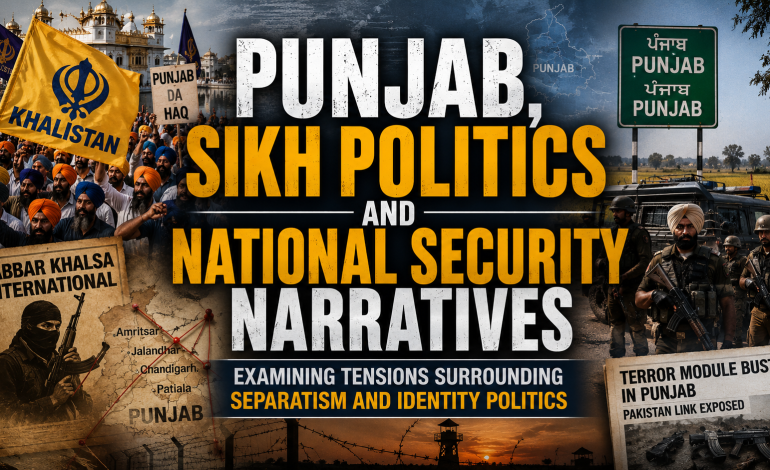

TOPIC 39
PUNJAB, SIKH POLITICS AND NATIONAL SECURITY NARRATIVES
Examining Tensions Surrounding Separatism and Identity Politics
In early May 2026, Punjab Chief Minister Bhagwant Mann was fighting to save his government. A day of high drama in the Vidhan Sabha saw the Aam Aadmi Party administration scrambling to prove its majority after a series of defections and the collapse of its alliance with the BJP at the Union level. Congress MP Sukhjinder Singh Randhawa predicted that President’s Rule would be imposed in Punjab within days, accusing the Mann government of dramatizing a special session to cover its desperation.
Yet the political crisis was merely the surface. Beneath it churned deeper currents that had defined Punjab for decades. Just days earlier, on April 27, 2026, an explosion on the Rajpura-Shambhu railway track had killed a man—identified by police as Jagroop Singh, a key operative of a Pakistan-linked terror module . The blast was the third in a series: a grenade attack on the CIA Moga police post in November 2025, a railway track blast in Sirhind in January 2026, and now the Shambhu explosion . Police traced the module to Malaysia-based handlers connected to terror networks in the United States and Pakistan .
On April 25, 2026, intelligence agencies had issued a fresh alert: Babbar Khalsa International, the banned separatist outfit, was shifting its strategy. Having failed to radicalize urban youth, it was now targeting rural Punjab—unemployed and less-educated youth vulnerable to misinformation campaigns. Its goal: low-intensity attacks on urban targets including courts, police stations, and government buildings, intended to destabilize the state without direct civilian casualties .
The arrest of separatist leader Amritpal Singh in 2023 had been hailed as a victory against Khalistani extremism. But his recent release from detention—with the National Security Act removed—raised urgent questions. BKI’s new strategy, the resurgence of gangster-terrorist networks, and the specter of Pakistan’s ISI using Punjab as a “low-cost target” threatened to undo years of hard-won peace .
This article examines the complex interplay of national security narratives and Sikh identity politics in contemporary Punjab. It explores the resurgence of separatist activity, the response of state and central agencies, the political uses of “anti-national” accusations, and the deeper economic and social grievances that extremists exploit to fuel unrest.
WHAT – The intersection of Punjab politics, Sikh identity, and national security narratives encompasses the historical demand for Khalistan (a separate Sikh homeland), its resurgence in recent years through groups like Waris Punjab De and Babbar Khalsa International, the response of Indian security agencies, and the political exploitation of separatist threats by rival parties. It also involves the complex dynamics of the Sikh diaspora, which constitutes approximately 25% of the global Sikh population and exerts significant influence on the community’s politics .
WHO – Key actors include pro-Khalistan separatists and organizations (Waris Punjab De led by Amritpal Singh, Babbar Khalsa International, Sikhs for Justice in the diaspora); Punjab’s political class (AAP government led by Bhagwant Mann, opposition Congress and Shiromani Akali Dal); Union government and security agencies (Enforcement Directorate, Intelligence Bureau, Border Security Force); Pakistan’s Inter-Services Intelligence (which has historically supported Sikh militant groups as part of its “bleed India with a thousand cuts” strategy); the Sikh diaspora in Canada, the US, and the UK; and the broader Sikh populace in Punjab (58% of the state’s population) and across India (approximately 2% of the national population) .
WHEN – The modern phase of the Khalistan movement began in the 1980s, peaking with Operation Blue Star (1984) and the subsequent anti-Sikh riots. After a period of relative quiescence, the movement saw a resurgence from 2020 onwards, driven by the farmers’ protests against central farm laws, the rise of Amritpal Singh (2022-2023), renewed intelligence alerts about BKI activity (2025-2026), and the series of grenade and bomb attacks in late 2025 and early 2026 .
WHERE – Within India, the tensions are centered in Punjab, particularly its rural belts and border districts adjacent to Pakistan. Outside India, the Khalistan movement has significant support in the Sikh diaspora of Canada (particularly British Columbia), the United Kingdom, the United States, and Australia, where referendums have been organized by groups like Sikhs for Justice .
WHY – The persistence of separatist sentiment stems from multiple factors: historical grievances (the 1984 anti-Sikh riots, Operation Blue Star, unaddressed justice for victims); economic distress (rural unemployment, farm debt, the pervasive drug crisis); political marginalization (perceived dominance of Hindu nationalists and dilution of Sikh identity); and external exploitation (Pakistan’s ISI using separatism as a tool to destabilize India). As the RSS and BJP advance a Hindutva agenda, minority communities—including Sikhs—have grown increasingly concerned about losing their distinct identity in what they fear could become a “Hindu Rashtra” .
HOW – Through a combination of overt militant action (grenade attacks, bombings, targeted killings), hybrid warfare (online misinformation campaigns, radicalization of youth via social media, drone-dropped narcotics and weapons from Pakistan), political mobilization (religious and cultural assertion framed as defensive), and diaspora lobbying (international campaigns, referendums, pressure on foreign governments) .
THE KHALISTAN MOVEMENT – HISTORICAL ROOTS AND CONTEMPORARY RESURGENCE
The Historical Grievance
The demand for a separate Sikh homeland, Khalistan, traces its origins to the Partition of 1947. When India was divided, Punjab was split into two—the Indian state of Punjab and the Pakistani province of Punjab—leaving up to an estimated one million dead and displacing millions of Hindus, Muslims, and Sikhs . The trauma of Partition, combined with the political marginalization of Sikhs in independent India, created fertile ground for separatist ideologies.
The 1980s witnessed the peak of the Khalistan insurgency. On June 6, 1984, the Indian Army stormed the Golden Temple in Amritsar—the holiest site in Sikhism—to flush out militants led by Jarnail Singh Bhindranwale. Operation Blue Star, as it was code-named, caused extensive damage to the temple complex and resulted in significant casualties. Four months later, on October 31, 1984, Prime Minister Indira Gandhi was assassinated by her two Sikh bodyguards in retaliation. The assassination triggered horrific anti-Sikh riots across northern India, in which thousands of Sikhs were killed and their properties destroyed. Successive governments failed to deliver justice to the victims .
For the Sikh community, these events remain a “festering source of tension” to this day. Pro-Khalistani factions in the diaspora continue to lobby foreign governments to declare the 1984 anti-Sikh riots as “genocide”—a move that would damage India’s international reputation and open avenues for further legal and political action .
The 2020-2023 Resurgence
After the decline of militancy in the 1990s, the Khalistan movement appeared to have lost its mass base in Punjab. However, the farmers’ protests against the central government’s three farm laws (2020-2021) provided a new rallying point. The protests were disproportionately led by Sikh farmers from Punjab, and their months-long encampments on Delhi’s borders—through a harsh winter and the deadly second wave of COVID-19—became symbols of resistance .
It was during this period that Amritpal Singh emerged as a prominent separatist leader. His organization, Waris Punjab De (“Heirs of Punjab”), mobilized farmers and youth around issues of unemployment, drug abuse, and perceived threats to Sikh identity. In February 2023, Singh and his followers stormed a police station in Ajnala armed with clubs and swords, leading to a massive manhunt. Singh evaded arrest for over a month before being captured in April 2023 and detained under the National Security Act .
The Current Security Alert
In April 2026, intelligence agencies issued a warning of a renewed push by Babbar Khalsa International (BKI) to revive the Khalistan movement . BKI’s earlier strategy—recruiting and radicalizing youth in urban areas—had largely failed due to greater public awareness and tighter security monitoring. Its new approach focuses on two fronts:
Rural Radicalization: BKI is shifting its recruitment drive to rural areas, targeting unemployed and less-educated youth whom officials consider more vulnerable to propaganda. The group plans to launch a “sustained online misinformation campaign in rural belts, spreading anti-India narratives and portraying Punjab as suffering due to its association with the Indian State” .
Low-Intensity Urban Attacks: Even as BKI focuses on rural recruitment, it intends to carry out low-intensity attacks in urban centers including Chandigarh. Potential targets include courts, intelligence offices, police stations, and other government buildings. The objective, officials said, is to “target the establishment rather than civilians, as attacking common people could further erode whatever support the group hopes to gain” .
The intelligence alert noted that BKI is under “immense pressure from its own cadres as well as Pakistan’s Inter-Services Intelligence to step up operations in Punjab.” The ISI’s strategy—shielding, funding, and training BKI cadres—is aimed at destabilizing Punjab and creating unrest in both Jammu & Kashmir and Punjab simultaneously .
THE GANGSTER-TERRORIST-FACILITATOR NEXUS
Perhaps the most alarming development in recent years has been the fusion of organized crime with separatist terrorism—a nexus that Indian security experts have termed the “gangster-terrorist-facilitator” triangle.
Cross-Border Networks
The border picture is alarming. In 2025 alone, the Border Security Force’s Punjab Frontier seized 272 drones, over 367 kilograms of heroin, 19 kilograms of methamphetamine, more than 10 kilograms of RDX and improvised explosive device material, 12 hand grenades, and around 200 weapons—a five-fold jump in arms recoveries .
These seizures may represent only the tip of the iceberg. As one military analyst notes, “for every drone caught, many more must be getting through” . The drones—operated from across the border in Pakistan—carry narcotics that fuel Punjab’s devastating drug crisis, as well as weapons and explosives that arm separatist modules and criminal gangs.
The Shambhu Blast and Its Aftermath
The explosion on the Rajpura-Shambhu railway track on April 27, 2026, marked a significant escalation. The blast killed Jagroop Singh, a key operative of a Pakistan-backed terror module. Subsequent investigations by the Punjab Police’s State Special Operations Cell revealed that the same module was responsible for three major incidents: the grenade attack on the CIA Moga police post (November 2025), the Sirhind railway track blast (January 2026), and the Shambhu explosion .
All three acts, police confirmed, were executed under the instructions of Malaysia-based handlers, who are reportedly connected to terror elements in the United States and Pakistan . The arrest of Gurjinder Singh, alias Baba Beant—a key associate of the deceased bomber—established direct links between the attacks.
Critically, before this arrest, police had taken four highly radicalized individuals into custody and recovered a significant cache of militant hardware, including a Rocket Propelled Grenade (RPG), hand grenades, and sophisticated communication devices . The recovery of an RPG—a military-grade weapon—suggests the scale and sophistication of the smuggling networks operating across the border.
The Narcotics-Directed Nexus
Punjab’s drug crisis is not merely a public health emergency but a national security threat. Under the state’s “Yudh Nashe Virudh” campaign since March 2025, Punjab registered between 26,000 and 31,000 NDPS (Narcotic Drugs and Psychotropic Substances) cases, with nearly 39,000 to 45,000 accused persons. The state seized between 1,714 and 2,000-plus kilograms of heroin, and over 4.26 million intoxicant pills and capsules .
A retired Major General noted pointedly: “The state, comprising just 2.3 per cent of India’s population, has long accounted for a disproportionate share of national heroin seizures. These are not mere law-and-order figures, but they signal deep social corrosion and national-security stress” .
The narcotics trade and separatist extremism are intimately connected. As the Intelligence Bureau official explained, Pakistan’s ISI uses drug money to fund terror modules. Smuggling networks that bring heroin into Punjab are the same networks that deliver weapons and explosives. Addicts, desperate for their next fix, become recruits for petty crime—and sometimes, through prolonged exposure, for more radical ideologies.
While the Punjab Police dismantled hundreds of gangster modules in 2025—arresting nearly 1,000 criminals and seizing hundreds of weapons and vehicles—over 400 gangs or modules remain active. Dozens of foreign-based handlers, many with Pakistan links, orchestrate extortion rackets, targeted killings, and narco-funding from abroad .
THE SACRILEGE DIMENSION – BEADBI AS POLITICAL TOOL
The desecration of the Guru Granth Sahib, Sikhism’s holy scripture, has emerged as a key flashpoint exploited by separatist groups to stoke communal tensions. The concept of beadbi (sacrilege) has been “increasingly exploited by Sikh separatist groups in India and the diaspora to advance Khalistani agendas” .
The Bargari Case and Its Aftermath
The watershed moment came in 2015, when sacrilege of the Guru Granth Sahib occurred in Bargari, Faridkot district. The desecration was followed by police firing at Behbal Kalan, which killed two protesters. This sparked a wave of sacrilege cases across Punjab—many still under trial in Punjab and Chandigarh courts .
Critically, since 2015, four of over two dozen accused in the Bargari case have been killed in targeted attacks by pro-Khalistani groups abroad or their affiliated gangsters . The pattern is consistent: an accused is killed before trial, often by vigilante mobs or criminal gangs, and the killing is framed as “instant justice” by separatist sympathizers. In some instances, perpetrators have been honored by gurdwaras or panthic organizations, further entrenching this cycle of violence .
Data on Sacrilege
National Crime Records Bureau data underscores Punjab’s persistent issue with sacrilege. Between 2018 and 2023, Punjab recorded the highest crime rate for offenses under Sections 295-297 of the Indian Penal Code—which deal with damaging or defiling sacred religious objects—with over 190 cases annually in each of these years .
The Legislative Response
In response, the Punjab Legislative Assembly passed the Punjab Prevention of Offenses against Holy Scripture(s) Bill, 2025, on July 15, 2025. The bill proposes penalties ranging from ten years to life imprisonment for sacrilege, and a 15-member committee was formed to consult stakeholders and report within six months .
However, successive Punjab governments—both before and after the AAP came to power—have faced criticism for their inadequate response to sacrilege cases. “Many investigations remain incomplete, with accusations of deliberate dilution by labeling the accused as ‘mentally unsound'” .
Political Exploitation
Radical political groups have capitalized on these incidents to advance their agendas. Sarabjeet Singh—son of Beant Singh, the assassin of former Prime Minister Indira Gandhi—won the Faridkot parliamentary seat in the last general election by focusing his campaign on the 2015 sacrilege case, exploiting public frustration over delayed justice .
Pro-Khalistani factions seize upon sacrilege incidents to propagate a narrative of Sikh victimhood under “Hindu hegemony.” These groups, often aligned with diaspora networks and gangsters in Punjab, “portray such acts as deliberate attempts by the Indian state to undermine Sikhism. This rhetoric, reminiscent of the 1980s Khalistani insurgency, leverages digital platforms to amplify a siege mentality, framing every sacrilege case as a conspiracy by rival communities or the state” .
PAKISTAN’S HYBRID WARFARE STRATEGY
Punjab as “Low-Cost Target”
After India’s Operation Sindoor in May 2025, which dramatically raised the cost of overt terrorism in Jammu & Kashmir for Pakistan, Islamabad adapted its strategy. With spectacular attacks in the Valley now too risky, Pakistan shifted focus to Punjab, which military analysts describe as a “tempting low-cost target” for hybrid warfare .
Punjab is a crowded borderland with villages, farms, roads, canals, and a large youth population living amid unemployment, debt, and addiction stress. Unlike Jammu & Kashmir, where the security grid is historically tight and threat perception consistently high, “Punjab’s normalcy can itself become a vulnerability” .
Strategic Vulnerabilities
Strategically, Punjab is arguably more consequential than J&K. It is the “rear logistics artery for India’s northern military posture”—the main surface corridor to Jammu & Kashmir runs through Punjab. Major force concentrations of the Indian Army and Indian Air Force, along with critical logistics hubs, lie here. Punjab is also central to northern water management, with projects such as the near-complete Shahpur Kandi Dam on the Ravi designed to harness waters for irrigation and prevent surplus flow into Pakistan—a direct strategic lever post-Indus Waters Treaty tensions .
The military analyst warns: “Destabilising Punjab will adversely impact the security of J&K and India’s wider military reinforcement, economic and water-security architecture. Punjab, therefore, cannot be treated as a rear area while J&K is treated as the front. Punjab is the front too” .
The ISI’s Bleed-India Strategy
The exploitation of beadbi incidents to “manipulate Sikh identity and provoke communal tensions aligns with external strategies, notably Pakistan’s ‘bleed India with a thousand cuts’ policy” . By supporting and funding multiple separatist movements—in Kashmir, Punjab, and the Northeast—the ISI seeks to stretch Indian security forces across numerous fronts without engaging in conventional warfare.
The intelligence alert from April 2026 explicitly noted that BKI is under “immense pressure from its own cadres as well as Pakistan’s Inter-Services Intelligence to step up operations in Punjab” . The ISI’s strategy in shielding, funding, and training BKI cadres is aimed at destabilizing Punjab and simultaneously creating unrest in both Jammu & Kashmir and Punjab.
THE POLITICAL CRISIS – AAP, BJP, AND THE BATTLE FOR PUNJAB
The Enforcement Directorate Raids
In early May 2026, just days before a scheduled floor test in the Punjab Vidhan Sabha, the Enforcement Directorate raided and arrested Punjab Minister Sanjeev Arora from his official residence in Sector 2, Chandigarh, under the Prevention of Money Laundering Act .
AAP National Convenor Arvind Kejriwal immediately drew a political line from the raids to the central government’s strategy in Punjab. Addressing a press conference, Kejriwal compared Prime Minister Narendra Modi to the Mughal emperor Aurangzeb:
“Punjab is the land of the Gurus. Several hundred years ago, Aurangzeb seized control of many parts of the country through crime and oppression. Modi ji too has deceitfully seized control of many parts of the country. After that, Aurangzeb arrived in Punjab. Modi ji has now arrived in Punjab as well” .
Invoking the historical persecution of Sikh Gurus by the Mughal state, Kejriwal framed the ED raids as a continuation of that oppression: “Aurangzeb perpetrated great atrocities on the Gurus. Modi ji is also perpetrating atrocities on Punjabis” .
Kejriwal alleged political motives behind the timing of the raids: “As soon as the Bengal elections ended, Modi ji started conducting daily ED raids in Punjab. In the past few years, Modi ji has dealt Punjab a heavy blow. Punjabis have been harassed in every possible way” .
He accused the government of using ED raids as a tool for political defection: “A raid was carried out at Ashok Mittal’s place, and the very next day, he was brought into the BJP. This means the purpose of the ED raid wasn’t to uncover stolen money. It was solely to break Ashok Mittal and get him to join the BJP” .
The NSA Removal Controversy
A major political flashpoint emerged around the removal of the National Security Act from detained separatist leader Amritpal Singh. Congress MP Sukhjinder Singh Randhawa slammed the AAP government for this decision, warning it posed a serious threat to Punjab’s security.
“Randhawa asked the Chief Minister to explain why and on whose advice the National Security Act was removed from Amritpal Singh. He said such an incident occurring soon after his release is alarming and signals danger. He termed it a failure of both central and state agencies” .
Randhawa warned that “the nexus between extremists and gangsters poses a serious threat to Hindu-Sikh unity in Punjab and must be broken to save the state” . He demanded that central investigation agencies conduct a thorough probe into the alleged links between separatist sympathizers and the accused in the railway blast.
Accusations of Anti-Nationalism
The competitive political landscape in Punjab has seen all major parties—AAP, Congress, and Shiromani Akali Dal—accusing each other of being “soft on separatism” or “anti-national” for political gain. The BJP, which had a long-standing electoral alliance with the Akali Dal, has seen its support in Punjab erode significantly. Meanwhile, the AAP government faces accusations from the opposition of inadequate security measures and of taking politically expedient decisions (like the NSA removal) that compromise national security.
THE HINDUTVA DIMENSION – IDENTITY AND RESENTMENT
The Sikh Diaspora Factor
Approximately 25% of the global Sikh population—over eight million out of thirty million—lives outside India, predominantly in Canada, the United States, the United Kingdom, and Australia . This diaspora exerts disproportionate influence over Sikh politics and identity.
“Growing numbers and economic success have helped Sikhs to join active politics in many Western countries,” one analysis notes. “The Sikh diaspora is increasingly lobbying in the US Congress to declare the 1984 anti-Sikh riot as ‘genocide'” .
Sikh diaspora organizations have also campaigned to amend Article 25(2)(b) of the Indian Constitution, which includes Sikhs, Jains, and Buddhists within the legal category of “Hindus” for certain purposes related to religious institutions—a provision that many Sikhs find offensive as it subsumes their distinct identity under Hinduism.
Rise of Hindutva as Driver of Separatism
One political analyst argues that the rise of Hindutva has provided fertile ground for the re-emergence of Sikh militancy: “Given how the RSS members, Hindu mobs, and zealots often take things too far, the countercurrents from the other religious minority groups are not unnatural. Sikhs, like other minority groups in India, are getting increasingly apprehensive of the growing power of Hindu nationalist forces in the country” .
With the political agenda of the BJP and Hindutva forces aiming to establish a framework of “one nation, one religion, and one leader” through propagating populist, neo-nationalist, and Hindutva ideology, “the other communities are increasingly concerned that they may lose their identity in India, a country that has been so far extolled for its pluralistic nature” .
At the same time, the analyst notes that political strategy itself can provoke separatist sentiment: “The BJP uses external and internal national security issues as a recurring electoral campaign theme. The Hindu neo-nationalist BJP leaders are able to justify anything that goes against the BJP as anti-national using the religious rhetoric supported by the RSS and Hindutva ideology” .
This creates a self-reinforcing cycle: aggressive Hindutva rhetoric alienates Sikhs, feeding separatist sentiment; separatist activity allows the government to label any Sikh assertion as “anti-national”; this further alienates moderate Sikhs; pushing them closer to separatist positions.
THE FARMERS’ PROTESTS – CATALYST FOR RESURGENCE
The farmers’ protests against the three central farm laws (2020-2021) cannot be separated from the resurgence of Sikh separatism. The protests were overwhelmingly led by Sikh farmers from Punjab, and the months-long encampments on Delhi’s borders became symbols of resistance against what many Sikhs perceived as an attack on their economic and cultural survival.
The Withdrawal and Its Aftermath
The government withdrew the farm legislation in November 2021 after a year of sustained protest—a rare reversal of central policy driven by public pressure. However, the withdrawal did not resolve the underlying grievances. The experience of the protests—of thousands of Sikh farmers living through harsh winters and deadly pandemic waves—had left a lasting political consciousness.
The Waris Punjab De Connection
It was during the farmers’ protests that Amritpal Singh and Waris Punjab De rose to prominence. Crucially, Singh and his organization did not begin with overt Khalistani rhetoric; they began by addressing the concrete grievances that affected ordinary Punjabis: farm debt, rural unemployment, the drug crisis, and inadequate government services.
As one analyst notes, “Amritpal Singh and the Waris Punjab De movement have focused on the key social problems in Punjab that have resonated with people there. Punjab has suffered from a widespread drug abuse problem coupled with high unemployment. Both drugs and unemployment have consistently ranked high as issues in political polls, but politicians have yet to deliver any positive reforms or changes to resolve them” .
By taking on these issues directly—at a time when mainstream political parties appeared unable or unwilling to do so—Singh built a following. Only after gaining this following did he begin openly promoting separatist ideology and threatening BJP officials.
THE NEED FOR A COUNTER-HYBRID THREAT COMMAND
Military and security experts have called for a comprehensive restructuring of Punjab’s security architecture to address the evolving nature of the threat.
The J&K vs. Punjab Comparison
Unlike Jammu & Kashmir, which has a layered, permanent joint security architecture integrating multiple agencies, Punjab lacks such an integrated command. As one Major General noted:
“Given its higher strategic stakes, ad-hoc coordination risks lagging behind fast-evolving asymmetric tactics, a dedicated Punjab-specific Counter-Hybrid Threat Command — integrating BSF, Army, state police, NCB and intelligence — is urgently needed. That is the core lesson of asymmetric warfare in 2026. An adversary does not need battalions crossing the border. It needs drones, narcotics, cheap pistols, encrypted handlers, local gang proxies, social media amplification and a few vulnerable young men” .
The Maritime Security Gap
India’s primary vulnerability, the analyst argues, is not on land but at sea. The 1,600-km Exclusive Economic Zone west of Gujarat is the “most heavily narcotics-trafficked region in Asia,” with dhow boats and fishing vessels depositing thousands of kilograms of narcotics from global cartels. These drugs—including ICE (crystal meth), heroin, and cocaine—enter markets in Gujarat and Punjab, with proceeds funding both domestic crime and terror activities. The threat from Pakistan, “while real, is not the only one that India must contend with” .
The PRAHAAR Framework
In February 2026, India launched PRAHAAR—the country’s first comprehensive national counter-terrorism policy. However, as a recent initiative barely two months old as of April 2026, “it remains largely a high-level framework. Drawbacks include federal friction over State List subjects, technological and capacity asymmetries in local policing and the lack of granular mechanisms for real-time financial intelligence” .
The author concludes with a stark warning: “Baisakhi celebrates renewal. India should use it to renew its strategic attention to Punjab before the costs of neglect become far higher than the costs of vigilance. The frontier of the future may not be where bunkers are strongest, but where society is open, productive and therefore vulnerable. The fields are ripe for harvest. Let the next Baisakhi dawn in a Punjab secured by vigilance, prosperity and unyielding resolve” .
THE DIASPORA FACTOR – INTERNATIONAL DIMENSIONS
The Khalistan movement cannot be understood without examining the role of the Sikh diaspora, which constitutes about 25% of the total Sikh population .
Referendums and International Campaigns
On September 19, 2022, over 100,000 Canadian Sikhs voted for a “Khalistan Referendum” organized by the group Sikhs for Justice. The referendum demanded the carving out of a separate country for Sikhs. The future plan, according to reports, is to “establish before the UN that Punjabi people demand independence from India” .
In 2018, Indian embassy officials in North America and Europe were banned by Sikh religious organizations from visiting gurdwaras. A number of gurdwaras in Europe and North America “continue to support and propagate separatist ideology by highlighting the issues of injustice and human rights abuse by India in the 1980s and 1990s at various public and private forums” .
The Foreign Interference Question
There is growing evidence—and allegation—of foreign interference in Sikh politics. The Intelligence Bureau alert on Babbar Khalsa International noted that the group is coordinating with Malaysia-based handlers connected to terror networks in the United States and Pakistan .
Similarly, the analyst from the Institute for Conflict Management noted that “Khalistani diaspora groups, positioning themselves as defenders of Sikhism, often ignore broader issues like discrimination against Sikhs abroad or forced conversions of Sikh minorities in countries like Pakistan. Their focus remains on an anti-India narrative, sidelining global violations of religious freedom” .
The Hindu diaspora abroad—particularly in the United States—has also become “overtly vocal about its backing for Hindutva ideology,” which in turn provokes counter-mobilization from the Sikh diaspora. “Hindu revivalism abroad has been gathering strength and assuming a powerful political shape, raising insecurity among other Indian communities living abroad. Hindu revivalism abroad has instigated the Sikh diaspora to mobilize again to promote a separate Sikh identity and demand a separate homeland” .
THE CENTRAL QUESTION – SEPARATISM OR POLITICAL ASSERTION?
The politics of Punjab and the national security narrative that surrounds it rest on a fundamental question: When does political and cultural assertion by the Sikh community cross the line into separatism?
The Spectrum of Sikh Politics
Sikh political expression exists on a spectrum. At one end are panthic organizations like the Shiromani Akali Dal, which operate within the constitutional framework while advocating for Sikh interests—greater autonomy for Punjab, protection of Sikh symbols and institutions, and justice for historical wrongs.
In the middle are organizations like Waris Punjab De, which began by addressing economic grievances but moved toward separatism.
At the far end are banned militant organizations like Babbar Khalsa International, which advocate armed struggle and a separate state.
The challenge for the Indian state—and for security analysts—is distinguishing genuine separatist threats from legitimate political and cultural assertion. Labeling all Sikh assertion as “anti-national” risks alienating moderate Sikhs and pushing them toward more radical positions. Failing to address genuine grievances—unemployment, drug addiction, inadequate justice for sacrilege victims—provides oxygen for separatist movements.
The Grievances That Fuel Separatism
The Institute for Conflict Management’s analysis emphasizes that “the exploitation of beadbi incidents to manipulate Sikh identity and provoke communal tensions aligns with external strategies.” But it also acknowledges that “successive Punjab governments have faced criticism for their inadequate response to sacrilege cases. Many investigations remain incomplete” .
The military analyst’s call for a Counter-Hybrid Threat Command acknowledges the seriousness of the security threat. But he also notes the underlying vulnerabilities: “Punjab is a crowded borderland with villages, farms, roads, canals and a large youth population living amid unemployment, debt and addiction stress” .
The Unanswered Question
The central question of this topic—whether separatist tensions can sustain long-term polarization—depends on whether the underlying grievances that fuel separatism are addressed. If Punjab’s economy remains stagnant, if its youth remain unemployed, if the drug crisis continues unchecked, and if sacrilege cases go unresolved with perpetrators facing “instant justice” rather than due process—then separatist movements will continue to find recruits.
Pakistan’s ISI will continue to exploit these vulnerabilities. Militant groups will continue to shift their strategies—from urban to rural, from mass attacks to low-intensity bombings, from overt militancy to hybrid warfare.
But the ultimate solution is not merely security—it is economic opportunity, social cohesion, and political representation. As the military analyst concluded: “The frontier of the future may not be where bunkers are strongest, but where society is open, productive and therefore vulnerable” .
Whether the Indian state—in Punjab and at the Center—has the wisdom to address these deeper vulnerabilities, or merely the capacity to respond to their symptoms, will determine whether the specter of separatism continues to haunt the land of the Gurus.
KEY THREAT DIMENSIONS IN PUNJAB
| Threat Dimension | Nature of Threat | Key Actors | 2025-2026 Indicators | Countermeasures |
|---|---|---|---|---|
| Cross-Border Infiltration | Drone-dropped weapons, narcotics; smuggling networks | Pakistan ISI, BKI, transnational gangs | 272 drones seized (2025); 367 kg heroin; 200 weapons; 5-fold arms recovery jump | BSF expanded jurisdiction; anti-drone systems; PRAHAAR framework |
| Urban Low-Intensity Attacks | Grenade attacks, bombings at government buildings | BKI modules; Malaysia/US-linked handlers | CIA Moga attack (Nov 2025); Sirhind blast (Jan 2026); Shambhu blast (April 2026) | Intelligence-led operations; SSOC Amritsar; Counter Intelligence |
| Rural Radicalization | Online misinformation; recruitment of unemployed youth | BKI; social media networks | Fresh IB alert (April 2026); shift from urban to rural recruitment | Village-level vigilance; community outreach; employment generation |
| Gangster-Terrorist Nexus | Extortion; targeted killings; narco-funding | 400+ active gang modules; foreign handlers | 1,000 criminals arrested (2025); hundreds of weapons seized | Operations ‘Gangsteran Te Vaar’ and ‘Prahaar-2’ |
| Sacrilege (Beadbi) Exploitation | Communal provocation; vigilante justice; separatist narrative | Pro-Khalistan groups; diaspora networks | Highest national sacrilege rates (2018-2023); four accused killed before trial | Punjab Prevention of Offences against Holy Scripture(s) Bill, 2025 |
| Diaspora Mobilization | International campaigns; referendums; foreign lobbying | Sikhs for Justice; SFJ; gurdwara committees | Canada referendum (Sept 2022); embassy exclusion (2018); 25% of Sikhs abroad | Diplomatic engagement; counter-narrative campaigns |
| Hindutva-RSS Backlash | Identity threat; cultural anxiety | Hindutva organizations; Hindu diaspora | Growing Sikh apprehension of “Hindu Rashtra” | Constitutional protections; inclusive secularism |